PROFILE · SCIENCE & TECHNOLOGY
Rosalind Franklin
Rosalind Elsie Franklin
chemist and X-ray crystallographer
Born 25 July 1920 · Notting Hill, London, United Kingdom · 51.51° N, 0.20° WX
Source: Birth time not documented in publicly accessible records
About this chart
No birth time is documented for this person. The chart therefore shows planetary positions in their signs, the slow aspects between them, and the generational context — but not house placements, the Ascendant, or the Midheaven, which require an accurate birth time. The Moon's sign carries a ±6° margin: if it falls near a sign boundary, the sign could vary. Positions for all other planets are reliable.
Do you have a verified source for this birth time? Share it →
The sky at birth
No birth time is documented for Rosalind Franklin. The Ascendant, the Midheaven, and the house positions cannot be determined; the reading is confined to planetary sign placements and the aspects between planets. The positions below are calculated for noon local time and are accurate to a fraction of a degree for the slow-moving bodies. One caveat: the Moon lies near a sign boundary, so without an exact time it cannot be fixed to a single sign — it sits close to 1°43' Sagittarius within a daily margin of about ±7°.
The Moon is near 1°43' Sagittarius (noon position, ±7° margin). Sun is at 2°09' Leo. Mercury is at 5°16' Leo, retrograde. Venus is at 8°08' Leo. Mars is at 6°28' Scorpio. Jupiter is at 22°55' Leo. Saturn is at 9°40' Virgo. Uranus is at 4°54' Pisces, retrograde. Neptune is at 10°55' Leo. Pluto is at 7°54' Cancer.
5 bodies occupy Leo (Sun, Mercury, Venus, Jupiter and Neptune) — a concentration that stands out as a structural feature of the chart.
The tightest major aspects between planets: Sun trine Moon (0°26'); Mercury square Mars (1°13'); Mars trine Pluto (1°26'); Mars trine Uranus (1°34'); Venus square Mars (1°40'); Saturn sextile Pluto (1°46').
Uranus trine Pluto (3°01') is structural but generational — an alignment of slow-moving outer planets shared across many birth years.
The engine also registers tight minor aspects involving asteroids and calculated points: Mercury sesquiquadrate Vesta (0°05'); Neptune trine Chiron (0°30'); Neptune square North Node (0°32'); Moon semi-sextile Lilith (0°39'). These are reported for completeness and carry less weight in traditional reading.
The chart was calculated using NASA JPL DE441 ephemerides, sub-arcsecond precision.
| Planet | Sign | Position |
|---|---|---|
| Sun | Leo | 02°09' |
| Moon | Sagittarius | 01°43'±6° |
| Mercury | Leo | 05°16'retrograde |
| Venus | Leo | 08°08' |
| Mars | Scorpio | 06°28' |
| Jupiter | Leo | 22°55' |
| Saturn | Virgo | 09°40' |
| Uranus | Pisces | 04°54'retrograde |
| Neptune | Leo | 10°55' |
| Pluto | Cancer | 07°54' |
| Chiron | Aries | 10°25'retrograde |
 Sun
Sun Moon
Moon Mercury
 Venus
Venus Mars
Mars Jupiter
 Saturn
 Uranus
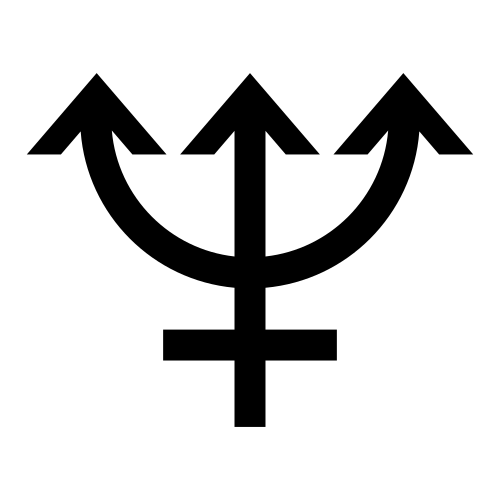 Neptune
 Pluto
Pluto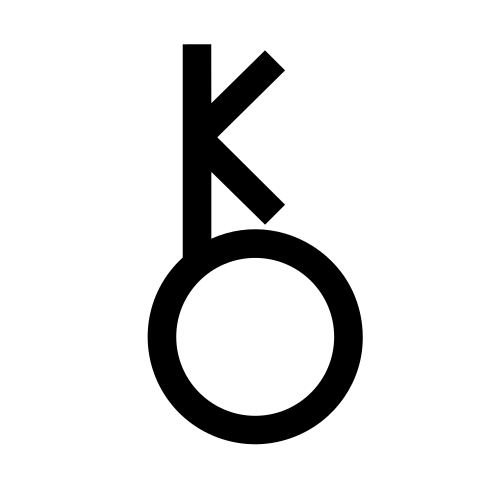 Chiron
Birth time unknown — house positions and Ascendant/MC are not available.
Astronomical context
Pluto crossed Cancer from 1914 to 1939. In astrological tradition this transit is linked to the transformation of home, family, nation, and the sense of belonging — the generation whose lives were marked by the World Wars and a profound redefinition of the nation and the home.
Rosalind Franklin (born 1920) belongs to this generational configuration. Astrian groups profiles by such shared signatures rather than by any claim of shared destiny. Related profiles in Astrian: Francis Crick · James Watson · Linus Pauling. The symbolic reading is correlative, not causal.
Other profiles from this Pluto in Cancer generation
Symbolic reading
The following describes what classical astrological tradition associates with these configurations. Astrian does not apply these descriptions to the person's biography.
The Sun in Leo is the most prominent structural feature available without a birth time, centring the chart on expression, pride, and the creative self. There is no Ascendant or Midheaven to anchor the angles, so the reading rests on sign placements and the aspects between planets rather than on houses.
Among the personal planets, the Moon in Sagittarius is associated in tradition with expansion, conviction, and the horizon (the Moon's sign is given for the noon chart and may shift with an exact time); Mercury in Leo with expression, pride, and the creative self; Venus in Leo with expression, pride, and the creative self; and Mars in Scorpio with intensity, depth, and the will to transform. These placements describe registers of feeling, thought, attraction, and action as the tradition catalogues them, independent of the life that follows.
Sun trine Moon (0°26'): tradition reads identity and central purpose in easy flow with emotional life and instinct.
Mercury square Mars (1°13'): tradition reads thought and communication in friction with drive, assertion, and action.
Mars trine Pluto (1°26'): tradition reads drive, assertion, and action in easy flow with depth, power, and transformation.
Mars trine Uranus (1°34'): tradition reads drive, assertion, and action in easy flow with disruption and innovation.
These placements are presented as a symbolic portrait, correlative and never causal — a description within the tradition's vocabulary, not an explanation of the life that follows.
Astrology is a symbolic language with 2,500 years of literature. The reading above is interpretive, not explanatory.
Astrian does not claim that the natal chart of Rosalind Franklin caused or determined any of the above. Astrology is a symbolic system with 2,500 years of literature. Its capacity for retrospective description does not imply explanatory capacity.
A parallel life
The following are verified biographical facts. No connection to the natal chart is implied.
Rosalind Elsie Franklin was born on 25 July 1920 in London into a prominent Anglo-Jewish family. She studied natural sciences at Newnham College, Cambridge, graduating in 1941. She completed her doctoral research on the microstructure of coals and cokes at Cambridge, receiving her doctorate in 1945.
After her doctorate, Franklin worked at the Laboratoire Central des Services Chimiques de l'Etat in Paris from 1947 to 1950, where she developed expertise in X-ray diffraction techniques applied to disordered carbon materials. This work advanced the understanding of graphite microstructure and the properties of coals.
In 1951, Franklin joined King's College London, where she was tasked with applying X-ray diffraction to biological fibres, specifically DNA. Working with Raymond Gosling, she produced high-quality X-ray diffraction photographs of DNA, including the image known as Photograph 51, which showed clear evidence for a helical structure with specific dimensional parameters. Her meticulous measurements of the unit cell dimensions and water content of DNA fibres provided important data for structural determination.
The relationship between the DNA research at King's College and the work of James Watson and Francis Crick at Cambridge has been the subject of extensive historical examination. Watson and Crick's 1953 paper in Nature proposing the double-helix structure of DNA acknowledged, in a brief footnote, awareness of Franklin and Gosling's unpublished results. Franklin herself published papers on DNA structure in the same issue of Nature.
Franklin left King's College in 1953 and joined Birkbeck College, University of London, where she led a research group studying the structure of tobacco mosaic virus and other viruses using X-ray crystallography. This work produced significant results on viral architecture.
Franklin died on 16 April 1958 in London, at the age of 37, from ovarian cancer. Watson, Crick, and Wilkins received the Nobel Prize in Physiology or Medicine in 1962, four years after her death; the Nobel Prize is not awarded posthumously.
Biographical sources
- Maddox, Brenda. Rosalind Franklin: The Dark Lady of DNA. London: HarperCollins, 2002..
- Franklin, Rosalind E., and R. G. Gosling. "Molecular Configuration in Sodium Thymonucleate." Nature 171 (1953): 740-741..
- Watson, James D. The Double Helix: A Personal Account of the Discovery of the Structure of DNA. New York: Atheneum, 1968..
- Glynn, Jenifer. My Sister Rosalind Franklin. Oxford: Oxford University Press, 2012..
This profile presents the sky at the birth of Rosalind Franklin and verified facts of their biography. Astrian does not claim that astrology has predictive capacity or that the natal chart determines the trajectory of a life. Astrology is a symbolic system with 2,500 years of literature. Its capacity for retrospective description does not imply explanatory capacity.
Calculate your own birth chart with the same NASA JPL DE441 precision.
Calculate my birth chartLast updated: June 14, 2026
Newsletter
A short reading once a month, in your inbox.
A note on the symbolism of the season, recent editorial pieces, and what to look for in next month's sky. No predictions.
Support this project
Independent, no venture funding, no ads. A contribution keeps Astrian precise and free.
Support on Ko-fi (opens in new tab)