PROFILE · SCIENCE & TECHNOLOGY
Linus Pauling
Linus Carl Pauling
chemist
Born 28 February 1901 · 22:00 · 12:37 UTC · Portland, Oregon, United States · 45.52° N, 122.68° WAA
Source: Astro-Databank (Rodden Rating AA)
The sky at birth
With a documented birth time, the full chart can be cast. The Ascendant falls at 26°53' Libra and the Midheaven at 3°22' Leo, which fixes the angular framework and allows the planets to be placed in houses.
Sun is at 9°59' Pisces, house 5. Moon is at 22°45' Cancer, house 9. Mercury is at 21°30' Pisces, house 5, retrograde. Venus is at 24°33' Aquarius, house 4. Mars is at 0°12' Virgo, house 10, retrograde. Jupiter is at 7°47' Capricorn, house 3. Saturn is at 13°57' Capricorn, house 3. Uranus is at 16°42' Sagittarius, house 2. Neptune is at 26°27' Gemini, house 8, retrograde. Pluto is at 15°41' Gemini, house 8.
The tightest major aspects between planets: Uranus opposite Pluto (1°01'); Moon trine Mercury (1°15'); Venus trine Neptune (1°54'); Sun sextile Jupiter (2°11'); Mars sextile Neptune (3°46'); Sun sextile Saturn (3°58').
Uranus opposite Pluto (1°01') is structural but generational — an alignment of slow-moving outer planets shared across many birth years.
The engine also registers tight minor aspects involving asteroids and calculated points: Mercury sesquiquadrate Vesta (0°05'); Mercury quincunx Lilith (0°08'); Pluto square Ceres (0°11'); Neptune quincunx North Node (0°14'). These are reported for completeness and carry less weight in traditional reading.
The chart was calculated using NASA JPL DE441 ephemerides, sub-arcsecond precision.
| Planet | Sign | Position | House |
|---|---|---|---|
| Ascendant | Libra | 26°53' | — |
| Midheaven | Leo | 03°22' | — |
| Sun | Pisces | 09°59' | H5 |
| Moon | Cancer | 22°45' | H9 |
| Mercury | Pisces | 21°30'retrograde | H5 |
| Venus | Aquarius | 24°33' | H4 |
| Mars | Virgo | 00°12'retrograde | H10 |
| Jupiter | Capricorn | 07°47' | H3 |
| Saturn | Capricorn | 13°57' | H3 |
| Uranus | Sagittarius | 16°42' | H2 |
| Neptune | Gemini | 26°27'retrograde | H8 |
| Pluto | Gemini | 15°41' | H8 |
| Chiron | Capricorn | 04°02' | H3 |
 Sun
Sun Moon
Moon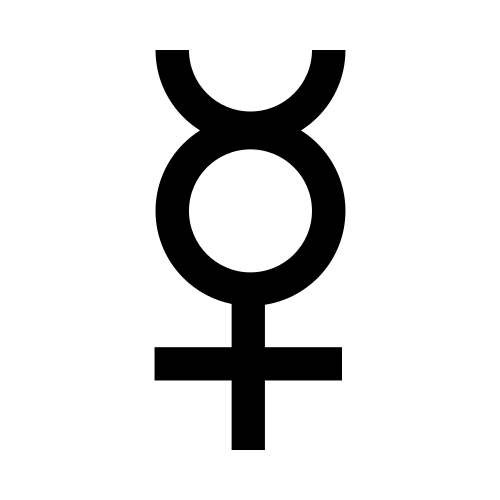 Mercury
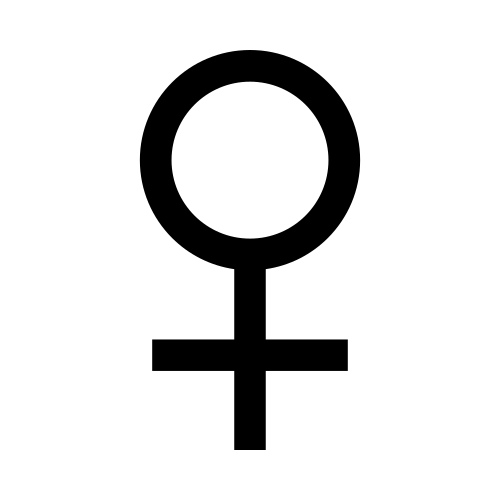 Venus
Venus Mars
Mars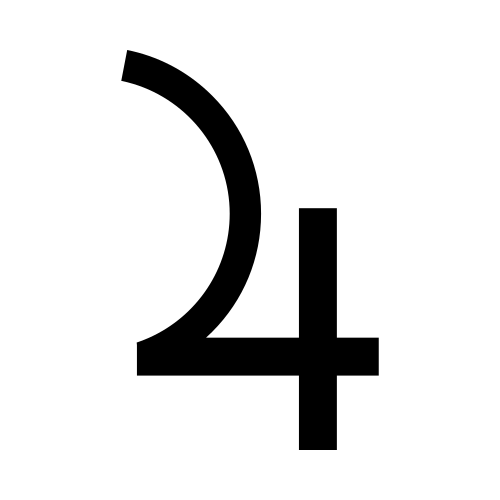 Jupiter
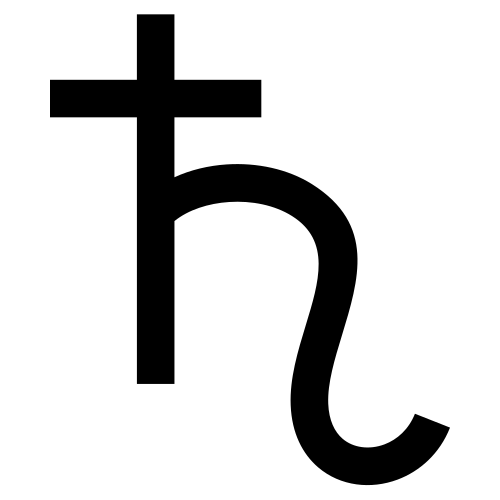 Saturn
 Uranus
 Neptune
 Pluto
Pluto Chiron
Astronomical context
Pluto travelled through Gemini from the mid-1880s to 1914. In astrological tradition this transit is associated with the transformation of communication, ideas, transport, and the press — the generation that came of age amid the spread of mass media, the telephone, and accelerating mobility.
Linus Pauling (born 1901) belongs to this generational configuration. Astrian groups profiles by such shared signatures rather than by any claim of shared destiny. Related profiles in Astrian: Francis Crick · Rosalind Franklin · James Watson. The symbolic reading is correlative, not causal.
Other profiles from this Pluto in Gemini generation
Symbolic reading
The following describes what classical astrological tradition associates with these configurations. Astrian does not apply these descriptions to the person's biography.
The Sun in Pisces centres the chart on imagination, dissolution, and empathy. With the Ascendant in Libra, tradition adds balance, relationship, and proportion as the threshold through which that energy meets the world; the Sun marks the central drive, the Ascendant the manner of approach.
Among the personal planets, the Moon in Cancer is associated in tradition with attachment, memory, and protection; Mercury in Pisces with imagination, dissolution, and empathy; Venus in Aquarius with independence, abstraction, and the collective; and Mars in Virgo with analysis, craft, and the refinement of method. These placements describe registers of feeling, thought, attraction, and action as the tradition catalogues them, independent of the life that follows.
Uranus opposite Pluto (1°01'): tradition reads disruption and innovation set in polarity with depth, power, and transformation.
Moon trine Mercury (1°15'): tradition reads emotional life and instinct in easy flow with thought and communication.
Venus trine Neptune (1°54'): tradition reads values, attraction, and harmony in easy flow with dissolution, imagination, and idealism.
Sun sextile Jupiter (2°11'): tradition reads identity and central purpose in supportive contact with expansion and meaning.
These placements are presented as a symbolic portrait, correlative and never causal — a description within the tradition's vocabulary, not an explanation of the life that follows.
Astrology is a symbolic language with 2,500 years of literature. The reading above is interpretive, not explanatory.
Astrian does not claim that the natal chart of Linus Pauling caused or determined any of the above. Astrology is a symbolic system with 2,500 years of literature. Its capacity for retrospective description does not imply explanatory capacity.
A parallel life
The following are verified biographical facts. No connection to the natal chart is implied.
Linus Carl Pauling was born on February 28, 1901, in Portland, Oregon. His father, a pharmacist, died when Pauling was nine, and he grew up in modest circumstances. He showed an early aptitude for chemistry and enrolled at Oregon Agricultural College (now Oregon State University), graduating in 1922. He then moved to the California Institute of Technology, where he completed his doctorate in physical chemistry and mathematical physics in 1925, working with Roscoe Dickinson and Richard Tolman.
A postdoctoral fellowship allowed Pauling to study in Europe, where he encountered the new quantum mechanics being developed by Werner Heisenberg, Erwin Schrödinger, and others. Returning to Caltech, he applied quantum mechanical methods to the problem of chemical bonding, producing a series of landmark papers throughout the 1930s.
Pauling introduced the concept of resonance in chemistry, showing that many molecules are best described as intermediate between two or more classical structures. He developed the concept of electronegativity, which quantifies an atom's tendency to attract electrons. He proposed the hybridization of atomic orbitals to explain molecular geometry, and he articulated five key rules governing the structure of ionic crystals that became known as Pauling's rules. His 1939 book The Nature of the Chemical Bond synthesized much of this work and became one of the most cited scientific works of the twentieth century.
In the early 1950s, Pauling turned to the structure of proteins. Using X-ray crystallography data and molecular model building, he and Robert Corey proposed the alpha helix and beta sheet as fundamental secondary structures of proteins in 1951, a breakthrough in structural biology. He also made an early but ultimately incorrect proposal for a triple-helix structure of DNA.
In 1954, Pauling received the Nobel Prize in Chemistry. During the 1950s, he became an outspoken campaigner against nuclear weapons testing, collecting signatures from thousands of scientists and presenting a petition to the United Nations. In 1962, he was awarded the Nobel Peace Prize, making him the only person to win two unshared Nobel Prizes.
In his later years, Pauling promoted large doses of vitamin C, a position that generated controversy within the scientific community. He founded the Linus Pauling Institute of Science and Medicine in 1973.
Linus Pauling died on August 19, 1994, in Big Sur, California.
Biographical sources
- Thomas Hager, Force of Nature: The Life of Linus Pauling (Simon and Schuster, 1995).
- Linus Pauling, The Nature of the Chemical Bond and the Structure of Molecules and Crystals (Cornell University Press, 1939).
- Nobel Pri.
This profile presents the sky at the birth of Linus Pauling and verified facts of their biography. Astrian does not claim that astrology has predictive capacity or that the natal chart determines the trajectory of a life. Astrology is a symbolic system with 2,500 years of literature. Its capacity for retrospective description does not imply explanatory capacity.
Related profiles
Calculate your own birth chart with the same NASA JPL DE441 precision.
Calculate my birth chartLast updated: June 14, 2026
Newsletter
A short reading once a month, in your inbox.
A note on the symbolism of the season, recent editorial pieces, and what to look for in next month's sky. No predictions.
Support this project
Independent, no venture funding, no ads. A contribution keeps Astrian precise and free.
Support on Ko-fi (opens in new tab)