PROFILE · SPORTS
Larry Bird
Larry Joe Bird
basketball player
Born 7 December 1956 · West Baden Springs, Indiana, United States · 38.57° N, 86.61° WX
Source: Birth time not documented in publicly accessible records
About this chart
No birth time is documented for this person. The chart therefore shows planetary positions in their signs, the slow aspects between them, and the generational context — but not house placements, the Ascendant, or the Midheaven, which require an accurate birth time. The Moon's sign carries a ±6° margin: if it falls near a sign boundary, the sign could vary. Positions for all other planets are reliable.
Do you have a verified source for this birth time? Share it →
The sky at birth
No birth time is documented for Larry Bird. The Ascendant, the Midheaven, and the house positions cannot be determined; the reading is confined to planetary sign placements and the aspects between planets. The positions below are calculated for noon local time and are accurate to a fraction of a degree for the slow-moving bodies.
The Moon is near 15°12' Aquarius (noon position, ±7° margin). Sun is at 15°35' Sagittarius. Mercury is at 29°06' Sagittarius. Venus is at 15°00' Scorpio. Mars is at 0°36' Aries. Jupiter is at 29°25' Virgo. Saturn is at 6°32' Sagittarius. Uranus is at 6°42' Leo, retrograde. Neptune is at 1°43' Scorpio. Pluto is at 0°27' Virgo, retrograde.
3 bodies occupy Sagittarius (Sun, Mercury and Saturn) — a concentration that stands out as a structural feature of the chart.
The tightest major aspects between planets: Saturn trine Uranus (0°10'); Moon square Venus (0°12'); Mercury square Jupiter (0°19'); Sun sextile Moon (0°23'); Mars opposite Jupiter (1°11'); Neptune sextile Pluto (1°16').
Neptune sextile Pluto (1°16') is structural but generational — an alignment of slow-moving outer planets shared across many birth years.
The engine also registers tight minor aspects involving asteroids and calculated points: Chiron semi-sextile Vesta (0°07'); Jupiter trine Juno (0°19'); Uranus trine Ceres (0°31'); Mercury semi-sextile Juno (0°38'). These are reported for completeness and carry less weight in traditional reading.
The chart was calculated using NASA JPL DE441 ephemerides, sub-arcsecond precision.
| Planet | Sign | Position |
|---|---|---|
| Sun | Sagittarius | 15°35' |
| Moon | Aquarius | 15°12'±6° |
| Mercury | Sagittarius | 29°06' |
| Venus | Scorpio | 15°00' |
| Mars | Aries | 00°36' |
| Jupiter | Virgo | 29°25' |
| Saturn | Sagittarius | 06°32' |
| Uranus | Leo | 06°42'retrograde |
| Neptune | Scorpio | 01°43' |
| Pluto | Virgo | 00°27'retrograde |
| Chiron | Aquarius | 08°00' |
 Sun
Sun Moon
Moon Mercury
 Venus
Venus Mars
Mars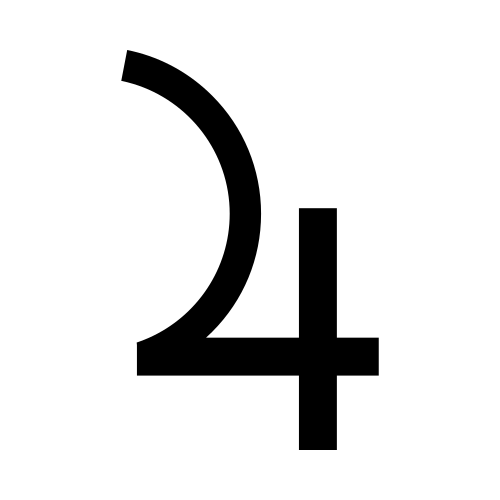 Jupiter
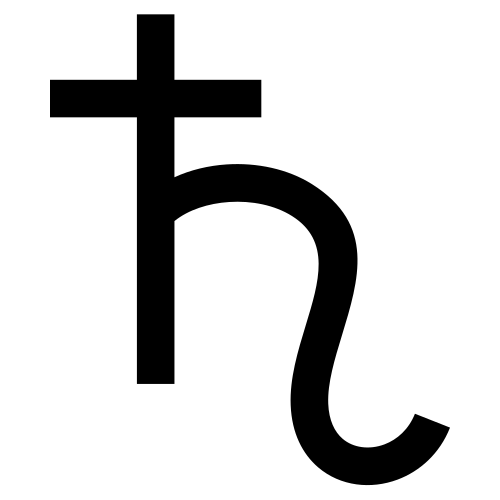 Saturn
 Uranus
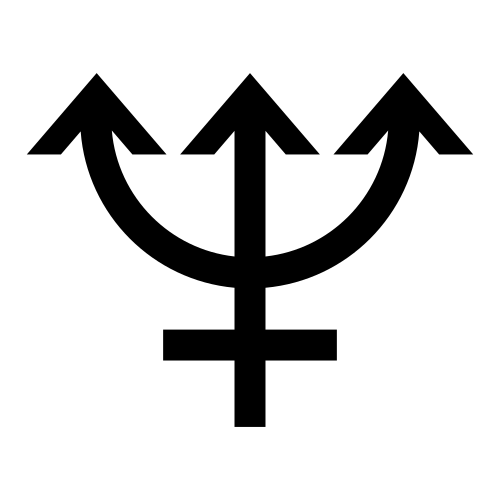 Neptune
 Pluto
Pluto Chiron
Birth time unknown — house positions and Ascendant/MC are not available.
Astronomical context
Pluto crossed Virgo from the late 1950s to 1971. In astrological tradition the passage is linked to the transformation of work, health, technique, and systems of organization — the generation that came of age amid automation and the reorganization of labour.
Larry Bird (born 1956) belongs to this generational configuration. Astrian groups profiles by such shared signatures rather than by any claim of shared destiny. Related profiles in Astrian: Hakeem Olajuwon · Carl Lewis · Joe Montana. The symbolic reading is correlative, not causal.
Other profiles from this Pluto in Virgo generation
Symbolic reading
The following describes what classical astrological tradition associates with these configurations. Astrian does not apply these descriptions to the person's biography.
The Sun in Sagittarius is the most prominent structural feature available without a birth time, centring the chart on expansion, conviction, and the horizon. There is no Ascendant or Midheaven to anchor the angles, so the reading rests on sign placements and the aspects between planets rather than on houses.
Among the personal planets, the Moon in Aquarius is associated in tradition with independence, abstraction, and the collective (the Moon's sign is given for the noon chart and may shift with an exact time); Mercury in Sagittarius with expansion, conviction, and the horizon; Venus in Scorpio with intensity, depth, and the will to transform; and Mars in Aries with initiative, directness, and the will to begin. These placements describe registers of feeling, thought, attraction, and action as the tradition catalogues them, independent of the life that follows.
Saturn trine Uranus (0°10'): tradition reads structure, limitation, and discipline in easy flow with disruption and innovation.
Moon square Venus (0°12'): tradition reads emotional life and instinct in friction with values, attraction, and harmony.
Mercury square Jupiter (0°19'): tradition reads thought and communication in friction with expansion and meaning.
Sun sextile Moon (0°23'): tradition reads identity and central purpose in supportive contact with emotional life and instinct.
These placements are presented as a symbolic portrait, correlative and never causal — a description within the tradition's vocabulary, not an explanation of the life that follows.
Astrology is a symbolic language with 2,500 years of literature. The reading above is interpretive, not explanatory.
Astrian does not claim that the natal chart of Larry Bird caused or determined any of the above. Astrology is a symbolic system with 2,500 years of literature. Its capacity for retrospective description does not imply explanatory capacity.
A parallel life
The following are verified biographical facts. No connection to the natal chart is implied.
Larry Joe Bird was born on December 7, 1956, in West Baden Springs, Indiana, and grew up in French Lick, a small rural community where basketball provided a central outlet for his competitive drive. He attended Indiana State University, where he led the Sycamores to the NCAA championship game in 1979, a final that drew enormous national attention largely because of the anticipated matchup with Magic Johnson's Michigan State team.
Selected by the Boston Celtics in the 1978 NBA Draft, Bird joined the team in 1979 and immediately transformed its fortunes. During his thirteen seasons with the Celtics, he won three NBA championships and was named the league's Most Valuable Player three consecutive times, from 1984 through 1986. He was selected to twelve All-Star Games and was regarded as one of the most complete players in the history of professional basketball, combining exceptional scoring, passing, rebounding, and competitive intelligence.
His rivalry with Magic Johnson and the Los Angeles Lakers defined the NBA through much of the 1980s and is credited with revitalizing interest in the league at a critical period. Bird was also a key member of the United States men's basketball team at the 1992 Barcelona Olympics, where the squad, widely known as the Dream Team, won the gold medal.
Back problems curtailed the final years of his playing career and contributed to his retirement in 1992. He subsequently moved into coaching and front-office roles, serving as head coach of the Indiana Pacers from 1997 to 2000, leading them to the NBA Finals in 2000. He later served as president of basketball operations for the Pacers.
Bird was inducted into the Naismith Memorial Basketball Hall of Fame in 1998 and is consistently ranked among the greatest players in NBA history. His influence on the game as a player, coach, and executive spans more than four decades.
Biographical sources
- Bird, Larry, with Bob Ryan. Drive: The Story of My Life. New York: Doubleday, 1989..
- Naismith Memorial Basketball Hall of Fame. "Larry Bird Inductee Profile." Springfield, MA, 1998..
- Associated Press. "Bird Leads Celtics to Third Title." June 1986..
- NBA Official Records. "Larry Bird Career Statistics and Awards." NBA History Archive..
This profile presents the sky at the birth of Larry Bird and verified facts of their biography. Astrian does not claim that astrology has predictive capacity or that the natal chart determines the trajectory of a life. Astrology is a symbolic system with 2,500 years of literature. Its capacity for retrospective description does not imply explanatory capacity.
Related profiles
Calculate your own birth chart with the same NASA JPL DE441 precision.
Calculate my birth chartLast updated: June 14, 2026
Newsletter
A short reading once a month, in your inbox.
A note on the symbolism of the season, recent editorial pieces, and what to look for in next month's sky. No predictions.
Support this project
Independent, no venture funding, no ads. A contribution keeps Astrian precise and free.
Support on Ko-fi (opens in new tab)