PROFILE · ENTREPRENEURS

Tim Cook
Timothy Donald Cook
business executive
Born 1 November 1960 · Mobile, Alabama, United States · 30.70° N, 88.04° WX
Source: Birth time not documented in publicly accessible records
About this chart
No birth time is documented for this person. The chart therefore shows planetary positions in their signs, the slow aspects between them, and the generational context — but not house placements, the Ascendant, or the Midheaven, which require an accurate birth time. The Moon's sign carries a ±6° margin: if it falls near a sign boundary, the sign could vary. Positions for all other planets are reliable.
Do you have a verified source for this birth time? Share it →
The sky at birth
No birth time is documented for Tim Cook. The Ascendant, Midheaven, and house positions cannot be determined. The planetary positions below are calculated for noon local time. The positions are given to degree-level precision; arcminute data is not available for this chart. The Moon's position carries a margin of approximately ±6°.
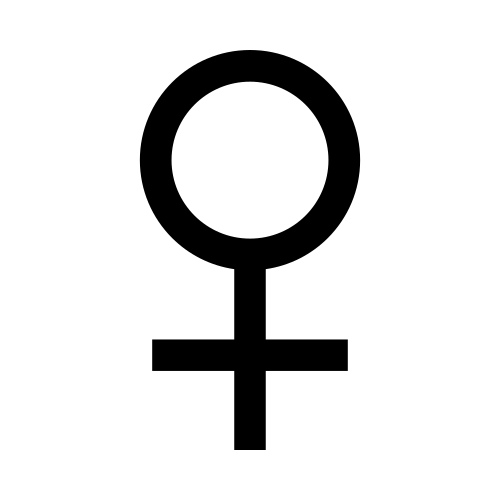
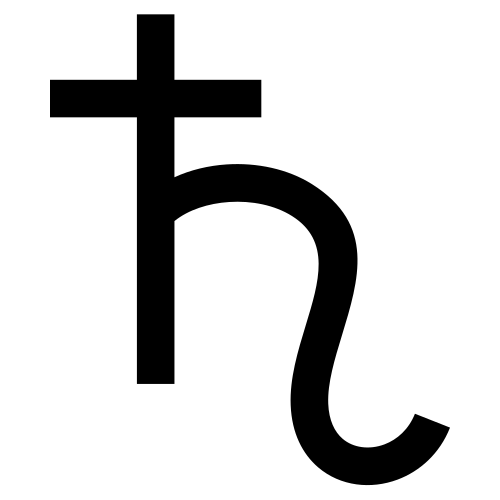
The Sun is at approximately 9° Scorpio. The Moon is at approximately 18° Aries (noon position, ±6° margin). Mercury is at approximately 23° Scorpio. Venus is at approximately 14° Sagittarius. Mars is at approximately 16° Gemini. Jupiter is at approximately 5° Capricorn. Saturn is at approximately 19° Capricorn. Uranus is at approximately 22° Leo. Neptune is at approximately 9° Scorpio. Pluto is at approximately 8° Virgo.
The Sun at approximately 9° Scorpio conjoins Neptune at approximately 9° Scorpio (less than 1°) — functionally exact and the tightest major aspect in the chart. The Sun sextiles Pluto at approximately 8° Virgo (~1°). Neptune sextiles Pluto (~1°, generational). Mercury at approximately 23° Scorpio squares Uranus at approximately 22° Leo (~1°). The Moon at approximately 18° Aries squares Saturn at approximately 19° Capricorn (~1°), though this aspect carries the Moon's ±6° uncertainty. Venus at approximately 14° Sagittarius opposes Mars at approximately 16° Gemini (~2°). The Moon sextiles Mars (~2°), under the Moon's uncertainty. Jupiter at approximately 5° Capricorn trines Pluto (~3°). The Moon trines Venus (~4°), under the Moon's uncertainty. The Moon trines Uranus (~4°), also under the Moon's uncertainty.
The tightest major aspects between planets: Sun conjunct Neptune (~0°), Sun sextile Pluto (~1°), Neptune sextile Pluto (~1°), Mercury square Uranus (~1°), Moon square Saturn (~1°), Venus opposition Mars (~2°), Moon sextile Mars (~2°), Jupiter trine Pluto (~3°), Moon trine Venus (~4°), Moon trine Uranus (~4°). All orbs are approximate to ±1° due to the degree-level precision of positions.
The Moon at approximately 18° Aries stays within Aries for the full range of possible birth times. The Moon's sign placement in Aries is stable for this chart.
The chart was calculated by Astrian's engine using NASA JPL DE441 ephemerides. Timezone: America/Chicago (Central Standard Time, UTC −6).
| Planet | Sign | Position |
|---|---|---|
| Sun | Scorpio | 09°19' |
| Moon | Aries | 18°15'±6° |
| Mercury | Scorpio | 22°02'retrograde |
| Venus | Sagittarius | 13°27' |
| Mars | Cancer | 16°21' |
| Jupiter | Capricorn | 01°10' |
| Saturn | Capricorn | 13°33' |
| Uranus | Leo | 25°24' |
| Neptune | Scorpio | 08°53' |
| Pluto | Virgo | 07°45' |
| Chiron | Aquarius | 27°25'retrograde |
 Sun
Sun Moon
Moon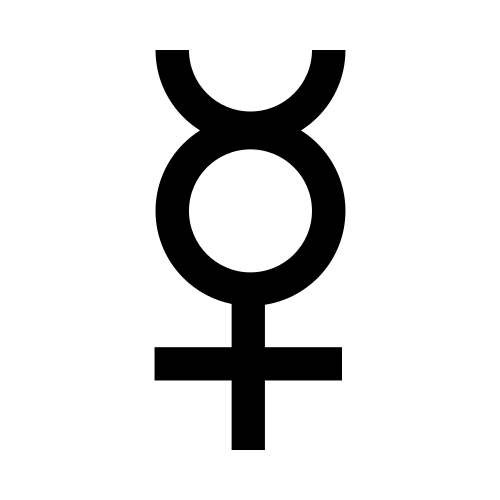 Mercury
 Venus
Venus Mars
Mars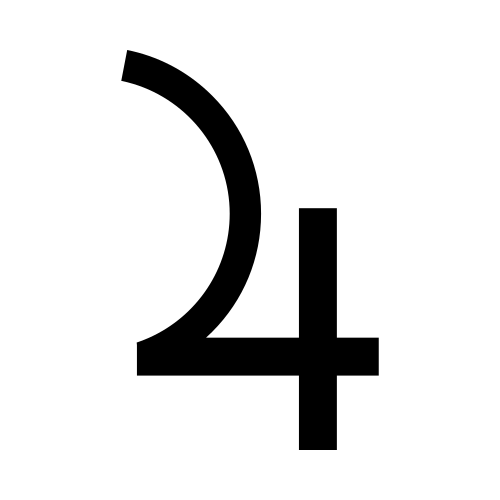 Jupiter
 Saturn
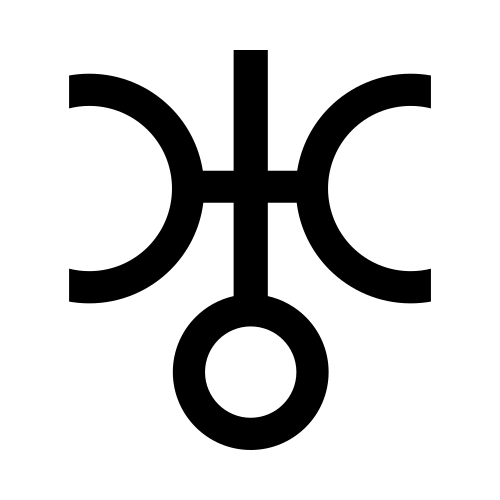 Uranus
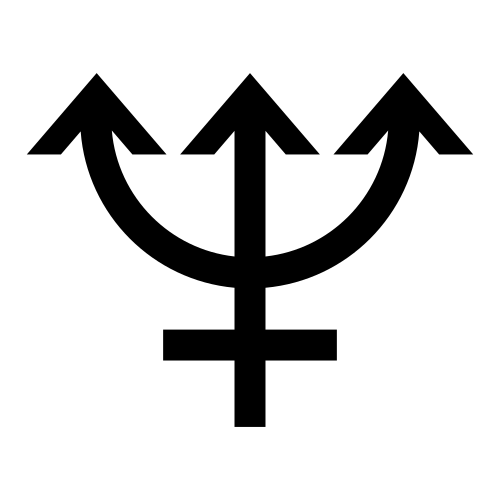 Neptune
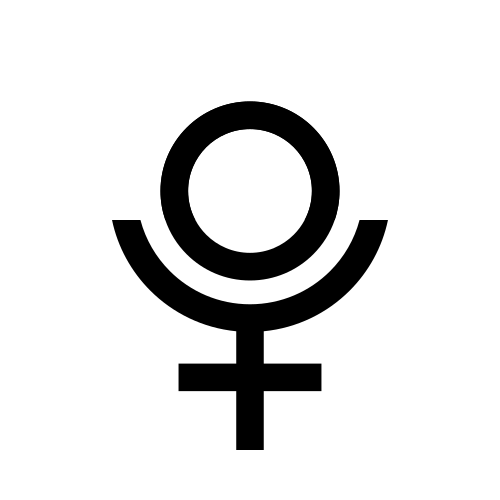 Pluto
Pluto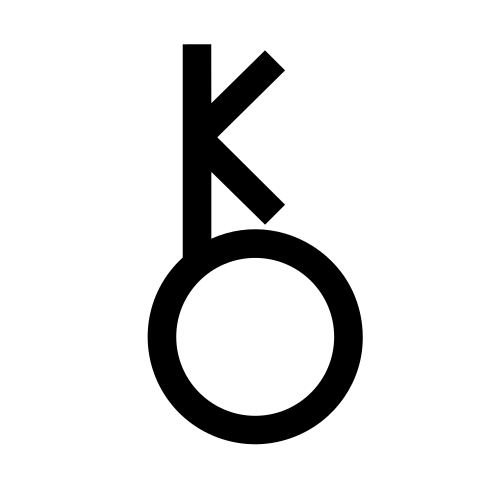 Chiron
Birth time unknown — house positions and Ascendant/MC are not available.
Astronomical context
Those born between approximately 1957 and 1972 carried Pluto in Virgo. This generation grew up during the late Cold War, the space race, the early environmental movement, and the first stirrings of the information economy. They came of age in a world that was beginning to measure, optimize, and systematize everything — from manufacturing processes to personal health to the flow of data through networks that did not yet exist when they were born.
In astrological tradition, Pluto in Virgo is associated with collective transformation of the domains that sign governs: precision, technical mastery, analysis, the decomposition of systems into their functional parts, and the drive to optimize what exists through relentless, methodical improvement. Virgo is the sign of the craftsman, the analyst, the one who makes things work. The symbolic reading is correlative, not causal.
Other profiles in the Astrian collection born under this configuration include Madonna (1958), Michael Jackson (1958), Diego Maradona (1960), Jeff Bezos (1964), and Elon Musk (1971). Tim Cook, born in 1960, belongs to the early years of this generational wave.
Other profiles from this Pluto in Virgo generation
Symbolic reading
The following describes what classical astrological tradition associates with these configurations. Astrian does not apply these descriptions to the person's biography.
The Sun at approximately 9° Scorpio is the most prominent structural feature of this chart. Without a documented birth time, there is no Ascendant or Midheaven — the reading is confined to planetary positions by sign and the aspects between planets. All positions carry degree-level precision; the analysis below reflects this limitation.
The Moon at approximately 18° Aries represents the noon position; the actual placement falls within approximately 6° on either side. The Moon remains in Aries throughout the day. Mercury at approximately 23° Scorpio, Venus at approximately 14° Sagittarius, and Mars at approximately 16° Gemini complete the personal planet picture.
The chart's most striking structural feature is the conjunction of the Sun and Neptune in Scorpio — the two bodies occupy nearly the same degree of the zodiac. A secondary axis runs between Venus in Sagittarius and Mars in Gemini, an opposition that spans the axis of information and movement. Saturn sits in its own sign, Capricorn, in full domicile strength.
### Sun conjunct Neptune in Scorpio: identity and the invisible
The Sun at approximately 9° Scorpio conjoins Neptune at approximately 9° Scorpio, within less than 1° — the tightest aspect in the chart, functionally exact. The Sun governs identity and the central organizing principle of the personality. Neptune governs vision, dissolution, the ideal, and the capacity to perceive what lies beneath the surface of things. Their conjunction in Scorpio — the sign of depth, concentrated resource, and what operates out of public sight — merges the identity faculty with the visionary-dissolving faculty in the register of what is hidden, strategic, and controlled.
Both sextile Pluto at approximately 8° Virgo (~1°), creating a three-body configuration in which the Sun-Neptune conjunction connects cooperatively to the transformative depth of Pluto in the sign of systems and precision. The tradition reads this as an identity that has natural access to what lies beneath — and the capacity to work with hidden or complex structures without losing orientation.
### Mercury square Uranus: disrupted thinking
Mercury at approximately 23° Scorpio squares Uranus at approximately 22° Leo, orb ~1°. Mercury governs communication, information processing, and the patterns by which the mind organizes reality. Uranus governs disruption, sudden insight, and the capacity to see what convention renders invisible. The square places them in tension: the communicative faculty (Mercury in Scorpio — probing, strategic, concerned with what is not said) is pressured by the disruptive faculty (Uranus in Leo — innovation operating through the register of creative authority and individual expression). Squares generate friction that demands action; this one reads as a mind that cannot leave existing systems unexamined.
### Venus opposition Mars: desire against action
Venus at approximately 14° Sagittarius opposes Mars at approximately 16° Gemini, orb ~2°. Venus governs value, desire, and the aesthetic sense. Mars governs action, assertion, and the capacity for effort. The opposition places them in polarity across the Sagittarius-Gemini axis — the axis of broad vision and expansive principle (Sagittarius) against rapid information and tactical movement (Gemini). The opposition reads as a tension between the impulse toward the comprehensive and the impulse toward the immediate, between strategic patience and operational speed.
### Saturn in Capricorn: domicile authority
Saturn at approximately 19° Capricorn occupies its own sign — a domicile placement, one of the strongest positions for Saturn in the traditional framework. Saturn governs structure, discipline, limitation, and the long construction of things that endure. In Capricorn — the sign of institutional authority, accumulated achievement, and patient building — Saturn operates with full possession of its own nature. The tradition reads domicile Saturn as a point of genuine structural capacity: the ability to build systems that last because the builder understands the material from the inside.
The Moon at approximately 18° Aries squares Saturn (~1°), though this aspect carries the Moon's ±6° uncertainty. If the birth time places the Moon near its noon position, the emotional faculty (Moon in Aries — impulsive, self-starting, direct) is in structural tension with the authority-building faculty (Saturn in Capricorn). The tradition reads Moon-Saturn squares as configurations where emotional spontaneity must negotiate with institutional discipline.
The planetary pattern here is read as a symbolic portrait, not a causal explanation. No planet caused, predicted, or determined any event or characteristic.
Astrology is a symbolic language with 2,500 years of literature. The reading above is interpretive, not explanatory.
Astrian does not claim that the natal chart of Tim Cook caused or determined any of the above. Astrology is a symbolic system with 2,500 years of literature. Its capacity for retrospective description does not imply explanatory capacity.
A parallel life
The following are verified biographical facts. No connection to the natal chart is implied.
Timothy Donald Cook was born on 1 November 1960 in Mobile, Alabama, the son of Donald Cook, a worker at a shipyard, and Geraldine Cook, a pharmacist's assistant. He grew up in Robertsdale, a small town near the Alabama Gulf Coast, and graduated from Robertsdale High School in 1978.
He earned a bachelor's degree in industrial engineering from Auburn University in 1982 and a Master of Business Administration from the Fuqua School of Business at Duke University in 1988. He worked at IBM for twelve years in manufacturing and distribution roles, rising to Director of North American Fulfillment — responsible for the logistics of IBM's personal computer division. He held a position at Intelligent Electronics and served as Vice President of Corporate Materials at Compaq before receiving a phone call in early 1998.
Steve Jobs telephoned Cook and offered him a position at Apple, which at the time was in severe financial difficulty. Cook later recalled that, despite the company's precarious state, he accepted within minutes of meeting Jobs. He joined Apple as Senior Vice President of Worldwide Operations in March 1998.
His primary task in the first years was to transform Apple's supply chain and manufacturing operations. He closed warehouses, shut factories, moved manufacturing to Asia, and reorganized supplier relationships in a way that reduced Apple's inventory from months to days. The operational efficiencies he built are widely credited as essential to making the iPod (2001), the iPhone (2007), and the iPad (2010) manufacturable at the volumes their commercial success required. Before the products could change the world, someone had to make them producible at scale. That was Cook's work.
He served as acting CEO on three occasions while Jobs was on medical leave — in 2004, 2009, and 2011. Jobs resigned as CEO on 24 August 2011, naming Cook as his successor. Jobs died on 5 October 2011.
Under Cook's leadership, Apple launched the Apple Watch (2015), AirPods (2016), the M1 chip and Apple Silicon transition (2020), and Vision Pro (2024). Revenue grew from approximately $108 billion in fiscal 2011 to approximately $383 billion in fiscal 2023. Apple's market capitalisation crossed one trillion dollars in August 2018, two trillion in August 2020, and three trillion in January 2022 — the first company in history to reach each of those thresholds.
In October 2014, Cook published a column in Bloomberg Businessweek in which he publicly stated that he is gay. "I consider being gay among the greatest gifts God has given me," he wrote. He became the first openly gay CEO of a Fortune 500 company.
In April 2026, Apple announced that Cook would transition out of the chief executive role on 1 September 2026, succeeded by John Ternus, Senior Vice President of Hardware Engineering. The fifteen-year tenure saw Apple's market capitalisation grow from approximately $350 billion to over $3 trillion.
Biographical sources
- Mickle, Tripp. After Steve: How Apple Became a Trillion-Dollar Company and Lost Its Soul. William Morrow 2022
- Lashinsky, Adam. Inside Apple. Business Plus 2012
This profile presents the sky at the birth of Tim Cook and verified facts of their biography. Astrian does not claim that astrology has predictive capacity or that the natal chart determines the trajectory of a life. Astrology is a symbolic system with 2,500 years of literature. Its capacity for retrospective description does not imply explanatory capacity.
Related profiles
Calculate your own birth chart with the same NASA JPL DE441 precision.
Calculate my birth chartLast updated: June 12, 2026
Newsletter
A short reading once a month, in your inbox.
A note on the symbolism of the season, recent editorial pieces, and what to look for in next month's sky. No predictions.
Support this project
Independent, no venture funding, no ads. A contribution keeps Astrian precise and free.
Support on Ko-fi (opens in new tab)