PROFILE · SPORTS
Niki Lauda
Andreas Nikolaus Lauda
Formula One driver
Born 22 February 1949 · Vienna, Austria · 48.21° N, 16.37° EX
Source: Birth time not documented in publicly accessible records
About this chart
No birth time is documented for this person. The chart therefore shows planetary positions in their signs, the slow aspects between them, and the generational context — but not house placements, the Ascendant, or the Midheaven, which require an accurate birth time. The Moon's sign carries a ±6° margin: if it falls near a sign boundary, the sign could vary. Positions for all other planets are reliable.
Do you have a verified source for this birth time? Share it →
The sky at birth
No birth time is documented for Niki Lauda. The Ascendant, the Midheaven, and the house positions cannot be determined; the reading is confined to planetary sign placements and the aspects between planets. The positions below are calculated for noon local time and are accurate to a fraction of a degree for the slow-moving bodies. One caveat: the Moon lies near a sign boundary, so without an exact time it cannot be fixed to a single sign — it sits close to 2°44' Capricorn within a daily margin of about ±7°.
The Moon is near 2°44' Capricorn (noon position, ±7° margin). Sun is at 3°30' Pisces. Mercury is at 7°21' Aquarius. Venus is at 20°05' Aquarius. Mars is at 8°27' Pisces. Jupiter is at 22°01' Capricorn. Saturn is at 2°44' Virgo, retrograde. Uranus is at 26°33' Gemini, retrograde. Neptune is at 14°48' Libra, retrograde. Pluto is at 14°57' Leo, retrograde.
The tightest major aspects between planets: Moon trine Saturn (0°00'); Neptune sextile Pluto (0°09'); Sun sextile Moon (0°46'); Sun opposite Saturn (0°46'); Sun conjunct Mars (4°57'); Venus opposite Pluto (5°08').
Neptune sextile Pluto (0°09') is structural but generational — an alignment of slow-moving outer planets shared across many birth years.
The engine also registers tight minor aspects involving asteroids and calculated points: Mars square Chiron (0°01'); Neptune sextile Ceres (0°01'); Pluto conjunct Ceres (0°10'); Pallas semi-sextile Juno (0°14'). These are reported for completeness and carry less weight in traditional reading.
The chart was calculated using NASA JPL DE441 ephemerides, sub-arcsecond precision.
| Planet | Sign | Position |
|---|---|---|
| Sun | Pisces | 03°30' |
| Moon | Capricorn | 02°44'±6° |
| Mercury | Aquarius | 07°21' |
| Venus | Aquarius | 20°05' |
| Mars | Pisces | 08°27' |
| Jupiter | Capricorn | 22°01' |
| Saturn | Virgo | 02°44'retrograde |
| Uranus | Gemini | 26°33'retrograde |
| Neptune | Libra | 14°48'retrograde |
| Pluto | Leo | 14°57'retrograde |
| Chiron | Sagittarius | 08°28' |
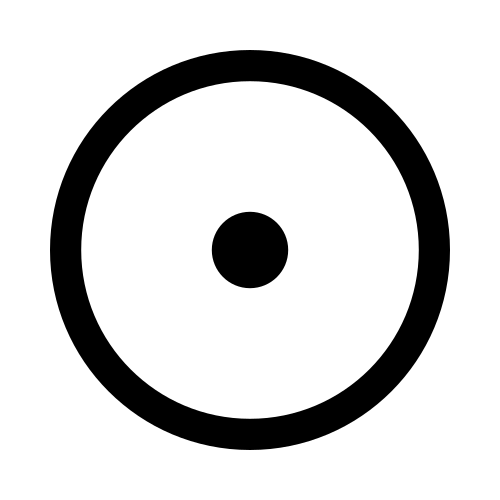 Sun
Sun Moon
Moon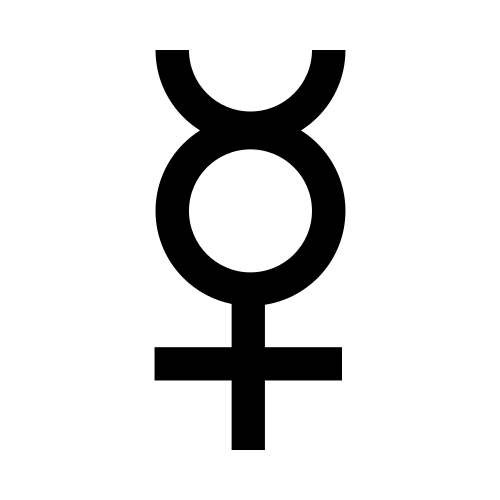 Mercury
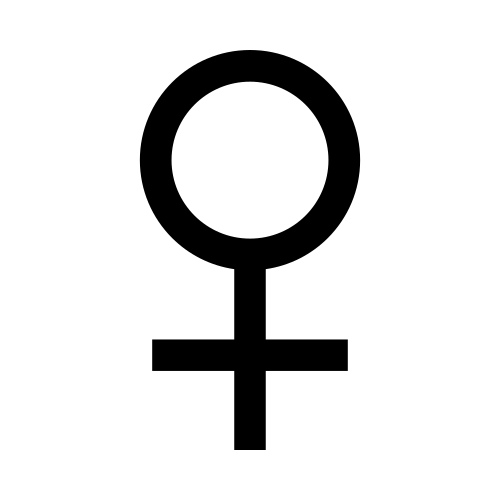 Venus
Venus Mars
Mars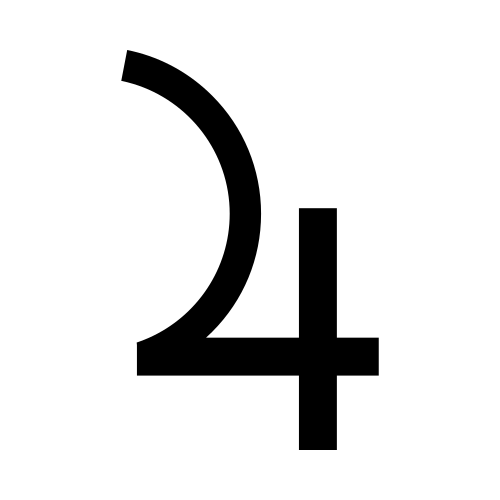 Jupiter
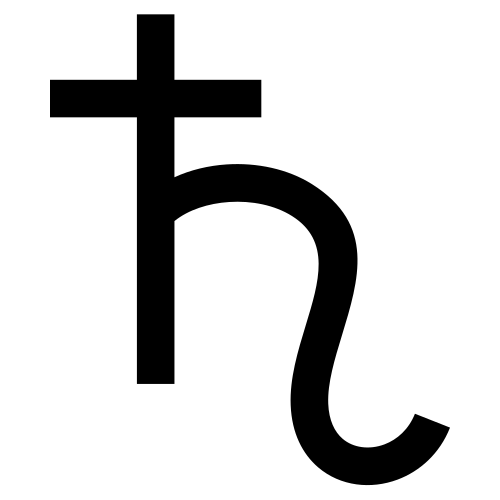 Saturn
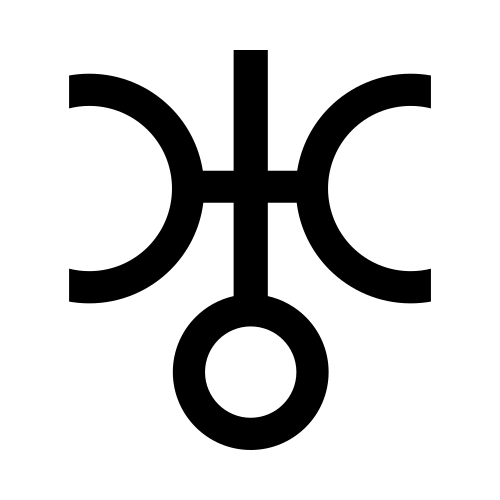 Uranus
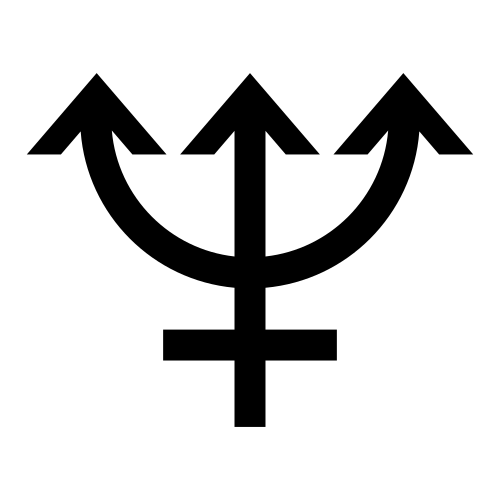 Neptune
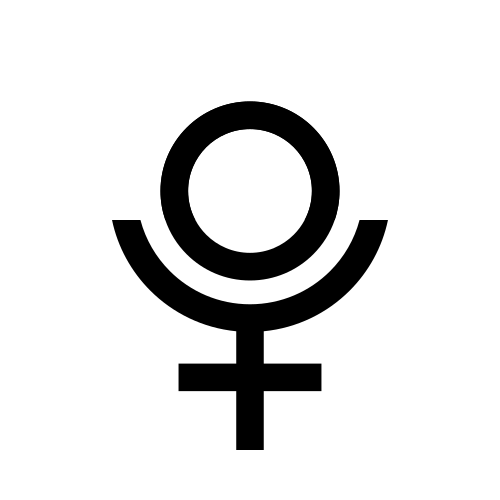 Pluto
Pluto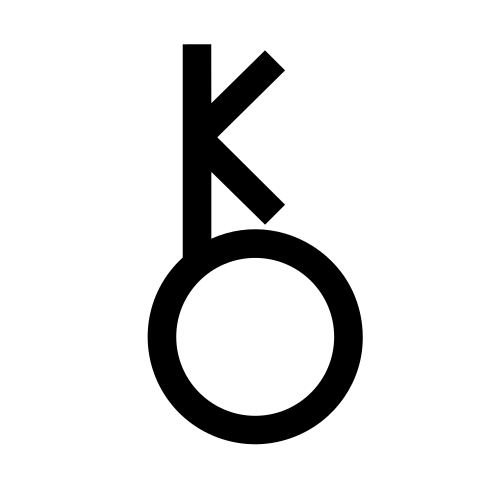 Chiron
Birth time unknown — house positions and Ascendant/MC are not available.
Astronomical context
Pluto moved through Leo from the late 1930s to the late 1950s. In astrological tradition this transit is associated with the collective transformation of self-expression, authority, and the cult of the individual — the cohort that rebuilt the post-war world and expanded mass culture.
Niki Lauda (born 1949) belongs to this generational configuration. Astrian groups profiles by such shared signatures rather than by any claim of shared destiny. Related profiles in Astrian: Alain Prost · Sebastian Vettel · Eddy Merckx. The symbolic reading is correlative, not causal.
Other profiles from this Pluto in Leo generation
Symbolic reading
The following describes what classical astrological tradition associates with these configurations. Astrian does not apply these descriptions to the person's biography.
The Sun in Pisces is the most prominent structural feature available without a birth time, centring the chart on imagination, dissolution, and empathy. There is no Ascendant or Midheaven to anchor the angles, so the reading rests on sign placements and the aspects between planets rather than on houses.
Among the personal planets, the Moon in Capricorn is associated in tradition with ambition, structure, and the long view (the Moon's sign is given for the noon chart and may shift with an exact time); Mercury in Aquarius with independence, abstraction, and the collective; Venus in Aquarius with independence, abstraction, and the collective; and Mars in Pisces with imagination, dissolution, and empathy. These placements describe registers of feeling, thought, attraction, and action as the tradition catalogues them, independent of the life that follows.
Moon trine Saturn (0°00'): tradition reads emotional life and instinct in easy flow with structure, limitation, and discipline.
Neptune sextile Pluto (0°09'): tradition reads dissolution, imagination, and idealism in supportive contact with depth, power, and transformation.
Sun sextile Moon (0°46'): tradition reads identity and central purpose in supportive contact with emotional life and instinct.
Sun opposite Saturn (0°46'): tradition reads identity and central purpose set in polarity with structure, limitation, and discipline.
These placements are presented as a symbolic portrait, correlative and never causal — a description within the tradition's vocabulary, not an explanation of the life that follows.
Astrology is a symbolic language with 2,500 years of literature. The reading above is interpretive, not explanatory.
Astrian does not claim that the natal chart of Niki Lauda caused or determined any of the above. Astrology is a symbolic system with 2,500 years of literature. Its capacity for retrospective description does not imply explanatory capacity.
A parallel life
The following are verified biographical facts. No connection to the natal chart is implied.
Andreas Nikolaus Lauda was born on February 22, 1949, in Vienna, Austria, into a prominent business family. He pursued motor racing against his family's wishes, taking out bank loans to finance his early career in Formula Two. His ambition and technical precision attracted the attention of top teams and he eventually secured a drive with Ferrari, where his analytical approach to car development quickly distinguished him.
Lauda won his first Formula One World Championship with Ferrari in 1975, establishing himself as one of the most technically capable drivers of his generation. The following season, 1976, brought the most dramatic episode of his career. At the German Grand Prix at the Nurburgring, his Ferrari caught fire after an accident, and Lauda suffered severe burns and inhaled toxic fumes. The injuries were life-threatening and last rites were administered. Remarkably, he returned to racing just six weeks later, competing at the Italian Grand Prix with his face still heavily bandaged.
The 1976 season ended with Lauda losing the championship to James Hunt by a single point, having elected not to race in the rain-soaked final round for safety reasons, a decision he stood by publicly. He won his second championship with Ferrari in 1977 before moving to Brabham, then retiring temporarily in 1979. He returned to the sport with McLaren in 1982 and won his third championship in 1984, edging out his teammate Alain Prost by half a point in one of the closest title finishes in Formula One history.
Beyond racing, Lauda built a parallel career in aviation, founding and running several airlines, most notably Lauda Air and later Laudamotion. He also served as non-executive chairman of the Mercedes Formula One team from 2012 until his death and played a key role in recruiting Lewis Hamilton to the team.
Lauda died on May 20, 2019, in Zurich, following complications from a lung transplant he had received the previous year. He is remembered as one of the greatest drivers and most consequential figures in the history of Formula One.
Biographical sources
- Lauda, Niki. To Hell and Back: An Autobiography. London: Stanley Paul, 1986..
- Henry, Alan. Niki Lauda: The Biography. Newbury Park: Haynes Publishing, 2012..
- Associated Press. "Niki Lauda, Three-Time Formula One Champion, Dies at 70." May 20, 2019..
- Formula One Official Records. "Niki Lauda World Championship Statistics." FIA Historical Archive..
This profile presents the sky at the birth of Niki Lauda and verified facts of their biography. Astrian does not claim that astrology has predictive capacity or that the natal chart determines the trajectory of a life. Astrology is a symbolic system with 2,500 years of literature. Its capacity for retrospective description does not imply explanatory capacity.
Related profiles
Calculate your own birth chart with the same NASA JPL DE441 precision.
Calculate my birth chartLast updated: June 14, 2026
Newsletter
A short reading once a month, in your inbox.
A note on the symbolism of the season, recent editorial pieces, and what to look for in next month's sky. No predictions.
Support this project
Independent, no venture funding, no ads. A contribution keeps Astrian precise and free.
Support on Ko-fi (opens in new tab)