PROFILE · SCIENCE & TECHNOLOGY
Richard Dawkins
Clinton Richard Dawkins
evolutionary biologist and author
Born 26 March 1941 · Nairobi, Kenya Colony · 1.29° S, 36.82° EX
Source: Birth time not documented in publicly accessible records
About this chart
No birth time is documented for this person. The chart therefore shows planetary positions in their signs, the slow aspects between them, and the generational context — but not house placements, the Ascendant, or the Midheaven, which require an accurate birth time. The Moon's sign carries a ±6° margin: if it falls near a sign boundary, the sign could vary. Positions for all other planets are reliable.
Do you have a verified source for this birth time? Share it →
The sky at birth
No birth time is documented for Richard Dawkins. The Ascendant, the Midheaven, and the house positions cannot be determined; the reading is confined to planetary sign placements and the aspects between planets. The positions below are calculated for noon local time and are accurate to a fraction of a degree for the slow-moving bodies.
The Moon is near 19°15' Pisces (noon position, ±7° margin). Sun is at 5°19' Aries. Mercury is at 7°34' Pisces. Venus is at 29°11' Pisces. Mars is at 25°05' Capricorn. Jupiter is at 16°03' Taurus. Saturn is at 12°39' Taurus. Uranus is at 23°25' Taurus. Neptune is at 26°04' Virgo, retrograde. Pluto is at 2°06' Leo, retrograde.
3 bodies occupy Pisces (Moon, Mercury and Venus) and 3 bodies occupy Taurus (Jupiter, Saturn and Uranus) — a concentration that stands out as a structural feature of the chart.
The tightest major aspects between planets: Mars trine Neptune (0°59'); Mars trine Uranus (1°40'); Uranus trine Neptune (2°40'); Venus trine Pluto (2°55'); Venus opposite Neptune (3°07'); Moon sextile Jupiter (3°11').
Uranus trine Neptune (2°40') is structural but generational — an alignment of slow-moving outer planets shared across many birth years.
The engine also registers tight minor aspects involving asteroids and calculated points: Pluto square Lilith (0°03'); Mars opposite Chiron (0°10'); Lilith quincunx North Node (0°22'); Pluto sextile North Node (0°25'). These are reported for completeness and carry less weight in traditional reading.
The chart was calculated using NASA JPL DE441 ephemerides, sub-arcsecond precision.
| Planet | Sign | Position |
|---|---|---|
| Sun | Aries | 05°19' |
| Moon | Pisces | 19°15'±6° |
| Mercury | Pisces | 07°34' |
| Venus | Pisces | 29°11' |
| Mars | Capricorn | 25°05' |
| Jupiter | Taurus | 16°03' |
| Saturn | Taurus | 12°39' |
| Uranus | Taurus | 23°25' |
| Neptune | Virgo | 26°04'retrograde |
| Pluto | Leo | 02°06'retrograde |
| Chiron | Cancer | 25°15'retrograde |
 Sun
Sun Moon
Moon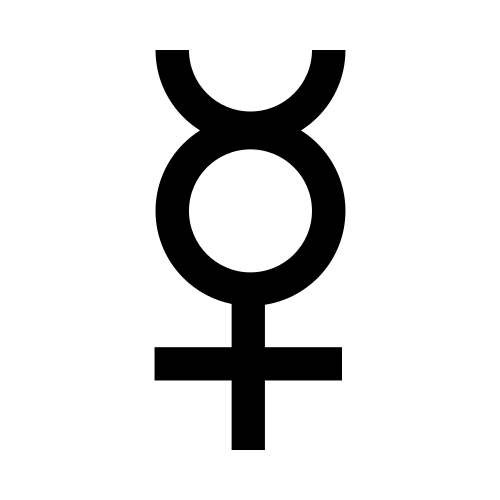 Mercury
 Venus
Venus Mars
Mars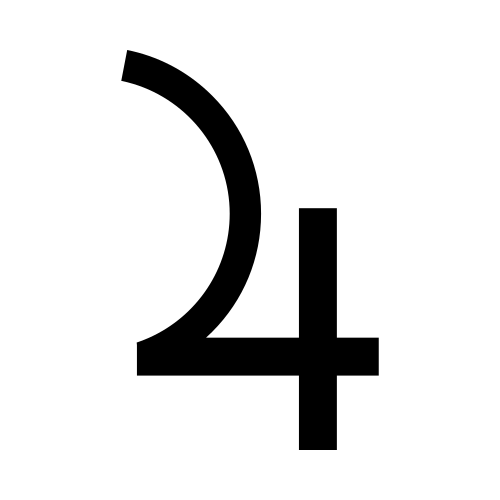 Jupiter
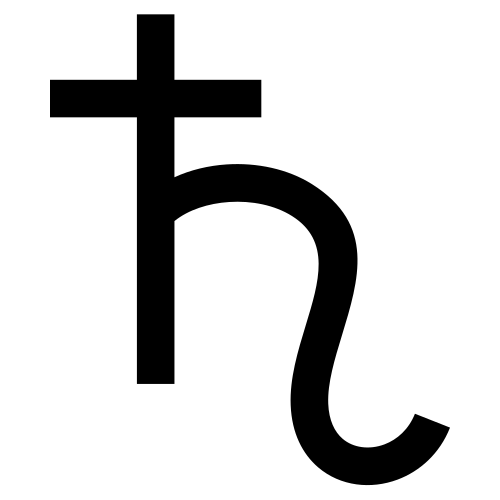 Saturn
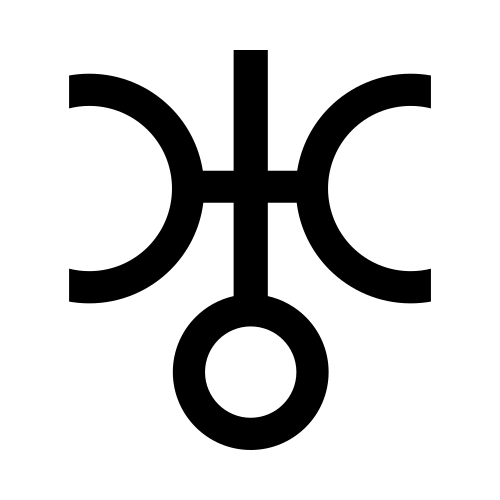 Uranus
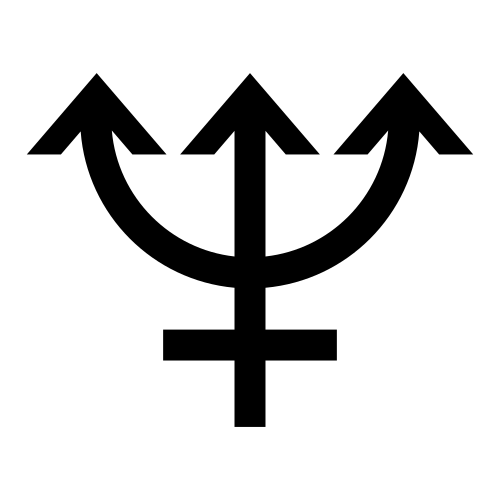 Neptune
 Pluto
Pluto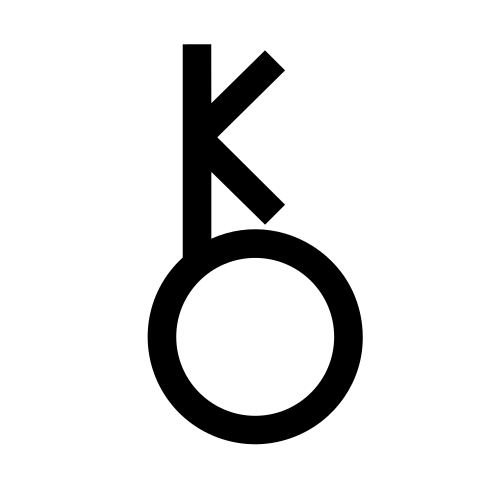 Chiron
Birth time unknown — house positions and Ascendant/MC are not available.
Astronomical context
Pluto moved through Leo from the late 1930s to the late 1950s. In astrological tradition this transit is associated with the collective transformation of self-expression, authority, and the cult of the individual — the cohort that rebuilt the post-war world and expanded mass culture.
Richard Dawkins (born 1941) belongs to this generational configuration. Astrian groups profiles by such shared signatures rather than by any claim of shared destiny. Related profiles in Astrian: Neil deGrasse Tyson · Yuval Noah Harari · Noam Chomsky. The symbolic reading is correlative, not causal.
Other profiles from this Pluto in Leo generation
Symbolic reading
The following describes what classical astrological tradition associates with these configurations. Astrian does not apply these descriptions to the person's biography.
The Sun in Aries is the most prominent structural feature available without a birth time, centring the chart on initiative, directness, and the will to begin. There is no Ascendant or Midheaven to anchor the angles, so the reading rests on sign placements and the aspects between planets rather than on houses.
Among the personal planets, the Moon in Pisces is associated in tradition with imagination, dissolution, and empathy (the Moon's sign is given for the noon chart and may shift with an exact time); Mercury in Pisces with imagination, dissolution, and empathy; Venus in Pisces with imagination, dissolution, and empathy; and Mars in Capricorn with ambition, structure, and the long view. These placements describe registers of feeling, thought, attraction, and action as the tradition catalogues them, independent of the life that follows.
Mars trine Neptune (0°59'): tradition reads drive, assertion, and action in easy flow with dissolution, imagination, and idealism.
Mars trine Uranus (1°40'): tradition reads drive, assertion, and action in easy flow with disruption and innovation.
Uranus trine Neptune (2°40'): tradition reads disruption and innovation in easy flow with dissolution, imagination, and idealism.
Venus trine Pluto (2°55'): tradition reads values, attraction, and harmony in easy flow with depth, power, and transformation.
These placements are presented as a symbolic portrait, correlative and never causal — a description within the tradition's vocabulary, not an explanation of the life that follows.
Astrology is a symbolic language with 2,500 years of literature. The reading above is interpretive, not explanatory.
Astrian does not claim that the natal chart of Richard Dawkins caused or determined any of the above. Astrology is a symbolic system with 2,500 years of literature. Its capacity for retrospective description does not imply explanatory capacity.
A parallel life
The following are verified biographical facts. No connection to the natal chart is implied.
Clinton Richard Dawkins was born on 26 March 1941 in Nairobi, Kenya, where his father was stationed with the Colonial Service. The family returned to England in 1949. Dawkins studied zoology at Balliol College, Oxford, where he received his bachelor's degree and subsequently completed his doctorate under the ethologist Nikolaas Tinbergen, who was awarded the Nobel Prize in Physiology or Medicine in 1973.
After completing his doctorate, Dawkins taught at the University of California, Berkeley from 1967 to 1969, then returned to Oxford, where he held a lectureship at New College. In 1976 he published The Selfish Gene, his first book, which presented the gene-centered view of evolution to a broad audience. The book introduced the concept of the meme as a cultural analogue of the gene, a term that has since passed into general use. The Selfish Gene remains one of the most widely cited works in popular science.
His subsequent books include The Extended Phenotype (1982), which elaborated his theoretical arguments for a specialist audience; The Blind Watchmaker (1986); River Out of Eden (1995); Climbing Mount Improbable (1996); Unweaving the Rainbow (1998); The Ancestor's Tale (2004); and The Greatest Show on Earth (2009), among others. In 2006 he published The God Delusion, which argued against the existence of God and became a global bestseller.
In 1995, Oxford University established the Simonyi Professorship for the Public Understanding of Science, a position funded by the software engineer Charles Simonyi. Dawkins was the first holder of this professorship and held it until his retirement from the position in 2008. He has continued to write and give public lectures since retiring from the professorship.
Dawkins is a Fellow of the Royal Society and a Fellow of the Royal Society of Literature. He received the Royal Society of Literature Award in 1987 and has received numerous honorary degrees. He founded the Richard Dawkins Foundation for Reason and Science in 2006.
Biographical sources
- Dawkins, Richard. The Selfish Gene. Oxford University Press, 1976..
- Dawkins, Richard. An Appetite for Wonder: The Making of a Scientist. HarperCollins, 2013..
- University of Oxford. Simonyi Professorship: Richard Dawkins. ox.ac.uk..
- Royal Society. Fellows Directory: Richard Dawkins. royalsociety.org..
This profile presents the sky at the birth of Richard Dawkins and verified facts of their biography. Astrian does not claim that astrology has predictive capacity or that the natal chart determines the trajectory of a life. Astrology is a symbolic system with 2,500 years of literature. Its capacity for retrospective description does not imply explanatory capacity.
Related profiles
Calculate your own birth chart with the same NASA JPL DE441 precision.
Calculate my birth chartLast updated: June 14, 2026
Newsletter
A short reading once a month, in your inbox.
A note on the symbolism of the season, recent editorial pieces, and what to look for in next month's sky. No predictions.
Support this project
Independent, no venture funding, no ads. A contribution keeps Astrian precise and free.
Support on Ko-fi (opens in new tab)