PROFILE · SCIENCE & TECHNOLOGY
Yuval Noah Harari
historian and author
Born 24 February 1976 · Kiryat Ata, Israel · 32.80° N, 35.10° EX
Source: Birth time not documented in publicly accessible records
About this chart
No birth time is documented for this person. The chart therefore shows planetary positions in their signs, the slow aspects between them, and the generational context — but not house placements, the Ascendant, or the Midheaven, which require an accurate birth time. The Moon's sign carries a ±6° margin: if it falls near a sign boundary, the sign could vary. Positions for all other planets are reliable.
Do you have a verified source for this birth time? Share it →
The sky at birth
No birth time is documented for Yuval Noah Harari. The Ascendant, the Midheaven, and the house positions cannot be determined; the reading is confined to planetary sign placements and the aspects between planets. The positions below are calculated for noon local time and are accurate to a fraction of a degree for the slow-moving bodies. One caveat: the Moon lies near a sign boundary, so without an exact time it cannot be fixed to a single sign — it sits close to 0°36' Capricorn within a daily margin of about ±7°.
The Moon is near 0°36' Capricorn (noon position, ±7° margin). Sun is at 4°55' Pisces. Mercury is at 9°47' Aquarius. Venus is at 5°48' Aquarius. Mars is at 21°02' Gemini. Jupiter is at 23°18' Aries. Saturn is at 26°57' Cancer, retrograde. Uranus is at 7°03' Scorpio, retrograde. Neptune is at 13°51' Sagittarius. Pluto is at 11°15' Libra, retrograde.
The tightest major aspects between planets: Venus square Uranus (1°15'); Mercury trine Pluto (1°28'); Sun trine Uranus (2°08'); Mars sextile Jupiter (2°16'); Neptune sextile Pluto (2°36'); Mercury square Uranus (2°44').
Neptune sextile Pluto (2°36') is structural but generational — an alignment of slow-moving outer planets shared across many birth years.
The engine also registers tight minor aspects involving asteroids and calculated points: Juno quincunx Lilith (0°09'); Venus trine Ceres (0°23'); Sun square Ceres (0°30'); Pluto opposite Pallas (0°34'). These are reported for completeness and carry less weight in traditional reading.
The chart was calculated using NASA JPL DE441 ephemerides, sub-arcsecond precision.
| Planet | Sign | Position |
|---|---|---|
| Sun | Pisces | 04°55' |
| Moon | Capricorn | 00°36'±6° |
| Mercury | Aquarius | 09°47' |
| Venus | Aquarius | 05°48' |
| Mars | Gemini | 21°02' |
| Jupiter | Aries | 23°18' |
| Saturn | Cancer | 26°57'retrograde |
| Uranus | Scorpio | 07°03'retrograde |
| Neptune | Sagittarius | 13°51' |
| Pluto | Libra | 11°15'retrograde |
| Chiron | Aries | 24°45' |
 Sun
Sun Moon
Moon Mercury
 Venus
Venus Mars
Mars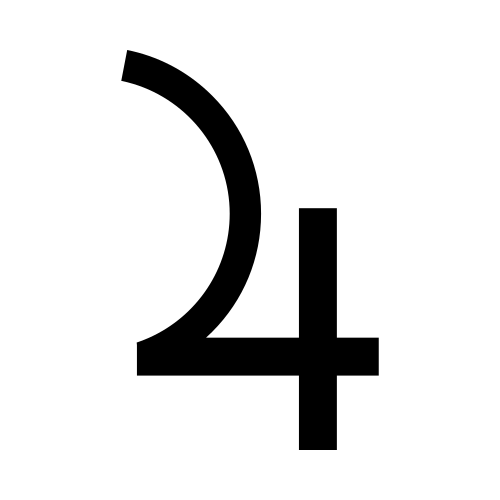 Jupiter
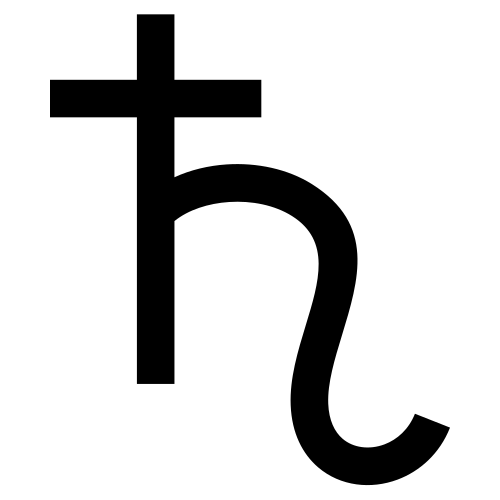 Saturn
 Uranus
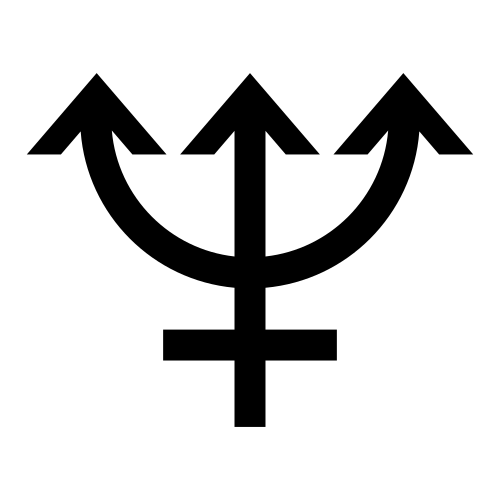 Neptune
 Pluto
Pluto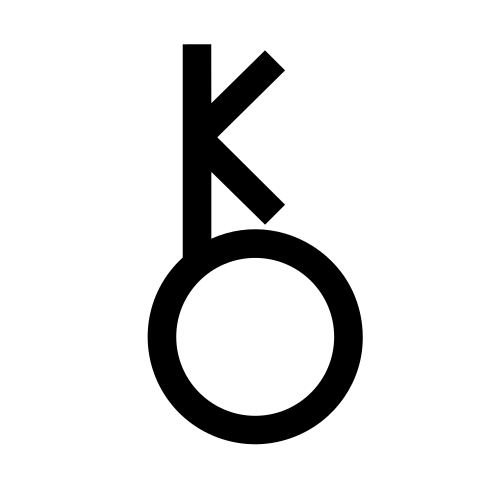 Chiron
Birth time unknown — house positions and Ascendant/MC are not available.
Astronomical context
Pluto travelled through Libra from 1971 to 1984. In astrological tradition this transit is associated with the transformation of relationships, partnership, and the idea of balance — the cohort that redrew norms around marriage, equality, and the terms of personal alliance.
Yuval Noah Harari (born 1976) belongs to this generational configuration. Astrian groups profiles by such shared signatures rather than by any claim of shared destiny. Related profiles in Astrian: Noam Chomsky · Richard Dawkins · Hannah Arendt. The symbolic reading is correlative, not causal.
Other profiles from this Pluto in Libra generation
Symbolic reading
The following describes what classical astrological tradition associates with these configurations. Astrian does not apply these descriptions to the person's biography.
The Sun in Pisces is the most prominent structural feature available without a birth time, centring the chart on imagination, dissolution, and empathy. There is no Ascendant or Midheaven to anchor the angles, so the reading rests on sign placements and the aspects between planets rather than on houses.
Among the personal planets, the Moon in Capricorn is associated in tradition with ambition, structure, and the long view (the Moon's sign is given for the noon chart and may shift with an exact time); Mercury in Aquarius with independence, abstraction, and the collective; Venus in Aquarius with independence, abstraction, and the collective; and Mars in Gemini with curiosity, exchange, and versatility. These placements describe registers of feeling, thought, attraction, and action as the tradition catalogues them, independent of the life that follows.
Venus square Uranus (1°15'): tradition reads values, attraction, and harmony in friction with disruption and innovation.
Mercury trine Pluto (1°28'): tradition reads thought and communication in easy flow with depth, power, and transformation.
Sun trine Uranus (2°08'): tradition reads identity and central purpose in easy flow with disruption and innovation.
Mars sextile Jupiter (2°16'): tradition reads drive, assertion, and action in supportive contact with expansion and meaning.
These placements are presented as a symbolic portrait, correlative and never causal — a description within the tradition's vocabulary, not an explanation of the life that follows.
Astrology is a symbolic language with 2,500 years of literature. The reading above is interpretive, not explanatory.
Astrian does not claim that the natal chart of Yuval Noah Harari caused or determined any of the above. Astrology is a symbolic system with 2,500 years of literature. Its capacity for retrospective description does not imply explanatory capacity.
A parallel life
The following are verified biographical facts. No connection to the natal chart is implied.
Yuval Noah Harari was born on 24 February 1976 in Kiryat Ata, Israel. He completed his undergraduate studies at the Hebrew University of Jerusalem and earned his doctorate from Jesus College, Oxford, in 2002, with a dissertation on the experience of soldiers in late medieval and early modern warfare.
Harari returned to the Hebrew University of Jerusalem, where he is a professor in the Department of History. His early academic work focused on medieval and early modern military history, including his book Special Operations in the Age of Chivalry (2007).
His global profile changed significantly with the publication of Sapiens: A Brief History of Humankind in Hebrew in 2011, with an English edition in 2014. The book offers a broad narrative account of human history, covering biological evolution, the agricultural revolution, the rise of empires, and the emergence of modernity. It became an international bestseller and has been translated into numerous languages.
Homo Deus: A Brief History of Tomorrow (Hebrew 2015, English 2016) turned attention toward the future, examining possibilities including extended lifespans, artificial intelligence, and the potential transformation of human experience through technology and data. 21 Lessons for the 21st Century (2018) addressed contemporary political and technological challenges.
Harari has given widely attended public lectures and has participated in conversations with political and business leaders. He co-founded Sapienship, a social impact company and content studio, with his husband Iyar Yonay, who is also his literary manager.
His work is addressed to general audiences rather than primarily to academic specialists, and his books synthesize findings from multiple disciplines including history, biology, economics, and philosophy. He continues to teach at the Hebrew University of Jerusalem and to publish and speak on themes related to the future of humanity, artificial intelligence, and global challenges.
Biographical sources
- Harari, Y.N. (2014). Sapiens: A Brief History of Humankind. Harper..
- Harari, Y.N. (2016). Homo Deus: A Brief History of Tomorrow. Harper..
- Hebrew University of Jerusalem faculty profile: https://new.huji.ac.il/en/person/yuval-noah-harari.
- Sapienship: https://www.sapienship.co/yuval-noah-harari.
This profile presents the sky at the birth of Yuval Noah Harari and verified facts of their biography. Astrian does not claim that astrology has predictive capacity or that the natal chart determines the trajectory of a life. Astrology is a symbolic system with 2,500 years of literature. Its capacity for retrospective description does not imply explanatory capacity.
Related profiles
Calculate your own birth chart with the same NASA JPL DE441 precision.
Calculate my birth chartLast updated: June 14, 2026
Newsletter
A short reading once a month, in your inbox.
A note on the symbolism of the season, recent editorial pieces, and what to look for in next month's sky. No predictions.
Support this project
Independent, no venture funding, no ads. A contribution keeps Astrian precise and free.
Support on Ko-fi (opens in new tab)