PROFILE · SCIENCE & TECHNOLOGY
Neil deGrasse Tyson
astrophysicist and science communicator
Born 5 October 1958 · Manhattan, New York, United States · 40.73° N, 73.99° WX
Source: Birth time not documented in publicly accessible records
About this chart
No birth time is documented for this person. The chart therefore shows planetary positions in their signs, the slow aspects between them, and the generational context — but not house placements, the Ascendant, or the Midheaven, which require an accurate birth time. The Moon's sign carries a ±6° margin: if it falls near a sign boundary, the sign could vary. Positions for all other planets are reliable.
Do you have a verified source for this birth time? Share it →
The sky at birth
No birth time is documented for Neil deGrasse Tyson. The Ascendant, the Midheaven, and the house positions cannot be determined; the reading is confined to planetary sign placements and the aspects between planets. The positions below are calculated for noon local time and are accurate to a fraction of a degree for the slow-moving bodies.
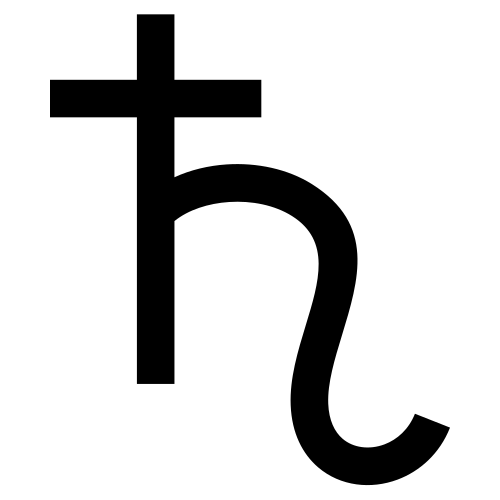
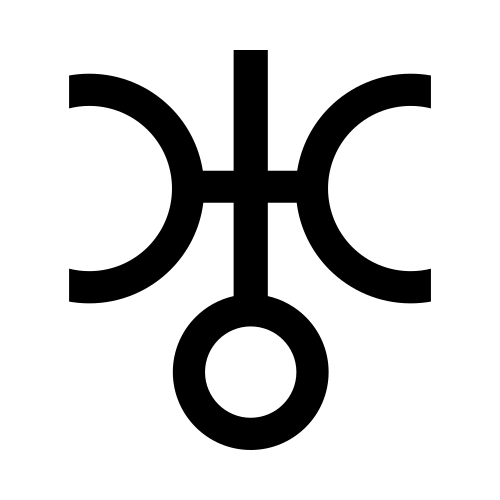
The Moon is near 7°19' Cancer (noon position, ±7° margin). Sun is at 11°54' Libra. Mercury is at 12°00' Libra. Venus is at 2°27' Libra. Mars is at 2°22' Gemini. Jupiter is at 5°33' Scorpio. Saturn is at 20°31' Sagittarius. Uranus is at 15°21' Leo. Neptune is at 3°40' Scorpio. Pluto is at 3°18' Virgo.
3 bodies occupy Libra (Sun, Mercury and Venus) — a concentration that stands out as a structural feature of the chart.
The tightest major aspects between planets: Venus trine Mars (0°05'); Sun conjunct Mercury (0°07'); Neptune sextile Pluto (0°22'); Mars square Pluto (0°56'); Moon trine Jupiter (1°47'); Jupiter conjunct Neptune (1°53').
Neptune sextile Pluto (0°22') is structural but generational — an alignment of slow-moving outer planets shared across many birth years.
The engine also registers tight minor aspects involving asteroids and calculated points: Chiron sesquiquadrate Ceres (0°01'); Pluto semi-sextile Ceres (0°25'); Venus conjunct Ceres (0°26'); Venus sesquiquadrate Chiron (0°28'). These are reported for completeness and carry less weight in traditional reading.
The chart was calculated using NASA JPL DE441 ephemerides, sub-arcsecond precision.
| Planet | Sign | Position |
|---|---|---|
| Sun | Libra | 11°54' |
| Moon | Cancer | 07°19'±6° |
| Mercury | Libra | 12°00' |
| Venus | Libra | 02°27' |
| Mars | Gemini | 02°22' |
| Jupiter | Scorpio | 05°33' |
| Saturn | Sagittarius | 20°31' |
| Uranus | Leo | 15°21' |
| Neptune | Scorpio | 03°40' |
| Pluto | Virgo | 03°18' |
| Chiron | Aquarius | 17°54'retrograde |
 Sun
Sun Moon
Moon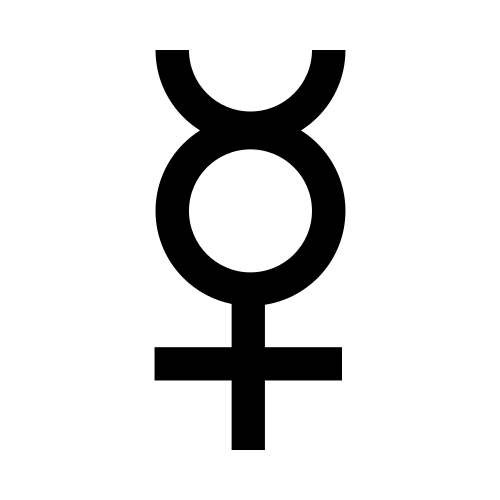 Mercury
 Venus
Venus Mars
Mars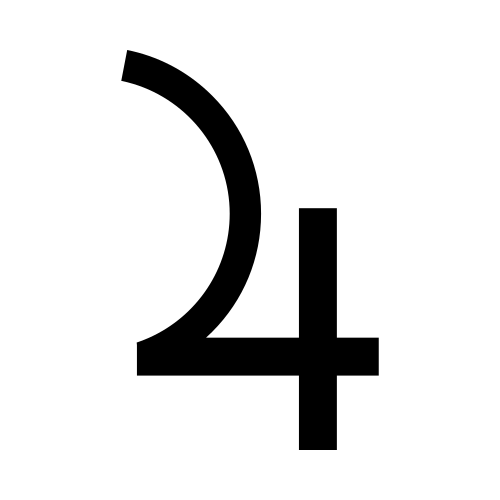 Jupiter
 Saturn
 Uranus
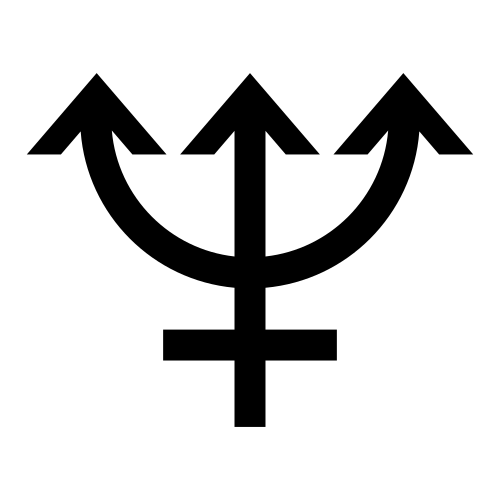 Neptune
 Pluto
Pluto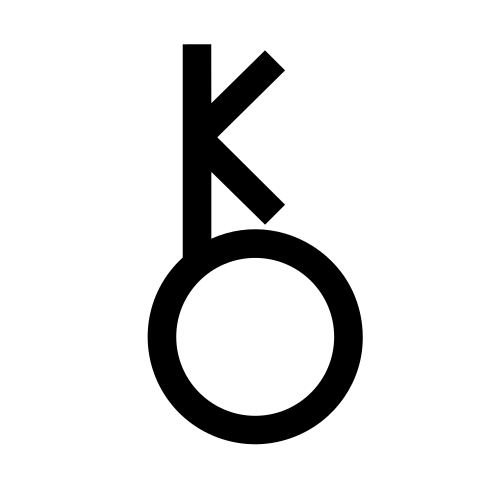 Chiron
Birth time unknown — house positions and Ascendant/MC are not available.
Astronomical context
Pluto crossed Virgo from the late 1950s to 1971. In astrological tradition the passage is linked to the transformation of work, health, technique, and systems of organization — the generation that came of age amid automation and the reorganization of labour.
Neil deGrasse Tyson (born 1958) belongs to this generational configuration. Astrian groups profiles by such shared signatures rather than by any claim of shared destiny. Related profiles in Astrian: Richard Dawkins · Carl Sagan · Edwin Hubble. The symbolic reading is correlative, not causal.
Other profiles from this Pluto in Virgo generation
Symbolic reading
The following describes what classical astrological tradition associates with these configurations. Astrian does not apply these descriptions to the person's biography.
The Sun in Libra is the most prominent structural feature available without a birth time, centring the chart on balance, relationship, and proportion. There is no Ascendant or Midheaven to anchor the angles, so the reading rests on sign placements and the aspects between planets rather than on houses.
Among the personal planets, the Moon in Cancer is associated in tradition with attachment, memory, and protection (the Moon's sign is given for the noon chart and may shift with an exact time); Mercury in Libra with balance, relationship, and proportion; Venus in Libra with balance, relationship, and proportion; and Mars in Gemini with curiosity, exchange, and versatility. These placements describe registers of feeling, thought, attraction, and action as the tradition catalogues them, independent of the life that follows.
Venus trine Mars (0°05'): tradition reads values, attraction, and harmony in easy flow with drive, assertion, and action.
Sun conjunct Mercury (0°07'): tradition reads identity and central purpose fused with thought and communication.
Neptune sextile Pluto (0°22'): tradition reads dissolution, imagination, and idealism in supportive contact with depth, power, and transformation.
Mars square Pluto (0°56'): tradition reads drive, assertion, and action in friction with depth, power, and transformation.
These placements are presented as a symbolic portrait, correlative and never causal — a description within the tradition's vocabulary, not an explanation of the life that follows.
Astrology is a symbolic language with 2,500 years of literature. The reading above is interpretive, not explanatory.
Astrian does not claim that the natal chart of Neil deGrasse Tyson caused or determined any of the above. Astrology is a symbolic system with 2,500 years of literature. Its capacity for retrospective description does not imply explanatory capacity.
A parallel life
The following are verified biographical facts. No connection to the natal chart is implied.
Neil deGrasse Tyson was born on 5 October 1958 in Manhattan, New York City. He grew up in the Bronx and developed an interest in astronomy from an early age, visiting the Hayden Planetarium at the American Museum of Natural History as a child. He later described those visits as formative.
He studied physics at Harvard University, where he received his bachelor's degree in 1980. He then completed a master's degree in astronomy at the University of Texas at Austin in 1983 and a doctorate in astrophysics at Columbia University in 1991. His doctoral research focused on the structure and evolution of the Milky Way's galactic bulge.
He joined the staff of the American Museum of Natural History in 1994 and became director of the Hayden Planetarium in 1996. In 2000, the planetarium completed a major renovation and reopened as part of the Rose Center for Earth and Space. Tyson played a significant role in the reclassification of Pluto from planet to dwarf planet, as the renovated Hayden Planetarium initially did not include Pluto in its planetary display. This generated substantial public discussion and media coverage.
His research interests include star formation, exploding stars, dwarf galaxies, and the structure of the Milky Way. He has authored or co-authored several books aimed at general audiences, including The Pluto Files (2009), Space Chronicles (2012), Astrophysics for People in a Hurry (2017), and Starry Messenger (2022). He served as the host of the television series Cosmos: A Spacetime Odyssey (2014) and its follow-up Cosmos: Possible Worlds (2020), both of which continued the format established by Carl Sagan's original 1980 series.
He hosts the weekly podcast StarTalk, which began in 2009, and has appeared frequently in media discussing scientific topics. He serves on various advisory bodies related to science policy and space exploration. Tyson is a fellow of several scientific organizations.
Biographical sources
- Tyson, Neil deGrasse. The Sky Is Not the Limit: Adventures of an Urban Astrophysicist. Prometheus Books, 2004..
- Tyson, Neil deGrasse. Astrophysics for People in a Hurry. W. W. Norton, 2017..
- American Museum of Natural History. Neil deGrasse Tyson: Astrophysicist. amnh.org..
- NASA Advisory Council biography. nasa.gov..
This profile presents the sky at the birth of Neil deGrasse Tyson and verified facts of their biography. Astrian does not claim that astrology has predictive capacity or that the natal chart determines the trajectory of a life. Astrology is a symbolic system with 2,500 years of literature. Its capacity for retrospective description does not imply explanatory capacity.
Related profiles
Calculate your own birth chart with the same NASA JPL DE441 precision.
Calculate my birth chartLast updated: June 14, 2026
Newsletter
A short reading once a month, in your inbox.
A note on the symbolism of the season, recent editorial pieces, and what to look for in next month's sky. No predictions.
Support this project
Independent, no venture funding, no ads. A contribution keeps Astrian precise and free.
Support on Ko-fi (opens in new tab)