PROFILE · ENTREPRENEURS

Steve Jobs
Steven Paul Jobs
entrepreneur and product designer
Born 24 February 1955 · San Francisco, California, United States · 37.77° N, 122.42° WX
Source: Birth time not documented in publicly accessible records
About this chart
No birth time is documented for this person. The chart therefore shows planetary positions in their signs, the slow aspects between them, and the generational context — but not house placements, the Ascendant, or the Midheaven, which require an accurate birth time. The Moon's sign carries a ±6° margin: if it falls near a sign boundary, the sign could vary. Positions for all other planets are reliable.
Do you have a verified source for this birth time? Share it →
The sky at birth
No birth time is documented for Steve Jobs. The Ascendant, Midheaven, and house positions cannot be determined. The planetary positions below are calculated for noon local time and are accurate to within a fraction of a degree for the slow-moving planets. The Moon's position carries a margin of approximately ±7°.
The Sun is at 5°26' Pisces. The Moon is at 3°28' Aries (noon position, ±7° margin). Mercury is at 14°22' Aquarius R. Venus is at 20°49' Capricorn. Mars is at 28°52' Aries. Jupiter is at 20°31' Cancer R. Saturn is at 21°09' Scorpio. Uranus is at 24°08' Cancer R. Neptune is at 28°03' Libra R. Pluto is at 25°19' Leo R.
Venus at 20°49' Capricorn sits at the focal point of a tight triangular configuration: it opposes Jupiter at 20°31' Cancer (0°18') and sextiles Saturn at 21°09' Scorpio (0°20'). Jupiter and Saturn themselves form a trine at 0°38'. This three-body alignment across water and earth signs, all within less than one degree, is the defining geometric structure of the chart. Mars at 28°52' Aries opposes Neptune at 28°03' Libra (0°49'), adding a second tight axis.
The tightest major aspects between planets: Venus opposition Jupiter (0°18'), Venus sextile Saturn (0°20'), Jupiter trine Saturn (0°38'), Mars opposition Neptune (0°49'), Saturn trine Uranus (2°59'), Venus opposition Uranus (3°19'), Mars trine Pluto (3°33'), Jupiter conjunct Uranus (3°37').
The engine also identifies the following tight minor aspects involving asteroids and calculated points: sun sesquiquadrate jupiter (0.08° app); juno quincunx vesta (0.20° app); chiron semi-sextile northNode (0.21° app); venus opposition jupiter (0.30° sep).
The chart was calculated by Astrian's engine using NASA JPL DE441 ephemerides, sub-arcsecond precision. Timezone: Pacific Standard Time (America/Los_Angeles, UTC −8).
| Planet | Sign | Position |
|---|---|---|
| Sun | Pisces | 05°26' |
| Moon | Aries | 03°28'±6° |
| Mercury | Aquarius | 14°22'retrograde |
| Venus | Capricorn | 20°49' |
| Mars | Aries | 28°52' |
| Jupiter | Cancer | 20°31'retrograde |
| Saturn | Scorpio | 21°09' |
| Uranus | Cancer | 24°08'retrograde |
| Neptune | Libra | 28°03'retrograde |
| Pluto | Leo | 25°19'retrograde |
| Chiron | Aquarius | 02°18' |
 Sun
Sun Moon
Moon Mercury
 Venus
Venus Mars
Mars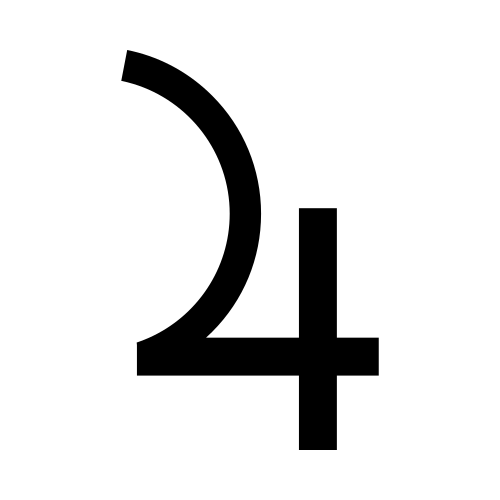 Jupiter
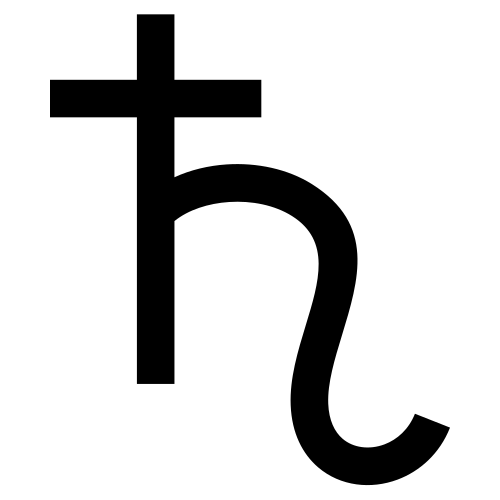 Saturn
 Uranus
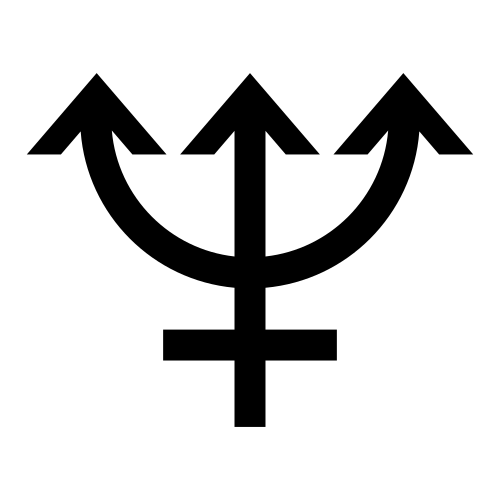 Neptune
 Pluto
Pluto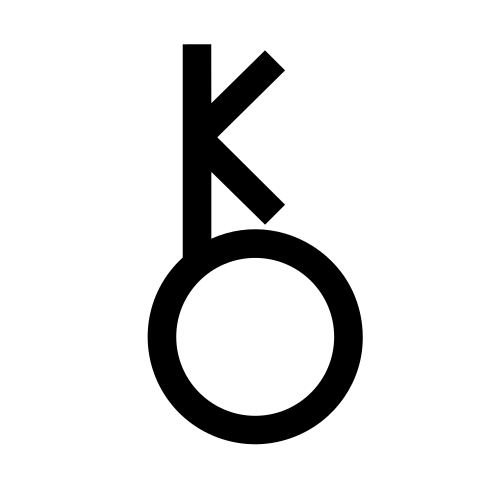 Chiron
Birth time unknown — house positions and Ascendant/MC are not available.
Astronomical context
Those born between approximately 1939 and 1957 carried Pluto in Leo. This generation witnessed the postwar reconstruction of global order, the rise of mass consumer culture, the Cold War, the birth of television, and the beginning of the space age.
In astrological tradition, Pluto in Leo is associated with collective transformation of the domains that sign governs: self-expression, creative authority, spectacle, and the individual as center of cultural gravity. The generation that carried this placement built the institutions of mass entertainment, reshaped the relationship between public persona and private life, and — in the technology sector — turned personal computing from a hobbyist pursuit into a consumer revolution. The symbolic reading is correlative, not causal.
Others in the Astrian collection born under this configuration include Stephen Hawking (1942), Pele (1940), Franz Beckenbauer (1945), George Best (1946), Johan Cruyff (1947), and Donald Trump (1946). Jobs, born in 1955, belongs to the final years of this generational wave.
Other profiles from this Pluto in Leo generation
Symbolic reading
The following describes what classical astrological tradition associates with these configurations. Astrian does not apply these descriptions to the person's biography.
The Sun at 5°26' Pisces is the most prominent structural feature of this chart. Without a documented birth time, there is no Ascendant or Midheaven — the reading is confined to planetary positions by sign and the aspects between planets.
The Moon at 3°28' Aries represents the noon position; the actual placement falls within approximately 7° on either side. If born in the morning, the Moon might be in late Pisces; if born in the afternoon or evening, firmly in Aries. The Moon's sign placement is uncertain for this chart.
Mercury at 14°22' Aquarius R, Venus at 20°49' Capricorn, and Mars at 28°52' Aries complete the personal planet picture.
### Venus at the apex of a tight triangle
The most striking geometric feature of this chart is the configuration involving Venus, Jupiter, and Saturn. Venus at 20°49' Capricorn opposes Jupiter at 20°31' Cancer retrograde with an orb of just 0°18'. Simultaneously, Venus sextiles Saturn at 21°09' Scorpio with an orb of 0°20'. Jupiter and Saturn complete the triangle with a trine of 0°38'. All three bodies occupy degrees between 20° and 21° of their respective signs.
In astrological tradition, Venus governs aesthetics, value, and the sense of what is desirable. Jupiter governs expansion, vision, and the impulse to amplify. Saturn governs structure, discipline, and the long term. The opposition between Venus and Jupiter creates a polarity — desire and expansion in tension across an axis. Saturn's trine to Jupiter and sextile to Venus stabilizes the configuration, providing structural support to both poles.
Venus in Capricorn — a sign associated with ambition, material mastery, and austere refinement — occupies the apex of this triangle. In the vocabulary of the tradition, this placement is read as an aesthetic sense oriented toward the essential and the enduring rather than the decorative or the ephemeral. The opposition to Jupiter in Cancer (in exaltation) intensifies the tension between restraint and abundance.
### Mars opposition Neptune
Mars at 28°52' Aries opposes Neptune at 28°03' Libra retrograde, orb 0°49'. Mars in Aries — its own sign, in domicile — represents drive in its most direct form: assertion, initiative, the will to begin. Neptune's register involves the ideal, the visionary, and what transcends the literal. Oppositions place two principles in polarity. The tradition reads Mars-Neptune oppositions as configurations where the impulse to act is amplified — or complicated — by a vision of what the action should ultimately achieve, a sense of the ideal that exceeds the practical.
### Mercury retrograde in Aquarius
Mercury at 14°22' Aquarius retrograde does not form tight major aspects to other planets in this chart, operating somewhat independently. In the tradition, Mercury retrograde suggests a mode of thinking that is revisionary — returning to ideas, reworking communications, approaching problems from unexpected angles. In Aquarius, a sign associated with systems thinking and unconventional frameworks, this placement intensifies the emphasis on originality in the realm of ideas.
### Jupiter conjunct Uranus in Cancer
Jupiter at 20°31' Cancer and Uranus at 24°08' Cancer are within 3°37' of conjunction. Both are retrograde. Jupiter in Cancer occupies exaltation — one of the most traditionally favorable placements in the zodiac. Uranus adds disruption and innovation to Jupiter's expansive register. The conjunction merges these qualities in Cancer, a sign associated with home, protection, and what is foundational.
The planetary pattern here is read as a symbolic portrait, not a causal explanation. No planet caused, predicted, or determined any event or characteristic.
Astrology is a symbolic language with 2,500 years of literature. The reading above is interpretive, not explanatory.
Astrian does not claim that the natal chart of Steve Jobs caused or determined any of the above. Astrology is a symbolic system with 2,500 years of literature. Its capacity for retrospective description does not imply explanatory capacity.
A parallel life
The following are verified biographical facts. No connection to the natal chart is implied.
Steven Paul Jobs was born on 24 February 1955 in San Francisco, the biological son of Abdulfattah Jandali, a Syrian graduate student in political science at the University of Wisconsin, and Joanne Schieble, a graduate student from a Catholic family in Wisconsin. The birth parents, unmarried, arranged for adoption. Paul Reinhold Jobs, a machinist and Coast Guard veteran, and Clara Hagopian Jobs, an accountant of Armenian descent, adopted the child and raised him in Mountain View, California, in what would later be called Silicon Valley.
He grew up tinkering with electronics in the family garage. In 1969, when he was thirteen, he called Bill Hewlett at home to ask for spare parts for a frequency counter; Hewlett gave him the parts and a summer job at Hewlett-Packard. He attended Homestead High School in Cupertino, where he met Steve Wozniak, five years his senior, through a mutual friend. After graduating in 1972, he enrolled at Reed College in Portland, Oregon, dropped out after one semester, and continued to audit classes — including a calligraphy course that, by his own account, influenced the typography of the Macintosh.
He worked briefly at Atari, traveled to India in 1974, returned to California, and in 1976 co-founded Apple Computer with Wozniak in the Jobs family garage. The Apple II (1977), designed largely by Wozniak, became one of the first commercially successful personal computers. Apple went public on 12 December 1980; Jobs, at twenty-five, was worth more than $200 million.
The Macintosh, introduced on 24 January 1984 with a famous television advertisement directed by Ridley Scott, brought the graphical user interface to a mass-market personal computer for the first time. It sold below projections. A power struggle with CEO John Sculley, whom Jobs himself had recruited from Pepsi, ended with Jobs's removal from operational authority in May 1985. He resigned from Apple in September 1985.
He founded NeXT Computer, which produced elegant but commercially marginal workstations, and in 1986 purchased the computer graphics division of Lucasfilm for $10 million, renaming it Pixar. Pixar's Toy Story (1995), the first entirely computer-animated feature film, earned $373 million at the box office and established the studio as a creative and commercial force. Pixar was sold to Disney in 2006 for $7.4 billion; Jobs became Disney's largest individual shareholder.
Apple, struggling through the 1990s, acquired NeXT in December 1996 for $427 million, and Jobs returned as interim CEO in July 1997. What followed was a sequence of products that each redefined its category: the iMac (1998), which revived Apple's hardware business; the iPod (2001), which restructured the music industry; the iTunes Store (2003), which demonstrated that digital media could be sold legally at scale; the iPhone (2007), which created the smartphone as a mass-market category; and the iPad (2010), which established the tablet as a consumer device.
In October 2003, Jobs was diagnosed with a pancreatic neuroendocrine tumor. He initially pursued alternative treatments before undergoing surgery in July 2004. He received a liver transplant in 2009. His health deteriorated through 2011. He resigned as CEO of Apple on 24 August 2011, appointing Tim Cook as his successor, and died at his home in Palo Alto on 5 October 2011. He was fifty-six.
At the time of his death, Apple was the most valuable publicly traded company in the world.
Biographical sources
- Isaacson, Walter. Steve Jobs. Simon & Schuster 2011
- Schlender, Brent, and Tet.
This profile presents the sky at the birth of Steve Jobs and verified facts of their biography. Astrian does not claim that astrology has predictive capacity or that the natal chart determines the trajectory of a life. Astrology is a symbolic system with 2,500 years of literature. Its capacity for retrospective description does not imply explanatory capacity.
Related profiles
Calculate your own birth chart with the same NASA JPL DE441 precision.
Calculate my birth chartLast updated: June 12, 2026
Newsletter
A short reading once a month, in your inbox.
A note on the symbolism of the season, recent editorial pieces, and what to look for in next month's sky. No predictions.
Support this project
Independent, no venture funding, no ads. A contribution keeps Astrian precise and free.
Support on Ko-fi (opens in new tab)