PROFILE · SCIENCE & TECHNOLOGY
Hannah Arendt
Johanna Arendt
political theorist
Born 14 October 1906 · 21:15 · 12:32 UTC · Hannover, German Empire · 52.37° N, 9.71° EAA
Source: Astro-Databank (Rodden Rating AA)
The sky at birth
With a documented birth time, the full chart can be cast. The Ascendant falls at 8°50' Cancer and the Midheaven at 4°02' Pisces, which fixes the angular framework and allows the planets to be placed in houses.
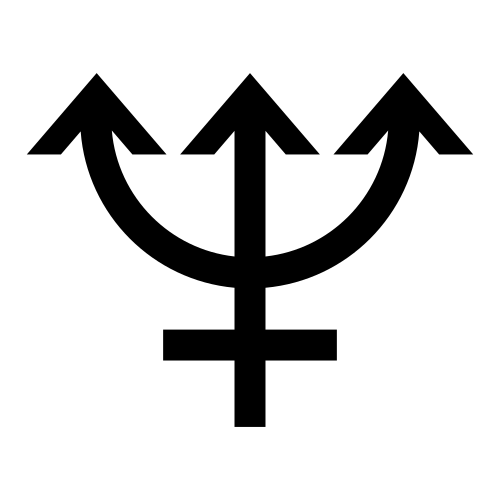
Sun is at 20°34' Libra, house 5. Moon is at 9°35' Virgo, house 4. Mercury is at 4°25' Scorpio, house 5. Venus is at 4°06' Sagittarius, house 6. Mars is at 20°22' Virgo, house 4. Jupiter is at 10°41' Cancer, house 1. Saturn is at 9°00' Pisces, house 10, retrograde. Uranus is at 4°53' Capricorn, house 6. Neptune is at 12°39' Cancer, house 1. Pluto is at 23°41' Gemini, house 12, retrograde.
The tightest major aspects between planets: Mercury sextile Uranus (0°28'); Moon opposite Saturn (0°35'); Moon sextile Jupiter (1°06'); Jupiter trine Saturn (1°41'); Jupiter conjunct Neptune (1°58'); Moon sextile Neptune (3°04').
Uranus opposite Neptune (7°45') is structural but generational — an alignment of slow-moving outer planets shared across many birth years.
The engine also registers tight minor aspects involving asteroids and calculated points: Mars square Ceres (0°03'); Sun trine Ceres (0°14'); Jupiter semi-sextile Lilith (0°16'); Neptune trine Vesta (0°22'). These are reported for completeness and carry less weight in traditional reading.
The chart was calculated using NASA JPL DE441 ephemerides, sub-arcsecond precision.
| Planet | Sign | Position | House |
|---|---|---|---|
| Ascendant | Cancer | 08°50' | — |
| Midheaven | Pisces | 04°02' | — |
| Sun | Libra | 20°34' | H5 |
| Moon | Virgo | 09°35' | H4 |
| Mercury | Scorpio | 04°25' | H5 |
| Venus | Sagittarius | 04°06' | H6 |
| Mars | Virgo | 20°22' | H4 |
| Jupiter | Cancer | 10°41' | H1 |
| Saturn | Pisces | 09°00'retrograde | H10 |
| Uranus | Capricorn | 04°53' | H6 |
| Neptune | Cancer | 12°39' | H1 |
| Pluto | Gemini | 23°41'retrograde | H12 |
| Chiron | Aquarius | 07°27'retrograde | H8 |
 Sun
Sun Moon
Moon Mercury
 Venus
Venus Mars
Mars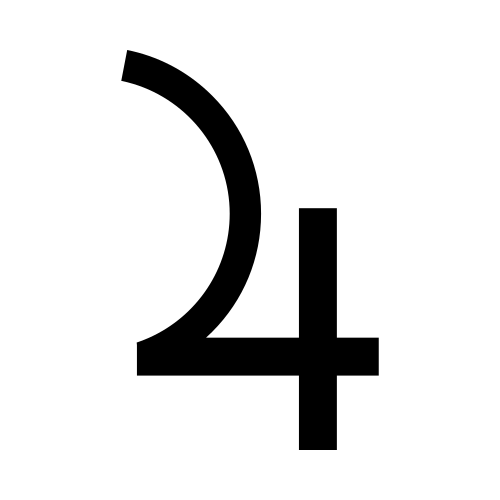 Jupiter
 Saturn
 Uranus
 Neptune
 Pluto
Pluto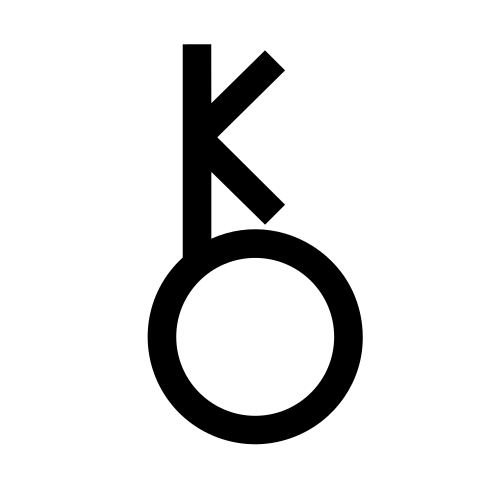 Chiron
Astronomical context
Pluto travelled through Gemini from the mid-1880s to 1914. In astrological tradition this transit is associated with the transformation of communication, ideas, transport, and the press — the generation that came of age amid the spread of mass media, the telephone, and accelerating mobility.
Hannah Arendt (born 1906) belongs to this generational configuration. Astrian groups profiles by such shared signatures rather than by any claim of shared destiny. Related profiles in Astrian: Simone de Beauvoir · Jean-Paul Sartre · Albert Camus. The symbolic reading is correlative, not causal.
Other profiles from this Pluto in Gemini generation
Symbolic reading
The following describes what classical astrological tradition associates with these configurations. Astrian does not apply these descriptions to the person's biography.
The Sun in Libra centres the chart on balance, relationship, and proportion. With the Ascendant in Cancer, tradition adds attachment, memory, and protection as the threshold through which that energy meets the world; the Sun marks the central drive, the Ascendant the manner of approach.
Among the personal planets, the Moon in Virgo is associated in tradition with analysis, craft, and the refinement of method; Mercury in Scorpio with intensity, depth, and the will to transform; Venus in Sagittarius with expansion, conviction, and the horizon; and Mars in Virgo with analysis, craft, and the refinement of method. These placements describe registers of feeling, thought, attraction, and action as the tradition catalogues them, independent of the life that follows.
Mercury sextile Uranus (0°28'): tradition reads thought and communication in supportive contact with disruption and innovation.
Moon opposite Saturn (0°35'): tradition reads emotional life and instinct set in polarity with structure, limitation, and discipline.
Moon sextile Jupiter (1°06'): tradition reads emotional life and instinct in supportive contact with expansion and meaning.
Jupiter trine Saturn (1°41'): tradition reads expansion and meaning in easy flow with structure, limitation, and discipline.
These placements are presented as a symbolic portrait, correlative and never causal — a description within the tradition's vocabulary, not an explanation of the life that follows.
Astrology is a symbolic language with 2,500 years of literature. The reading above is interpretive, not explanatory.
Astrian does not claim that the natal chart of Hannah Arendt caused or determined any of the above. Astrology is a symbolic system with 2,500 years of literature. Its capacity for retrospective description does not imply explanatory capacity.
A parallel life
The following are verified biographical facts. No connection to the natal chart is implied.
Johanna Arendt was born on 14 October 1906 in Linden, near Hannover, Germany, into a secular Jewish family. Her father died when she was seven, and she was raised by her mother in Konigsberg, the city associated with Immanuel Kant. She studied classical Greek and Latin in her youth and showed early scholarly aptitude.
Arendt studied philosophy at the University of Marburg, where she attended the lectures of Martin Heidegger, and later at the University of Heidelberg, where she completed her doctorate in 1929 under Karl Jaspers. Her dissertation examined the concept of love in the work of Augustine of Hippo.
Following the rise of National Socialism in Germany, Arendt was briefly detained by the Gestapo in 1933 after carrying out research for a Zionist organization. She fled Germany and spent several years in Paris, working with Jewish refugee organizations. After the fall of France in 1940, she was interned for a time in a French camp before escaping. In 1941 she emigrated to the United States, where she eventually became a citizen in 1951.
In New York, Arendt worked as a journalist, editor, and later as a teacher. Her first major work, The Origins of Totalitarianism (1951), traced the historical and ideological roots of Nazism and Stalinism, arguing that totalitarianism was a genuinely novel form of political domination that sought to eliminate human plurality and political freedom entirely.
The Human Condition (1958) developed a tripartite distinction among labor, work, and action as fundamental modes of human activity, arguing for the particular importance of political action and the public realm in human life.
In 1961, Arendt attended the trial of Adolf Eichmann in Jerusalem as a correspondent for The New Yorker. Her subsequent reporting, published as Eichmann in Jerusalem: A Report on the Banality of Evil (1963), argued that Eichmann was not a monster but an ordinary bureaucrat who carried out evil through thoughtlessness rather than pathological malice. The book generated substantial controversy.
Arendt taught at several institutions including the University of Chicago and the New School for Social Research in New York. She died of a heart attack on 4 December 1975 in New York City.
Biographical sources
- Young-Bruehl, E. (1982). Hannah Arendt: For Love of the World. Yale University Press..
- Arendt, H. (1951). The Origins of Totalitarianism. Schocken Books..
- Arendt, H. (1963). Eichmann in Jerusalem: A Report on the Banality of Evil. Viking Press..
- Stanford Encyclopedia of Philosophy: Hannah Arendt: https://plato.stanford.edu/entries/arendt/.
This profile presents the sky at the birth of Hannah Arendt and verified facts of their biography. Astrian does not claim that astrology has predictive capacity or that the natal chart determines the trajectory of a life. Astrology is a symbolic system with 2,500 years of literature. Its capacity for retrospective description does not imply explanatory capacity.
Related profiles
Calculate your own birth chart with the same NASA JPL DE441 precision.
Calculate my birth chartLast updated: June 14, 2026
Newsletter
A short reading once a month, in your inbox.
A note on the symbolism of the season, recent editorial pieces, and what to look for in next month's sky. No predictions.
Support this project
Independent, no venture funding, no ads. A contribution keeps Astrian precise and free.
Support on Ko-fi (opens in new tab)