PROFILE · SCIENCE & TECHNOLOGY
Albert Camus
philosopher, author and journalist
Born 7 November 1913 · 02:00 · 12:32 UTC · Mondovi (Dréan), French Algeria · 36.68° N, 7.75° EAA
Source: Astro-Databank (Rodden Rating AA)
The sky at birth
With a documented birth time, the full chart can be cast. The Ascendant falls at 24°35' Virgo and the Midheaven at 23°58' Gemini, which fixes the angular framework and allows the planets to be placed in houses.
Sun is at 14°04' Scorpio, house 2. Moon is at 28°30' Aquarius, house 6. Mercury is at 6°44' Sagittarius, house 3. Venus is at 20°51' Libra, house 1. Mars is at 22°06' Cancer, house 10. Jupiter is at 13°50' Capricorn, house 4. Saturn is at 16°57' Gemini, house 9, retrograde. Uranus is at 3°51' Aquarius, house 5. Neptune is at 28°13' Cancer, house 11, retrograde. Pluto is at 0°54' Cancer, house 10, retrograde.
3 bodies occupy Cancer (Mars, Neptune and Pluto) — a concentration that stands out as a structural feature of the chart.
The tightest major aspects between planets: Sun sextile Jupiter (0°14'); Venus square Mars (1°14'); Moon trine Pluto (2°25'); Mercury sextile Uranus (2°53'); Venus trine Saturn (3°54'); Uranus opposite Neptune (5°38').
Uranus opposite Neptune (5°38') is structural but generational — an alignment of slow-moving outer planets shared across many birth years.
The engine also registers tight minor aspects involving asteroids and calculated points: Venus semi-square Pallas (0°01'); Vesta semi-square Lilith (0°02'); Uranus semi-square Ceres (0°17'); Neptune sesquiquadrate Juno (0°17'). These are reported for completeness and carry less weight in traditional reading.
The chart was calculated using NASA JPL DE441 ephemerides, sub-arcsecond precision.
| Planet | Sign | Position | House |
|---|---|---|---|
| Ascendant | Virgo | 24°35' | — |
| Midheaven | Gemini | 23°58' | — |
| Sun | Scorpio | 14°04' | H2 |
| Moon | Aquarius | 28°30' | H6 |
| Mercury | Sagittarius | 06°44' | H3 |
| Venus | Libra | 20°51' | H1 |
| Mars | Cancer | 22°06' | H10 |
| Jupiter | Capricorn | 13°50' | H4 |
| Saturn | Gemini | 16°57'retrograde | H9 |
| Uranus | Aquarius | 03°51' | H5 |
| Neptune | Cancer | 28°13'retrograde | H11 |
| Pluto | Cancer | 00°54'retrograde | H10 |
| Chiron | Pisces | 10°33'retrograde | H6 |
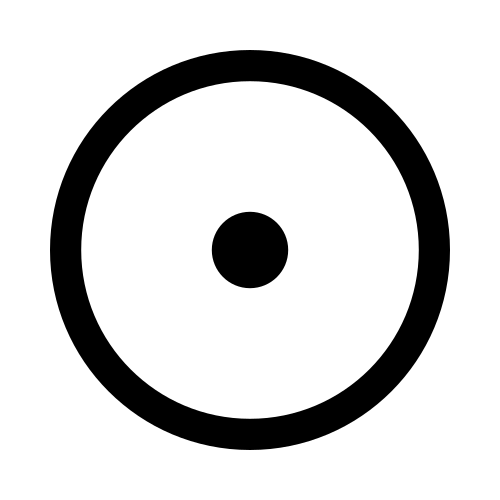 Sun
Sun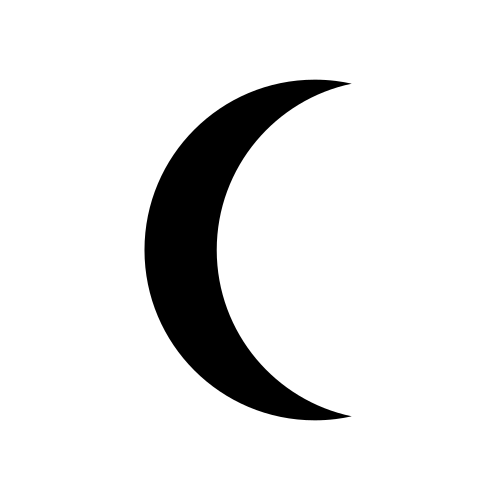 Moon
Moon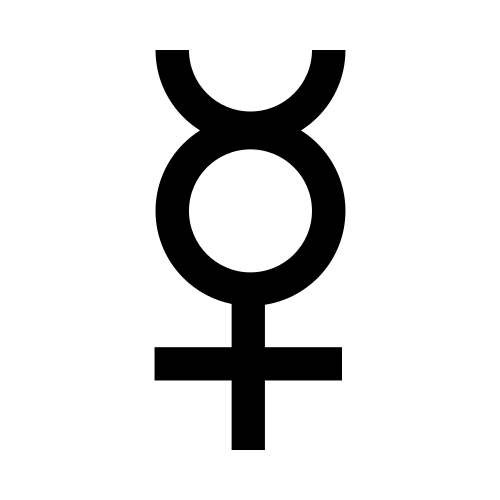 Mercury
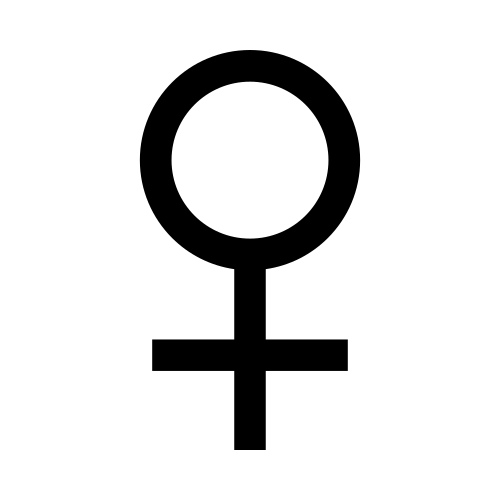 Venus
Venus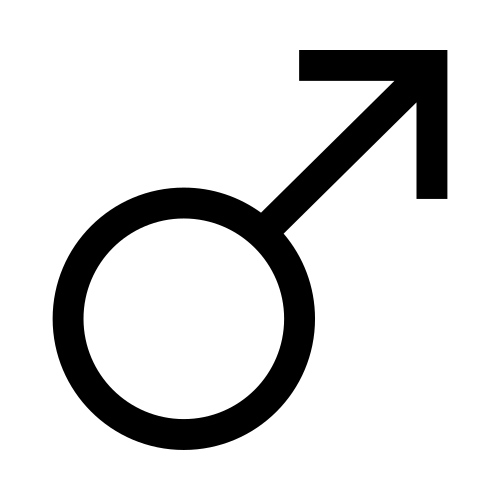 Mars
Mars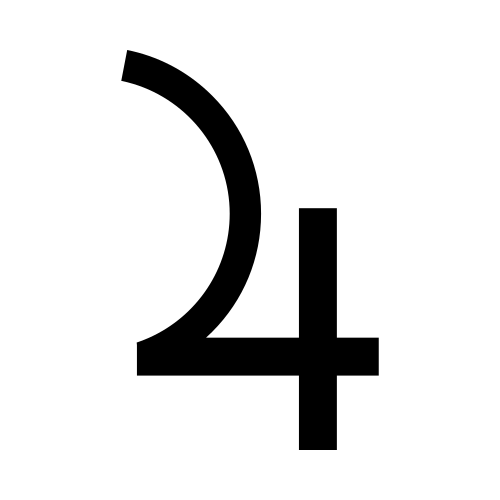 Jupiter
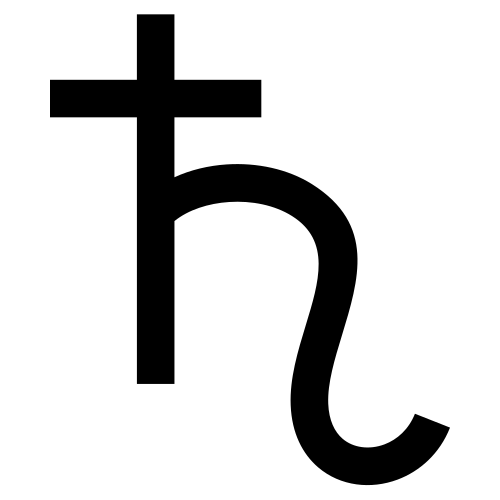 Saturn
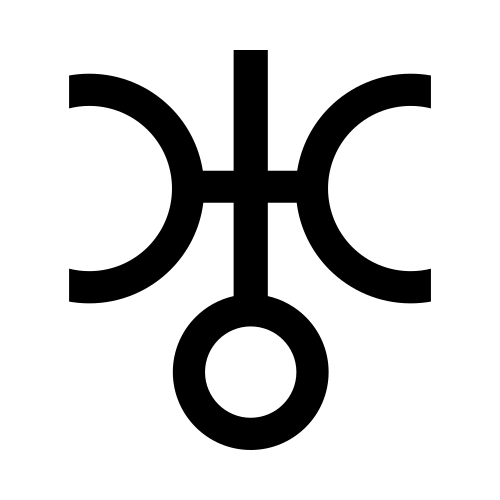 Uranus
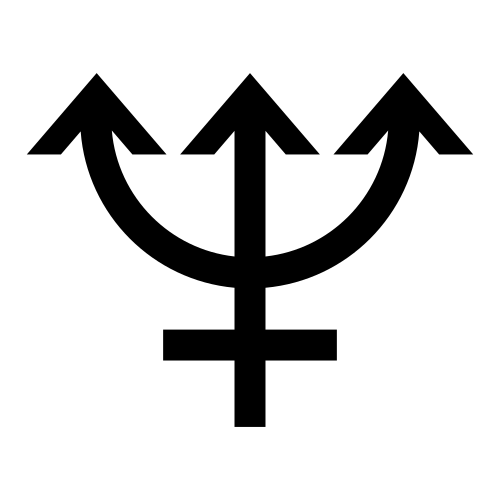 Neptune
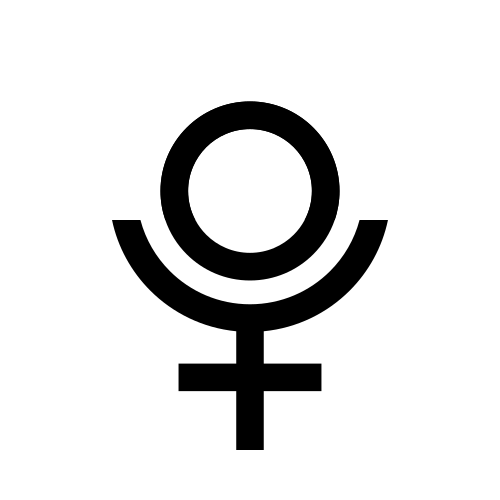 Pluto
Pluto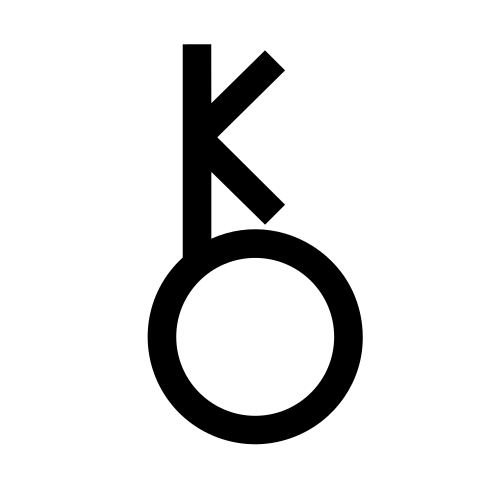 Chiron
Astronomical context
Pluto crossed Cancer from 1914 to 1939. In astrological tradition this transit is linked to the transformation of home, family, nation, and the sense of belonging — the generation whose lives were marked by the World Wars and a profound redefinition of the nation and the home.
Albert Camus (born 1913) belongs to this generational configuration. Astrian groups profiles by such shared signatures rather than by any claim of shared destiny. Related profiles in Astrian: Jean-Paul Sartre · Simone de Beauvoir · Friedrich Nietzsche. The symbolic reading is correlative, not causal.
Other profiles from this Pluto in Cancer generation
Symbolic reading
The following describes what classical astrological tradition associates with these configurations. Astrian does not apply these descriptions to the person's biography.
The Sun in Scorpio centres the chart on intensity, depth, and the will to transform. With the Ascendant in Virgo, tradition adds analysis, craft, and the refinement of method as the threshold through which that energy meets the world; the Sun marks the central drive, the Ascendant the manner of approach.
Among the personal planets, the Moon in Aquarius is associated in tradition with independence, abstraction, and the collective; Mercury in Sagittarius with expansion, conviction, and the horizon; Venus in Libra with balance, relationship, and proportion; and Mars in Cancer with attachment, memory, and protection. These placements describe registers of feeling, thought, attraction, and action as the tradition catalogues them, independent of the life that follows.
Sun sextile Jupiter (0°14'): tradition reads identity and central purpose in supportive contact with expansion and meaning.
Venus square Mars (1°14'): tradition reads values, attraction, and harmony in friction with drive, assertion, and action.
Moon trine Pluto (2°25'): tradition reads emotional life and instinct in easy flow with depth, power, and transformation.
Mercury sextile Uranus (2°53'): tradition reads thought and communication in supportive contact with disruption and innovation.
These placements are presented as a symbolic portrait, correlative and never causal — a description within the tradition's vocabulary, not an explanation of the life that follows.
Astrology is a symbolic language with 2,500 years of literature. The reading above is interpretive, not explanatory.
Astrian does not claim that the natal chart of Albert Camus caused or determined any of the above. Astrology is a symbolic system with 2,500 years of literature. Its capacity for retrospective description does not imply explanatory capacity.
A parallel life
The following are verified biographical facts. No connection to the natal chart is implied.
Albert Camus was born on 7 November 1913 in Mondovi (now Dréan), in eastern Algeria, then part of French Algeria. His father, Lucien Camus, an agricultural worker of French-Alsatian descent, was killed in the First Battle of the Marne in 1914, when Camus was less than a year old. His mother, Catherine Sintes, of Spanish descent, was partially deaf. The family lived in poverty in Algiers, where Camus grew up in the working-class Belcourt neighborhood.
Camus showed academic promise and, with the support of a primary school teacher, Jean Grenier, who became a lasting intellectual influence, gained access to secondary education. He studied philosophy at the University of Algiers, completing his thesis in 1936, though tuberculosis, which he contracted in his youth, prevented him from taking the agregation examination.
He worked as a journalist in Algiers, and was a founding member of the Theatre du Travail, for which he wrote, directed, and acted. He joined the French Communist Party briefly in the mid-1930s and later left. He moved to France in 1940 and worked for the Paris-Soir newspaper.
During the German occupation of France, Camus wrote for the underground Resistance publication Combat, eventually becoming its editor. His novel The Stranger (L'Etranger), published in 1942, presented a protagonist who experiences the world with emotional detachment and faces the absurdity of existence. In the same year, his philosophical essay The Myth of Sisyphus examined the concept of the absurd: the conflict between the human desire for meaning and the world's silence in response, arguing that the appropriate response was not despair or evasion but revolt and continued engagement with life.
The Plague (1947), a novel set in an Algerian city during an epidemic, explored collective responses to suffering and death and was widely read as carrying allegorical significance related to the Occupation. The Rebel (1951) examined the ethics and history of political revolt.
Camus received the Nobel Prize in Literature in 1957. He died on 4 January 1960 in a road accident near Sens, France, at the age of 46. A manuscript of an unfinished novel, The First Man, was found in the wreckage of the car and was published posthumously in 1994.
Biographical sources
- Todd, O. (1997). Albert Camus: A Life. Alfred A. Knopf..
- Camus, A. (1942). The Myth of Sisyphus. Gallimard (French original)..
- Camus, A. (1942). The Stranger. Gallimard (French original)..
- Nobel Pri.
This profile presents the sky at the birth of Albert Camus and verified facts of their biography. Astrian does not claim that astrology has predictive capacity or that the natal chart determines the trajectory of a life. Astrology is a symbolic system with 2,500 years of literature. Its capacity for retrospective description does not imply explanatory capacity.
Calculate your own birth chart with the same NASA JPL DE441 precision.
Calculate my birth chartLast updated: June 14, 2026
Newsletter
A short reading once a month, in your inbox.
A note on the symbolism of the season, recent editorial pieces, and what to look for in next month's sky. No predictions.
Support this project
Independent, no venture funding, no ads. A contribution keeps Astrian precise and free.
Support on Ko-fi (opens in new tab)