PROFILE · SCIENCE & TECHNOLOGY
Jean-Paul Sartre
Jean-Paul Charles Aymard Sartre
philosopher and writer
Born 21 June 1905 · 18:36 · 12:32 UTC · Paris, France · 48.86° N, 2.35° EAA
Source: Astro-Databank (Rodden Rating AA)
The sky at birth
With a documented birth time, the full chart can be cast. The Ascendant falls at 11°55' Sagittarius and the Midheaven at 9°02' Libra, which fixes the angular framework and allows the planets to be placed in houses.
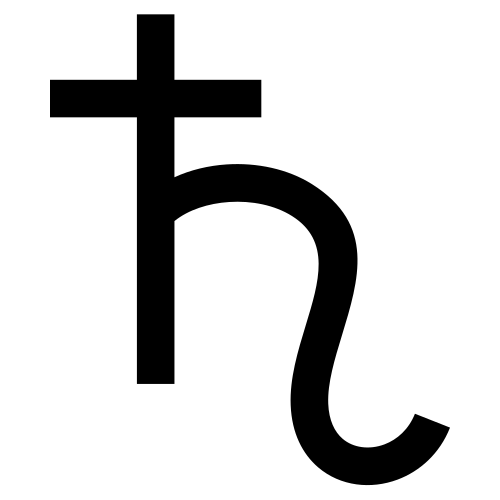
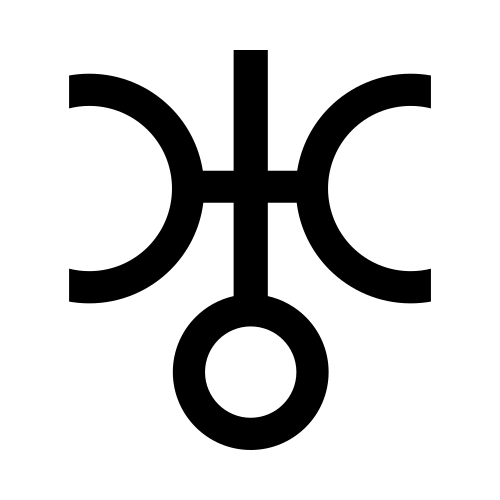
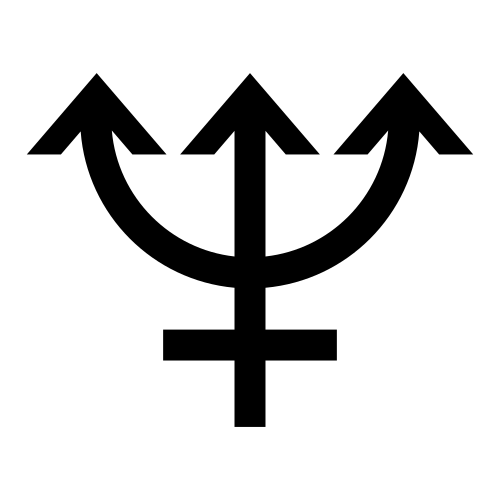
Sun is at 29°39' Gemini, house 7. Moon is at 25°36' Aquarius, house 2. Mercury is at 26°24' Gemini, house 7. Venus is at 14°57' Taurus, house 5. Mars is at 8°27' Scorpio, house 11. Jupiter is at 24°15' Taurus, house 5. Saturn is at 2°50' Pisces, house 3, retrograde. Uranus is at 2°21' Capricorn, house 1, retrograde. Neptune is at 7°33' Cancer, house 7. Pluto is at 21°24' Gemini, house 7.
3 bodies occupy Gemini (Sun, Mercury and Pluto) — a concentration that stands out as a structural feature of the chart.
The tightest major aspects between planets: Saturn sextile Uranus (0°29'); Moon trine Mercury (0°48'); Mars trine Neptune (0°53'); Moon square Jupiter (1°20'); Sun opposite Uranus (2°41'); Sun trine Saturn (3°11').
Uranus opposite Neptune (5°13') is structural but generational — an alignment of slow-moving outer planets shared across many birth years.
The engine also registers tight minor aspects involving asteroids and calculated points: Saturn quincunx Vesta (0°04'); Uranus square Vesta (0°25'); Neptune semi-sextile Juno (0°26'); Saturn opposite North Node (0°31'). These are reported for completeness and carry less weight in traditional reading.
The chart was calculated using NASA JPL DE441 ephemerides, sub-arcsecond precision.
| Planet | Sign | Position | House |
|---|---|---|---|
| Ascendant | Sagittarius | 11°55' | — |
| Midheaven | Libra | 09°02' | — |
| Sun | Gemini | 29°39' | H7 |
| Moon | Aquarius | 25°36' | H2 |
| Mercury | Gemini | 26°24' | H7 |
| Venus | Taurus | 14°57' | H5 |
| Mars | Scorpio | 08°27' | H11 |
| Jupiter | Taurus | 24°15' | H5 |
| Saturn | Pisces | 02°50'retrograde | H3 |
| Uranus | Capricorn | 02°21'retrograde | H1 |
| Neptune | Cancer | 07°33' | H7 |
| Pluto | Gemini | 21°24' | H7 |
| Chiron | Aquarius | 05°49'retrograde | H2 |
 Sun
Sun Moon
Moon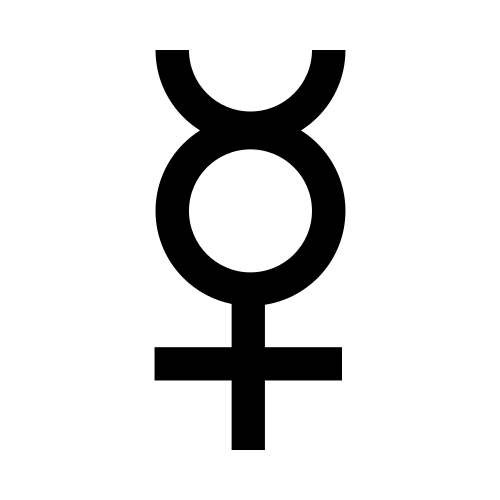 Mercury
 Venus
Venus Mars
Mars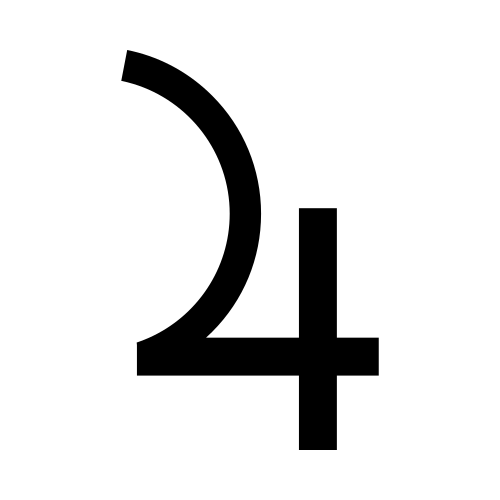 Jupiter
 Saturn
 Uranus
 Neptune
 Pluto
Pluto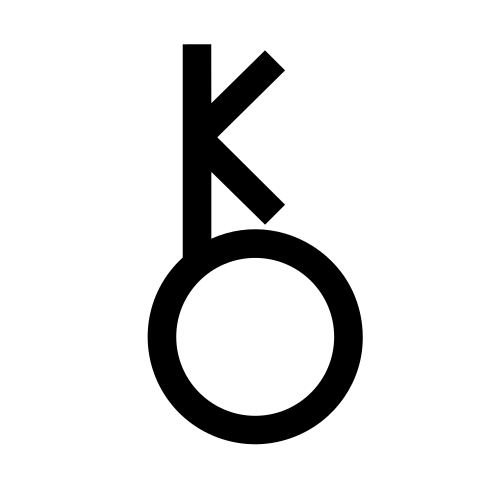 Chiron
Astronomical context
Pluto travelled through Gemini from the mid-1880s to 1914. In astrological tradition this transit is associated with the transformation of communication, ideas, transport, and the press — the generation that came of age amid the spread of mass media, the telephone, and accelerating mobility.
Jean-Paul Sartre (born 1905) belongs to this generational configuration. Astrian groups profiles by such shared signatures rather than by any claim of shared destiny. Related profiles in Astrian: Simone de Beauvoir · Albert Camus · Michel Foucault. The symbolic reading is correlative, not causal.
Other profiles from this Pluto in Gemini generation
Symbolic reading
The following describes what classical astrological tradition associates with these configurations. Astrian does not apply these descriptions to the person's biography.
The Sun in Gemini centres the chart on curiosity, exchange, and versatility. With the Ascendant in Sagittarius, tradition adds expansion, conviction, and the horizon as the threshold through which that energy meets the world; the Sun marks the central drive, the Ascendant the manner of approach.
Among the personal planets, the Moon in Aquarius is associated in tradition with independence, abstraction, and the collective; Mercury in Gemini with curiosity, exchange, and versatility; Venus in Taurus with stability, persistence, and the tangible; and Mars in Scorpio with intensity, depth, and the will to transform. These placements describe registers of feeling, thought, attraction, and action as the tradition catalogues them, independent of the life that follows.
Saturn sextile Uranus (0°29'): tradition reads structure, limitation, and discipline in supportive contact with disruption and innovation.
Moon trine Mercury (0°48'): tradition reads emotional life and instinct in easy flow with thought and communication.
Mars trine Neptune (0°53'): tradition reads drive, assertion, and action in easy flow with dissolution, imagination, and idealism.
Moon square Jupiter (1°20'): tradition reads emotional life and instinct in friction with expansion and meaning.
These placements are presented as a symbolic portrait, correlative and never causal — a description within the tradition's vocabulary, not an explanation of the life that follows.
Astrology is a symbolic language with 2,500 years of literature. The reading above is interpretive, not explanatory.
Astrian does not claim that the natal chart of Jean-Paul Sartre caused or determined any of the above. Astrology is a symbolic system with 2,500 years of literature. Its capacity for retrospective description does not imply explanatory capacity.
A parallel life
The following are verified biographical facts. No connection to the natal chart is implied.
Jean-Paul Charles Aymard Sartre was born on 21 June 1905 in Paris, France. His father, a naval officer, died when Sartre was fifteen months old, and he was raised largely by his mother and maternal grandfather, Charles Schweitzer, a language teacher and uncle of Albert Schweitzer. Sartre showed strong literary inclinations from childhood.
He studied at the Ecole Normale Superieure in Paris, where he first encountered Simone de Beauvoir, beginning a lifelong intellectual and personal relationship. He passed the agregation examination in philosophy in 1929, ranking first. He subsequently spent a year in Berlin, where he studied the phenomenology of Edmund Husserl and Martin Heidegger, work that would significantly shape his philosophical development.
Sartre's early philosophical writing included The Imagination (1936), Sketch for a Theory of the Emotions (1939), and The Imaginary (1940). His novel Nausea (1938) was his first major literary work, exploring themes of contingency and the absurdity of existence through the diary of a protagonist confronting the sheer fact of being.
Being and Nothingness (1943), written partly while Sartre was a prisoner of war in Germany and completed after his release, is his principal philosophical work. Drawing on phenomenological methods, it argued that human consciousness is characterized by radical freedom and that existence precedes essence, meaning that human beings define themselves through their choices and actions rather than being determined by a prior nature.
After the liberation of France, Sartre became a major public intellectual, co-founding and editing the journal Les Temps Modernes with de Beauvoir and others. His plays, including No Exit (1944) and The Flies (1943), and his novel trilogy Roads to Freedom brought existentialist themes to wider audiences. His lecture Existentialism is a Humanism (1945) was widely distributed.
Sartre was awarded the Nobel Prize in Literature in 1964 but refused it, stating that he did not wish to be institutionalized and that a writer should refuse to be transformed into an institution. He continued to publish philosophical works, including the Critique of Dialectical Reason (1960).
He died on 15 April 1980 in Paris. His funeral drew an estimated fifty thousand people.
Biographical sources
- Cohen-Solal, A. (1987). Sartre: A Life. Pantheon Books..
- Sartre, J.-P. (1943). Being and Nothingness. Gallimard (French original)..
- Hayman, R. (1986). Sartre: A Biography. Simon and Schuster..
- Stanford Encyclopedia of Philosophy: Jean-Paul Sartre: https://plato.stanford.edu/entries/sartre/.
This profile presents the sky at the birth of Jean-Paul Sartre and verified facts of their biography. Astrian does not claim that astrology has predictive capacity or that the natal chart determines the trajectory of a life. Astrology is a symbolic system with 2,500 years of literature. Its capacity for retrospective description does not imply explanatory capacity.
Related profiles
Calculate your own birth chart with the same NASA JPL DE441 precision.
Calculate my birth chartLast updated: June 14, 2026
Newsletter
A short reading once a month, in your inbox.
A note on the symbolism of the season, recent editorial pieces, and what to look for in next month's sky. No predictions.
Support this project
Independent, no venture funding, no ads. A contribution keeps Astrian precise and free.
Support on Ko-fi (opens in new tab)