PROFILE · SCIENCE & TECHNOLOGY
Simone de Beauvoir
Simone Lucie Ernestine Marie Bertrand de Beauvoir
philosopher and writer
Born 9 January 1908 · 04:30 · 12:32 UTC · Paris, France · 48.86° N, 2.35° EAA
Source: Astro-Databank (Rodden Rating AA)
The sky at birth
With a documented birth time, the full chart can be cast. The Ascendant falls at 1°37' Sagittarius and the Midheaven at 24°22' Virgo, which fixes the angular framework and allows the planets to be placed in houses.
Sun is at 17°31' Capricorn, house 2. Moon is at 29°58' Pisces, house 4. Mercury is at 14°16' Capricorn, house 2. Venus is at 15°54' Aquarius, house 2. Mars is at 28°35' Pisces, house 4. Jupiter is at 11°13' Leo, house 8, retrograde. Saturn is at 22°26' Pisces, house 3. Uranus is at 13°05' Capricorn, house 2. Neptune is at 13°22' Cancer, house 8, retrograde. Pluto is at 23°20' Gemini, house 7, retrograde.
3 bodies occupy Capricorn (Sun, Mercury and Uranus) and 3 bodies occupy Pisces (Moon, Mars and Saturn) — a concentration that stands out as a structural feature of the chart.
The tightest major aspects between planets: Uranus opposite Neptune (0°17'); Mercury opposite Neptune (0°54'); Saturn square Pluto (0°55'); Mercury conjunct Uranus (1°11'); Moon conjunct Mars (1°23'); Sun conjunct Mercury (3°15').
Uranus opposite Neptune (0°17') is structural but generational — an alignment of slow-moving outer planets shared across many birth years.
The engine also registers tight minor aspects involving asteroids and calculated points: Uranus square Ceres (0°04'); Venus conjunct Chiron (0°09'); Mercury opposite North Node (0°14'); Neptune square Ceres (0°14'). These are reported for completeness and carry less weight in traditional reading.
The chart was calculated using NASA JPL DE441 ephemerides, sub-arcsecond precision.
| Planet | Sign | Position | House |
|---|---|---|---|
| Ascendant | Sagittarius | 01°37' | — |
| Midheaven | Virgo | 24°22' | — |
| Sun | Capricorn | 17°31' | H2 |
| Moon | Pisces | 29°58' | H4 |
| Mercury | Capricorn | 14°16' | H2 |
| Venus | Aquarius | 15°54' | H2 |
| Mars | Pisces | 28°35' | H4 |
| Jupiter | Leo | 11°13'retrograde | H8 |
| Saturn | Pisces | 22°26' | H3 |
| Uranus | Capricorn | 13°05' | H2 |
| Neptune | Cancer | 13°22'retrograde | H8 |
| Pluto | Gemini | 23°20'retrograde | H7 |
| Chiron | Aquarius | 16°03' | H3 |
 Sun
Sun Moon
Moon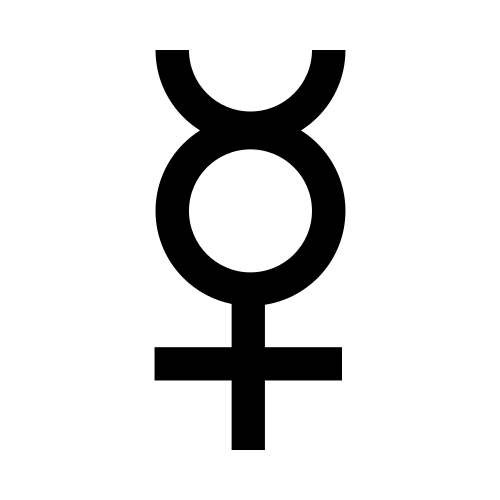 Mercury
 Venus
Venus Mars
Mars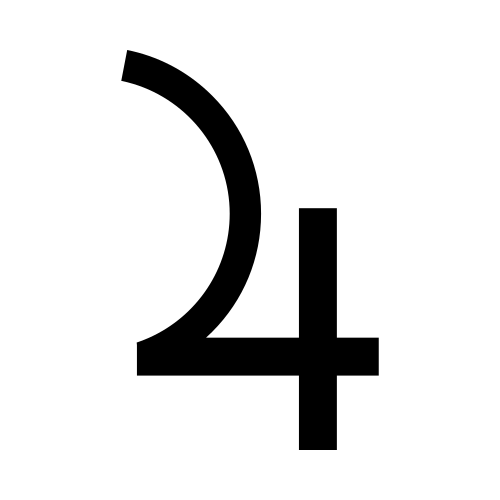 Jupiter
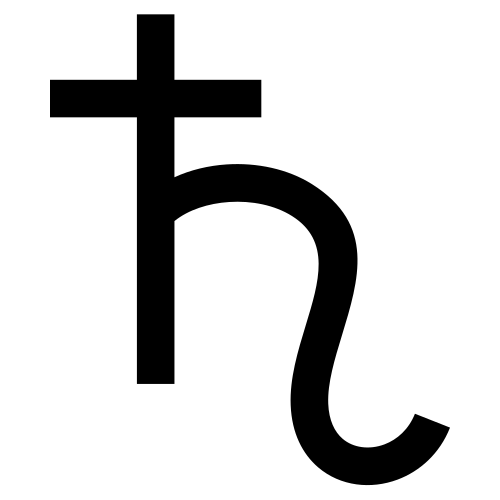 Saturn
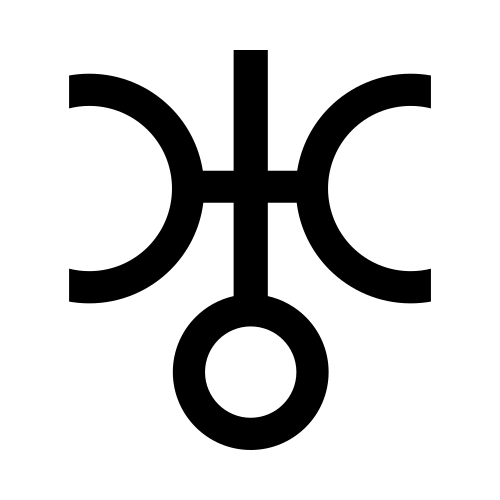 Uranus
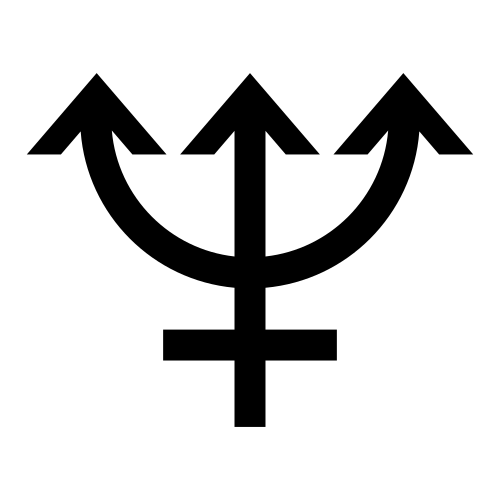 Neptune
 Pluto
Pluto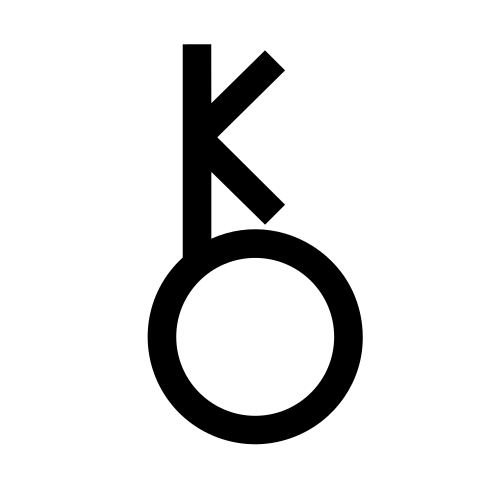 Chiron
Astronomical context
Pluto travelled through Gemini from the mid-1880s to 1914. In astrological tradition this transit is associated with the transformation of communication, ideas, transport, and the press — the generation that came of age amid the spread of mass media, the telephone, and accelerating mobility.
Simone de Beauvoir (born 1908) belongs to this generational configuration. Astrian groups profiles by such shared signatures rather than by any claim of shared destiny. Related profiles in Astrian: Jean-Paul Sartre · Albert Camus · Hannah Arendt. The symbolic reading is correlative, not causal.
Other profiles from this Pluto in Gemini generation
Symbolic reading
The following describes what classical astrological tradition associates with these configurations. Astrian does not apply these descriptions to the person's biography.
The Sun in Capricorn centres the chart on ambition, structure, and the long view. With the Ascendant in Sagittarius, tradition adds expansion, conviction, and the horizon as the threshold through which that energy meets the world; the Sun marks the central drive, the Ascendant the manner of approach.
Among the personal planets, the Moon in Pisces is associated in tradition with imagination, dissolution, and empathy; Mercury in Capricorn with ambition, structure, and the long view; Venus in Aquarius with independence, abstraction, and the collective; and Mars in Pisces with imagination, dissolution, and empathy. These placements describe registers of feeling, thought, attraction, and action as the tradition catalogues them, independent of the life that follows.
Uranus opposite Neptune (0°17'): tradition reads disruption and innovation set in polarity with dissolution, imagination, and idealism.
Mercury opposite Neptune (0°54'): tradition reads thought and communication set in polarity with dissolution, imagination, and idealism.
Saturn square Pluto (0°55'): tradition reads structure, limitation, and discipline in friction with depth, power, and transformation.
Mercury conjunct Uranus (1°11'): tradition reads thought and communication fused with disruption and innovation.
These placements are presented as a symbolic portrait, correlative and never causal — a description within the tradition's vocabulary, not an explanation of the life that follows.
Astrology is a symbolic language with 2,500 years of literature. The reading above is interpretive, not explanatory.
Astrian does not claim that the natal chart of Simone de Beauvoir caused or determined any of the above. Astrology is a symbolic system with 2,500 years of literature. Its capacity for retrospective description does not imply explanatory capacity.
A parallel life
The following are verified biographical facts. No connection to the natal chart is implied.
Simone de Beauvoir was born on 9 January 1908 in Paris, France, into a bourgeois family. Her father was a lawyer and she was raised in a Catholic household, though she later moved away from religious belief. She showed exceptional academic ability from an early age and studied mathematics and philosophy.
She studied philosophy at the Sorbonne and in 1929 passed the highly competitive agregation examination in philosophy, placing second nationally. Jean-Paul Sartre placed first. The two began a lifelong intellectual and personal relationship that became well documented in their correspondence and memoirs.
De Beauvoir taught philosophy at secondary schools in Marseille, Rouen, and Paris. Her first novel, She Came to Stay (1943), explored themes of consciousness, freedom, and the presence of others, drawing on existentialist ideas. Her philosophical essay The Ethics of Ambiguity (1947) addressed questions of freedom, responsibility, and moral commitment from an existentialist perspective.
The Second Sex, published in French in 1949, is her most widely discussed work. It offered an extensive analysis of the historical, biological, literary, and social treatment of women, arguing that women are defined not by nature but by the social and cultural situations imposed upon them. The book's opening claim that "one is not born, but rather becomes, a woman" became one of the most cited phrases in twentieth-century humanistic scholarship.
De Beauvoir also wrote influential autobiographical works, including Memoirs of a Dutiful Daughter (1958), The Prime of Life (1960), and All Said and Done (1972), as well as the essay The Coming of Age (1970), which examined the social treatment of old age. Her novel The Mandarins (1954) won the Prix Goncourt.
She was a long-term contributor to Les Temps Modernes, the journal founded by Sartre, and engaged in political debates throughout her life. She died on 14 April 1986 in Paris.
Biographical sources
- Bair, D. (1990). Simone de Beauvoir: A Biography. Summit Books..
- De Beauvoir, S. (1949). The Second Sex. Gallimard (French original)..
- Full, M. (2021). The Cambridge Companion to Simone de Beauvoir. Cambridge University Press..
- Stanford Encyclopedia of Philosophy: Simone de Beauvoir: https://plato.stanford.edu/entries/beauvoir/.
This profile presents the sky at the birth of Simone de Beauvoir and verified facts of their biography. Astrian does not claim that astrology has predictive capacity or that the natal chart determines the trajectory of a life. Astrology is a symbolic system with 2,500 years of literature. Its capacity for retrospective description does not imply explanatory capacity.
Related profiles
Calculate your own birth chart with the same NASA JPL DE441 precision.
Calculate my birth chartLast updated: June 14, 2026
Newsletter
A short reading once a month, in your inbox.
A note on the symbolism of the season, recent editorial pieces, and what to look for in next month's sky. No predictions.
Support this project
Independent, no venture funding, no ads. A contribution keeps Astrian precise and free.
Support on Ko-fi (opens in new tab)