PROFILE · ENTREPRENEURS

Bill Gates
William Henry Gates III
entrepreneur and philanthropist
Born 28 October 1955 · Seattle, Washington, United States · 47.61° N, 122.33° WX
Source: Birth time not documented in publicly accessible records
About this chart
No birth time is documented for this person. The chart therefore shows planetary positions in their signs, the slow aspects between them, and the generational context — but not house placements, the Ascendant, or the Midheaven, which require an accurate birth time. The Moon's sign carries a ±6° margin: if it falls near a sign boundary, the sign could vary. Positions for all other planets are reliable.
Do you have a verified source for this birth time? Share it →
The sky at birth
No birth time is documented for Bill Gates. The Ascendant, Midheaven, and house positions cannot be determined. The planetary positions below are calculated for noon local time and are accurate to within a fraction of a degree for the slow-moving planets. The Moon's position carries a margin of approximately ±7°.
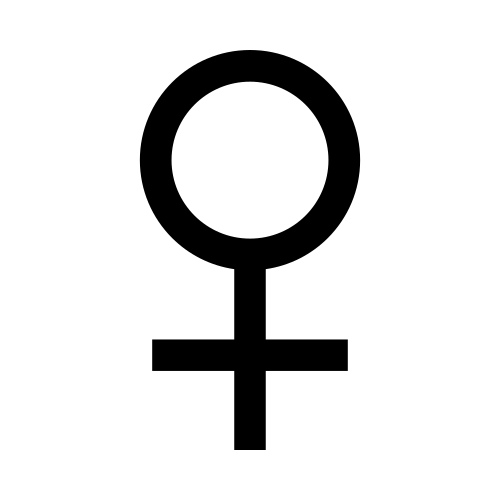
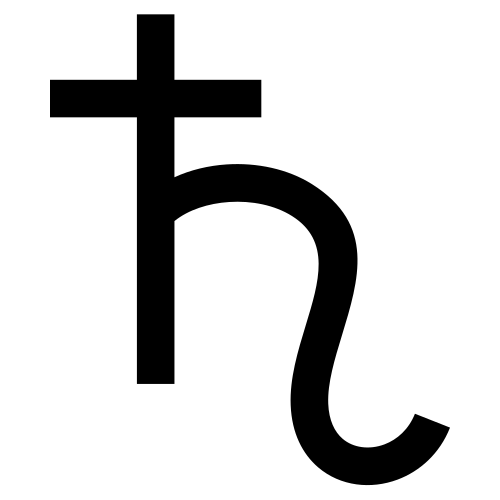
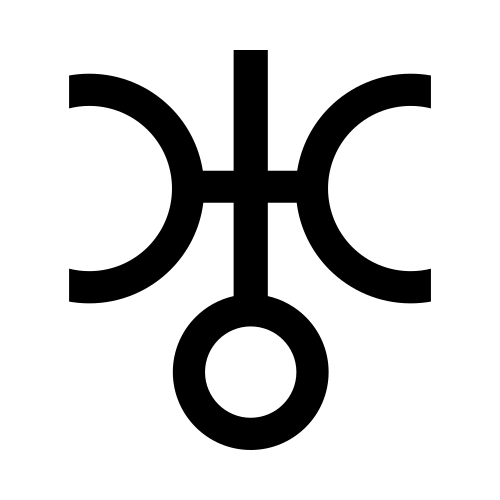
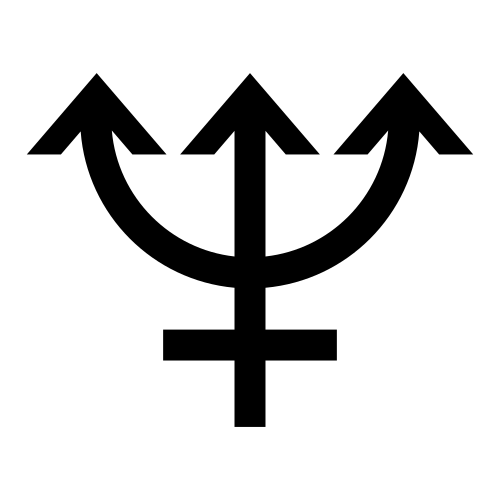
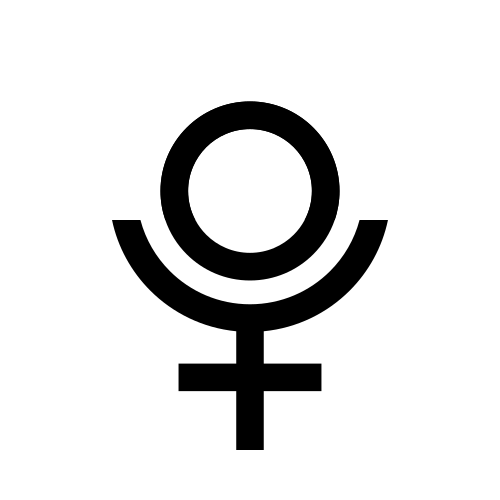
The Sun is at 4°37' Scorpio. The Moon is at 2°26' Aries (noon position, ±7° margin). Mercury is at 16°12' Libra. Venus is at 19°42' Scorpio. Mars is at 9°51' Libra. Jupiter is at 27°43' Leo. Saturn is at 21°32' Scorpio. Uranus is at 2°17' Leo. Neptune is at 28°13' Libra. Pluto is at 28°20' Leo.
Neptune at 28°13' Libra sextiles Pluto at 28°20' Leo (0°07') — functionally exact and the tightest aspect in the chart, though this is a generational configuration. The Moon at 2°26' Aries trines Uranus at 2°17' Leo (0°09') — the tightest personal aspect, also functionally exact, though it carries the Moon's ±7° uncertainty. Jupiter at 27°43' Leo sextiles Neptune at 28°13' Libra (0°30'). Jupiter at 27°43' Leo conjoins Pluto at 28°20' Leo (0°37'). Venus at 19°42' Scorpio conjoins Saturn at 21°32' Scorpio (1°50'). The Sun at 4°37' Scorpio squares Uranus at 2°17' Leo (2°20').
The engine also identifies the following tight minor aspects involving asteroids and calculated points: venus sextile ceres (0.06° app); sun semi-square northNode (0.13° sep); moon trine uranus (0.15° sep); jupiter trine pallas (0.15° app).
The tightest major aspects between planets: Neptune sextile Pluto (0°07'), Moon trine Uranus (0°09'), Jupiter sextile Neptune (0°30'), Jupiter conjunct Pluto (0°37'), Venus conjunct Saturn (1°50'), Sun square Uranus (2°20').
Note on the Moon's sign: The Moon at 2°26' Aries at noon is near the Pisces-Aries boundary. If born in the early hours of the day, the Moon could have been in late Pisces; if born later, securely in Aries. The Moon's sign placement is probable but not certain for the entire day.
The chart was calculated by Astrian's engine using NASA JPL DE441 ephemerides, sub-arcsecond precision. Timezone: America/Los_Angeles (Pacific Standard Time, UTC −8).
| Planet | Sign | Position |
|---|---|---|
| Sun | Scorpio | 04°37' |
| Moon | Aries | 02°26'±6° |
| Mercury | Libra | 16°12' |
| Venus | Scorpio | 19°42' |
| Mars | Libra | 09°51' |
| Jupiter | Leo | 27°43' |
| Saturn | Scorpio | 21°32' |
| Uranus | Leo | 02°17' |
| Neptune | Libra | 28°13' |
| Pluto | Leo | 28°20' |
| Chiron | Aquarius | 00°19' |
 Sun
Sun Moon
Moon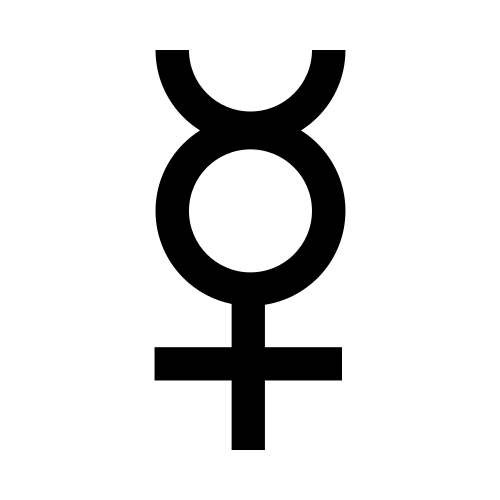 Mercury
 Venus
Venus Mars
Mars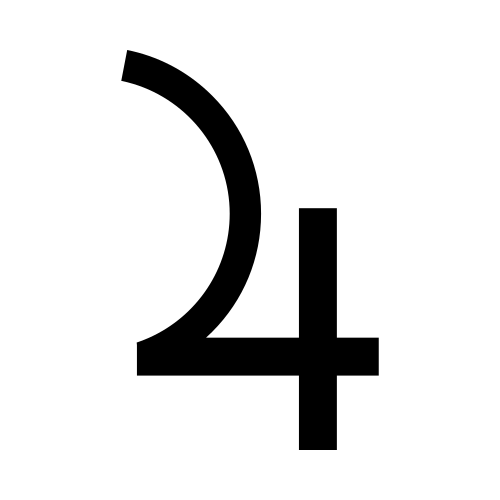 Jupiter
 Saturn
 Uranus
 Neptune
 Pluto
Pluto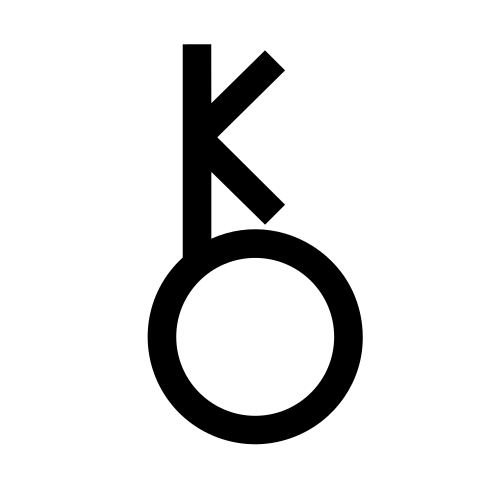 Chiron
Birth time unknown — house positions and Ascendant/MC are not available.
Astronomical context
Those born between approximately 1939 and 1957 carried Pluto in Leo. This generation arrived during or immediately after the Second World War and came of age as the structures of postwar prosperity — mass consumption, suburban expansion, television, the nuclear family as economic unit — reached their fullest expression. They inherited the world the war had broken and rebuilt it according to new scales of ambition, consumption, and individual visibility.
In astrological tradition, Pluto in Leo is associated with collective transformation of the domains that sign governs: individual identity, creative authority, self-expression, performance, and the display of power. Leo is the sign of the singular figure, of the one who stands at the centre of the stage and demands to be seen. Pluto's transit through Leo coincided with the emergence of television, the cult of celebrity, the cold-war nuclear standoff that placed individual leaders at the centre of existential risk, and the first generation of mass consumer culture that measured worth by visibility and accumulation. The symbolic reading is correlative, not causal.
Other profiles in the Astrian collection born under this configuration include John Lennon (1940) and David Bowie (1947). Bill Gates, born in 1955, belongs to the final years of this generational wave.
Other profiles from this Pluto in Leo generation
Symbolic reading
The following describes what classical astrological tradition associates with these configurations. Astrian does not apply these descriptions to the person's biography.
The Sun at 4°37' Scorpio is the most prominent structural feature of this chart. Without a documented birth time, there is no Ascendant or Midheaven — the reading is confined to planetary positions by sign and the aspects between planets.
The Moon at 2°26' Aries represents the noon position; the actual placement falls within approximately 7° on either side. If born early in the day, the Moon could have been in late Pisces; if born later, securely in early Aries. Mercury at 16°12' Libra, Venus at 19°42' Scorpio, and Mars at 9°51' Libra complete the personal planet picture. Sun and Venus in Scorpio, Mercury and Mars in Libra — a configuration that concentrates the personal energies between signs of strategic depth (Scorpio) and relational calculation (Libra).
### Venus conjunct Saturn: desire bound to structure
Venus at 19°42' Scorpio conjoins Saturn at 21°32' Scorpio, orb 1°50'. Venus governs value, desire, and the aesthetic sense — what one finds worth pursuing. Saturn governs structure, discipline, limitation, and the long-term framework within which things are built. Their conjunction in Scorpio fuses these faculties: the capacity to desire (Venus) is inseparable from the capacity to structure (Saturn), and both operate through the register of Scorpio — concentrated, strategic, concerned with what is beneath the surface.
In the tradition, Venus-Saturn conjunctions are read as configurations where pleasure is deferred, where value is measured not by immediacy but by durability, and where the aesthetic sense tends toward the functional rather than the decorative. In Scorpio, this conjunction adds a layer of depth: the structures built are not visible from the outside but operate at the level of the system itself — the architecture that other people use without seeing who designed it.
### Jupiter conjunct Pluto: expansion meets transformative power
Jupiter at 27°43' Leo conjoins Pluto at 28°20' Leo, orb 0°37' — functionally exact. Jupiter governs expansion, generosity, and the instinct toward the large gesture. Pluto governs transformation, concentrated power, and the forces that operate beneath visibility. Their conjunction in Leo — the sign of individual authority and creative display — reads as a configuration where the expansive faculty is fused with the transformative one. The result is not modest expansion but expansion at a scale that changes the landscape itself.
Jupiter also sextiles Neptune at 28°13' Libra (0°30'), creating a Jupiter-Neptune-Pluto network: expansion (Jupiter) cooperates with vision and dissolution of limits (Neptune) and is fused with transformative power (Pluto). This triple configuration operates across Leo and Libra — the individual and the relational, the display and the negotiation.
### Sun square Uranus: identity against disruption
The Sun at 4°37' Scorpio squares Uranus at 2°17' Leo, orb 2°20'. The Sun governs identity, will, and the central organizing principle of the personality. Uranus governs disruption, innovation, and the introduction of what has never existed before. The square creates structural tension: the identity (Sun in Scorpio — strategic, deep, concerned with control) exists in friction with the disruptive faculty (Uranus in Leo — the impulse to revolutionize through individual vision).
Sun-Uranus squares in the tradition are read as configurations of restless innovation — where the self cannot settle into the conventional but is driven to break and rebuild the structures it inhabits. The Scorpio-Leo axis adds intensity: this is not gentle innovation but a drive to dominate through disruption.
### Moon trine Uranus: emotional intelligence meets the unconventional
The Moon at 2°26' Aries trines Uranus at 2°17' Leo, orb 0°09' — the tightest personal aspect in the chart, though it carries the Moon's ±7° uncertainty. If the actual birth time places the Moon near its noon position, the emotional faculty (Moon in Aries — immediate, instinctive, competitive) flows cooperatively with the disruptive faculty (Uranus in Leo — visionary, unconventional, insistent on the new). The trine is harmonious: the feelings and the innovative impulse work at the same speed, both oriented toward action.
The planetary pattern here is read as a symbolic portrait, not a causal explanation. No planet caused, predicted, or determined any event or characteristic.
Astrology is a symbolic language with 2,500 years of literature. The reading above is interpretive, not explanatory.
Astrian does not claim that the natal chart of Bill Gates caused or determined any of the above. Astrology is a symbolic system with 2,500 years of literature. Its capacity for retrospective description does not imply explanatory capacity.
A parallel life
The following are verified biographical facts. No connection to the natal chart is implied.
William Henry Gates III was born on 28 October 1955 in Seattle, Washington, the second of three children and only son of William H. Gates II, a prominent attorney, and Mary Maxwell Gates, a schoolteacher who later served on the boards of First Interstate BancSystem and the United Way. The family was upper-middle-class and connected: his maternal grandfather had been a national bank president.
At thirteen, Gates enrolled at Lakeside School, an exclusive preparatory school in Seattle. Lakeside had recently installed a Teletype terminal connected to a General Electric time-sharing computer — an almost unprecedented investment for a secondary school in 1968. Gates and his classmate Paul Allen became consumed by programming. They exhausted their allotted computer time within weeks, found bugs in the system's accounting software to obtain more, and were eventually banned and then invited back to find further bugs in exchange for unlimited access. By the time he was fifteen, Gates and Allen had written a traffic-counting program for the city of Seattle and earned $20,000 from it.
He enrolled at Harvard in 1973. In January 1975, Allen showed him the cover of Popular Electronics featuring the MITS Altair 8800, the first commercially available microcomputer. Gates called MITS and claimed he and Allen had written a BASIC interpreter for the machine. They had not; they wrote it over the following weeks, and it worked on the first demonstration. They founded Microsoft — originally Micro-Soft — in Albuquerque, New Mexico, in April 1975. Gates was nineteen.
The decisive moment came in 1980, when IBM approached Microsoft about an operating system for its forthcoming personal computer. Microsoft did not have one. Gates purchased QDOS (Quick and Dirty Operating System) from a Seattle programmer named Tim Paterson for $50,000, adapted it, and licensed it to IBM as MS-DOS — crucially, as a license rather than a sale, retaining the right to license it to other manufacturers. When the IBM PC became the industry standard and dozens of manufacturers produced compatible clones, every one of them needed MS-DOS. The licensing structure Gates had negotiated — non-exclusive, royalty-per-copy — meant that Microsoft collected a payment on virtually every personal computer sold in the world.
Windows, released in 1985 and iterating through increasingly dominant versions, extended this control from the operating system to the graphical interface. By the mid-1990s, Microsoft's share of the desktop operating system market exceeded 90 percent. The company's market capitalization made Gates the richest person in the world in 1995 — a position he held, with brief interruptions, for more than two decades.
The US Department of Justice filed antitrust proceedings against Microsoft in 1998, alleging that the company had used its operating system monopoly to crush competitors, particularly in the browser market by bundling Internet Explorer with Windows. In 2001, a federal court found that Microsoft had maintained its monopoly by anticompetitive means. The case was settled with a consent decree rather than a breakup.
Gates stepped down as CEO in 2000, handing the position to Steve Ballmer. He and his then-wife Melinda French Gates had established the Bill & Melinda Gates Foundation in 2000, merging their earlier philanthropic vehicles. The foundation's endowment grew to exceed fifty billion dollars, making it the largest private charitable foundation in history. Its focus areas — global health (particularly malaria, polio, and HIV/AIDS), agricultural development in sub-Saharan Africa, and educational reform in the United States — reflected a systems-level approach to philanthropy: identify the variables with the highest leverage, fund interventions at scale, measure results quantitatively.
Warren Buffett pledged the bulk of his fortune to the Gates Foundation in 2006 — the largest charitable gift in history at that time — effectively doubling the foundation's resources. The alliance between Gates and Buffett, and their joint Giving Pledge initiative encouraging billionaires to commit the majority of their wealth to philanthropy, became the defining partnership of early twenty-first-century institutional philanthropy.
Gates and Melinda French Gates divorced in 2021 after twenty-seven years of marriage. The divorce was accompanied by reporting on Gates's relationship with the convicted sex offender Jeffrey Epstein — meetings Gates acknowledged and described as a mistake. Melinda French Gates resigned from the foundation in 2024.
As of 2026, Gates remains one of the wealthiest people in the world, actively involved in climate-technology investment through Breakthrough Energy Ventures, in pandemic preparedness advocacy, and in the continued operations of the Gates Foundation.
Biographical sources
- Wallace, James, and Jim Erickson. Hard Drive: Bill Gates and the Making of the Microsoft Empire. Wiley 1992
- Isaacson, Walter. The Innovators: How a Group of Hackers, Geniuses, and Geeks Created the Digital Revolution. Simon & Schuster 2014
- Gates, Bill. The Road Ahead. Viking 1995
This profile presents the sky at the birth of Bill Gates and verified facts of their biography. Astrian does not claim that astrology has predictive capacity or that the natal chart determines the trajectory of a life. Astrology is a symbolic system with 2,500 years of literature. Its capacity for retrospective description does not imply explanatory capacity.
Related profiles
Calculate your own birth chart with the same NASA JPL DE441 precision.
Calculate my birth chartLast updated: June 12, 2026
Newsletter
A short reading once a month, in your inbox.
A note on the symbolism of the season, recent editorial pieces, and what to look for in next month's sky. No predictions.
Support this project
Independent, no venture funding, no ads. A contribution keeps Astrian precise and free.
Support on Ko-fi (opens in new tab)