PROFILE · MUSIC
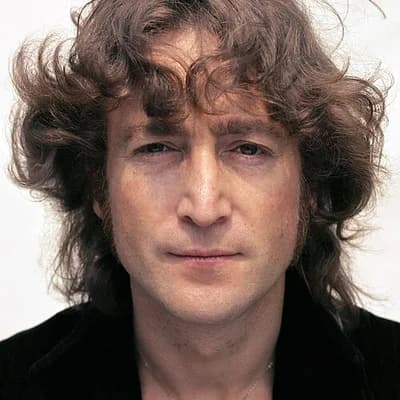
John Lennon
John Winston Ono Lennon
musician
Born 9 October 1940 · Liverpool, United Kingdom · 53.41° N, 2.99° WX
Source: Birth time not documented in publicly accessible records
About this chart
No birth time is documented for this person. The chart therefore shows planetary positions in their signs, the slow aspects between them, and the generational context — but not house placements, the Ascendant, or the Midheaven, which require an accurate birth time. The Moon's sign carries a ±6° margin: if it falls near a sign boundary, the sign could vary. Positions for all other planets are reliable.
Do you have a verified source for this birth time? Share it →
The sky at birth
No birth time is documented for John Lennon. The Ascendant, Midheaven, and house positions cannot be determined. The planetary positions below are calculated for noon local time and are accurate to within a fraction of a degree for the slow-moving planets. The Moon's position carries a margin of approximately ±7°.
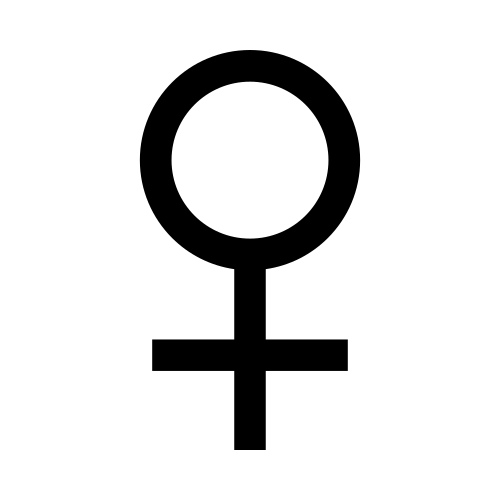
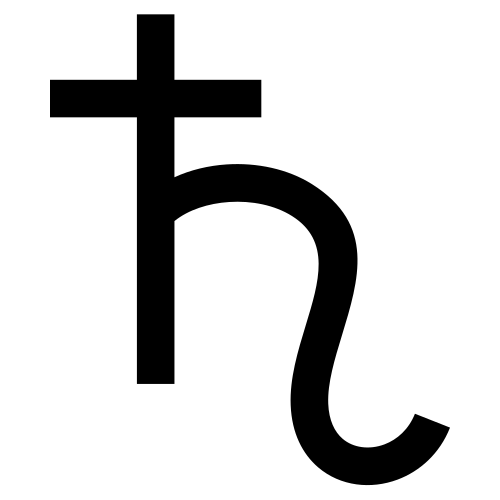
The Sun is at 16°00' Libra. The Moon is at 0°08' Aquarius (noon position, ±7° margin). Mercury is at 8°11' Scorpio. Venus is at 2°54' Virgo. Mars is at 2°29' Libra. Jupiter is at 13°43' Taurus R. Saturn is at 13°14' Taurus R. Uranus is at 25°33' Taurus R. Neptune is at 26°01' Virgo. Pluto is at 4°11' Leo.
Three planets occupy Taurus: Jupiter at 13°43' retrograde, Saturn at 13°14' retrograde, and Uranus at 25°33' retrograde. The Jupiter-Saturn conjunction at 0°29' separation is the chart's defining structural feature — the two largest planets in the solar system within half a degree of each other. The Sun at 16°00' Libra forms a quincunx to Jupiter at 13°43' Taurus (2°17') and a quincunx to Saturn at 13°14' Taurus (2°46'). Mars at 2°29' Libra sextiles Pluto at 4°11' Leo (1°42'). Mercury at 8°11' Scorpio squares Pluto at 4°11' Leo (4°00'). Uranus at 25°33' Taurus trines Neptune at 26°01' Virgo (0°28').
The tightest major aspects between planets: Uranus trine Neptune (0°28'), Jupiter conjunction Saturn (0°29'), Mars sextile Pluto (1°42'), Sun quincunx Jupiter (2°17'), Sun quincunx Saturn (2°46'), Mercury square Pluto (4°00').
The engine also identifies the following tight minor aspects involving asteroids and calculated points: sun sextile juno (0.03° sep); uranus sesquiquadrate northNode (0.04° sep); saturn semi-sextile lilith (0.12° sep); jupiter quincunx pallas (0.26° sep).
The chart was calculated by Astrian's engine using NASA JPL DE441 ephemerides, sub-arcsecond precision. Timezone: British Summer Time (Europe/London, UTC +1).
| Planet | Sign | Position |
|---|---|---|
| Sun | Libra | 16°00' |
| Moon | Aquarius | 00°08'±6° |
| Mercury | Scorpio | 08°11' |
| Venus | Virgo | 02°54' |
| Mars | Libra | 02°29' |
| Jupiter | Taurus | 13°43'retrograde |
| Saturn | Taurus | 13°14'retrograde |
| Uranus | Taurus | 25°33'retrograde |
| Neptune | Virgo | 26°01' |
| Pluto | Leo | 04°11' |
| Chiron | Leo | 00°33' |
 Sun
Sun Moon
Moon Mercury
 Venus
Venus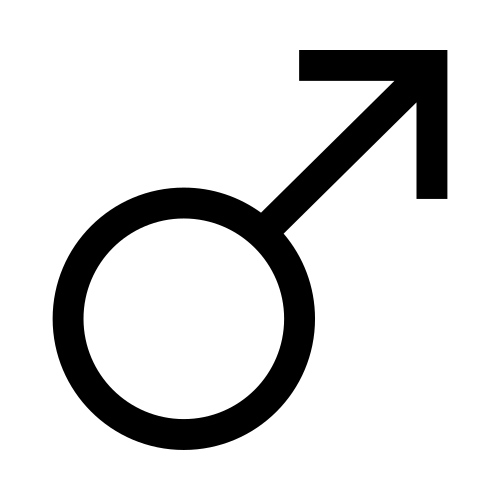 Mars
Mars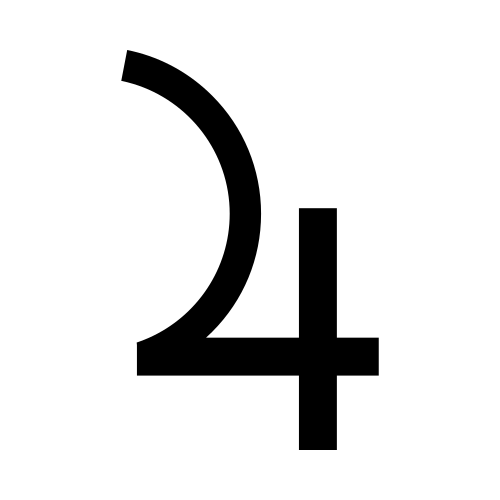 Jupiter
 Saturn
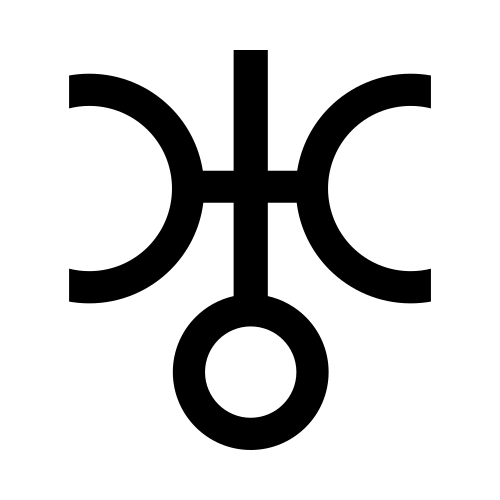 Uranus
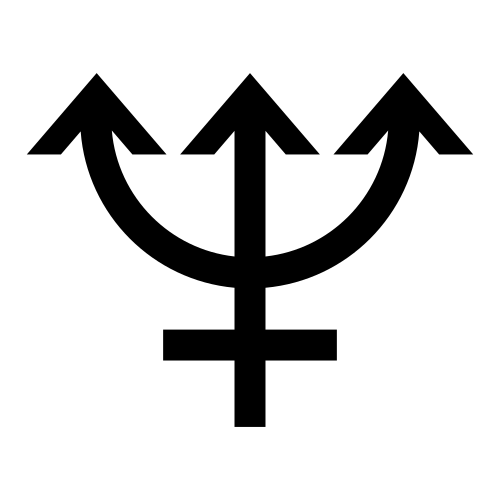 Neptune
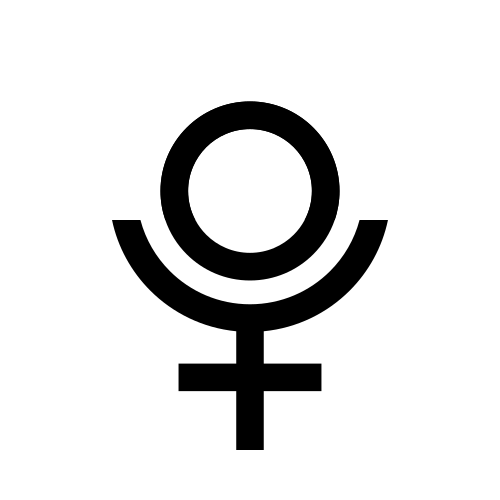 Pluto
Pluto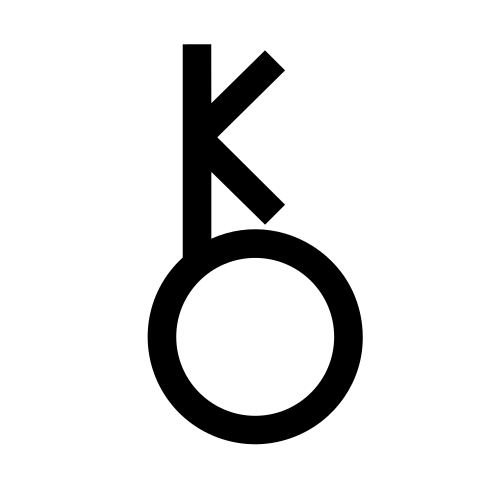 Chiron
Birth time unknown — house positions and Ascendant/MC are not available.
Astronomical context
Those born between approximately 1939 and 1957 carried Pluto in Leo. This generation witnessed the post-war reconstruction of the global order and the rise of mass culture, consumer capitalism, the nuclear age, and the first era of television.
In astrological tradition, Pluto in Leo is associated with collective transformation of the domains that sign governs: creative self-expression, performance, the cult of personality, the relationship between the individual and the audience, and the structures of fame. Leo is the sign of the stage, the heart, and the creative act. Pluto's transit through Leo is read, symbolically, as a generational mandate to transform the nature of personal expression and its relationship to power. The symbolic reading is correlative, not causal.
Others in the Astrian collection born under this configuration include David Bowie (1947), Bob Marley (1945), Freddie Mercury (1946), Steve Jobs (1955), and Stephen Hawking (1942). Lennon, born in 1940, belongs to the earliest years of this generational wave.
Other profiles from this Pluto in Leo generation
Symbolic reading
The following describes what classical astrological tradition associates with these configurations. Astrian does not apply these descriptions to the person's biography.
The Sun at 16°00' Libra is the most prominent structural feature of this chart. Without a documented birth time, there is no Ascendant or Midheaven — the reading is confined to planetary positions by sign and the aspects between planets.
The Moon at 0°08' Aquarius represents the noon position; the actual placement falls within approximately 7° on either side. If born early in the day, the Moon could be in the mid-twenties of Capricorn; if born late, in the mid-single digits of Aquarius. The Moon's sign placement is uncertain — it may be in late Capricorn or early Aquarius depending on birth time.
Mercury at 8°11' Scorpio, Venus at 2°54' Virgo, and Mars at 2°29' Libra complete the personal planet picture.
### Jupiter conjunction Saturn in Taurus
The chart's defining structural feature is the conjunction of Jupiter at 13°43' Taurus retrograde and Saturn at 13°14' Taurus retrograde — a separation of 0°29'. This is the tightest major aspect in the chart between classical planets.
Jupiter-Saturn conjunctions occur approximately every twenty years and have been tracked by astrologers since Babylonian times. They were traditionally called "Great Conjunctions" and used to mark generational shifts. The conjunction of 1940 fell in Taurus, an earth sign governing material resources, the body, aesthetic value, and the relationship to the physical world.
Jupiter represents expansion, abundance, vision, and the amplification of what it touches. Saturn represents structure, limitation, discipline, and the endurance of form. Their conjunction fuses these contrasting principles within a single degree — the impulse to expand and the demand for structure operating not in opposition but in synthesis. In Taurus, this synthesis is grounded, material, and oriented toward enduring form. Both planets are retrograde, which the tradition reads as an inward or reflective quality in their operation.
### The Sun's double quincunx to Jupiter and Saturn
The Sun at 16°00' Libra forms a quincunx to Jupiter at 13°43' Taurus (2°17') and a quincunx to Saturn at 13°14' Taurus (2°46'). The quincunx connects signs that share nothing in common — no element, no modality, no traditional affinity. It creates a relationship of persistent adjustment, a tension that does not resolve into harmony or open conflict but remains perpetually unresolved.
The Sun's double quincunx to the Jupiter-Saturn conjunction means that the central identity stands in a relationship of continuous adjustment with the chart's most powerful structural feature. The self does not merge with the Jupiter-Saturn synthesis, nor does it oppose it directly. It operates at an oblique angle — connected but never fully integrated.
### Mars sextile Pluto
Mars at 2°29' Libra sextiles Pluto at 4°11' Leo, orb 1°42'. Mars governs action, assertion, and the application of will. Pluto governs transformation, power, and the encounter with what lies beneath surfaces. The sextile is a productive, cooperative aspect — it connects action with transformative intensity in a relationship of flow rather than friction. In an air-fire axis (Libra and Leo), this alignment operates with directness and social energy.
### Mercury square Pluto
Mercury at 8°11' Scorpio squares Pluto at 4°11' Leo, orb 4°00'. Mercury governs communication, thought, and the articulation of experience. Pluto governs transformation and depth. The square creates friction between the communicative faculty and the transformative depths — a configuration the tradition reads as one where thought and speech carry unusual intensity and are drawn toward what is hidden, uncomfortable, or psychologically charged. Mercury in Scorpio already operates in the register of the penetrating and the unspoken; its square to Pluto amplifies this quality.
### Three planets in Taurus
Jupiter, Saturn, and Uranus all occupy Taurus, spanning from 13°14' to 25°33' — a range of just over 12°. While Uranus is too distant from Jupiter and Saturn to form a conjunction with them, the three-body concentration in Taurus gives the sign unusual weight in the chart. Taurus governs the senses, material value, aesthetic pleasure, the body, and the relationship to the physical world. In the tradition, a concentration of outer planets in Taurus directs generational energy toward the transformation and restructuring of material and aesthetic foundations.
Uranus at 25°33' Taurus retrograde trines Neptune at 26°01' Virgo, orb 0°28'. This is the tightest aspect in the chart by orb, though it is generational — the Uranus-Neptune trine persisted throughout the early 1940s. Uranus governs originality and disruption; Neptune governs the ideal and the dissolution of boundaries. Their trine connects the revolutionary impulse with the visionary capacity in a harmonious earth-sign axis (Taurus and Virgo) that operates through material and practical channels rather than abstraction.
The planetary pattern here is read as a symbolic portrait, not a causal explanation. No planet caused, predicted, or determined any event or characteristic.
Astrology is a symbolic language with 2,500 years of literature. The reading above is interpretive, not explanatory.
Astrian does not claim that the natal chart of John Lennon caused or determined any of the above. Astrology is a symbolic system with 2,500 years of literature. Its capacity for retrospective description does not imply explanatory capacity.
A parallel life
The following are verified biographical facts. No connection to the natal chart is implied.
John Winston Lennon was born on 9 October 1940 at the Oxford Street Maternity Hospital in Liverpool, England, during a German bombing raid on the city. His father, Alfred "Freddie" Lennon, was a merchant seaman who was frequently absent and eventually disappeared from his son's life. His mother, Julia Stanley Lennon, was unable to provide stable care, and from the age of five John was raised by his maternal aunt, Mary "Mimi" Smith, and her husband George in their semi-detached house at 251 Menlove Avenue, Woolton. Julia remained a presence in his adolescence, teaching him to play the banjo and introducing him to rock and roll records. She was killed by a car driven by an off-duty police officer on 15 July 1958, when John was seventeen.
He attended Quarry Bank High School, where he was a persistent troublemaker but showed aptitude for art and writing. He enrolled at the Liverpool College of Art in September 1957. Earlier that year, on 6 July 1957, he had formed The Quarrymen, a skiffle group, and performed at the Woolton Parish Church garden fete, where he met Paul McCartney. McCartney joined the group within weeks. George Harrison joined in early 1958. Stuart Sutcliffe played bass briefly before his death in 1962. Pete Best drummed until August 1962, when Ringo Starr replaced him.
By 1960 the group had become The Beatles. They served an apprenticeship in Hamburg's club circuit — the Indra, the Kaiserkeller, the Star-Club — playing eight-hour sets that honed their performance and repertoire. Brian Epstein became their manager in January 1962. George Martin signed them to Parlophone, and their first single, "Love Me Do," was released in October 1962.
Between 1963 and 1970, The Beatles released thirteen studio albums and transformed the landscape of popular music, fashion, film, and cultural politics. Please Please Me (1963) and A Hard Day's Night (1964) established them as a commercial and creative force. Rubber Soul (1965), Revolver (1966), Sgt. Pepper's Lonely Hearts Club Band (1967), The Beatles (the White Album, 1968), and Abbey Road (1969) progressively expanded the formal possibilities of the pop album. Their global record sales exceed 600 million units.
Lennon and McCartney's songwriting partnership, credited as Lennon-McCartney, produced the majority of the group's original material. Lennon's contributions — "Strawberry Fields Forever," "A Day in the Life," "Across the Universe," "Come Together," "In My Life" — are characterized by introspective lyrics, harmonic adventurousness, and a willingness to absorb influences from avant-garde art, literature, and non-Western music.
He married Cynthia Powell in August 1962; their son Julian was born in April 1963. The marriage ended in divorce in November 1968. He began his relationship with Yoko Ono in 1966 and married her on 20 March 1969 in Gibraltar. Their public collaborations — the Bed-Ins for Peace in Amsterdam and Montreal, the "War Is Over! (If You Want It)" billboard campaign — made them internationally recognized figures in the peace movement.
The Beatles disbanded acrimoniously in 1970. Lennon released John Lennon/Plastic Ono Band (1970), a raw, confessional album influenced by primal therapy, and Imagine (1971), whose title track became one of the most widely known songs of the twentieth century. He released several further albums through 1975, then withdrew from public life to raise his son Sean Taro Ono Lennon, born on 9 October 1975 — Lennon's thirty-fifth birthday.
He returned to recording with Double Fantasy (1980), a collaboration with Ono released in November 1980. Three weeks later, on the evening of 8 December 1980, he was shot and killed by Mark David Chapman outside the entrance to the Dakota, his apartment building on Central Park West in New York City. He was forty years old.
He was posthumously inducted into the Rock and Roll Hall of Fame as a solo artist in 1994 (The Beatles had been inducted in 1988). The song "Imagine" was designated one of the 100 most important musical works of the twentieth century by the Recording Industry Association of America.
Biographical sources
- Norman, Philip. John Lennon: The Life. Ecco 2008
- Coleman, Ray. Lennon: The Definitive Biography. McGraw-Hill 1984
This profile presents the sky at the birth of John Lennon and verified facts of their biography. Astrian does not claim that astrology has predictive capacity or that the natal chart determines the trajectory of a life. Astrology is a symbolic system with 2,500 years of literature. Its capacity for retrospective description does not imply explanatory capacity.
Related profiles
Calculate your own birth chart with the same NASA JPL DE441 precision.
Calculate my birth chartLast updated: June 12, 2026
Newsletter
A short reading once a month, in your inbox.
A note on the symbolism of the season, recent editorial pieces, and what to look for in next month's sky. No predictions.
Support this project
Independent, no venture funding, no ads. A contribution keeps Astrian precise and free.
Support on Ko-fi (opens in new tab)