PROFILE · MUSIC
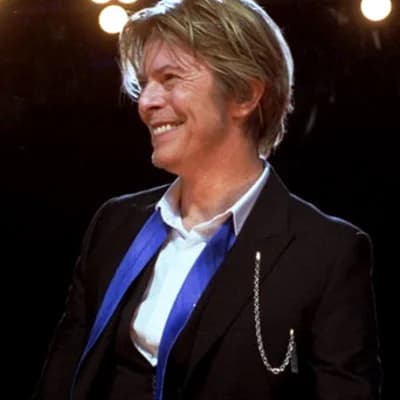
David Bowie
David Robert Jones
musician
Born 8 January 1947 · Brixton, London, United Kingdom · 51.46° N, 0.12° WX
Source: Birth time not documented in publicly accessible records
About this chart
No birth time is documented for this person. The chart therefore shows planetary positions in their signs, the slow aspects between them, and the generational context — but not house placements, the Ascendant, or the Midheaven, which require an accurate birth time. The Moon's sign carries a ±6° margin: if it falls near a sign boundary, the sign could vary. Positions for all other planets are reliable.
Do you have a verified source for this birth time? Share it →
The sky at birth
No birth time is documented for David Bowie. The Ascendant, Midheaven, and house positions cannot be determined. The planetary positions below are calculated for noon local time and are accurate to within a fraction of a degree for the slow-moving planets. The Moon's position carries a margin of approximately ±7°.
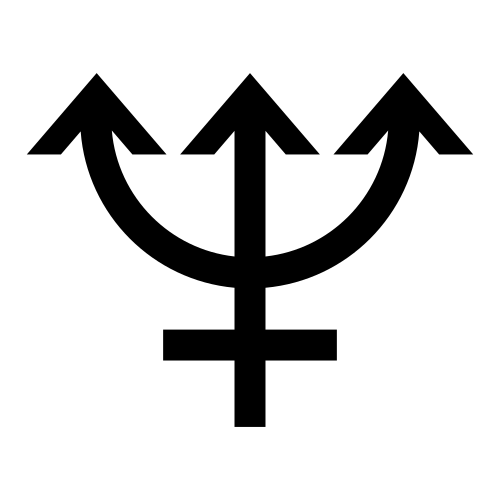
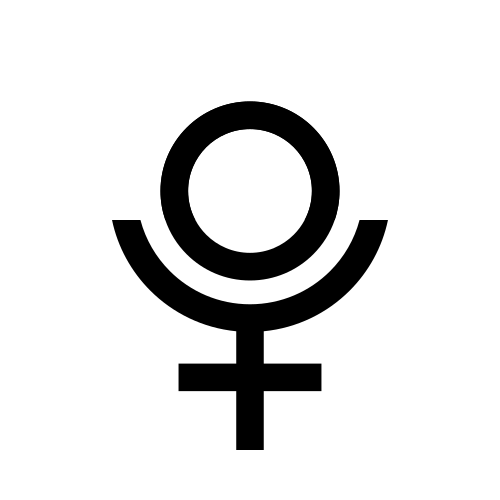
The Sun is at 17°22' Capricorn. The Moon is at 5°42' Leo (noon position, ±7° margin). Mercury is at 8°23' Capricorn. Venus is at 2°15' Sagittarius. Mars is at 16°49' Capricorn. Jupiter is at 21°38' Scorpio. Saturn is at 6°51' Leo R. Uranus is at 18°40' Gemini R. Neptune is at 10°48' Libra. Pluto is at 12°44' Leo R.
The chart's most prominent structural feature is the Sun-Mars conjunction in Capricorn: the Sun at 17°22' and Mars at 16°49', separated by 0°33'. Both the Sun and Mars form quincunxes to Uranus at 18°40' Gemini retrograde — the Sun-Uranus quincunx at 1°18', the Mars-Uranus quincunx at 1°51'. Mercury at 8°23' Capricorn forms a quincunx to Saturn at 6°51' Leo retrograde (1°32') and a square to Neptune at 10°48' Libra (2°25').
The tightest major aspects between planets: Sun conjunction Mars (0°33'), Sun quincunx Uranus (1°18'), Mercury quincunx Saturn (1°32'), Mars quincunx Uranus (1°51'), Neptune sextile Pluto (1°56'), Mercury square Neptune (2°25'), Saturn sextile Neptune (3°57').
The engine also identifies the following tight minor aspects involving asteroids and calculated points: saturn square chiron (0.01° sep); sun semi-square venus (0.12° sep); venus sextile pallas (0.12° app); pluto sesquiquadrate lilith (0.16° app).
The chart was calculated by Astrian's engine using NASA JPL DE441 ephemerides, sub-arcsecond precision. Timezone: Greenwich Mean Time (Europe/London, UTC +0).
| Planet | Sign | Position |
|---|---|---|
| Sun | Capricorn | 17°22' |
| Moon | Leo | 05°42'±6° |
| Mercury | Capricorn | 08°23' |
| Venus | Sagittarius | 02°15' |
| Mars | Capricorn | 16°49' |
| Jupiter | Scorpio | 21°38' |
| Saturn | Leo | 06°51'retrograde |
| Uranus | Gemini | 18°40'retrograde |
| Neptune | Libra | 10°48' |
| Pluto | Leo | 12°44'retrograde |
| Chiron | Scorpio | 06°51' |
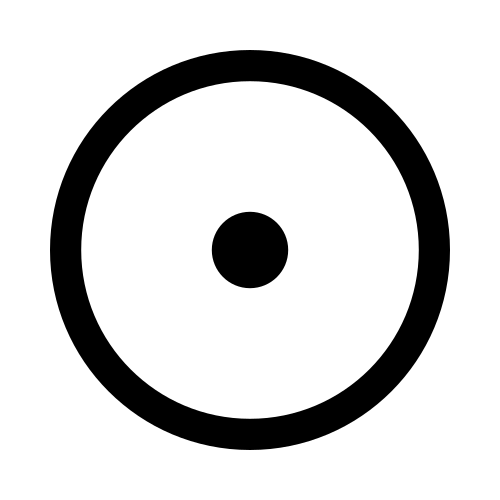 Sun
Sun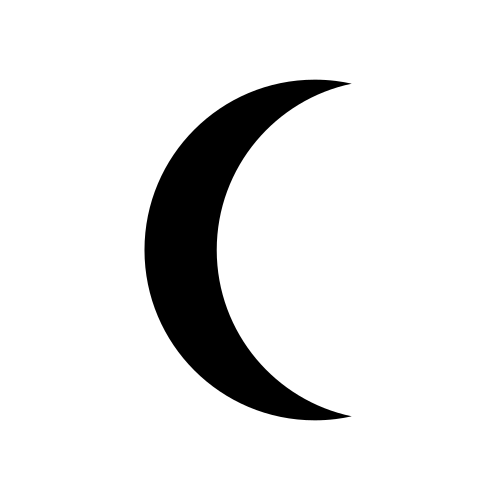 Moon
Moon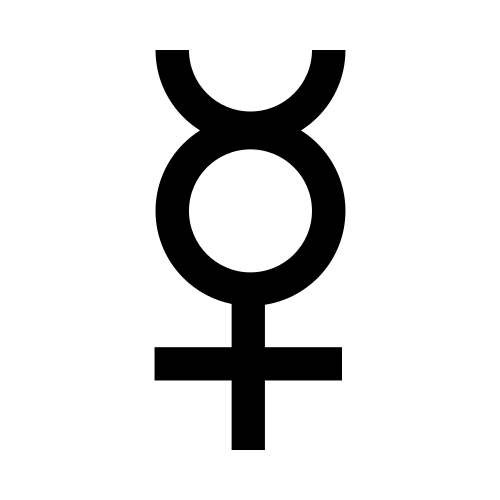 Mercury
 Venus
Venus Mars
Mars Jupiter
 Saturn
 Uranus
 Neptune
 Pluto
Pluto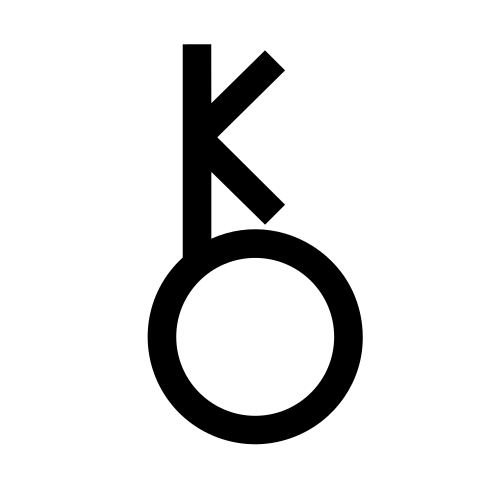 Chiron
Birth time unknown — house positions and Ascendant/MC are not available.
Astronomical context
Those born between approximately 1939 and 1957 carried Pluto in Leo. This generation witnessed the post-war reconstruction of the global order and the rise of mass culture, consumer capitalism, the nuclear age, and the first era of television.
In astrological tradition, Pluto in Leo is associated with collective transformation of the domains that sign governs: creative self-expression, performance, the cult of personality, the relationship between the individual and the audience, and the structures of fame. Leo is the sign of the stage, the heart, and the creative act. Pluto's transit through Leo is read, symbolically, as a generational mandate to transform the nature of personal expression and its relationship to power. The symbolic reading is correlative, not causal.
Others in the Astrian collection born under this configuration include John Lennon (1940), Bob Marley (1945), Freddie Mercury (1946), Steve Jobs (1955), and Stephen Hawking (1942). Bowie, born in 1947, belongs to the middle years of this generational wave.
Other profiles from this Pluto in Leo generation
Symbolic reading
The following describes what classical astrological tradition associates with these configurations. Astrian does not apply these descriptions to the person's biography.
The Sun at 17°22' Capricorn is the most prominent structural feature of this chart. Without a documented birth time, there is no Ascendant or Midheaven — the reading is confined to planetary positions by sign and the aspects between planets.
The Moon at 5°42' Leo represents the noon position; the actual placement falls within approximately 7° on either side. If born early in the day, the Moon could be near the end of Cancer; if born late, in the low teens of Leo. The Moon's sign placement is uncertain — it may be in late Cancer or Leo depending on birth time.
Mercury at 8°23' Capricorn, Venus at 2°15' Sagittarius, and Mars at 16°49' Capricorn complete the personal planet picture.
### Sun conjunction Mars in Capricorn
The chart's defining structural feature is the conjunction of the Sun at 17°22' Capricorn and Mars at 16°49' Capricorn — a separation of 0°33'. This is the tightest major aspect in the chart.
The Sun represents central identity and vitality. Mars represents action, assertion, drive, and the physical application of will. Their conjunction fuses identity with action — the self is experienced not as a static condition but as something that is continuously enacted. In Capricorn, a sign governing structure, ambition, endurance, and the architecture of worldly position, this fusion operates with strategic discipline. The Sun-Mars conjunction in Capricorn directs identity and drive toward the building of durable structures in the material world.
### The double quincunx to Uranus
Both the Sun and Mars form quincunxes to Uranus at 18°40' Gemini retrograde: the Sun at 1°18' orb, Mars at 1°51' orb. Uranus governs disruption, originality, radical novelty, and the breaking of established form. The quincunx connects signs that share nothing in common — it creates a relationship of persistent adjustment, an itch that cannot be scratched.
The Sun-Mars conjunction in Capricorn — disciplined, strategic, oriented toward enduring structure — stands in a permanent state of tension with Uranus in Gemini — mercurial, restless, drawn to the new and the multiple. The identity is structured and driven (Capricorn) but simultaneously agitated by an impulse toward constant reinvention (Uranus) that operates at an oblique angle to the core self. Neither force resolves the other. They coexist in a state of productive discomfort.
### Mercury quincunx Saturn
Mercury at 8°23' Capricorn forms a quincunx to Saturn at 6°51' Leo retrograde, orb 1°32'. Mercury governs communication, thought, and the articulation of experience. Saturn governs structure, discipline, and the weight of tradition. The quincunx creates a relationship of ongoing adjustment between the communicative faculty and the demand for formal structure — a configuration where expression must continuously negotiate with constraints that are neither harmonious nor openly hostile.
### Mercury square Neptune
Mercury at 8°23' Capricorn squares Neptune at 10°48' Libra, orb 2°25'. Mercury governs articulation and concrete thought; Neptune governs the ideal, the imaginary, and the dissolution of fixed categories. The square creates friction between precise communication and the visionary impulse — a tension the tradition reads as one where the mind is drawn toward the ideal but must work against structural resistance to articulate it. The combination of Mercury's quincunx to Saturn and square to Neptune places the communicative faculty under pressure from both structure and vision simultaneously.
### The Capricorn concentration
Three planets occupy Capricorn: Mercury at 8°23', Mars at 16°49', and the Sun at 17°22'. This concentration directs a significant proportion of the chart's energy toward the Capricornian domains of structure, ambition, and worldly architecture. The Sun-Mars conjunction anchors the concentration at its most intense point; Mercury extends the Capricorn emphasis to the communicative register.
The planetary pattern here is read as a symbolic portrait, not a causal explanation. No planet caused, predicted, or determined any event or characteristic.
Astrology is a symbolic language with 2,500 years of literature. The reading above is interpretive, not explanatory.
Astrian does not claim that the natal chart of David Bowie caused or determined any of the above. Astrology is a symbolic system with 2,500 years of literature. Its capacity for retrospective description does not imply explanatory capacity.
A parallel life
The following are verified biographical facts. No connection to the natal chart is implied.
David Robert Jones was born on 8 January 1947 at 40 Stansfield Road, Brixton, in south London, the son of Haywood Stenton "John" Jones, a promotions officer for the children's charity Barnardo's, and Margaret Mary "Peggy" Burns, a cinema usherette. His father was from Doncaster, Yorkshire; his mother was from the Shornells estate in southeast London. He had an older half-brother, Terry Burns, who was later diagnosed with schizophrenia and committed to Cane Hill psychiatric hospital — a figure who haunted Bowie's work and who took his own life in 1985.
The family moved to Bromley, Kent, in 1953. He attended Burnt Ash Junior School and then Bromley Technical High School, where his art teacher, Owen Frampton (father of Peter Frampton), encouraged his interest in design and music. At fifteen, a fight with his friend George Underwood over a girl left his left pupil permanently dilated after the sphincter muscles were damaged — giving him the appearance of heterochromatic eyes, one blue, one appearing dark, that became an iconic feature of his image.
He formed his first band, the Konrads, in 1962, and worked through a succession of groups — the King Bees, the Manish Boys, the Lower Third, the Buzz — before releasing a solo single, "The Laughing Gnome" (1967), that went nowhere. He adopted the stage name David Bowie in 1965 to avoid confusion with Davy Jones of The Monkees. His first album, David Bowie (1967), was a commercial failure. His second, Space Oddity (1969), produced a hit in its title track, timed to coincide with the Apollo 11 moon landing.
His transformation began with The Man Who Sold the World (1970) and Hunky Dory (1971), but it was The Rise and Fall of Ziggy Stardust and the Spiders from Mars (June 1972) that made him. The album and its accompanying stage persona — a fictional bisexual alien rock star — established Bowie as the central figure of glam rock and introduced the concept of the artist as a series of characters rather than a fixed personality. He "retired" Ziggy Stardust on stage at the Hammersmith Odeon on 3 July 1973.
What followed was a sequence of reinventions without precedent in popular music. Aladdin Sane (1973) pushed the glam template toward jazz and cabaret. Diamond Dogs (1974) drew on George Orwell's Nineteen Eighty-Four. Young Americans (1975) shifted to Philadelphia soul; the single "Fame," co-written with John Lennon, reached number one in the United States. Station to Station (1976) introduced the Thin White Duke persona, a cold, aristocratic figure influenced by Nietzsche and Aleister Crowley, created during a period of severe cocaine addiction in Los Angeles.
The "Berlin Trilogy" — Low (1977), "Heroes" (1977), and Lodger (1979) — produced in collaboration with Brian Eno and Tony Visconti, partly recorded at Hansa Studio near the Berlin Wall, represented his most radical artistic departure. The albums fused Krautrock, ambient electronics, and art-rock into a body of work that influenced post-punk, new wave, and electronic music for decades. The title track of "Heroes" became one of the defining songs of the Cold War era.
Scary Monsters (and Super Creeps) (1980) consolidated the Berlin innovations into a more accessible format. Let's Dance (1983), produced by Nile Rodgers, was his biggest commercial success — the album sold over 10 million copies worldwide, and the singles "Let's Dance," "China Girl," and "Modern Love" were global hits. The albums that followed through the 1980s and early 1990s — Tonight (1984), Never Let Me Down (1987), the Tin Machine project — were commercially successful but critically dismissed. He acknowledged this period as a creative low point.
The 1990s brought a partial artistic recovery: Outside (1995), produced with Brian Eno, explored industrial and drum-and-bass territory; Earthling (1997) engaged with jungle and electronica. After Heathen (2002) and Reality (2003), he disappeared from public life following a heart attack on stage in 2004.
Ten years of silence ended with The Next Day (2013), announced without warning on his sixty-sixth birthday. Blackstar, his final album, was released on 8 January 2016 — his sixty-ninth birthday. He died two days later, on 10 January 2016, in his apartment on Lafayette Street in New York City, from liver cancer. He had been diagnosed eighteen months earlier and had kept his illness private from all but his closest collaborators. The album, informed by his knowledge of his impending death, was received as one of the most remarkable final artistic statements in popular music.
He released twenty-seven studio albums across a career of nearly fifty years. His global record sales exceed 140 million units. He was inducted into the Rock and Roll Hall of Fame in 1996.
Biographical sources
- Buckley, David. Strange Fascination: David Bowie, The Definitive Story. Virgin Books 1999
- Morley, Paul. The Age of Bowie. Simon & Schuster 2016
This profile presents the sky at the birth of David Bowie and verified facts of their biography. Astrian does not claim that astrology has predictive capacity or that the natal chart determines the trajectory of a life. Astrology is a symbolic system with 2,500 years of literature. Its capacity for retrospective description does not imply explanatory capacity.
Related profiles
Calculate your own birth chart with the same NASA JPL DE441 precision.
Calculate my birth chartLast updated: May 21, 2026
Newsletter
A short reading once a month, in your inbox.
A note on the symbolism of the season, recent editorial pieces, and what to look for in next month's sky. No predictions.
Support this project
Independent, no venture funding, no ads. A contribution keeps Astrian precise and free.
Support on Ko-fi (opens in new tab)