PROFILE · SCIENCE & TECHNOLOGY
Michel Foucault
Paul-Michel Foucault
philosopher and historian
Born 15 October 1926 · 07:30 · 12:32 UTC · Poitiers, France · 46.58° N, 0.34° EAA
Source: Astro-Databank (Rodden Rating AA)
The sky at birth
With a documented birth time, the full chart can be cast. The Ascendant falls at 4°09' Scorpio and the Midheaven at 13°27' Leo, which fixes the angular framework and allows the planets to be placed in houses.
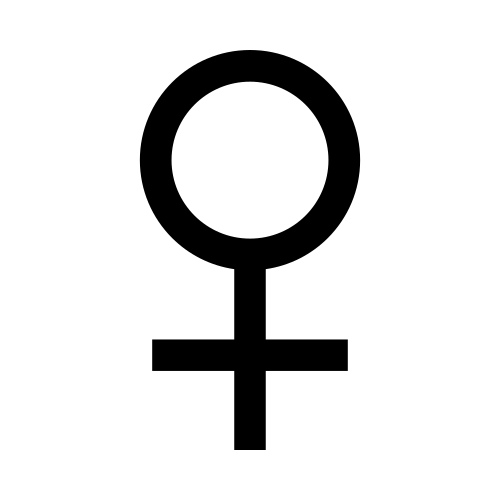
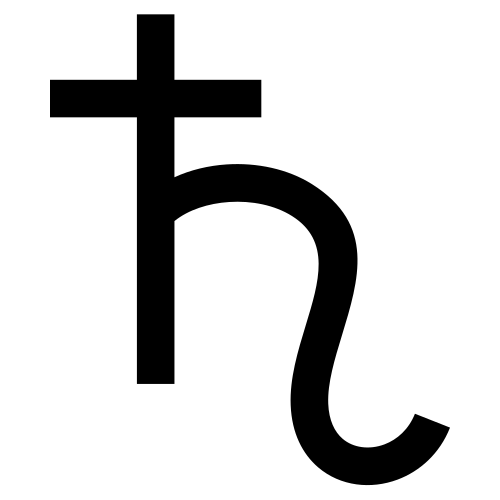
Sun is at 21°11' Libra, house 12. Moon is at 0°16' Aquarius, house 3. Mercury is at 8°07' Scorpio, house 1. Venus is at 11°46' Libra, house 11. Mars is at 17°32' Taurus, house 7, retrograde. Jupiter is at 17°18' Aquarius, house 4. Saturn is at 24°22' Scorpio, house 1. Uranus is at 26°31' Pisces, house 5, retrograde. Neptune is at 26°24' Leo, house 10. Pluto is at 15°56' Cancer, house 9.
The tightest major aspects between planets: Mars square Jupiter (0°14'); Mars sextile Pluto (1°36'); Saturn square Neptune (2°02'); Saturn trine Uranus (2°09'); Moon sextile Uranus (3°44'); Sun trine Jupiter (3°52').
The engine also registers tight minor aspects involving asteroids and calculated points: Moon square Chiron (0°02'); Mercury semi-square Vesta (0°16'); Neptune semi-square North Node (0°19'); Sun conjunct Ceres (0°40'). These are reported for completeness and carry less weight in traditional reading.
The chart was calculated using NASA JPL DE441 ephemerides, sub-arcsecond precision.
| Planet | Sign | Position | House |
|---|---|---|---|
| Ascendant | Scorpio | 04°09' | — |
| Midheaven | Leo | 13°27' | — |
| Sun | Libra | 21°11' | H12 |
| Moon | Aquarius | 00°16' | H3 |
| Mercury | Scorpio | 08°07' | H1 |
| Venus | Libra | 11°46' | H11 |
| Mars | Taurus | 17°32'retrograde | H7 |
| Jupiter | Aquarius | 17°18' | H4 |
| Saturn | Scorpio | 24°22' | H1 |
| Uranus | Pisces | 26°31'retrograde | H5 |
| Neptune | Leo | 26°24' | H10 |
| Pluto | Cancer | 15°56' | H9 |
| Chiron | Taurus | 00°14'retrograde | H6 |
 Sun
Sun Moon
Moon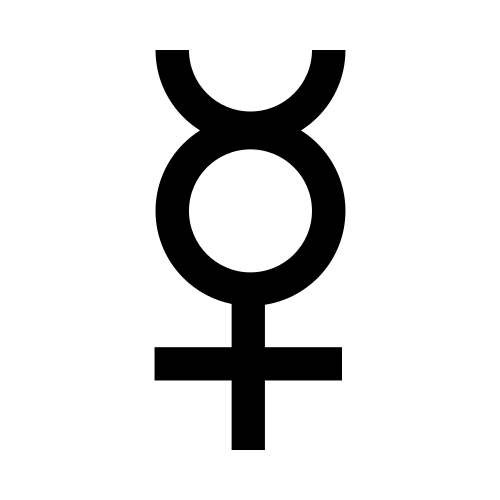 Mercury
 Venus
Venus Mars
Mars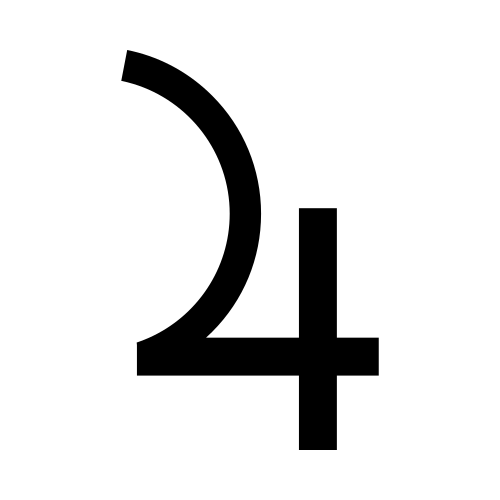 Jupiter
 Saturn
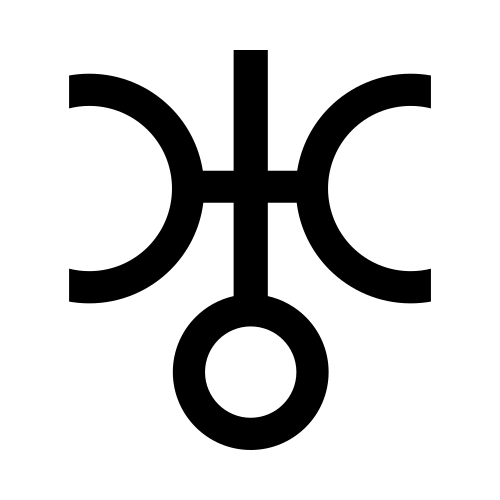 Uranus
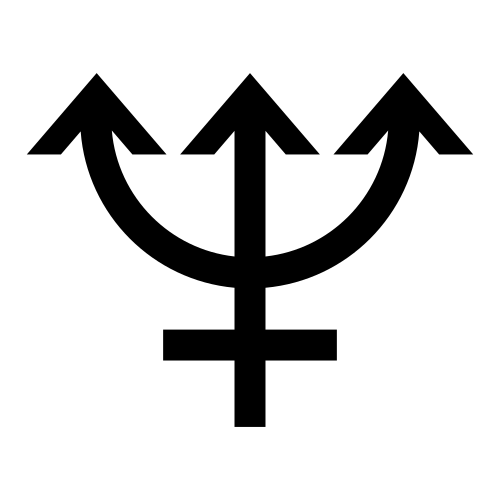 Neptune
 Pluto
Pluto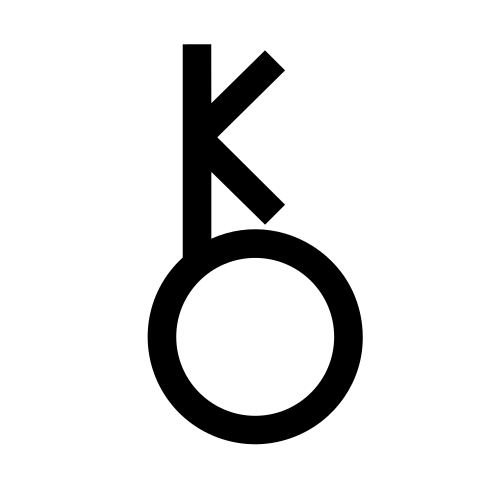 Chiron
Astronomical context
Pluto crossed Cancer from 1914 to 1939. In astrological tradition this transit is linked to the transformation of home, family, nation, and the sense of belonging — the generation whose lives were marked by the World Wars and a profound redefinition of the nation and the home.
Michel Foucault (born 1926) belongs to this generational configuration. Astrian groups profiles by such shared signatures rather than by any claim of shared destiny. Related profiles in Astrian: Jean-Paul Sartre · Simone de Beauvoir · Hannah Arendt. The symbolic reading is correlative, not causal.
Other profiles from this Pluto in Cancer generation
Symbolic reading
The following describes what classical astrological tradition associates with these configurations. Astrian does not apply these descriptions to the person's biography.
The Sun in Libra centres the chart on balance, relationship, and proportion. With the Ascendant in Scorpio, tradition adds intensity, depth, and the will to transform as the threshold through which that energy meets the world; the Sun marks the central drive, the Ascendant the manner of approach.
Among the personal planets, the Moon in Aquarius is associated in tradition with independence, abstraction, and the collective; Mercury in Scorpio with intensity, depth, and the will to transform; Venus in Libra with balance, relationship, and proportion; and Mars in Taurus with stability, persistence, and the tangible. These placements describe registers of feeling, thought, attraction, and action as the tradition catalogues them, independent of the life that follows.
Mars square Jupiter (0°14'): tradition reads drive, assertion, and action in friction with expansion and meaning.
Mars sextile Pluto (1°36'): tradition reads drive, assertion, and action in supportive contact with depth, power, and transformation.
Saturn square Neptune (2°02'): tradition reads structure, limitation, and discipline in friction with dissolution, imagination, and idealism.
Saturn trine Uranus (2°09'): tradition reads structure, limitation, and discipline in easy flow with disruption and innovation.
These placements are presented as a symbolic portrait, correlative and never causal — a description within the tradition's vocabulary, not an explanation of the life that follows.
Astrology is a symbolic language with 2,500 years of literature. The reading above is interpretive, not explanatory.
Astrian does not claim that the natal chart of Michel Foucault caused or determined any of the above. Astrology is a symbolic system with 2,500 years of literature. Its capacity for retrospective description does not imply explanatory capacity.
A parallel life
The following are verified biographical facts. No connection to the natal chart is implied.
Paul-Michel Foucault was born on 15 October 1926 in Poitiers, France, into a bourgeois family of physicians. His father was a surgeon who hoped his son would follow the same career. Foucault studied at the Lycee Henri-IV in Paris and was admitted to the Ecole Normale Superieure in 1946, where he studied under Louis Althusser and came into contact with existentialist and Marxist currents. He obtained degrees in philosophy and psychology.
Foucault held academic posts in Sweden, Poland, and Germany before returning to France, and taught at the University of Clermont-Ferrand and then at the experimental University of Vincennes. In 1970 he was elected to the College de France, where he held the chair of History of Systems of Thought until his death.
His first major work, Madness and Civilization (1961), examined the historical processes by which societies came to define and confine madness, arguing that the category of mental illness was shaped by institutional and cultural forces rather than being a simple medical discovery. The Birth of the Clinic (1963) extended this approach to the history of modern medicine.
In The Order of Things (1966), Foucault analyzed the underlying structures, which he called epistemes, that organize knowledge in different historical periods. The Archaeology of Knowledge (1969) elaborated his methodological approach to the history of ideas.
Discipline and Punish (1975) examined the transformation of penal systems in the Western world, tracing a shift from public physical punishment toward surveillance and normalization, and introduced his analysis of disciplinary mechanisms and the concept of the panopticon as a model of power. The History of Sexuality (1976, with subsequent volumes), examined how sexuality became a domain of knowledge, power, and individual identity in Western thought.
Foucault was a public intellectual who participated in political causes and co-founded the Groupe d'Information sur les Prisons in 1971. He lectured widely in Europe and the United States.
He died on 25 June 1984 in Paris. His work has had extensive influence across philosophy, history, sociology, literary theory, and other disciplines.
Biographical sources
- Eribon, D. (1991). Michel Foucault. Harvard University Press..
- Macey, D. (1993). The Lives of Michel Foucault. Pantheon Books..
- Foucault, M. (1975). Discipline and Punish. Gallimard (French original)..
- Stanford Encyclopedia of Philosophy: Michel Foucault: https://plato.stanford.edu/entries/foucault/.
This profile presents the sky at the birth of Michel Foucault and verified facts of their biography. Astrian does not claim that astrology has predictive capacity or that the natal chart determines the trajectory of a life. Astrology is a symbolic system with 2,500 years of literature. Its capacity for retrospective description does not imply explanatory capacity.
Calculate your own birth chart with the same NASA JPL DE441 precision.
Calculate my birth chartLast updated: June 14, 2026
Newsletter
A short reading once a month, in your inbox.
A note on the symbolism of the season, recent editorial pieces, and what to look for in next month's sky. No predictions.
Support this project
Independent, no venture funding, no ads. A contribution keeps Astrian precise and free.
Support on Ko-fi (opens in new tab)