PROFILE · SPORTS
Garry Kasparov
Garry Kimovich Kasparov
chess grandmaster
Born 13 April 1963 · 23:45 · 10:06 UTC · Baku, Soviet Union · 40.37° N, 49.84° EA
Source: Astro-Databank (Rodden Rating A)
The sky at birth
With a documented birth time, the full chart can be cast. The Ascendant falls at 17°27' Sagittarius and the Midheaven at 8°01' Libra, which fixes the angular framework and allows the planets to be placed in houses.
Sun is at 23°09' Aries, house 4. Moon is at 15°27' Sagittarius, house 12. Mercury is at 7°34' Taurus, house 5. Venus is at 17°37' Pisces, house 3. Mars is at 9°31' Leo, house 8. Jupiter is at 2°17' Aries, house 3. Saturn is at 21°06' Aquarius, house 2. Uranus is at 1°26' Virgo, house 8, retrograde. Neptune is at 14°52' Scorpio, house 11, retrograde. Pluto is at 9°53' Virgo, house 9, retrograde.
The tightest major aspects between planets: Mercury square Mars (1°58'); Sun sextile Saturn (2°04'); Moon square Venus (2°10'); Mercury trine Pluto (2°19'); Venus trine Neptune (2°44'); Neptune sextile Pluto (4°59').
Neptune sextile Pluto (4°59') is structural but generational — an alignment of slow-moving outer planets shared across many birth years.
The engine also registers tight minor aspects involving asteroids and calculated points: Venus opposite Vesta (0°10'); Pluto semi-square North Node (0°22'); Saturn quincunx Pallas (0°39'); Chiron opposite Juno (0°41'). These are reported for completeness and carry less weight in traditional reading.
The chart was calculated using NASA JPL DE441 ephemerides, sub-arcsecond precision.
| Planet | Sign | Position | House |
|---|---|---|---|
| Ascendant | Sagittarius | 17°27' | — |
| Midheaven | Libra | 08°01' | — |
| Sun | Aries | 23°09' | H4 |
| Moon | Sagittarius | 15°27' | H12 |
| Mercury | Taurus | 07°34' | H5 |
| Venus | Pisces | 17°37' | H3 |
| Mars | Leo | 09°31' | H8 |
| Jupiter | Aries | 02°17' | H3 |
| Saturn | Aquarius | 21°06' | H2 |
| Uranus | Virgo | 01°26'retrograde | H8 |
| Neptune | Scorpio | 14°52'retrograde | H11 |
| Pluto | Virgo | 09°53'retrograde | H9 |
| Chiron | Pisces | 13°03' | H3 |
 Sun
Sun Moon
Moon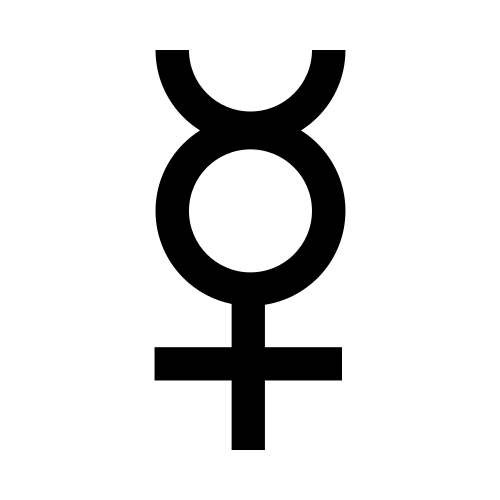 Mercury
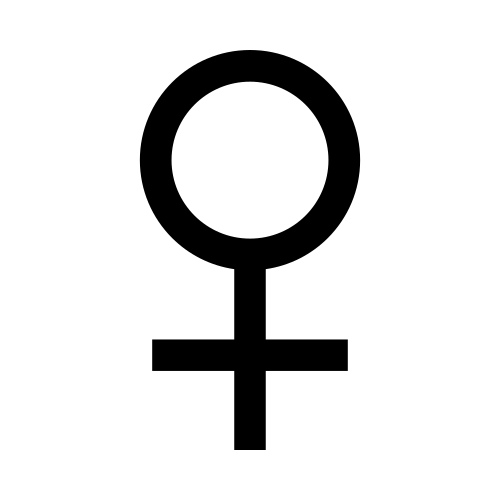 Venus
Venus Mars
Mars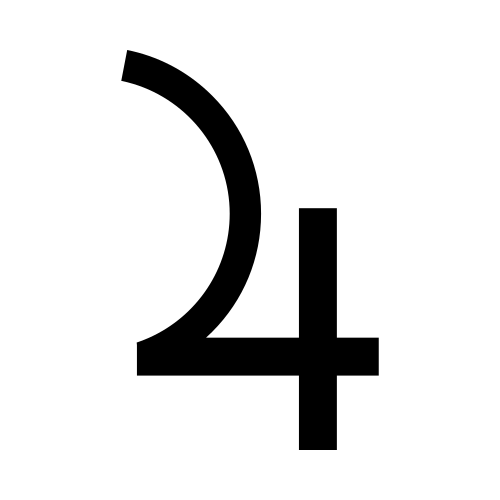 Jupiter
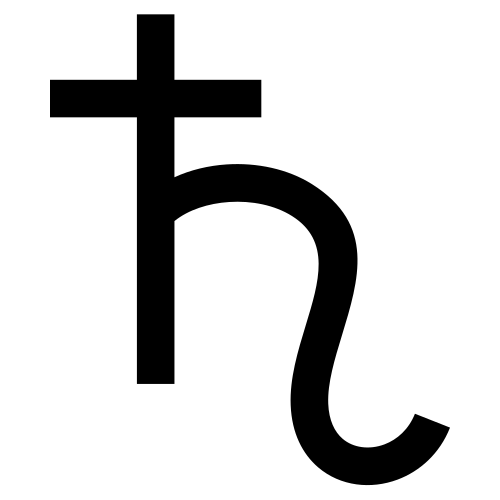 Saturn
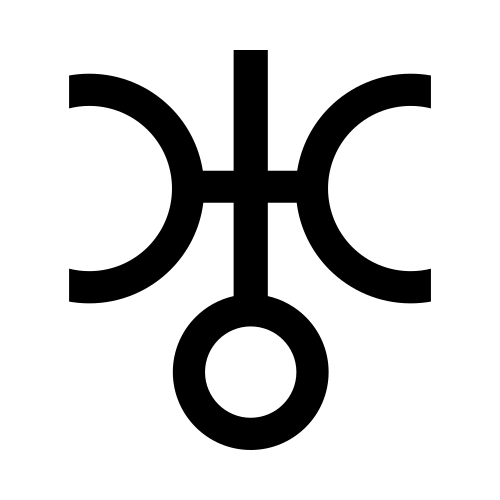 Uranus
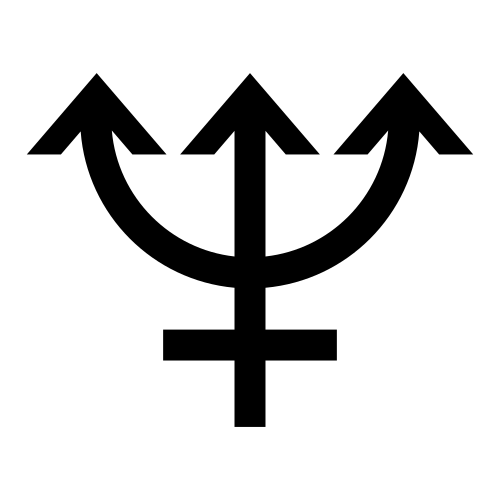 Neptune
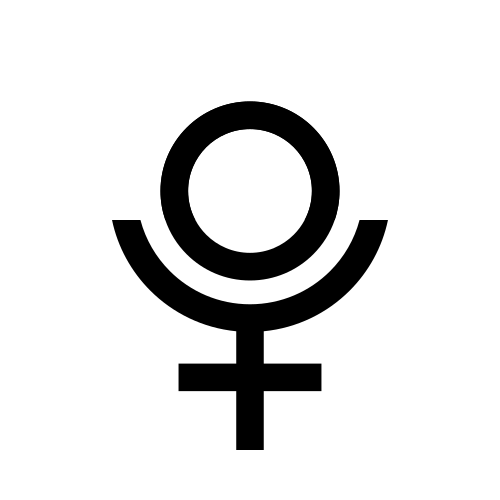 Pluto
Pluto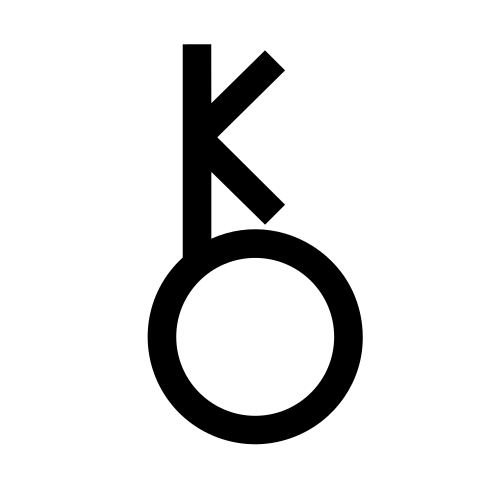 Chiron
Astronomical context
Pluto crossed Virgo from the late 1950s to 1971. In astrological tradition the passage is linked to the transformation of work, health, technique, and systems of organization — the generation that came of age amid automation and the reorganization of labour.
Garry Kasparov (born 1963) belongs to this generational configuration. Astrian groups profiles by such shared signatures rather than by any claim of shared destiny. Related profiles in Astrian: Sergei Bubka · Carl Lewis · Jesse Owens. The symbolic reading is correlative, not causal.
Other profiles from this Pluto in Virgo generation
Symbolic reading
The following describes what classical astrological tradition associates with these configurations. Astrian does not apply these descriptions to the person's biography.
The Sun in Aries centres the chart on initiative, directness, and the will to begin. With the Ascendant in Sagittarius, tradition adds expansion, conviction, and the horizon as the threshold through which that energy meets the world; the Sun marks the central drive, the Ascendant the manner of approach.
Among the personal planets, the Moon in Sagittarius is associated in tradition with expansion, conviction, and the horizon; Mercury in Taurus with stability, persistence, and the tangible; Venus in Pisces with imagination, dissolution, and empathy; and Mars in Leo with expression, pride, and the creative self. These placements describe registers of feeling, thought, attraction, and action as the tradition catalogues them, independent of the life that follows.
Mercury square Mars (1°58'): tradition reads thought and communication in friction with drive, assertion, and action.
Sun sextile Saturn (2°04'): tradition reads identity and central purpose in supportive contact with structure, limitation, and discipline.
Moon square Venus (2°10'): tradition reads emotional life and instinct in friction with values, attraction, and harmony.
Mercury trine Pluto (2°19'): tradition reads thought and communication in easy flow with depth, power, and transformation.
These placements are presented as a symbolic portrait, correlative and never causal — a description within the tradition's vocabulary, not an explanation of the life that follows.
Astrology is a symbolic language with 2,500 years of literature. The reading above is interpretive, not explanatory.
Astrian does not claim that the natal chart of Garry Kasparov caused or determined any of the above. Astrology is a symbolic system with 2,500 years of literature. Its capacity for retrospective description does not imply explanatory capacity.
A parallel life
The following are verified biographical facts. No connection to the natal chart is implied.
Garry Kimovich Kasparov was born on April 13, 1963, in Baku, Azerbaijan, then part of the Soviet Union. He showed a remarkable aptitude for chess from an early age and became a Soviet chess master while still a teenager. He earned the grandmaster title from FIDE in 1980 at the age of seventeen, one of the youngest players to achieve that distinction at the time.
Kasparov became World Chess Champion in 1985 when he defeated Anatoly Karpov in a legendary match that spanned more than five months and 48 games. He successfully defended the title in rematches against Karpov in 1986, 1987, and 1990, cementing his position as the dominant force in world chess. He held the undisputed or widely recognized world championship title from 1985 until 2000, when he lost a match to Vladimir Kramnik.
In 1997, Kasparov played a celebrated six-game match against the IBM supercomputer Deep Blue, losing the series two wins to one with three draws. The match attracted enormous global attention and became a landmark moment in discussions about artificial intelligence and human cognition. He had previously defeated an earlier version of Deep Blue in 1996.
Kasparov retired from professional chess in 2005. Following his retirement, he became an outspoken critic of the Russian government under Vladimir Putin and co-founded the United Civil Front in Russia. He subsequently moved to the United States and continued to be active in political commentary, writing several books including "How Life Imitates Chess" and "Winter Is Coming," which examined authoritarianism in contemporary geopolitics.
Kasparov's peak rating of 2851 on the FIDE Elo scale, achieved in 1999, remained the highest ever recorded for many years. He is widely cited by chess historians and analysts as the most dominant player in the history of the game.
Biographical sources
- FIDE. "Garry Kasparov Player Profile." World Chess Federation, fide.com, accessed 2024..
- Kasparov, Garry. "How Life Imitates Chess." Bloomsbury Publishing, 2007..
- Hsu, Feng-hsiung. "Behind Deep Blue: Building the Computer that Defeated the World Chess Champion." Princeton University Press, 2002..
- Newman, Bruce. "Kasparov vs. Deep Blue." Sports Illustrated, May 1997..
This profile presents the sky at the birth of Garry Kasparov and verified facts of their biography. Astrian does not claim that astrology has predictive capacity or that the natal chart determines the trajectory of a life. Astrology is a symbolic system with 2,500 years of literature. Its capacity for retrospective description does not imply explanatory capacity.
Related profiles
Calculate your own birth chart with the same NASA JPL DE441 precision.
Calculate my birth chartLast updated: June 14, 2026
Newsletter
A short reading once a month, in your inbox.
A note on the symbolism of the season, recent editorial pieces, and what to look for in next month's sky. No predictions.
Support this project
Independent, no venture funding, no ads. A contribution keeps Astrian precise and free.
Support on Ko-fi (opens in new tab)