PROFILE · SPORTS
Sergei Bubka
Serhiy Nazarovych Bubka
pole vaulter
Born 4 December 1963 · Luhansk, Soviet Union · 48.57° N, 39.30° EX
Source: Birth time not documented in publicly accessible records
About this chart
No birth time is documented for this person. The chart therefore shows planetary positions in their signs, the slow aspects between them, and the generational context — but not house placements, the Ascendant, or the Midheaven, which require an accurate birth time. The Moon's sign carries a ±6° margin: if it falls near a sign boundary, the sign could vary. Positions for all other planets are reliable.
Do you have a verified source for this birth time? Share it →
The sky at birth
No birth time is documented for Sergei Bubka. The Ascendant, the Midheaven, and the house positions cannot be determined; the reading is confined to planetary sign placements and the aspects between planets. The positions below are calculated for noon local time and are accurate to a fraction of a degree for the slow-moving bodies. One caveat: the Moon lies near a sign boundary, so without an exact time it cannot be fixed to a single sign — it sits close to 28°02' Cancer within a daily margin of about ±7°.
The Moon is near 28°02' Cancer (noon position, ±7° margin). Sun is at 11°28' Sagittarius. Mercury is at 27°17' Sagittarius. Venus is at 5°53' Capricorn. Mars is at 29°14' Sagittarius. Jupiter is at 9°32' Aries, retrograde. Saturn is at 18°01' Aquarius. Uranus is at 10°00' Virgo. Neptune is at 16°20' Scorpio. Pluto is at 14°11' Virgo.
3 bodies occupy Sagittarius (Sun, Mercury and Mars) — a concentration that stands out as a structural feature of the chart.
The tightest major aspects between planets: Sun square Uranus (1°29'); Saturn square Neptune (1°41'); Sun trine Jupiter (1°56'); Mercury conjunct Mars (1°57'); Neptune sextile Pluto (2°09'); Sun square Pluto (2°42').
Neptune sextile Pluto (2°09') is structural but generational — an alignment of slow-moving outer planets shared across many birth years.
The engine also registers tight minor aspects involving asteroids and calculated points: Mercury semi-square Juno (0°02'); Jupiter sesquiquadrate Ceres (0°07'); Uranus opposite Chiron (0°18'); Venus sextile Pallas (0°22'). These are reported for completeness and carry less weight in traditional reading.
The chart was calculated using NASA JPL DE441 ephemerides, sub-arcsecond precision.
| Planet | Sign | Position |
|---|---|---|
| Sun | Sagittarius | 11°28' |
| Moon | Cancer | 28°02'±6° |
| Mercury | Sagittarius | 27°17' |
| Venus | Capricorn | 05°53' |
| Mars | Sagittarius | 29°14' |
| Jupiter | Aries | 09°32'retrograde |
| Saturn | Aquarius | 18°01' |
| Uranus | Virgo | 10°00' |
| Neptune | Scorpio | 16°20' |
| Pluto | Virgo | 14°11' |
| Chiron | Pisces | 10°18' |
 Sun
Sun Moon
Moon Mercury
 Venus
Venus Mars
Mars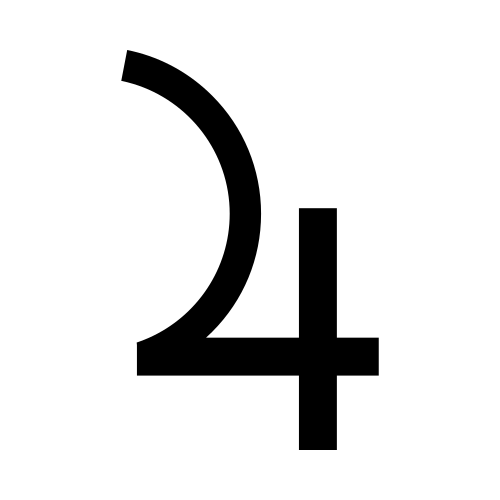 Jupiter
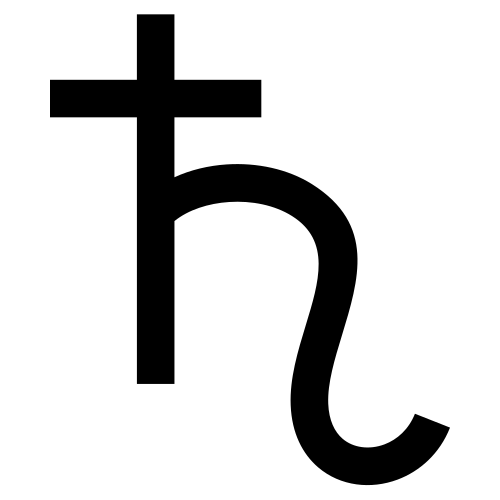 Saturn
 Uranus
 Neptune
 Pluto
Pluto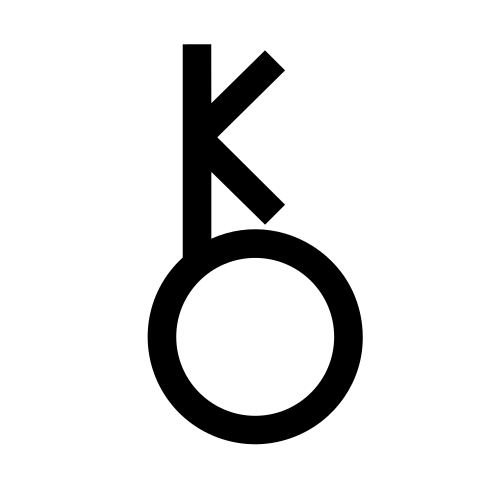 Chiron
Birth time unknown — house positions and Ascendant/MC are not available.
Astronomical context
Pluto crossed Virgo from the late 1950s to 1971. In astrological tradition the passage is linked to the transformation of work, health, technique, and systems of organization — the generation that came of age amid automation and the reorganization of labour.
Sergei Bubka (born 1963) belongs to this generational configuration. Astrian groups profiles by such shared signatures rather than by any claim of shared destiny. Related profiles in Astrian: Carl Lewis · Jesse Owens · Florence Griffith-Joyner. The symbolic reading is correlative, not causal.
Other profiles from this Pluto in Virgo generation
Symbolic reading
The following describes what classical astrological tradition associates with these configurations. Astrian does not apply these descriptions to the person's biography.
The Sun in Sagittarius is the most prominent structural feature available without a birth time, centring the chart on expansion, conviction, and the horizon. There is no Ascendant or Midheaven to anchor the angles, so the reading rests on sign placements and the aspects between planets rather than on houses.
Among the personal planets, the Moon in Cancer is associated in tradition with attachment, memory, and protection (the Moon's sign is given for the noon chart and may shift with an exact time); Mercury in Sagittarius with expansion, conviction, and the horizon; Venus in Capricorn with ambition, structure, and the long view; and Mars in Sagittarius with expansion, conviction, and the horizon. These placements describe registers of feeling, thought, attraction, and action as the tradition catalogues them, independent of the life that follows.
Sun square Uranus (1°29'): tradition reads identity and central purpose in friction with disruption and innovation.
Saturn square Neptune (1°41'): tradition reads structure, limitation, and discipline in friction with dissolution, imagination, and idealism.
Sun trine Jupiter (1°56'): tradition reads identity and central purpose in easy flow with expansion and meaning.
Mercury conjunct Mars (1°57'): tradition reads thought and communication fused with drive, assertion, and action.
These placements are presented as a symbolic portrait, correlative and never causal — a description within the tradition's vocabulary, not an explanation of the life that follows.
Astrology is a symbolic language with 2,500 years of literature. The reading above is interpretive, not explanatory.
Astrian does not claim that the natal chart of Sergei Bubka caused or determined any of the above. Astrology is a symbolic system with 2,500 years of literature. Its capacity for retrospective description does not imply explanatory capacity.
A parallel life
The following are verified biographical facts. No connection to the natal chart is implied.
Serhiy Nazarovych Bubka was born on December 4, 1963, in Luhansk, in what was then the Soviet Union. He grew up in Donetsk and began athletics training at the Donetsk Sports School, where he was coached by Vitaly Petrov, who would remain his coach throughout his competitive career. The combination of technical instruction and Bubka's physical attributes produced one of the most effective pole vaulters in the history of the discipline.
Bubka first came to global attention at the 1983 World Championships in Helsinki, where he won gold at the age of 19. He proceeded to win the World Championship title in every edition of the competition from 1983 to 1997, a total of six consecutive titles. This record of consistency across more than a decade of world-level competition has not been equaled in the pole vault.
At the 1988 Summer Olympics in Seoul, Bubka won the gold medal with a vault of 5.90 meters, his only Olympic appearance to result in a gold. He was hampered by injury at the 1992 Barcelona Games and failed to record a valid vault, and at the 1996 Atlanta Games he again did not medal. The Olympic record remained the one title that largely eluded him despite his dominance at every other major competition.
Over the course of his career, Bubka broke the world record in the pole vault 35 times in total: 17 outdoor records and 18 indoor records. His outdoor world record of 6.14 meters, set in Sestriere, Italy, in July 1994, stood as the world record for two decades. He was the first pole vaulter to clear 6.00 meters outdoors, which he achieved in 1985.
After retiring from competition, Bubka moved into sports administration. He served as a member of the International Olympic Committee and as president of the National Olympic Committee of Ukraine. He also held leadership roles within World Athletics. He was inducted into the IAAF Hall of Fame in 2012.
Biographical sources
- World Athletics. "Sergei Bubka: Hall of Fame." Monaco, 2012. https://worldathletics.org.
- Bubka, Sergei. "My Pole Vault Career: Records and Reflections." (Interviews compiled in multiple sporting publications, 1994–2000.).
- Wallechinsky, David, and Loucky, Jaime. "The Complete Book of the Olympics." London: Aurum Press, 2012..
- International Olympic Committee. "Seoul 1988: Athletics Results." Lausanne. https://olympics.com.
This profile presents the sky at the birth of Sergei Bubka and verified facts of their biography. Astrian does not claim that astrology has predictive capacity or that the natal chart determines the trajectory of a life. Astrology is a symbolic system with 2,500 years of literature. Its capacity for retrospective description does not imply explanatory capacity.
Related profiles
Calculate your own birth chart with the same NASA JPL DE441 precision.
Calculate my birth chartLast updated: June 14, 2026
Newsletter
A short reading once a month, in your inbox.
A note on the symbolism of the season, recent editorial pieces, and what to look for in next month's sky. No predictions.
Support this project
Independent, no venture funding, no ads. A contribution keeps Astrian precise and free.
Support on Ko-fi (opens in new tab)