PROFILE · ENTREPRENEURS

Jeff Bezos
Jeffrey Preston Bezos
entrepreneur
Born 12 January 1964 · Albuquerque, New Mexico, United States · 35.08° N, 106.65° WX
Source: Birth time not documented in publicly accessible records
About this chart
No birth time is documented for this person. The chart therefore shows planetary positions in their signs, the slow aspects between them, and the generational context — but not house placements, the Ascendant, or the Midheaven, which require an accurate birth time. The Moon's sign carries a ±6° margin: if it falls near a sign boundary, the sign could vary. Positions for all other planets are reliable.
Do you have a verified source for this birth time? Share it →
The sky at birth
No birth time is documented for Jeff Bezos. The Ascendant, Midheaven, and house positions cannot be determined. The planetary positions below are calculated for noon local time and are accurate to within a fraction of a degree for the slow-moving planets. The Moon's position carries a margin of approximately ±7°.
The Sun is at 21°36' Capricorn. The Moon is at 28°22' Sagittarius (noon position, ±7° margin). Mercury is at 5°02' Capricorn R. Venus is at 24°41' Aquarius. Mars is at 29°38' Capricorn. Jupiter is at 11°58' Aries. Saturn is at 21°39' Aquarius. Uranus is at 9°43' Virgo R. Neptune is at 17°27' Scorpio. Pluto is at 14°02' Virgo R.
Venus at 24°41' Aquarius conjoins Saturn at 21°39' Aquarius (3°02') — the tightest major aspect between personal planets in the chart. Neptune at 17°27' Scorpio sextiles Pluto at 14°02' Virgo retrograde (3°25') — a generational configuration. The Moon at 28°22' Sagittarius sextiles Venus at 24°41' Aquarius (3°41'), though this aspect carries the Moon's ±7° uncertainty. The Sun at 21°36' Capricorn sextiles Neptune at 17°27' Scorpio (4°09'). Saturn at 21°39' Aquarius squares Neptune at 17°27' Scorpio (4°12'). Uranus at 9°43' Virgo retrograde conjoins Pluto at 14°02' Virgo retrograde (4°19') — the great 1960s conjunction, a generational configuration shared by everyone born in this period.
The engine also identifies the following tight minor aspects involving asteroids and calculated points: sun semi-sextile saturn (0.05° app); ceres quincunx northNode (0.11° app); mars sextile lilith (0.13° app); venus square juno (0.48° sep).
The tightest major aspects between planets: Venus conjunct Saturn (3°02'), Neptune sextile Pluto (3°25'), Moon sextile Venus (3°41'), Sun sextile Neptune (4°09'), Saturn square Neptune (4°12'), Uranus conjunct Pluto (4°19').
Note on the Moon's sign: The Moon at 28°22' Sagittarius at noon is near the Sagittarius-Capricorn boundary. If born late in the day, the Moon could have crossed into early Capricorn. The Moon's sign placement in Sagittarius is probable but not certain for the entire day.
The chart was calculated by Astrian's engine using NASA JPL DE441 ephemerides, sub-arcsecond precision. Timezone: America/Denver (Mountain Standard Time, UTC −7).
| Planet | Sign | Position |
|---|---|---|
| Sun | Capricorn | 21°36' |
| Moon | Sagittarius | 28°22'±6° |
| Mercury | Capricorn | 05°02'retrograde |
| Venus | Aquarius | 24°41' |
| Mars | Capricorn | 29°38' |
| Jupiter | Aries | 11°58' |
| Saturn | Aquarius | 21°39' |
| Uranus | Virgo | 09°43'retrograde |
| Neptune | Scorpio | 17°27' |
| Pluto | Virgo | 14°02'retrograde |
| Chiron | Pisces | 11°29' |
 Sun
Sun Moon
Moon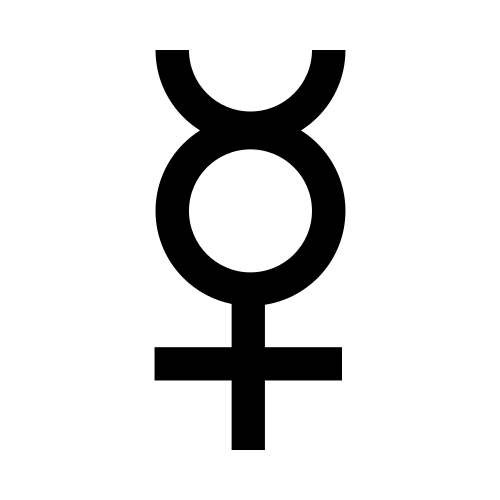 Mercury
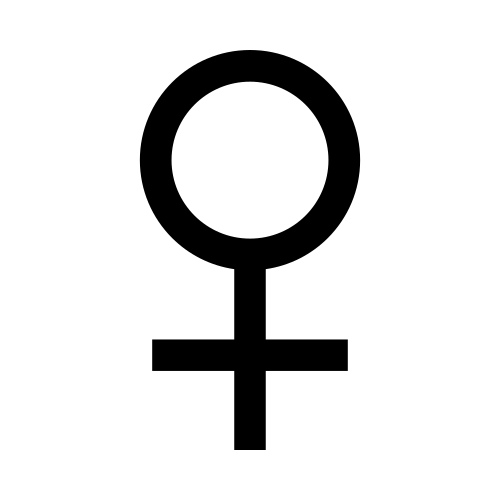 Venus
Venus Mars
Mars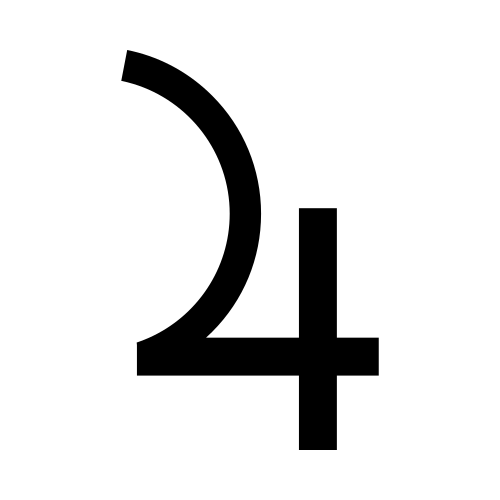 Jupiter
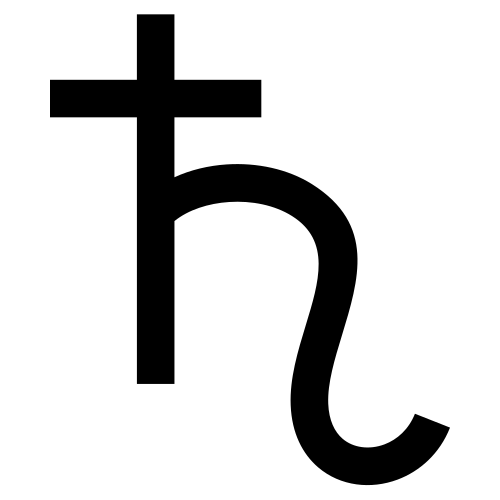 Saturn
 Uranus
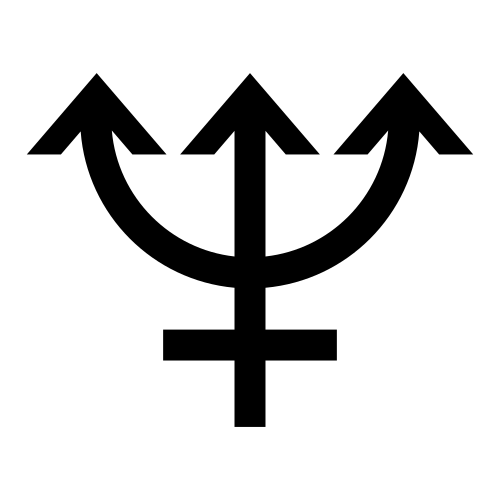 Neptune
 Pluto
Pluto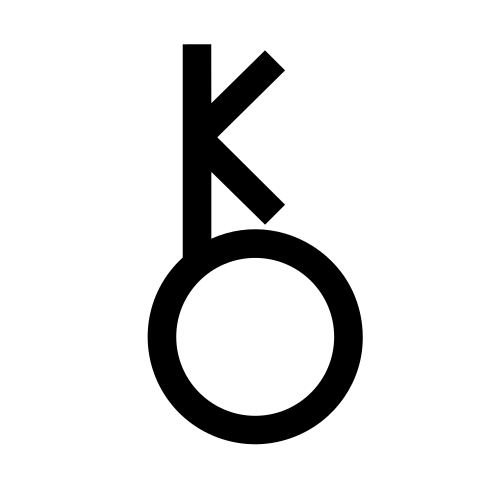 Chiron
Birth time unknown — house positions and Ascendant/MC are not available.
Astronomical context
Those born between approximately 1957 and 1972 carried Pluto in Virgo. This generation grew up during the social upheavals of the 1960s and 1970s — the civil rights movement, the Vietnam War, the Watergate crisis, the energy shocks that ended the postwar economic consensus — and came of age in a world where the institutions their parents had trusted were visibly failing. They inherited not optimism but the task of understanding why the systems had broken and what could be built from the wreckage.
In astrological tradition, Pluto in Virgo is associated with collective transformation of the domains that sign governs: work, systems, analysis, health, service, and the precise understanding of how things function at the level of their components. Virgo is the sign of the analyst, of the one who takes the machine apart to understand each piece. Pluto's transit through Virgo coincided with the rise of systems thinking, the birth of the personal computer, the emergence of evidence-based medicine, and the environmental movement's insistence that ecosystems could be understood, measured, and — if the data was right — saved. The symbolic reading is correlative, not causal.
The Uranus-Pluto conjunction in Virgo (exact in 1965-66, operative throughout the decade) added a disruptive charge to this generational signature. Those born during the conjunction carry both Pluto's transformative depth and Uranus's insistence on the radically new — both directed through the Virgoan register of analysis, efficiency, and systems.
Other profiles in the Astrian collection born under this configuration include Diego Maradona (1960) and Zinédine Zidane (1972). Jeff Bezos, born in 1964, belongs to the core years of this generational wave, during the Uranus-Pluto conjunction itself.
Other profiles from this Pluto in Virgo generation
Symbolic reading
The following describes what classical astrological tradition associates with these configurations. Astrian does not apply these descriptions to the person's biography.
The Sun at 21°36' Capricorn is the most prominent structural feature of this chart. Without a documented birth time, there is no Ascendant or Midheaven — the reading is confined to planetary positions by sign and the aspects between planets.
The Moon at 28°22' Sagittarius represents the noon position; the actual placement falls within approximately 7° on either side. If born late in the day, the Moon could have crossed into Capricorn. Mercury at 5°02' Capricorn retrograde, Venus at 24°41' Aquarius, and Mars at 29°38' Capricorn complete the personal planet picture. Sun, Mercury, and Mars in Capricorn — three personal planets concentrated in the sign of structure, ambition, and long-term construction. Venus in Aquarius introduces a different register: the faculty of value operating through the sign of systems, networks, and the collective.
### Venus conjunct Saturn: value structured by discipline
The chart's tightest personal aspect is Venus at 24°41' Aquarius conjunct Saturn at 21°39' Aquarius, orb 3°02'. Venus governs value, desire, and the aesthetic sense — what one finds worth pursuing. Saturn governs structure, discipline, and the framework within which things endure. Their conjunction in Aquarius places both faculties in the sign of systems, networks, and collective organization.
In the tradition, Venus-Saturn conjunctions are read as configurations where the sense of value is oriented toward what lasts rather than what pleases immediately, where desire is channelled through structure rather than expressed freely. In Aquarius, this conjunction adds a systemic dimension: the structures valued are not personal empires but networks — systems designed to serve at scale, where the architecture itself is the product.
### Saturn square Neptune: structure against dissolution
Saturn at 21°39' Aquarius squares Neptune at 17°27' Scorpio, orb 4°12'. Saturn governs structure and the insistence on what is materially real. Neptune governs vision, dissolution of limits, and the capacity to imagine what does not yet exist. The square places them in tension: the builder and the visionary press against each other. Aquarius (Saturn's position) demands systematic, collective solutions. Scorpio (Neptune's position) demands depth, transformation, and access to what is hidden.
Saturn-Neptune squares in the tradition are read as configurations where the practical and the visionary are in friction — where neither can operate without the other's resistance. The builder is haunted by the vision; the visionary is disciplined by the structure. The result is not paralysis but a particular kind of ambition: one that insists on building what has not existed before, and insists that it must actually work.
### Sun sextile Neptune: identity and the long vision
The Sun at 21°36' Capricorn sextiles Neptune at 17°27' Scorpio, orb 4°09'. The sextile is cooperative: the identity (Sun in Capricorn — practical, ambitious, oriented toward the long term) flows productively with the visionary faculty (Neptune in Scorpio — depth, transformation, the capacity to perceive what others cannot see). Capricorn builds; Scorpio penetrates. The sextile connects them without friction.
### The Capricorn concentration: Sun, Mercury, Mars
Three personal planets in Capricorn — Sun, Mercury retrograde, and Mars — create a substantial concentration in the sign of ambition, authority, and long-term construction. Mercury retrograde in Capricorn describes a mind that processes inward before expressing outward, that arrives at conclusions through extended internal deliberation. Mars in the final degrees of Capricorn (29°38') places the faculty of action at the culmination of the sign — the last degree, where the sign's qualities are concentrated to their maximum intensity before the transition into Aquarius.
The planetary pattern here is read as a symbolic portrait, not a causal explanation. No planet caused, predicted, or determined any event or characteristic.
Astrology is a symbolic language with 2,500 years of literature. The reading above is interpretive, not explanatory.
Astrian does not claim that the natal chart of Jeff Bezos caused or determined any of the above. Astrology is a symbolic system with 2,500 years of literature. Its capacity for retrospective description does not imply explanatory capacity.
A parallel life
The following are verified biographical facts. No connection to the natal chart is implied.
Jeffrey Preston Jorgensen was born on 12 January 1964 in Albuquerque, New Mexico. His mother, Jacklyn Gise Jorgensen, was seventeen years old. His biological father, Ted Jorgensen, was eighteen and worked in a bicycle shop. The marriage lasted little more than a year. When Jeff was four, his mother married Miguel Bezos, a Cuban immigrant who had arrived in the United States at sixteen as part of Operation Pedro Pan, the programme that brought fourteen thousand unaccompanied Cuban children to America between 1960 and 1962. Miguel Bezos adopted Jeff, who took his surname. Jeff did not meet his biological father again until 2013, when a reporter tracked Jorgensen down; Jorgensen said he had not known his son had become Jeff Bezos.
The family moved frequently — Houston, Miami, back to Albuquerque — following Miguel's career as an engineer at Exxon. Jeff spent summers on his maternal grandfather's ranch in Cotulla, Texas, where he castrated bulls, fixed windmills, and developed what he later described as a comfort with self-reliance and improvisation.
He graduated from Princeton in 1986 with degrees in computer science and electrical engineering, summa cum laude. He worked at Fitel, a financial telecommunications startup, then at Bankers Trust, then at D. E. Shaw & Co., a quantitative hedge fund, where he became the youngest senior vice president in the firm's history at thirty.
In the spring of 1994, Bezos read that World Wide Web usage was growing at 2,300 percent per year. He compiled a list of twenty products that could be sold online, reduced it to books — because no physical store could stock the roughly three million titles in print — and drove from New York to Seattle, writing the business plan in the passenger seat while his wife MacKenzie drove. They set up in a garage. Amazon.com launched in July 1995.
The company lost money for its first six years. Bezos insisted on reinvesting all revenue into growth, prioritizing long-term market share over quarterly profits — a strategy that bewildered Wall Street analysts and infuriated investors. "Your margin is my opportunity" became the company's operational philosophy. Amazon expanded from books to electronics, to clothing, to groceries, to cloud computing, to streaming, to advertising, to healthcare. Amazon Web Services, launched in 2006, became the dominant cloud computing platform and by the mid-2020s generated the majority of Amazon's operating profit.
The scale that resulted was unprecedented in the history of retail. By 2020, Amazon's share of US e-commerce exceeded forty percent. The company employed more than 1.5 million people worldwide, making it the second-largest private employer in the United States after Walmart. Its logistics network — fulfillment centres, delivery vans, cargo planes, last-mile robotics — constituted a parallel infrastructure rivalling national postal systems.
Bezos founded Blue Origin in 2000, a year before SpaceX. The company's motto, "Gradatim Ferociter" (Step by Step, Ferociously), reflected a development philosophy that prioritized safety and reusability over speed. Blue Origin flew its first crewed suborbital mission in July 2021, with Bezos aboard.
He and MacKenzie Scott divorced in 2019 after twenty-five years of marriage. Scott received approximately four percent of Amazon's shares, making her one of the wealthiest women in the world; she subsequently donated more than twelve billion dollars to nonprofit organizations in a giving programme deliberately structured to avoid the donor-centric philanthropy model.
Bezos stepped down as Amazon CEO in July 2021, assuming the role of executive chairman. He purchased the Washington Post in 2013 for $250 million. In 2024, he relocated from Seattle to Miami.
Biographical sources
- Stone, Brad. The Everything Store: Jeff Be*.
This profile presents the sky at the birth of Jeff Bezos and verified facts of their biography. Astrian does not claim that astrology has predictive capacity or that the natal chart determines the trajectory of a life. Astrology is a symbolic system with 2,500 years of literature. Its capacity for retrospective description does not imply explanatory capacity.
Related profiles
Calculate your own birth chart with the same NASA JPL DE441 precision.
Calculate my birth chartLast updated: June 12, 2026
Newsletter
A short reading once a month, in your inbox.
A note on the symbolism of the season, recent editorial pieces, and what to look for in next month's sky. No predictions.
Support this project
Independent, no venture funding, no ads. A contribution keeps Astrian precise and free.
Support on Ko-fi (opens in new tab)