PROFILE · SCIENCE & TECHNOLOGY
Alexander Fleming
Sir Alexander Fleming
bacteriologist
Born 6 August 1881 · 02:00 · 12:34 UTC · Darvel, Scotland, United Kingdom · 55.65° N, 4.25° WAA
Source: Astro-Databank (Rodden Rating AA)
The sky at birth
With a documented birth time, the full chart can be cast. The Ascendant falls at 16°19' Cancer and the Midheaven at 8°53' Pisces, which fixes the angular framework and allows the planets to be placed in houses.
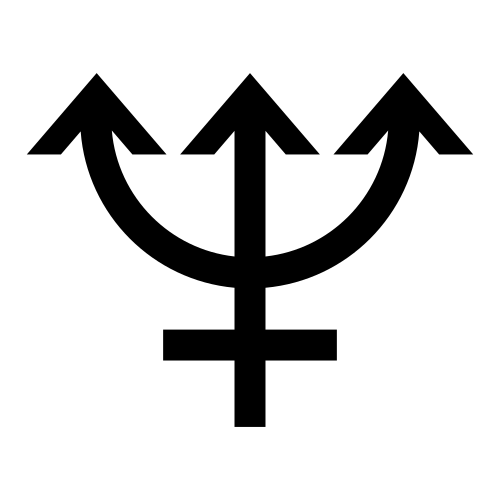
Sun is at 13°42' Leo, house 2. Moon is at 20°31' Sagittarius, house 6. Mercury is at 24°39' Cancer, house 1. Venus is at 29°42' Gemini, house 12. Mars is at 1°23' Gemini, house 11. Jupiter is at 23°45' Taurus, house 11. Saturn is at 12°08' Taurus, house 11. Uranus is at 12°14' Virgo, house 4. Neptune is at 16°32' Taurus, house 11. Pluto is at 29°13' Taurus, house 11.
4 bodies occupy Taurus (Jupiter, Saturn, Neptune and Pluto) — a concentration that stands out as a structural feature of the chart.
The tightest major aspects between planets: Saturn trine Uranus (0°07'); Mercury sextile Jupiter (0°54'); Sun square Saturn (1°34'); Mars conjunct Pluto (2°10'); Sun square Neptune (2°50'); Uranus trine Neptune (4°17').
Uranus trine Neptune (4°17') is structural but generational — an alignment of slow-moving outer planets shared across many birth years.
The engine also registers tight minor aspects involving asteroids and calculated points: Moon sesquiquadrate Lilith (0°01'); Sun trine North Node (1°25'); Neptune quincunx North Node (1°26'); Uranus square North Node (2°52'). These are reported for completeness and carry less weight in traditional reading.
The chart was calculated using NASA JPL DE441 ephemerides, sub-arcsecond precision.
| Planet | Sign | Position | House |
|---|---|---|---|
| Ascendant | Cancer | 16°19' | — |
| Midheaven | Pisces | 08°53' | — |
| Sun | Leo | 13°42' | H2 |
| Moon | Sagittarius | 20°31' | H6 |
| Mercury | Cancer | 24°39' | H1 |
| Venus | Gemini | 29°42' | H12 |
| Mars | Gemini | 01°23' | H11 |
| Jupiter | Taurus | 23°45' | H11 |
| Saturn | Taurus | 12°08' | H11 |
| Uranus | Virgo | 12°14' | H4 |
| Neptune | Taurus | 16°32' | H11 |
| Pluto | Taurus | 29°13' | H11 |
 Sun
Sun Moon
Moon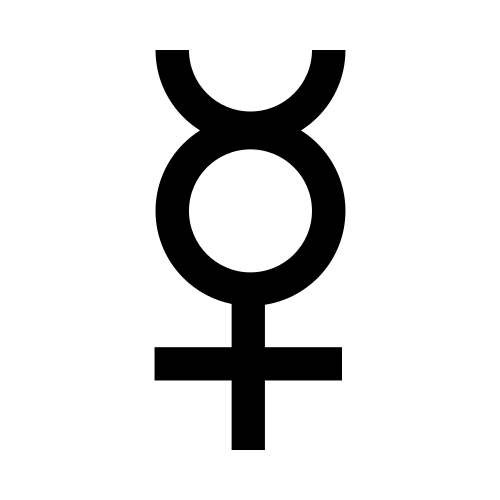 Mercury
 Venus
Venus Mars
Mars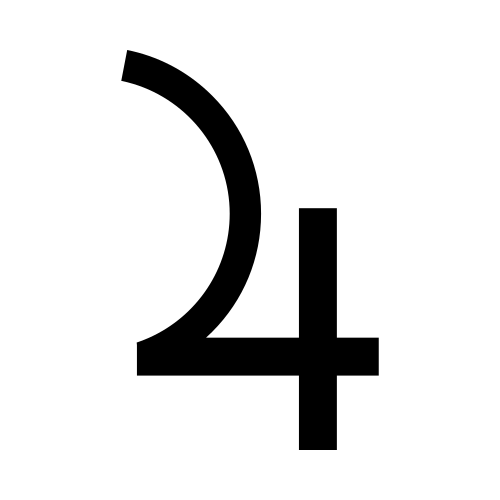 Jupiter
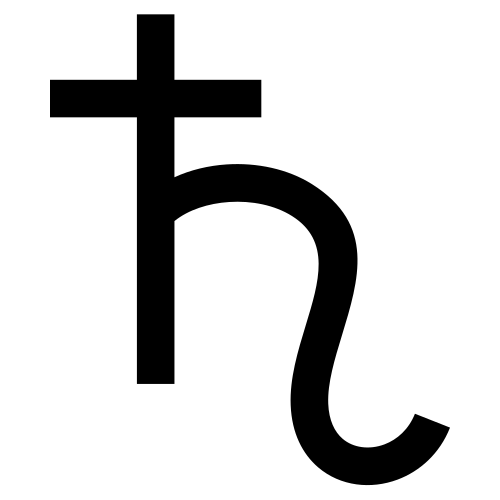 Saturn
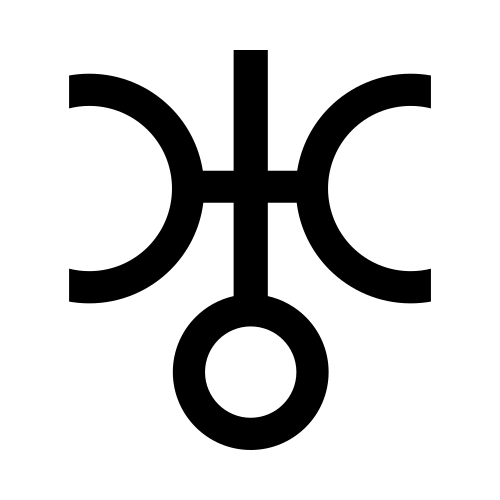 Uranus
 Neptune
 Pluto
PlutoAstronomical context
Pluto crossed Taurus roughly from 1853 to 1884. In astrological tradition this transit is linked to the transformation of value, resources, and the material world — the generation whose lifetimes coincided with the consolidation of industrial capital and new forms of wealth.
Alexander Fleming (born 1881) belongs to this generational configuration. Astrian groups profiles by such shared signatures rather than by any claim of shared destiny. Related profiles in Astrian: Louis Pasteur · Linus Pauling · Jonas Salk. The symbolic reading is correlative, not causal.
Other profiles from this Pluto in Taurus generation
Symbolic reading
The following describes what classical astrological tradition associates with these configurations. Astrian does not apply these descriptions to the person's biography.
The Sun in Leo centres the chart on expression, pride, and the creative self. With the Ascendant in Cancer, tradition adds attachment, memory, and protection as the threshold through which that energy meets the world; the Sun marks the central drive, the Ascendant the manner of approach.
Among the personal planets, the Moon in Sagittarius is associated in tradition with expansion, conviction, and the horizon; Mercury in Cancer with attachment, memory, and protection; Venus in Gemini with curiosity, exchange, and versatility; and Mars in Gemini with curiosity, exchange, and versatility. These placements describe registers of feeling, thought, attraction, and action as the tradition catalogues them, independent of the life that follows.
Saturn trine Uranus (0°07'): tradition reads structure, limitation, and discipline in easy flow with disruption and innovation.
Mercury sextile Jupiter (0°54'): tradition reads thought and communication in supportive contact with expansion and meaning.
Sun square Saturn (1°34'): tradition reads identity and central purpose in friction with structure, limitation, and discipline.
Mars conjunct Pluto (2°10'): tradition reads drive, assertion, and action fused with depth, power, and transformation.
These placements are presented as a symbolic portrait, correlative and never causal — a description within the tradition's vocabulary, not an explanation of the life that follows.
Astrology is a symbolic language with 2,500 years of literature. The reading above is interpretive, not explanatory.
Astrian does not claim that the natal chart of Alexander Fleming caused or determined any of the above. Astrology is a symbolic system with 2,500 years of literature. Its capacity for retrospective description does not imply explanatory capacity.
A parallel life
The following are verified biographical facts. No connection to the natal chart is implied.
Alexander Fleming was born on August 6, 1881, at Lochfield farm near Darvel, Ayrshire, Scotland. The seventh of eight children, he grew up in a rural farming household. He moved to London at the age of 13 and eventually enrolled at St Mary's Hospital Medical School, where he qualified as a physician in 1906 and joined the bacteriology department.
During World War I, Fleming served as a captain in the Royal Army Medical Corps and worked in battlefield hospitals in France. He observed that many soldiers died from wound infections rather than from their injuries directly, and that antiseptics then in use often damaged tissue and were ineffective against deep infections. This experience focused his attention on the search for antibacterial agents.
In 1921 Fleming discovered lysozyme, an enzyme present in mucus and tears that has natural antibacterial properties. This work sharpened his interest in substances capable of killing bacteria without harming human tissue.
The pivotal discovery came in September 1928. Fleming returned from a holiday to find that one of his petri dishes containing Staphylococcus bacteria had been contaminated by a mould, later identified as Penicillium notatum. He noticed that the area surrounding the mould was clear of bacterial colonies, suggesting the mould was producing a substance inhibitory to the bacteria. Fleming named this substance penicillin and published his observations in 1929. However, he and his team were unable to isolate and stabilise the active compound in sufficient quantities for clinical use.
It was Howard Florey, Ernst Boris Chain, and their colleagues at Oxford University who, between 1939 and 1941, purified penicillin and demonstrated its effectiveness in treating bacterial infections in animals and humans. Large-scale production was developed in the United States during World War II, making penicillin widely available by the war's end.
Fleming, Florey, and Chain shared the Nobel Prize in Physiology or Medicine in 1945. Fleming was knighted in 1944. He received honorary degrees from numerous universities and was made a Fellow of the Royal Society.
Alexander Fleming died on March 11, 1955, in London, and was buried in St Paul's Cathedral.
Biographical sources
- Gwyn Macfarlane, Alexander Fleming: The Man and the Myth (Harvard University Press, 1984).
- Nobel Pri.
This profile presents the sky at the birth of Alexander Fleming and verified facts of their biography. Astrian does not claim that astrology has predictive capacity or that the natal chart determines the trajectory of a life. Astrology is a symbolic system with 2,500 years of literature. Its capacity for retrospective description does not imply explanatory capacity.
Related profiles
Calculate your own birth chart with the same NASA JPL DE441 precision.
Calculate my birth chartLast updated: June 14, 2026
Newsletter
A short reading once a month, in your inbox.
A note on the symbolism of the season, recent editorial pieces, and what to look for in next month's sky. No predictions.
Support this project
Independent, no venture funding, no ads. A contribution keeps Astrian precise and free.
Support on Ko-fi (opens in new tab)