PROFILE · POLITICIANS
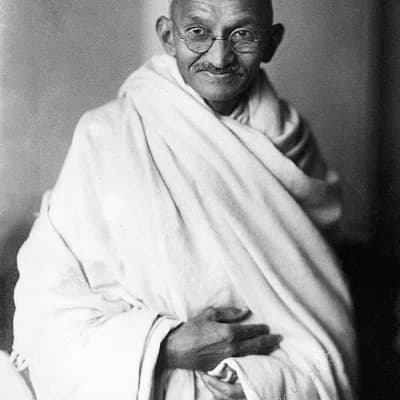
Mahatma Gandhi
Mohandas Karamchand Gandhi
activist and independence leader
Born 2 October 1869 · Porbandar, Gujarat, India · 21.64° N, 69.63° EX
Source: Birth time not documented in publicly accessible records
About this chart
No birth time is documented for this person. The chart therefore shows planetary positions in their signs, the slow aspects between them, and the generational context — but not house placements, the Ascendant, or the Midheaven, which require an accurate birth time. The Moon's sign carries a ±6° margin: if it falls near a sign boundary, the sign could vary. Positions for all other planets are reliable.
Do you have a verified source for this birth time? Share it →
The sky at birth
No birth time is documented for Mahatma Gandhi. The Ascendant, Midheaven, and house positions cannot be determined. The planetary positions below are calculated for noon local time and are accurate to within a fraction of a degree for the slow-moving planets. The Moon's position carries a margin of approximately ±7°.
The Sun is at 9°05' Libra. The Moon is at 22°20' Leo (noon position, ±7° margin). Mercury is at 3°52' Scorpio. Venus is at 16°37' Scorpio. Mars is at 18°30' Scorpio. Jupiter is at 20°09' Taurus R. Saturn is at 12°22' Sagittarius. Uranus is at 21°41' Cancer. Neptune is at 18°24' Aries R. Pluto is at 17°39' Taurus R.
Mars at 18°30' Scorpio opposes Pluto at 17°39' Taurus retrograde (0°51') — the tightest major aspect in the chart. Venus at 16°37' Scorpio opposes Pluto (0°58'). Mars opposes Jupiter at 20°09' Taurus retrograde (1°39'). Jupiter sextiles Uranus at 21°41' Cancer (1°32'). Venus conjoins Mars (1°53'). The Moon at 22°20' Leo squares Jupiter (2°11'), though this aspect carries the Moon's ±7° uncertainty. Jupiter conjoins Pluto (2°30'). Mars trines Uranus (3°11'). The Sun at 9°05' Libra sextiles Saturn at 12°22' Sagittarius (3°17'). Venus opposes Jupiter (3°32'). The Moon squares Mars (3°50'). The Moon trines Neptune at 18°24' Aries retrograde (3°56').
The engine also identifies the following tight minor aspects involving asteroids and calculated points: mars quincunx neptune (0.10° sep); mars sesquiquadrate lilith (0.11° app); mercury quincunx lilith (0.25° sep).
The tightest major aspects between planets: Mars opposition Pluto (0°51'), Venus opposition Pluto (0°58'), Jupiter sextile Uranus (1°32'), Mars opposition Jupiter (1°39'), Venus conjunction Mars (1°53'), Moon square Jupiter (2°11'), Jupiter conjunction Pluto (2°30'), Mars trine Uranus (3°11'), Sun sextile Saturn (3°17'), Venus opposition Jupiter (3°32'), Moon square Mars (3°50'), Moon trine Neptune (3°56').
The chart was calculated by Astrian's engine using NASA JPL DE441 ephemerides, sub-arcsecond precision. Timezone: Asia/Kolkata (local mean time for Porbandar).
| Planet | Sign | Position |
|---|---|---|
| Sun | Libra | 09°04' |
| Moon | Leo | 22°07'±6° |
| Mercury | Scorpio | 03°51' |
| Venus | Scorpio | 16°36' |
| Mars | Scorpio | 18°30' |
| Jupiter | Taurus | 20°09'retrograde |
| Saturn | Sagittarius | 12°22' |
| Uranus | Cancer | 21°41' |
| Neptune | Aries | 18°24'retrograde |
| Pluto | Taurus | 17°39'retrograde |
 Sun
Sun Moon
Moon Mercury
 Venus
Venus Mars
Mars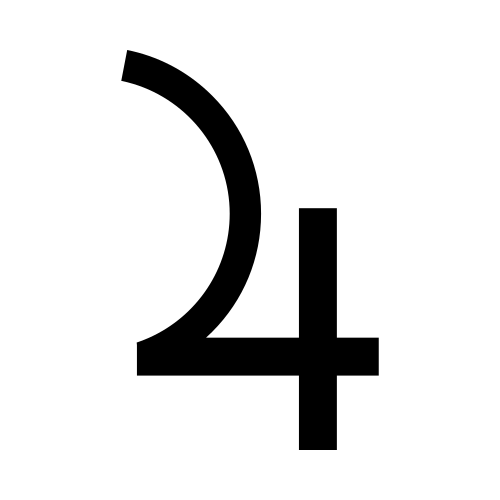 Jupiter
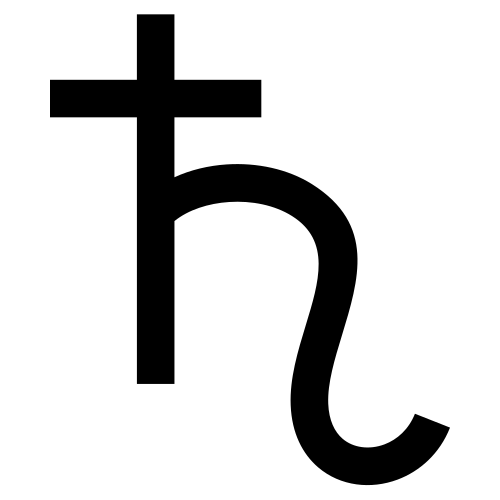 Saturn
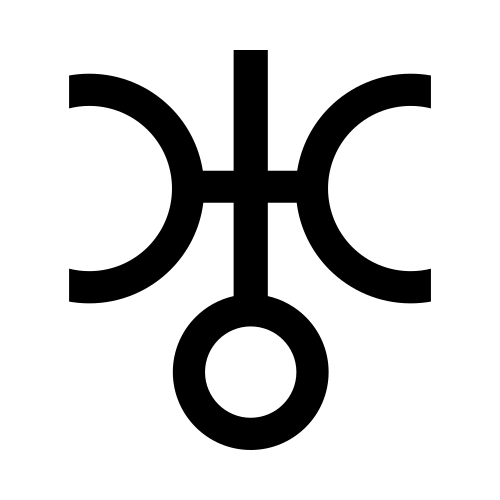 Uranus
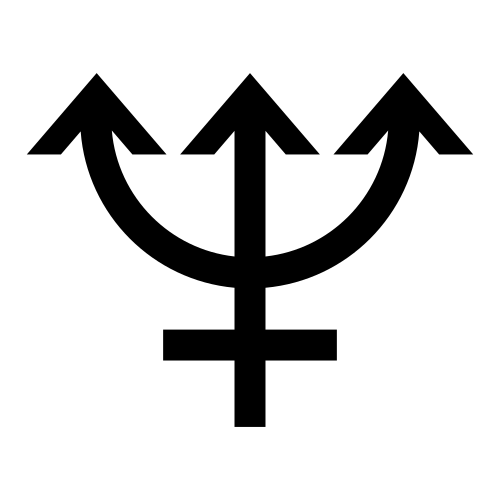 Neptune
 Pluto
PlutoBirth time unknown — house positions and Ascendant/MC are not available.
Astronomical context
Those born between approximately 1852 and 1884 carried Pluto in Taurus. This generation grew up during the high tide of the Industrial Revolution — the restructuring of agriculture, the emergence of industrial capitalism, the transformation of mass labour, the expansion of European colonial empires into every inhabited continent, and the radical remaking of the material conditions of life for billions of people who had no voice in the remaking.
In astrological tradition, Pluto in Taurus is associated with collective transformation of the domains that sign governs: the material, the physical, the valued, the possessed, the sensory, and the stable. Taurus is the sign of the builder, the farmer, the one who works with the earth and with what endures. Pluto's transit through Taurus is read, symbolically, as a period when the structures of material security, economic production, and the relationship between the human and the natural world were subjected to deep structural pressure — the old frameworks of how wealth was produced, how land was worked, and how stability was maintained were torn apart and rebuilt. The generation that carries this placement inherited a world where the nature of material existence itself was being radically transformed. The symbolic reading is correlative, not causal.
Other profiles in the Astrian collection born under this configuration include Albert Einstein (1879) and Carl Jung (1875). Mahatma Gandhi, born in 1869, belongs to the middle years of this generational wave.
Other profiles from this Pluto in Taurus generation
Symbolic reading
The following describes what classical astrological tradition associates with these configurations. Astrian does not apply these descriptions to the person's biography.
The Sun at 9°05' Libra is the most prominent structural feature of this chart. Without a documented birth time, there is no Ascendant or Midheaven — the reading is confined to planetary positions by sign and the aspects between planets.
The Moon at 22°20' Leo represents the noon position; the actual placement falls within approximately 7° on either side. If born early in the day, the Moon could be near 15° Leo; if born late, near 29° Leo or the first degree of Virgo. The Moon's sign placement in Leo is likely but not certain for the entire day.
Mercury at 3°52' Scorpio, Venus at 16°37' Scorpio, and Mars at 18°30' Scorpio complete the personal planet picture. Three planets in Scorpio — a concentration that defines the inner architecture of the chart.
### The Scorpio-Taurus axis: desire, action, and the transformation of the material
The chart's dominant structural feature is a series of oppositions across the Scorpio-Taurus axis. Venus at 16°37' Scorpio and Mars at 18°30' Scorpio are in conjunction (1°53'), and both oppose Pluto at 17°39' Taurus retrograde (Venus opposition Pluto at 0°58', Mars opposition Pluto at 0°51') and Jupiter at 20°09' Taurus retrograde (Mars opposition Jupiter at 1°39', Venus opposition Jupiter at 3°32'). Jupiter and Pluto in Taurus are themselves in conjunction (2°30').
This is the engine of the chart. Venus governs aesthetics, value, and desire. Mars governs action, assertion, and the will. Their conjunction in Scorpio fuses the aesthetic faculty and the capacity for action in the sign of depth, transformation, and the confrontation with what is hidden. What is desired and what is done share the same register — intensity, penetration, and the willingness to engage with the raw material of life.
Across the axis, Pluto in Taurus represents the deepest transformation of the material, the valued, and the possessed. Jupiter in Taurus represents the expansion and accumulation of material security. The Venus-Mars conjunction opposes both: the fused desire-and-action faculty faces the established order of wealth, possession, and material power across the most fundamental axis of the zodiac. The opposition reads as a configuration where the will to transform is directed at the structures of material accumulation themselves — not to seize them but to confront them, and not through violence (the conjunction is in Scorpio, which operates through depth and inner transformation rather than direct assault) but through a force that works beneath the surface.
### Sun in Libra sextile Saturn: justice and discipline
The Sun at 9°05' Libra sextiles Saturn at 12°22' Sagittarius, orb 3°17'. The Sun governs identity. Saturn governs discipline, authority, and the acceptance of limitation. The sextile connects them cooperatively: the identity that seeks balance and justice (Libra) finds a structured, disciplined form through philosophical commitment (Sagittarius). The reading is one of a self that is organised around principles and that accepts the constraints those principles impose.
### Moon trine Neptune: feeling and the ideal
The Moon at 22°20' Leo trines Neptune at 18°24' Aries retrograde, orb 3°56' — though this aspect carries the Moon's ±7° uncertainty. If the actual birth time places the Moon near its noon position, the emotional faculty (Moon in Leo — the feelings expressed through the register of the heroic, the dignified, and the heart) flows cooperatively with Neptune (the ideal, the self-sacrificing, the vision that transcends the individual). The trine reads as an emotional life that is naturally aligned with a larger ideal — the feelings serve the vision rather than competing with it.
### Jupiter sextile Uranus: the established and the disruptive
Jupiter at 20°09' Taurus retrograde sextiles Uranus at 21°41' Cancer, orb 1°32'. Jupiter governs expansion and the accumulation of what is valued. Uranus governs disruption and the introduction of the new. The sextile links them cooperatively: the established order and the force that disrupts it are not simply in opposition — they find a way to work together. Jupiter in Taurus (material security) cooperates with Uranus in Cancer (the disruption of home, nation, and belonging). The reading is one where the transformation of the material order is achieved not through destruction but through a method that turns the existing structures against themselves.
The planetary pattern here is read as a symbolic portrait, not a causal explanation. No planet caused, predicted, or determined any event or characteristic.
Astrology is a symbolic language with 2,500 years of literature. The reading above is interpretive, not explanatory.
Astrian does not claim that the natal chart of Mahatma Gandhi caused or determined any of the above. Astrology is a symbolic system with 2,500 years of literature. Its capacity for retrospective description does not imply explanatory capacity.
A parallel life
The following are verified biographical facts. No connection to the natal chart is implied.
Mohandas Karamchand Gandhi was born on 2 October 1869 in Porbandar, a coastal town in the Kathiawar peninsula of Gujarat, in western India. His father, Karamchand Uttamchand Gandhi, was the diwan (chief minister) of Porbandar state; his mother, Putlibai, was deeply religious — a devout Vaishnavite who practised regular fasting and whose moral influence Gandhi described as the strongest of his early life. The family belonged to the Modh Bania subcaste of the Vaishya varna — merchants, not Brahmins, but of sufficient standing that Gandhi's father and grandfather had held political office.
He was married at thirteen, as was customary, to Kasturba Makanji, also thirteen. The child marriage and its consequences — including the birth and immediate death of their first child when both parents were sixteen — became a source of lifelong guilt and shaped his later views on celibacy, self-discipline, and the relationship between personal conduct and political action.
He sailed to London in September 1888 to study law at the Inner Temple, arriving as a shy, awkward nineteen-year-old who initially attempted to refashion himself as an English gentleman — taking dancing lessons, buying a new wardrobe, practising elocution. He was called to the bar in 1891 and returned to India, where he failed to establish a legal practice in Bombay.
In April 1893, he accepted a contract to work for an Indian firm in South Africa. He intended to stay for one year. He stayed for twenty-one. It was in South Africa that the fundamental transformation occurred. On a train journey from Durban to Pretoria, he was ejected from a first-class compartment because of his skin colour. The incident — which he later described not as the cause of his political awakening but as the moment when a process already under way became irreversible — turned a diffident young lawyer into a political organiser.
Over the following two decades he developed the philosophy and method of Satyagraha — truth-force, or the insistence on truth as a form of resistance. The concept drew on Hinduism, Jainism, the Sermon on the Mount, Tolstoy's The Kingdom of God Is Within You, and Ruskin's Unto This Last, synthesised into a political method that was simultaneously a spiritual discipline. Nonviolent resistance was not passive; it was the active assertion of moral force against unjust authority, requiring the resister to accept suffering without retaliation and thereby to expose the violence inherent in the system being resisted.
He returned to India in January 1915, already famous. Within five years he was the dominant figure of the Indian National Congress. The Non-Cooperation Movement (1920-1922), the Salt March (1930), the Quit India Movement (1942) — each was a campaign of mass civil disobedience organised on a continental scale, involving millions of participants, and each demonstrated that an empire could be made ungovernable without a single shot being fired by the resisters.
His methods were inseparable from his personal disciplines. He adopted a loincloth and shawl as his only clothing. He spun cotton daily on a charkha — the spinning wheel became the symbol of Indian self-reliance and appeared on the Congress flag. He fasted repeatedly, using his own body as a political instrument — a fast unto death was the ultimate form of Satyagraha, the willingness to sacrifice the self in the service of truth. He established ashrams — communal living experiments at Sabarmati (1917) and Sevagram (1936) — where the principles of simplicity, manual labour, and religious tolerance were practised daily.
He advocated for the abolition of untouchability, calling the lower castes Harijans (children of God) — a term later rejected by Dalit activists, who found it patronising. His relationship with B. R. Ambedkar, the Dalit leader and architect of the Indian Constitution, was characterised by fundamental disagreements about caste, representation, and the pace of social change. His views on race, particularly the statements he made about Black South Africans during his early years in Natal and Transvaal, have been the subject of sustained criticism; the historical record shows views that evolved substantially over the course of his life but that began in a framework of racial prejudice common to his time and class.
Indian independence was achieved on 15 August 1947, accompanied by the Partition of India and Pakistan — a catastrophe that produced the largest mass migration in human history and the deaths of between one and two million people. Gandhi opposed Partition and spent the final months before independence fasting and walking through the communal violence in Bengal and Bihar, attempting by the force of his personal presence to stop the killing. He did not attend the independence celebrations in Delhi.
On 30 January 1948, at a prayer meeting in the garden of Birla House in New Delhi, he was shot three times at close range by Nathuram Godse, a Hindu nationalist who held Gandhi responsible for the perceived capitulation to Muslims during the Partition negotiations. He died within minutes. He was seventy-eight.
Biographical sources
- Gandhi, Mohandas K. An Autobiography: The Story of My Experiments with Truth. Navajivan 1927
- Guha, Ramachandra. Gandhi Before India. Alfred A. Knopf 2014
- Guha, Ramachandra. Gandhi: The Years That Changed the World, 1914-1948. Alfred A. Knopf 2018
This profile presents the sky at the birth of Mahatma Gandhi and verified facts of their biography. Astrian does not claim that astrology has predictive capacity or that the natal chart determines the trajectory of a life. Astrology is a symbolic system with 2,500 years of literature. Its capacity for retrospective description does not imply explanatory capacity.
Related profiles
Calculate your own birth chart with the same NASA JPL DE441 precision.
Calculate my birth chartLast updated: June 12, 2026
Newsletter
A short reading once a month, in your inbox.
A note on the symbolism of the season, recent editorial pieces, and what to look for in next month's sky. No predictions.
Support this project
Independent, no venture funding, no ads. A contribution keeps Astrian precise and free.
Support on Ko-fi (opens in new tab)