PROFILE · SCIENCE & TECHNOLOGY
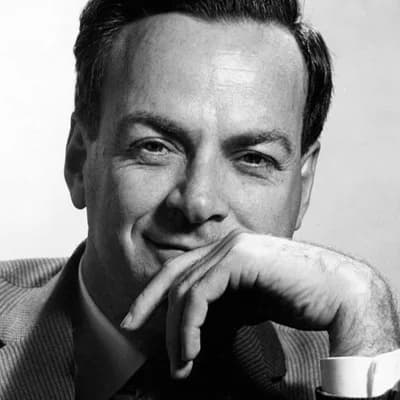
Richard Feynman
Richard Phillips Feynman
physicist
Born 11 May 1918 · Queens, New York, United States · 40.73° N, 73.79° WX
Source: Birth time not documented in publicly accessible records
About this chart
No birth time is documented for this person. The chart therefore shows planetary positions in their signs, the slow aspects between them, and the generational context — but not house placements, the Ascendant, or the Midheaven, which require an accurate birth time. The Moon's sign carries a ±6° margin: if it falls near a sign boundary, the sign could vary. Positions for all other planets are reliable.
Do you have a verified source for this birth time? Share it →
The sky at birth
No birth time is documented for Richard Feynman. The Ascendant, Midheaven, and house positions cannot be determined. The planetary positions below are calculated for noon local time and are accurate to within a fraction of a degree for the slow-moving planets. The Moon's position carries a margin of approximately ±7°.
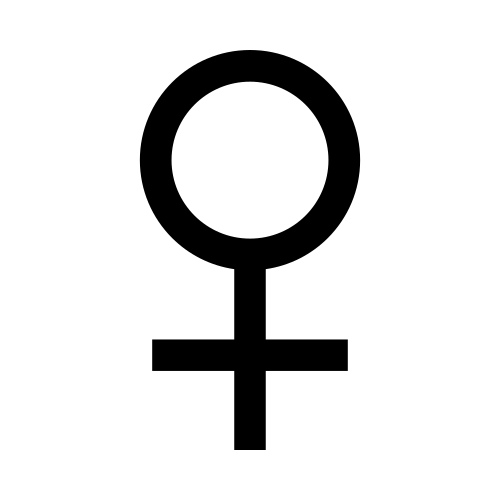
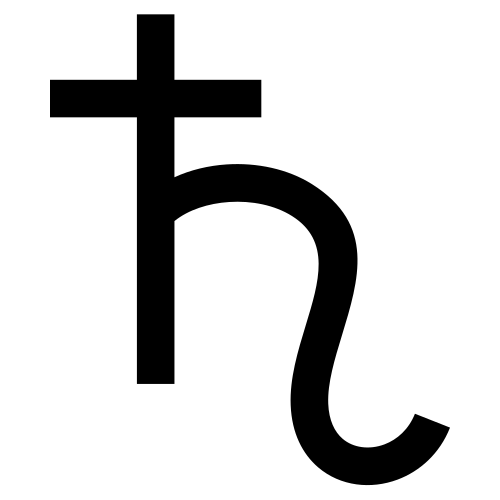
The Sun is at 20°10' Taurus. The Moon is at 5°55' Gemini (noon position, ±7° margin). Mercury is at 0°27' Taurus. Venus is at 5°08' Aries. Mars is at 15°20' Virgo. Jupiter is at 15°47' Gemini. Saturn is at 8°31' Leo. Uranus is at 27°31' Aquarius. Neptune is at 4°29' Leo. Pluto is at 3°58' Cancer.
Mars at 15°20' Virgo squares Jupiter at 15°47' Gemini (0°27') — the tightest major aspect in the chart. Venus at 5°08' Aries trines Neptune at 4°29' Leo (0°39'). The Moon at 5°55' Gemini sextiles Venus (0°47'), though this aspect carries the Moon's ±7° uncertainty. Venus squares Pluto at 3°58' Cancer (1°10'). The Moon sextiles Neptune (1°26'), again with lunar uncertainty. Mercury at 0°27' Taurus sextiles Uranus at 27°31' Aquarius retrograde (2°56'). Venus trines Saturn at 8°31' Leo (3°24'). Saturn conjoins Neptune (4°02'). The Sun at 20°10' Taurus trines Mars (4°50').
The engine also identifies the following tight minor aspects involving asteroids and calculated points: mars square pallas (0.00° sep); sun semi-square venus (0.02° app); mercury sesquiquadrate mars (0.12° app).
The tightest major aspects between planets: Mars square Jupiter (0°27'), Venus trine Neptune (0°39'), Moon sextile Venus (0°47'), Venus square Pluto (1°10'), Moon sextile Neptune (1°26'), Mercury sextile Uranus (2°56'), Venus trine Saturn (3°24'), Saturn conjunction Neptune (4°02'), Sun trine Mars (4°50').
The chart was calculated by Astrian's engine using NASA JPL DE441 ephemerides, sub-arcsecond precision. Timezone: Eastern Daylight Time (America/New_York, UTC −4).
| Planet | Sign | Position |
|---|---|---|
| Sun | Taurus | 20°07' |
| Moon | Gemini | 05°19'±6° |
| Mercury | Taurus | 00°27' |
| Venus | Aries | 05°06' |
| Mars | Virgo | 15°19' |
| Jupiter | Gemini | 15°47' |
| Saturn | Leo | 08°31' |
| Uranus | Aquarius | 27°31' |
| Neptune | Leo | 04°29' |
| Pluto | Cancer | 03°58' |
| Chiron | Aries | 02°10' |
 Sun
Sun Moon
Moon Mercury
 Venus
Venus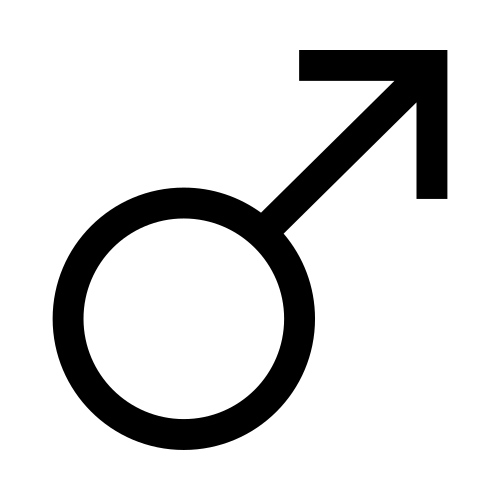 Mars
Mars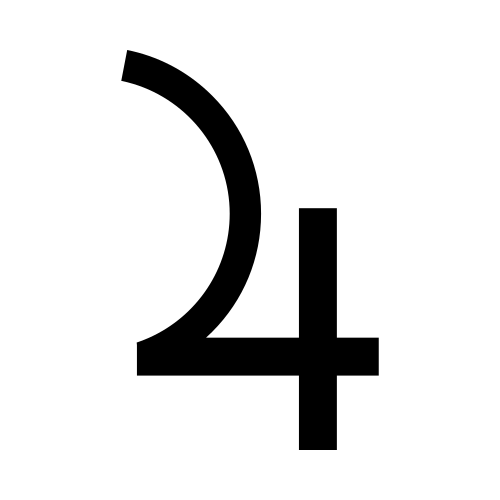 Jupiter
 Saturn
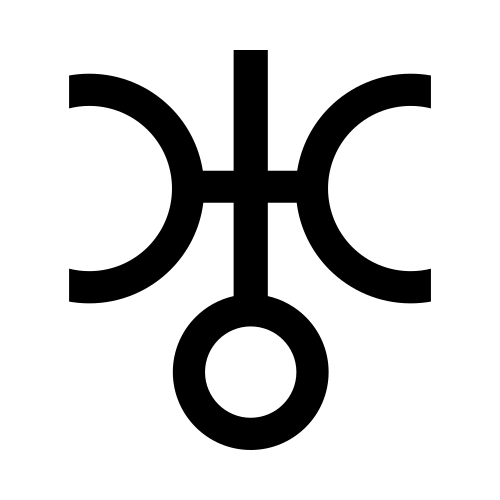 Uranus
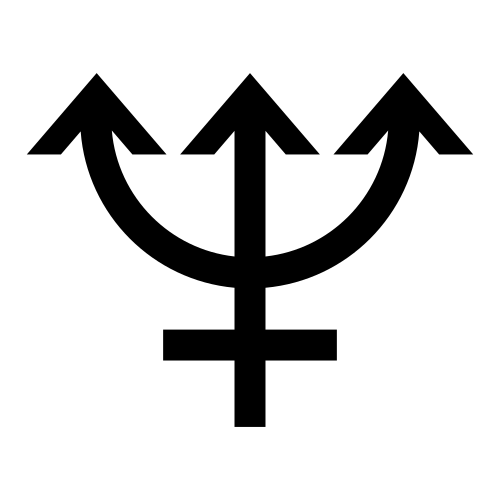 Neptune
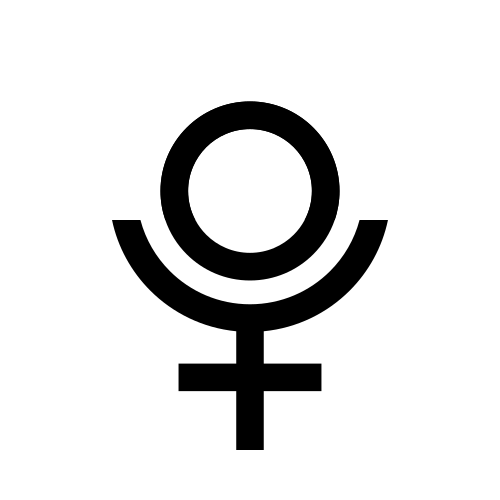 Pluto
Pluto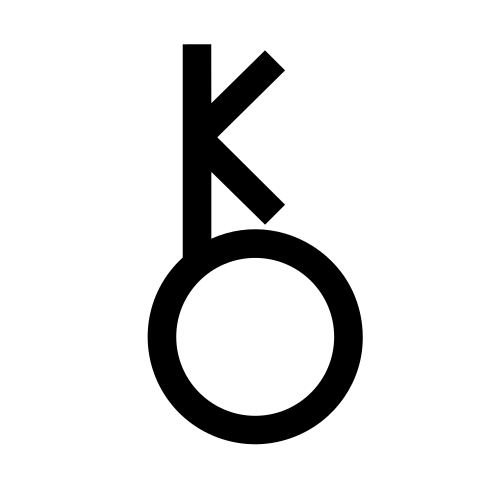 Chiron
Birth time unknown — house positions and Ascendant/MC are not available.
Astronomical context
Those born between approximately 1914 and 1939 carried Pluto in Cancer. This generation lived through two world wars and the Great Depression — a sustained period of upheaval that transformed the meaning of home, national identity, and collective security. They came of age during the Second World War or its immediate aftermath, and built the institutions of the post-war order: the United Nations, NATO, the welfare state, the space programme.
In astrological tradition, Pluto in Cancer is associated with collective transformation of the domains that sign governs: the home, the family, emotional security, the nation, and the structures of belonging through which individuals root themselves in the world. Cancer is the sign of the home, the mother, the homeland. Pluto's transit through Cancer is read, symbolically, as a period when the institutions of domestic security were subjected to destruction and reconstruction on a civilisational scale. The generation that carries this placement grew up watching borders dissolve and reform, families scatter and regroup, and the very idea of safety become something that had to be rebuilt from the wreckage. The symbolic reading is correlative, not causal.
Other profiles in the Astrian collection born under this configuration include Carl Sagan (1934), Martin Luther King (1929), and Nelson Mandela (1918). Richard Feynman, born in 1918, belongs to the early years of this generational wave.
Other profiles from this Pluto in Cancer generation
Symbolic reading
The following describes what classical astrological tradition associates with these configurations. Astrian does not apply these descriptions to the person's biography.
The Sun at 20°10' Taurus is the most prominent structural feature of this chart. Without a documented birth time, there is no Ascendant or Midheaven — the reading is confined to planetary positions by sign and the aspects between planets.
The Moon at 5°55' Gemini represents the noon position; the actual placement falls within approximately 7° on either side. If born early in the day, the Moon could be near the end of Taurus; if born late, in the low teens of Gemini. The Moon's sign placement in Gemini is probable but not absolutely secure for the entire day.
Mercury at 0°27' Taurus, Venus at 5°08' Aries, and Mars at 15°20' Virgo complete the personal planet picture.
### Mars square Jupiter: the restless drive
The chart's tightest major aspect is Mars at 15°20' Virgo squaring Jupiter at 15°47' Gemini, orb 0°27'. Mars governs action, the application of force, and the capacity to cut through resistance. Jupiter governs expansion, meaning, and the impulse to reach beyond the immediate toward the largest possible frame. The square places them in structural tension — the drive to act and the drive to understand pull in different directions and must be negotiated rather than blended.
Mars in Virgo acts through precision, method, and the disciplined application of effort to specific problems. Jupiter in Gemini expands through communication, intellectual breadth, and the pleasure of connecting disparate ideas. The square between them reads as a configuration where the meticulous and the expansive are both present at full force, generating a restlessness that is satisfied neither by detail alone nor by scope alone but only by the attempt to bring both together.
### Venus trine Neptune: the beauty of the unseen
Venus at 5°08' Aries trines Neptune at 4°29' Leo, orb 0°39' — a tight, cooperative aspect that links the sense of value and beauty (Venus) to the register of the ideal, the imaginary, and the dissolution of ordinary boundaries (Neptune). The trine connects them smoothly: the aesthetic sense is drawn naturally toward what lies beyond direct observation, toward what must be inferred, imagined, or intuited rather than simply seen.
Venus in Aries perceives beauty in directness, in the first encounter, in the unmediated impulse. Neptune in Leo operates through the register of creative vision, performance, and the capacity to make the invisible dramatic. The trine between them reads as an aesthetic faculty that responds to the grand and the vivid — the beauty not of the subtle and muted but of the bold and the visionary.
Venus also squares Pluto at 3°58' Cancer (1°10'), adding a dimension of intensity to the aesthetic sense. The beauty that attracts is not decorative but structural — it demands confrontation with what lies beneath the surface.
### Saturn conjunction Neptune in Leo: the disciplined imaginer
Saturn at 8°31' Leo conjoins Neptune at 4°29' Leo, orb 4°02'. Saturn governs structure, discipline, and the patient construction of form. Neptune governs the ideal, the imaginary, and the dissolution of fixed boundaries. The conjunction fuses them in the same sign — the disciplined and the visionary must operate through the same register rather than from separate vantage points.
In Leo, this conjunction operates through the register of creative expression, performance, and the impulse to bring the interior vision into visible, dramatic form. The Saturnian demand for rigour and the Neptunian impulse toward the ideal are both channelled through Leo's need to make things manifest — to turn abstraction into something that can be witnessed.
### Mercury sextile Uranus: the mind that leaps
Mercury at 0°27' Taurus sextiles Uranus at 27°31' Aquarius retrograde, orb 2°56'. Mercury governs perception, articulation, and the capacity to process information. Uranus governs originality, sudden insight, and the capacity to perceive what convention misses. The sextile connects them cooperatively — the analytical faculty and the inventive one work with each other rather than at cross purposes.
Mercury in Taurus processes information through the concrete, the tangible, and the patient accumulation of evidence. Uranus in Aquarius retrograde operates through an internalised drive to rethink systems and challenge established frameworks. The sextile between them reads as a mind that builds its insights from the ground up — beginning with what can be observed and measured, then making the unexpected leap to a framework that reorganises everything.
### Sun trine Mars: the body that follows through
The Sun at 20°10' Taurus trines Mars at 15°20' Virgo, orb 4°50'. The trine connects identity and will cooperatively in earth signs — the sense of self and the capacity for action are aligned rather than in conflict. Taurus gives the identity patience and groundedness; Virgo gives the action precision and method. The trine between them reads as a constitution that can sustain extended effort without exhausting itself, because the effort feels like an expression of the self rather than a demand imposed upon it.
The planetary pattern here is read as a symbolic portrait, not a causal explanation. No planet caused, predicted, or determined any event or characteristic.
Astrology is a symbolic language with 2,500 years of literature. The reading above is interpretive, not explanatory.
Astrian does not claim that the natal chart of Richard Feynman caused or determined any of the above. Astrology is a symbolic system with 2,500 years of literature. Its capacity for retrospective description does not imply explanatory capacity.
A parallel life
The following are verified biographical facts. No connection to the natal chart is implied.
Richard Phillips Feynman was born on 11 May 1918 in Far Rockaway, Queens, New York, the first child of Melville Arthur Feynman, a uniform salesman originally from Minsk, and Lucille Phillips, from a family of Polish-Jewish immigrants. His father, who had wanted to be a scientist but lacked the means, channelled his curiosity into his son from infancy — encouraging him to observe, question, and take nothing on authority. His sister Joan, nine years younger, became a physicist herself.
He attended the Massachusetts Institute of Technology for his undergraduate degree (1935–1939), then Princeton for his doctorate (1939–1942), working under John Archibald Wheeler on a reformulation of classical electrodynamics using the principle of least action. The dissertation was completed in the spring of 1942, and within weeks he was recruited to the Manhattan Project at Los Alamos, where he worked under Hans Bethe in the Theoretical Division on the physics of the implosion bomb. He was twenty-four. At Los Alamos he was known for his ability to perform complex calculations faster than anyone else in the division, and for a habit of picking locks on classified filing cabinets to demonstrate the inadequacy of security protocols.
His first wife, Arline Greenbaum, had been diagnosed with tuberculosis before their marriage. They married in June 1942 despite opposition from his family. She was transferred to a sanatorium in Albuquerque while he worked at Los Alamos, and he visited her regularly by hitchhiking the hundred miles of desert road. She died on 16 June 1945, three weeks before the Trinity test. He was twenty-seven.
After the war, he joined Cornell (1945–1950) and then the California Institute of Technology (1950–1988), where he remained for the rest of his career. In the late 1940s, he developed the path integral formulation of quantum mechanics — a radical reconceptualisation that replaced the classical notion of a single trajectory with a sum over all possible paths a particle could take. He then applied this framework to quantum electrodynamics (QED), producing a complete and self-consistent theory of the interaction between light and matter that resolved the infinities that had plagued earlier formulations. The visual language he invented for these calculations — Feynman diagrams — became the standard notation of particle physics. He shared the Nobel Prize in Physics in 1965 with Julian Schwinger and Sin-Itiro Tomonaga, who had arrived at equivalent formulations by different methods.
The lecture course he gave to Caltech undergraduates in 1961–1963, published as The Feynman Lectures on Physics (1963–1965), remains one of the most widely used physics textbooks in the world. The lectures were famous not for simplifying physics but for reconstructing it from first principles in a way that revealed the underlying architecture of each subject. He also made foundational contributions to the theory of superfluidity, the physics of the weak nuclear force, and the concept of quantum computing, which he proposed in a 1981 lecture at MIT.
He married Mary Louise Bell in 1952; they divorced in 1956. In 1960, he married Gweneth Howarth, a woman from Yorkshire he had met during a conference trip; they had a son, Carl, and adopted a daughter, Michelle. The marriage lasted until his death.
His public reputation grew through a series of anecdotal memoirs — Surely You're Joking, Mr. Feynman! (1985) and What Do You Care What Other People Think? (1988) — that portrayed a life governed by curiosity, irreverence, and an allergy to pretension. In 1986, he served on the presidential commission investigating the Challenger space shuttle disaster. His demonstration of the O-ring failure — dunking a rubber ring in ice water during a televised hearing — became one of the most famous moments in the history of public scientific communication.
He was diagnosed with two rare forms of abdominal cancer (liposarcoma and myxoid liposarcoma) in 1978 and underwent multiple surgeries over the following decade. He died on 15 February 1988 at the UCLA Medical Center in Los Angeles. His last recorded words were: "I'd hate to die twice. It's so boring."
Biographical sources
- Gleick, James. Genius: The Life and Science of Richard Feynman. Pantheon Books 1992
- Mehra, Jagdish. The Beat of a Different Drum: The Life and Science of Richard Feynman. Oxford University Press 1994
This profile presents the sky at the birth of Richard Feynman and verified facts of their biography. Astrian does not claim that astrology has predictive capacity or that the natal chart determines the trajectory of a life. Astrology is a symbolic system with 2,500 years of literature. Its capacity for retrospective description does not imply explanatory capacity.
Calculate your own birth chart with the same NASA JPL DE441 precision.
Calculate my birth chartLast updated: June 12, 2026
Newsletter
A short reading once a month, in your inbox.
A note on the symbolism of the season, recent editorial pieces, and what to look for in next month's sky. No predictions.
Support this project
Independent, no venture funding, no ads. A contribution keeps Astrian precise and free.
Support on Ko-fi (opens in new tab)