PROFILE · SPORTS
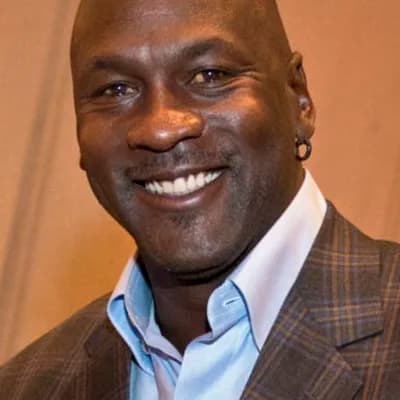
Michael Jordan
Michael Jeffrey Jordan
basketball player
Born 17 February 1963 · Brooklyn, New York, United States · 40.68° N, 73.94° WX
Source: Birth time not documented in publicly accessible records
About this chart
No birth time is documented for this person. The chart therefore shows planetary positions in their signs, the slow aspects between them, and the generational context — but not house placements, the Ascendant, or the Midheaven, which require an accurate birth time. The Moon's sign carries a ±6° margin: if it falls near a sign boundary, the sign could vary. Positions for all other planets are reliable.
Do you have a verified source for this birth time? Share it →
The sky at birth
No birth time is documented for Michael Jordan. The Ascendant, Midheaven, and house positions cannot be determined. The planetary positions below are calculated for noon local time and are accurate to within a fraction of a degree for the slow-moving planets. The Moon's position carries a margin of approximately ±7°.
The Sun is at 28°18' Aquarius. The Moon is at 9°09' Sagittarius (noon position, ±7° margin). Mercury is at 2°34' Aquarius. Venus is at 13°06' Capricorn. Mars is at 9°58' Leo R. Jupiter is at 19°04' Pisces. Saturn is at 15°31' Aquarius. Uranus is at 3°28' Virgo R. Neptune is at 15°39' Scorpio R. Pluto is at 11°11' Virgo R.
Saturn at 15°31' Aquarius squares Neptune at 15°39' Scorpio retrograde (0°08') — the tightest major aspect in the chart, functionally exact. The Moon at 9°09' Sagittarius trines Mars at 9°58' Leo retrograde (0°49'), though this aspect carries the Moon's ±7° uncertainty. Venus at 13°06' Capricorn trines Pluto at 11°11' Virgo retrograde (1°55'). The Moon squares Pluto (2°02'), also within the Moon's uncertainty margin. Venus sextiles Neptune (2°33'). Jupiter at 19°04' Pisces trines Neptune (3°25'). Neptune sextiles Pluto (4°28').
The engine also identifies the following tight minor aspects involving asteroids and calculated points: saturn square neptune (0.14° app); sun quincunx northNode (0.15° sep); sun semi-square venus (0.20° app); mars quincunx chiron (0.27° app).
The tightest major aspects between planets: Saturn square Neptune (0°08'), Moon trine Mars (0°49'), Venus trine Pluto (1°55'), Moon square Pluto (2°02'), Venus sextile Neptune (2°33'), Jupiter trine Neptune (3°25'), Neptune sextile Pluto (4°28').
The chart was calculated by Astrian's engine using NASA JPL DE441 ephemerides, sub-arcsecond precision. Timezone: America/New_York (Eastern Standard Time, UTC −5).
| Planet | Sign | Position |
|---|---|---|
| Sun | Aquarius | 28°18' |
| Moon | Sagittarius | 09°09'±6° |
| Mercury | Aquarius | 02°34' |
| Venus | Capricorn | 13°06' |
| Mars | Leo | 09°58'retrograde |
| Jupiter | Pisces | 19°04' |
| Saturn | Aquarius | 15°31' |
| Uranus | Virgo | 03°28'retrograde |
| Neptune | Scorpio | 15°39'retrograde |
| Pluto | Virgo | 11°11'retrograde |
| Chiron | Pisces | 09°42' |
 Sun
Sun Moon
Moon Mercury
 Venus
Venus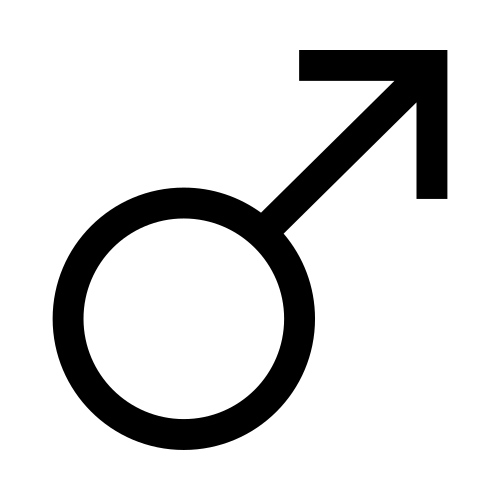 Mars
Mars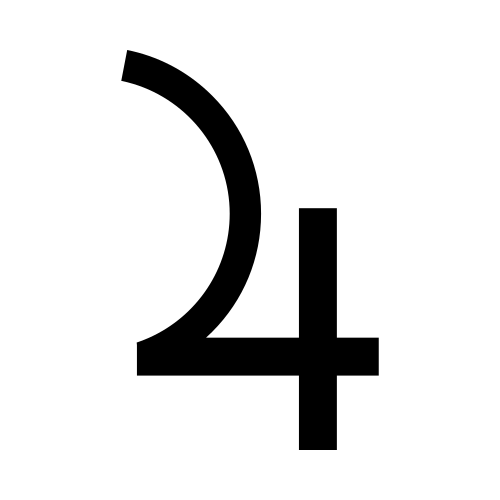 Jupiter
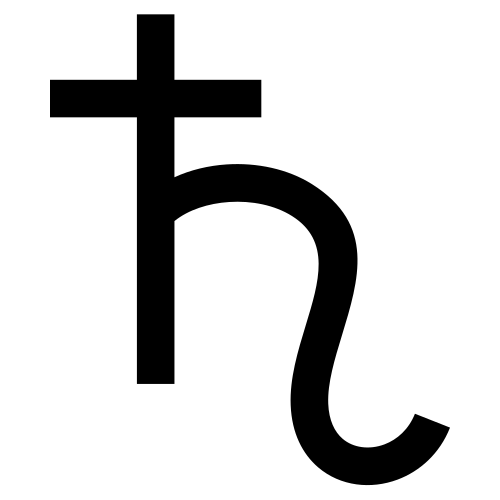 Saturn
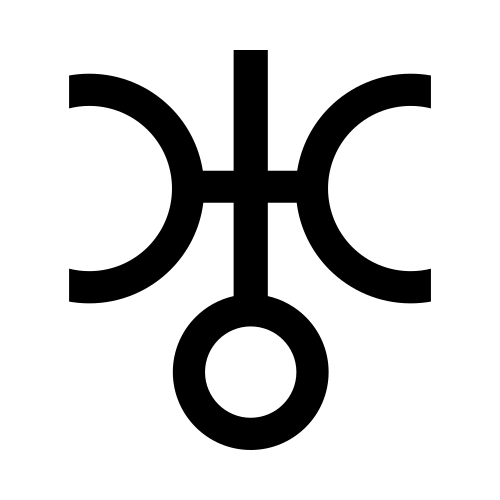 Uranus
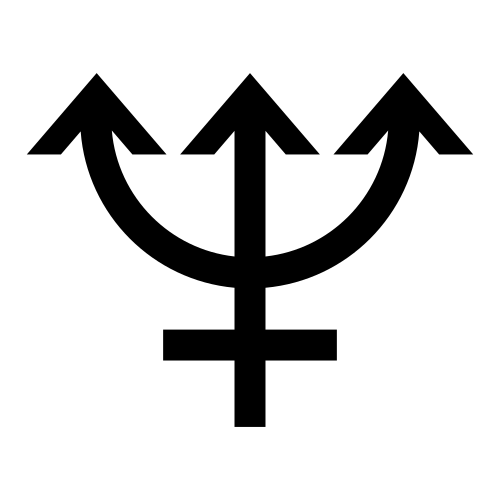 Neptune
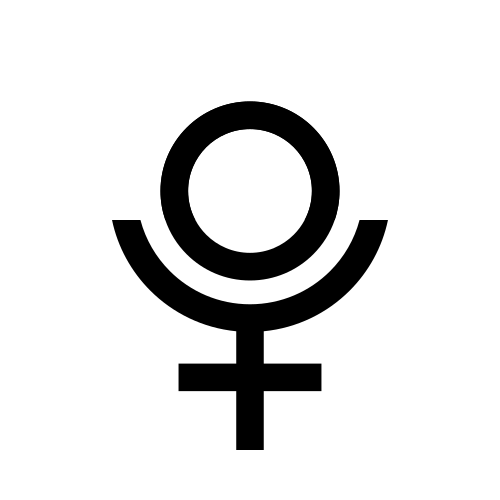 Pluto
Pluto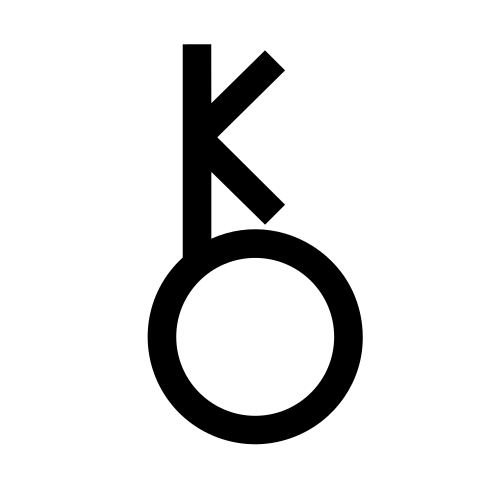 Chiron
Birth time unknown — house positions and Ascendant/MC are not available.
Astronomical context
Those born between approximately 1957 and 1972 carried Pluto in Virgo. This generation grew up in the aftermath of the postwar consensus — during the social upheavals of the 1960s and 1970s, the Vietnam War, the civil rights movement, the sexual revolution, the oil crises, and the disillusionment with institutional authority that followed Watergate. They inherited both the idealism and the wreckage of the generation before.
In astrological tradition, Pluto in Virgo is associated with collective transformation of the domains that sign governs: work, health, service, precision, analysis, and the relationship between the body and its capacities. Virgo is the sign of the craftsman, the analyst, the one who works with detail and who seeks to perfect what is imperfect. Pluto's transit through Virgo is read, symbolically, as a period when the structures of labour, health, and the disciplined use of the body were subjected to deep structural pressure — when the relationship between work and meaning, between the body and its exploitation, between service and power, was transformed. The generation that carries this placement inherited a world where the nature of work itself was being remade. The symbolic reading is correlative, not causal.
Other profiles in the Astrian collection born under this configuration include Diego Maradona (1960) and Zinedine Zidane (1972). Michael Jordan, born in 1963, belongs to the middle years of this generational wave.
Other profiles from this Pluto in Virgo generation
Symbolic reading
The following describes what classical astrological tradition associates with these configurations. Astrian does not apply these descriptions to the person's biography.
The Sun at 28°18' Aquarius is the most prominent structural feature of this chart. Without a documented birth time, there is no Ascendant or Midheaven — the reading is confined to planetary positions by sign and the aspects between planets.
The Moon at 9°09' Sagittarius represents the noon position; the actual placement falls within approximately 7° on either side. If born early in the day, the Moon could be near 2° Sagittarius; if born late, near 16° Sagittarius. The Moon's sign placement in Sagittarius is stable for the entire day.
Mercury at 2°34' Aquarius, Venus at 13°06' Capricorn, and Mars at 9°58' Leo retrograde complete the personal planet picture. The Sun and Mercury in Aquarius, Saturn also in Aquarius — three planets in the sign of the collective, the unconventional, and the systemic. Mars retrograde in Leo, the opposite sign, provides the counterweight: the individual will, turned inward and compressed.
### Saturn square Neptune: structure against dissolution
The chart's tightest major aspect is Saturn at 15°31' Aquarius square Neptune at 15°39' Scorpio retrograde, orb 0°08' — functionally exact, separated by less than half a minute of arc. Saturn governs discipline, structure, limitation, and the acceptance of what is real. Neptune governs the ideal, the transcendent, the dissolving of boundaries, and the capacity to envision what does not yet exist. Their square places them in structural tension: the disciplined and the visionary do not cooperate easily. The friction between them is constant.
Saturn in Aquarius structures the collective — the systems, the teams, the organisations within which individuals operate. Neptune in Scorpio retrograde represents the depth of the ideal, the intensity of the vision, the willingness to descend into the hidden and the psychological in pursuit of something that transcends the material. The square reads as a configuration where the capacity for disciplined, systematic work exists in permanent tension with an intensity of vision and psychological depth that refuses to be contained by systems alone. Neither faculty dominates; the tension between them is the engine.
In a chart without houses or angles, this near-exact square — tighter than one-seventh of a degree — functions as the chart's primary signature.
### Moon trine Mars: feeling and action in fire
The Moon at 9°09' Sagittarius trines Mars at 9°58' Leo retrograde, orb 0°49' — though this aspect carries the Moon's ±7° uncertainty. If the actual birth time places the Moon near its noon position, the emotional faculty (Moon in Sagittarius — the feelings expressed through the register of expansiveness, adventure, and the instinct to aim beyond what is reachable) flows cooperatively with Mars retrograde in Leo (the will to act, turned inward and refined, operating through the register of the sovereign, the performer, and the one who commands the stage). Both are in fire signs; the emotional and the active faculties share the same element. The trine reads as a configuration where feeling and action are naturally aligned — where what is felt is acted upon, and where the action carries the full heat of the emotional investment.
Mars retrograde in Leo is distinctive. Mars in Leo acts through display, through commanding attention, through the assertion of individual dominance. The retrograde condition suggests that this display is not spontaneous but rehearsed, internalised, refined through repetition until the performance becomes indistinguishable from the performer.
### Venus trine Pluto: the aesthetic of intensity
Venus at 13°06' Capricorn trines Pluto at 11°11' Virgo retrograde, orb 1°55'. Venus governs aesthetics, value, and the capacity for pleasure. Pluto governs transformation at the deepest structural level. Their trine connects them cooperatively in earth signs — the material, the physical, the embodied. Venus in Capricorn values discipline, achievement, and what endures. Pluto in Virgo transforms through precision, through the perfection of craft, through the disciplined use of the body.
The trine reads as a configuration where the aesthetic sense (Venus) is fused with transformative depth (Pluto) through the medium of disciplined physical craft. What is valued is not surface beauty but the kind of excellence that emerges from relentless refinement — the beauty of the thing done with absolute precision.
Venus also sextiles Neptune at 15°39' Scorpio retrograde (2°33'), connecting the aesthetic faculty to the visionary. The Venus-Neptune-Pluto network creates a triangular pattern: what is valued (Venus) is informed by both the vision (Neptune) and the transformative depth (Pluto), all operating through the practical, embodied registers of earth and water.
### Moon square Pluto: the emotional undertow
The Moon at 9°09' Sagittarius squares Pluto at 11°11' Virgo retrograde, orb 2°02' — within the Moon's ±7° uncertainty. The square creates tension between the emotional faculty (expansive, adventurous, aimed at the horizon) and the transformative depth (precise, analytical, relentless in its demand for perfection). The reading is one where the emotional life carries an undertow of intensity that the Sagittarian optimism does not fully acknowledge — where beneath the expansiveness there is a compulsive drive to transform through work, through physical discipline, through the perfection of detail.
The planetary pattern here is read as a symbolic portrait, not a causal explanation. No planet caused, predicted, or determined any event or characteristic.
Astrology is a symbolic language with 2,500 years of literature. The reading above is interpretive, not explanatory.
Astrian does not claim that the natal chart of Michael Jordan caused or determined any of the above. Astrology is a symbolic system with 2,500 years of literature. Its capacity for retrospective description does not imply explanatory capacity.
A parallel life
The following are verified biographical facts. No connection to the natal chart is implied.
Michael Jeffrey Jordan was born on 17 February 1963 in Brooklyn, New York, the fourth of five children of James R. Jordan Sr., a General Electric plant supervisor, and Deloris Peoples Jordan, a bank employee. The family moved to Wilmington, North Carolina, when he was a child. His father was murdered during a robbery at a highway rest stop in 1993 — a loss Jordan described as the most devastating of his life.
He was cut from the varsity basketball team at Emsley A. Laney High School as a sophomore. The rejection became the founding myth of his competitive psychology: the slight that was never forgotten, the fuel that was never exhausted. He made the team the following year and grew four inches over the summer. He accepted a scholarship to the University of North Carolina at Chapel Hill, where as a freshman he hit the game-winning shot in the 1982 NCAA championship game against Georgetown. He was named College Player of the Year in 1984.
The Chicago Bulls selected him third overall in the 1984 NBA Draft, behind Hakeem Olajuwon and Sam Bowie. He was named Rookie of the Year. What followed was, by any reasonable measure, the most dominant individual career in the history of professional team sport. Five regular-season MVP awards. Six NBA championships with the Bulls (1991, 1992, 1993, 1996, 1997, 1998). Six Finals MVP awards. Ten scoring titles. A Defensive Player of the Year award. Fourteen All-Star selections. Two Olympic gold medals.
The statistics are overwhelming but insufficient. What distinguished Jordan was not the accumulation of records but the manner in which they were produced. His game was defined by an uncommon fusion of athletic ability and competitive ferocity — the mid-range jump shot, the tongue-wagging drives to the basket, the defensive intensity, the capacity to elevate in the final minutes of a close game and produce performances that defied probability. Game 5 of the 1997 NBA Finals, played with a stomach virus at an altitude of 5,000 feet — "The Flu Game" — became one of the defining images of athletic will in the twentieth century.
His relationship with competition was not healthy in the conventional sense. He was ruthless with teammates, opponents, and himself. He gambled compulsively — on golf, on cards, on anything where winning and losing were at stake. His trash-talking was calculated to destroy the confidence of opponents. His first retirement, in October 1993, was partly a response to his father's murder but was accompanied by persistent reports of gambling debts and an investigation by the NBA that was never fully disclosed. His second career, with the Washington Wizards (2001–2003), was widely regarded as a diminishment — the body could no longer execute what the mind demanded.
What he built off the court was as consequential as what he achieved on it. The partnership with Nike, brokered by agent David Falk and Nike executive Sonny Vaccaro, produced the Air Jordan line — a sneaker brand that transformed the economics of professional sport. By 1986, Air Jordans were generating over $100 million annually. The brand created a template that every subsequent athlete-endorsement deal has attempted to replicate. Jordan's commercial reach made him the most globally recognised athlete of the late twentieth century and demonstrated that the economic value of an individual athlete could exceed the value of the franchise for which he played.
He became majority owner of the Charlotte Hornets (later Bobcats, then Hornets again) in 2010 — the first former player to become principal owner of an NBA franchise. He sold his majority stake in 2023. His net worth, driven primarily by the Jordan Brand royalties and business investments, has been estimated at over $3 billion.
Biographical sources
- Halberstam, David. Playing for Keeps: Michael Jordan and the World He Made. Random House 1999
- La.
This profile presents the sky at the birth of Michael Jordan and verified facts of their biography. Astrian does not claim that astrology has predictive capacity or that the natal chart determines the trajectory of a life. Astrology is a symbolic system with 2,500 years of literature. Its capacity for retrospective description does not imply explanatory capacity.
Related profiles
Calculate your own birth chart with the same NASA JPL DE441 precision.
Calculate my birth chartLast updated: June 12, 2026
Newsletter
A short reading once a month, in your inbox.
A note on the symbolism of the season, recent editorial pieces, and what to look for in next month's sky. No predictions.
Support this project
Independent, no venture funding, no ads. A contribution keeps Astrian precise and free.
Support on Ko-fi (opens in new tab)