PROFILE · FILM & STAGE

Pedro Almodóvar
Pedro Almodóvar Caballero
filmmaker
Born 25 September 1949 · Calzada de Calatrava, Castile–La Mancha, Spain · 38.71° N, 3.77° WX
Source: Birth time not documented in publicly accessible records
About this chart
No birth time is documented for this person. The chart therefore shows planetary positions in their signs, the slow aspects between them, and the generational context — but not house placements, the Ascendant, or the Midheaven, which require an accurate birth time. The Moon's sign carries a ±6° margin: if it falls near a sign boundary, the sign could vary. Positions for all other planets are reliable.
Do you have a verified source for this birth time? Share it →
The sky at birth
No birth time is documented for Pedro Almodóvar. The Ascendant, Midheaven, and house positions cannot be determined. The planetary positions below are calculated for noon local time and are accurate to within a fraction of a degree for the slow-moving planets. The Moon's position carries a margin of approximately ±7°.
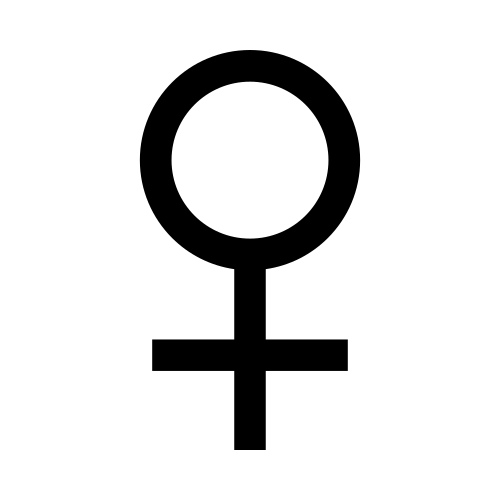
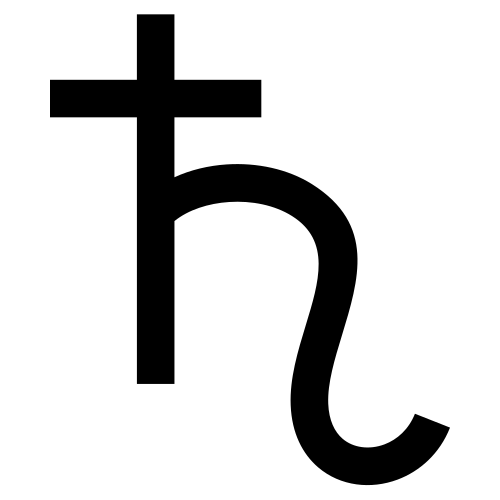
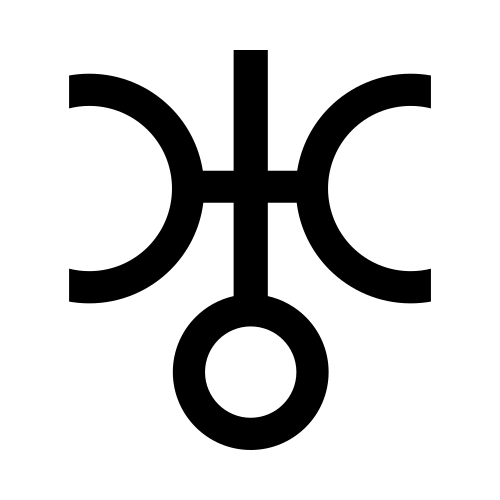
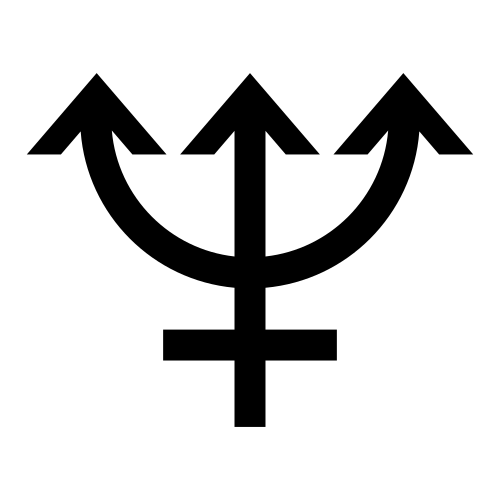
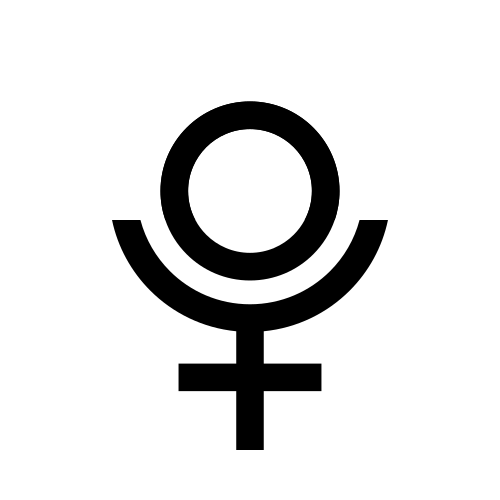
The Sun is at 2°02' Libra. The Moon is at 13°25' Scorpio (noon position, ±7° margin). Mercury is at 18°03' Libra R. Venus is at 12°37' Scorpio. Mars is at 11°20' Leo. Jupiter is at 22°24' Capricorn. Saturn is at 12°26' Virgo. Uranus is at 4°54' Cancer. Neptune is at 14°25' Libra. Pluto is at 17°30' Leo.
The Moon at 13°25' Scorpio conjoins Venus at 12°37' Scorpio (0°48'), though this aspect carries the Moon's ±7° uncertainty. Venus sextiles Saturn at 12°26' Virgo (0°11') — the tightest major aspect in the chart and one of the tightest Venus-Saturn sextiles in the Astrian collection. The Moon sextiles Saturn (0°59'). Venus squares Mars at 11°20' Leo (1°17'). The Moon squares Mars (2°05'). Mercury at 18°03' Libra retrograde sextiles Pluto at 17°30' Leo (0°33'). Mercury conjoins Neptune at 14°25' Libra (3°38'). The Sun at 2°02' Libra squares Uranus at 4°54' Cancer (2°52'). Mars sextiles Neptune (3°05'). The Moon squares Pluto (4°05').
The engine also identifies the following tight minor aspects involving asteroids and calculated points: mercury opposition lilith (0.07° app); uranus quincunx chiron (0.10° sep); saturn semi-sextile ceres (0.12° app).
The tightest major aspects between planets: Venus sextile Saturn (0°11'), Mercury sextile Pluto (0°33'), Moon conjunction Venus (0°48'), Moon sextile Saturn (0°59'), Venus square Mars (1°17'), Moon square Mars (2°05'), Sun square Uranus (2°52'), Mars sextile Neptune (3°05'), Mercury conjunction Neptune (3°38'), Moon square Pluto (4°05').
The chart was calculated by Astrian's engine using NASA JPL DE441 ephemerides, sub-arcsecond precision. Timezone: Central European Summer Time (Europe/Madrid, UTC +2).
| Planet | Sign | Position |
|---|---|---|
| Sun | Libra | 01°59' |
| Moon | Scorpio | 12°48'±6° |
| Mercury | Libra | 18°04'retrograde |
| Venus | Scorpio | 12°34' |
| Mars | Leo | 11°18' |
| Jupiter | Capricorn | 22°24' |
| Saturn | Virgo | 12°26' |
| Uranus | Cancer | 04°54' |
| Neptune | Libra | 14°25' |
| Pluto | Leo | 17°30' |
| Chiron | Sagittarius | 05°00' |
 Sun
Sun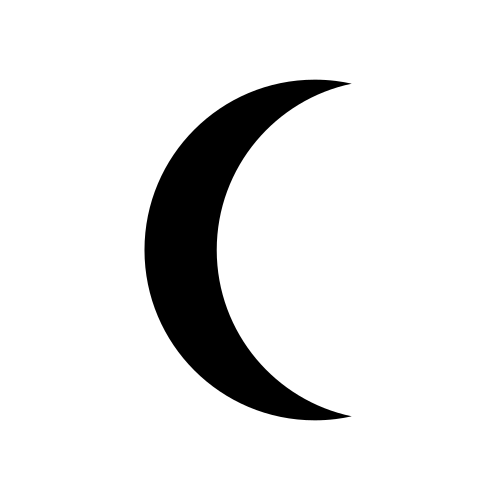 Moon
Moon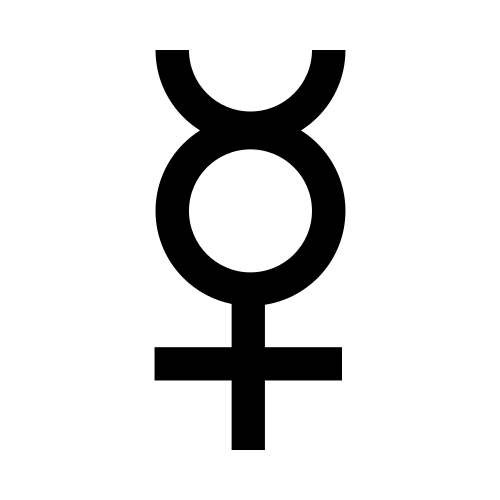 Mercury
 Venus
Venus Mars
Mars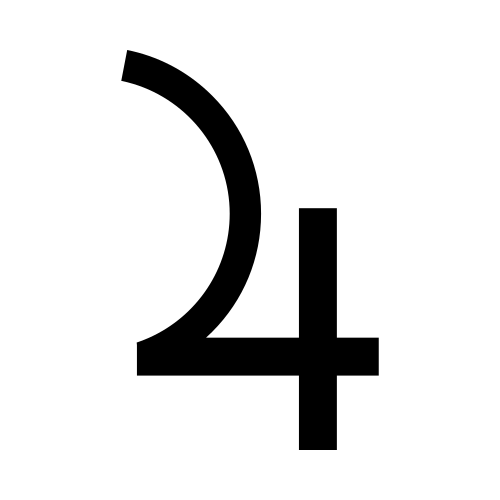 Jupiter
 Saturn
 Uranus
 Neptune
 Pluto
Pluto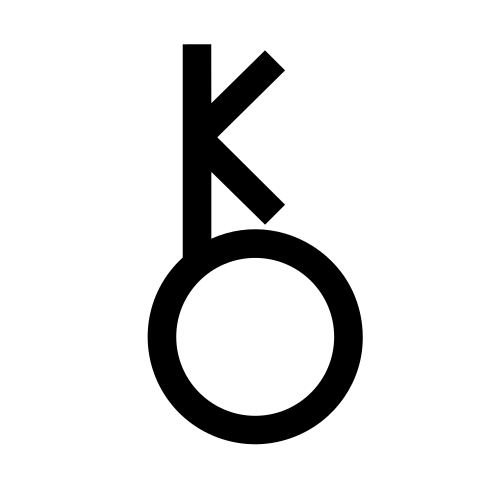 Chiron
Birth time unknown — house positions and Ascendant/MC are not available.
Astronomical context
Those born between approximately 1939 and 1957 carried Pluto in Leo. This generation came of age during the postwar reconstruction, the Cold War, the nuclear arms race, the space race, and the great expansion of mass media — cinema, television, rock and roll. They inherited the world that the Second World War had broken and rebuilt, and they shaped the culture of the second half of the twentieth century.
In astrological tradition, Pluto in Leo is associated with collective transformation of the domains that sign governs: creativity, self-expression, performance, the dramatic, the heroic, the individual will. Leo is the sign of the creator, the performer, the one who places the self at the centre of the stage. Pluto's transit through Leo is read, symbolically, as a period when the structures of creative expression, individual authority, and the relationship between the performer and the audience were subjected to deep structural pressure — the old frameworks of how art was made, how authority was exercised, and how the individual related to the collective were torn apart and rebuilt. The generation that carries this placement inherited a world where the nature of individual expression itself was being radically transformed. The symbolic reading is correlative, not causal.
Other profiles in the Astrian collection born under this configuration include John Lennon (1940), Martin Scorsese (1942), and Meryl Streep (1949). Pedro Almodóvar, born in 1949, belongs to the later years of this generational wave.
Other profiles from this Pluto in Leo generation
Symbolic reading
The following describes what classical astrological tradition associates with these configurations. Astrian does not apply these descriptions to the person's biography.
The Sun at 2°02' Libra is the most prominent structural feature of this chart. Without a documented birth time, there is no Ascendant or Midheaven — the reading is confined to planetary positions by sign and the aspects between planets.
The Moon at 13°25' Scorpio represents the noon position; the actual placement falls within approximately 7° on either side. If born early in the day, the Moon could be in the low single digits of Scorpio; if born late, near 20°. The Moon's sign placement in Scorpio is secure for the entire day.
Mercury at 18°03' Libra retrograde, Venus at 12°37' Scorpio, and Mars at 11°20' Leo complete the personal planet picture.
### Venus sextile Saturn: beauty through craft
The chart's defining feature is Venus at 12°37' Scorpio sextiling Saturn at 12°26' Virgo, orb 0°11' — functionally exact. Venus governs aesthetics, the sense of beauty and value, and the capacity to attract. Saturn governs form, limitation, discipline, and the demand that things be built to last. The sextile connects them cooperatively: the aesthetic faculty and the structuring principle work together rather than at cross purposes.
Venus in Scorpio perceives beauty in the raw, the hidden, the emotionally extreme — in what polite culture turns away from. Saturn in Virgo demands craft, precision, and economy of means. The sextile reads as a constitution where the aesthetic vision finds its form through meticulous work: beauty is not stumbled upon but constructed, and the construction is invisible in the finished object. The eye is drawn to the extreme; the hand that organises the extreme is disciplined.
### Moon conjunction Venus in Scorpio: feeling and beauty fused
The Moon at 13°25' Scorpio conjoins Venus at 12°37' Scorpio, orb 0°48' — though this aspect carries the Moon's ±7° uncertainty. If the actual birth time places the Moon near its noon position, this is a tight conjunction: the emotional faculty (Moon) and the aesthetic faculty (Venus) are fused in Scorpio. What is felt is simultaneously experienced as beautiful; what is beautiful carries the weight of feeling. The conjunction in Scorpio locates both faculties in the register of intensity, depth, the taboo, and the transformation that comes from confronting what has been hidden.
The Moon-Venus conjunction also sextiles Saturn (Moon sextile Saturn at 0°59'), extending the Venus-Saturn link to the emotional life. Emotion, beauty, and discipline form a cooperative pattern: the feelings are intense, the aesthetic is extreme, and both are given form through craft.
### Venus square Mars: desire against display
Venus at 12°37' Scorpio squares Mars at 11°20' Leo, orb 1°17'. Venus governs what is desired and what is found beautiful. Mars governs action, assertion, and the drive to impose the will. The square places them in friction: the desire for beauty through depth and the hidden (Scorpio) conflicts with the drive to act through spectacle and dramatic display (Leo). The square generates energy precisely because the conflict cannot be resolved — the pull toward the raw and the private is interrupted by the demand for theatrical expression, and the theatricality is charged with the intensity of what it is forced to contain.
Mars in Leo also squares the Moon in Scorpio (2°05', with lunar uncertainty), extending the tension into the emotional register. The emotional life, the aesthetic sense, and the drive to perform are locked in a productive friction that generates creative force.
### Sun square Uranus: identity disrupted
The Sun at 2°02' Libra squares Uranus at 4°54' Cancer, orb 2°52'. The Sun governs identity and the central organising principle of the self. Uranus governs the unexpected, originality, and the drive to break established patterns. The square forces them into confrontation: the identity cannot settle into the harmony that Libra seeks, because Uranus continually disrupts it from the direction of Cancer — the register of home, family, roots, and belonging. The reading is one of a self that is perpetually displaced from its origins, and that finds its identity precisely in the act of displacement.
### Mercury conjunction Neptune: the imaginal voice
Mercury at 18°03' Libra retrograde conjoins Neptune at 14°25' Libra, orb 3°38'. Mercury governs communication, the organisation of thought, and the naming of things. Neptune governs the imaginal, the dissolved, and the ideal. The conjunction fuses them: the communicative faculty operates in the register of dream, fantasy, and the dissolution of boundaries between the real and the imagined. Mercury retrograde in Libra processes through relationship and aesthetic categories, turning back over what has been said and reconsidering it. Neptune in Libra idealises beauty and relationship. The conjunction reads as a voice that speaks in images rather than arguments, and that finds its clarity in the suspension of the distinction between the real and the invented.
Mercury also sextiles Pluto at 17°30' Leo (0°33'), linking the communicative and imaginal faculties to the transformative and the powerful. What is imagined carries the force of depth; what is communicated reaches into the hidden and brings it to the surface.
The planetary pattern here is read as a symbolic portrait, not a causal explanation. No planet caused, predicted, or determined any event or characteristic.
Astrology is a symbolic language with 2,500 years of literature. The reading above is interpretive, not explanatory.
Astrian does not claim that the natal chart of Pedro Almodóvar caused or determined any of the above. Astrology is a symbolic system with 2,500 years of literature. Its capacity for retrospective description does not imply explanatory capacity.
A parallel life
The following are verified biographical facts. No connection to the natal chart is implied.
Pedro Almodóvar Caballero was born on 25 September 1949 in Calzada de Calatrava, a small town in the province of Ciudad Real, in the region of La Mancha. His father, Antonio Almodóvar Rojo, was a muleteer and later a winemaker; his mother, Francisca Caballero, managed the household and ran small commercial operations to supplement the family income. The family was poor, rural, and Catholic in the deepest sense of 1950s Spain under Franco.
When he was eight, the family moved to Cáceres, in Extremadura, where he attended a religious school run by Salesian and Franciscan orders. He would later describe his years in those schools as formative in an inverse sense — the ritualism, the repression, the theatricality of Catholic liturgy, and the hypocrisy he perceived between doctrine and practice all became raw material. He discovered cinema in the parish halls where priests screened films on weekends, and the gap between the moral instruction he received and the emotional worlds the films revealed struck him as the fundamental subject of his later work.
He arrived in Madrid in 1967, at eighteen, with no money and no connections. Franco had closed the Escuela Oficial de Cinematografía in 1969, eliminating any possibility of formal film training. He found work at Telefónica, the national telephone company, as an administrative assistant — a position he held for twelve years. The salary provided the financial base from which he made his first films. He spent his evenings and weekends writing, performing with the underground theatre group Los Goliardos, publishing stories and comic strips in countercultural magazines, and shooting Super 8 short films that circulated in Madrid's emerging underground scene.
The death of Franco in 1975 and the transition to democracy unleashed a period of cultural explosion known as La Movida Madrileña — a movement of musicians, filmmakers, photographers, designers, and performers who occupied the spaces that forty years of dictatorship had kept sealed. Almodóvar was at the centre of it, performing as part of a punk-glam duo with Fabio McNamara and establishing himself as a figure whose public persona was inseparable from his art.
His first feature, Pepi, Luci, Bom y otras chicas del montón (1980), was shot on 16mm over eighteen months, funded by small contributions and screened in alternative circuits. It was raw, transgressive, and technically rough — and it announced a sensibility. Laberinto de pasiones (1982) and Entre tinieblas (1983) followed in rapid succession. ¿Qué he hecho yo para merecer esto? (1984) marked his first significant commercial success, a neorealist comedy about a working-class housewife in a Madrid housing block that demonstrated he could work within genre conventions without losing his subversive edge.
In 1986, he and his brother Agustín founded El Deseo, the production company that has produced all his subsequent films and given him complete creative control — an arrangement almost without precedent in European cinema at his scale.
La ley del deseo (1987) was one of the first Spanish films to present queer desire without apology, moral framing, or tragedy. Mujeres al borde de un ataque de nervios (1988) was the international breakthrough — a screwball comedy of escalating hysteria that earned an Academy Award nomination for Best Foreign Language Film and established him as the most visible Spanish filmmaker since Buñuel.
The films of the 1990s deepened and complicated the work. Átame! (1990), Tacones lejanos (1991), Kika (1993), La flor de mi secreto (1995), and Carne trémula (1997) moved between melodrama, thriller, and comedy, frequently within the same film. He was building a world: a Spain of bold colours, strong women, damaged men, maternal sacrifice, sexual transgression, and a tenderness that persisted beneath the surface provocations.
Todo sobre mi madre (1999) won the Academy Award for Best Foreign Language Film, the BAFTA, the Golden Globe, the César, and the Best Director prize at Cannes. It was the film that synthesised everything he had been building — a story of loss, identity, performance, and motherhood told through a structure that incorporated Truman Capote, Tennessee Williams, and All About Eve into a distinctly Spanish emotional register.
Hable con ella (2002) won the Academy Award for Best Original Screenplay — the first Spanish-language film to win in that category. Volver (2006) returned to La Mancha and the world of his childhood. La piel que habito (2011), adapted from Thierry Jonquet's novel Mygale, was his darkest film. Julieta (2016) stripped the palette to cold tones and quiet anguish. Dolor y gloria (2019) was widely understood as autobiographical — Antonio Banderas, in a career-redefining performance, played a filmmaker in physical and creative decline who revisits the defining relationships and experiences of his life. Madres paralelas (2021) wove a story of maternity together with Spain's unresolved reckoning with the mass graves of the Civil War.
La habitación de al lado (2024), his first English-language film, starring Tilda Swinton and Julianne Moore, won the Golden Lion at the Venice Film Festival.
Across four decades and more than twenty features, his work has been defined by saturated colour, melodramatic structure used with full formal awareness, strong female protagonists, queer narratives presented without special pleading, and an emotional directness that bypasses irony without becoming naive. His recurring collaborators — Antonio Banderas, Penélope Cruz, Carmen Maura, Rossy de Palma, Marisa Paredes — constitute something closer to a repertory company than a casting list.
He has never married and has no children. He lives in Madrid.
Biographical sources
- Strauss, Frédéric. Almodóvar on Almodóvar. Faber and Faber, revised edition 2006
- D'Lugo, Marvin. Pedro Almodóvar. University of Illinois Press 2006
This profile presents the sky at the birth of Pedro Almodóvar and verified facts of their biography. Astrian does not claim that astrology has predictive capacity or that the natal chart determines the trajectory of a life. Astrology is a symbolic system with 2,500 years of literature. Its capacity for retrospective description does not imply explanatory capacity.
Related profiles
Calculate your own birth chart with the same NASA JPL DE441 precision.
Calculate my birth chartLast updated: June 12, 2026
Newsletter
A short reading once a month, in your inbox.
A note on the symbolism of the season, recent editorial pieces, and what to look for in next month's sky. No predictions.
Support this project
Independent, no venture funding, no ads. A contribution keeps Astrian precise and free.
Support on Ko-fi (opens in new tab)