PROFILE · FILM & STAGE
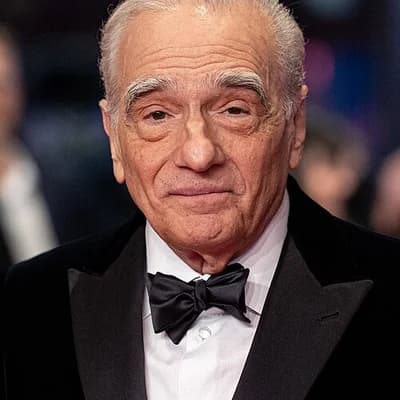
Martin Scorsese
Martin Charles Scorsese
filmmaker
Born 17 November 1942 · Queens, New York, United States · 40.73° N, 73.79° WX
Source: Birth time not documented in publicly accessible records
About this chart
No birth time is documented for this person. The chart therefore shows planetary positions in their signs, the slow aspects between them, and the generational context — but not house placements, the Ascendant, or the Midheaven, which require an accurate birth time. The Moon's sign carries a ±6° margin: if it falls near a sign boundary, the sign could vary. Positions for all other planets are reliable.
Do you have a verified source for this birth time? Share it →
The sky at birth
No birth time is documented for Martin Scorsese. The Ascendant, Midheaven, and house positions cannot be determined. The planetary positions below are calculated for noon local time and are accurate to within a fraction of a degree for the slow-moving planets. The Moon's position carries a margin of approximately ±7°.
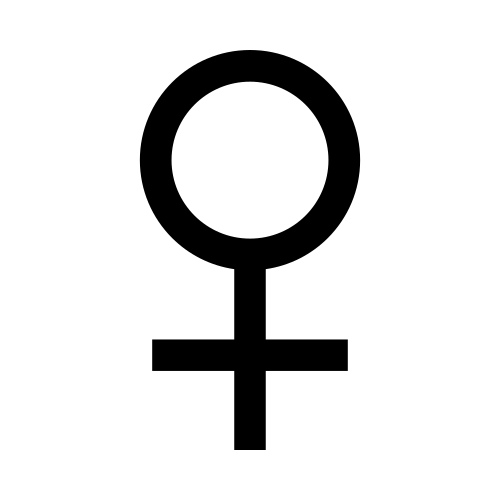
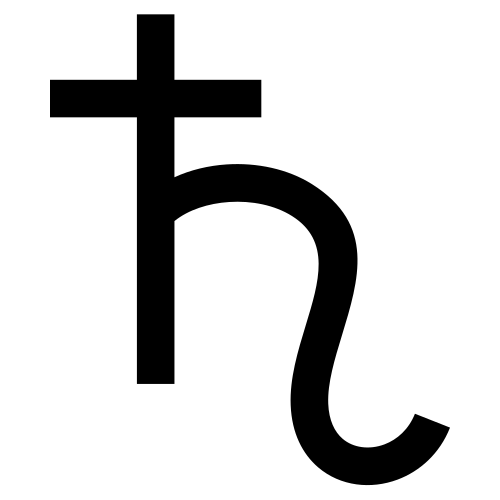
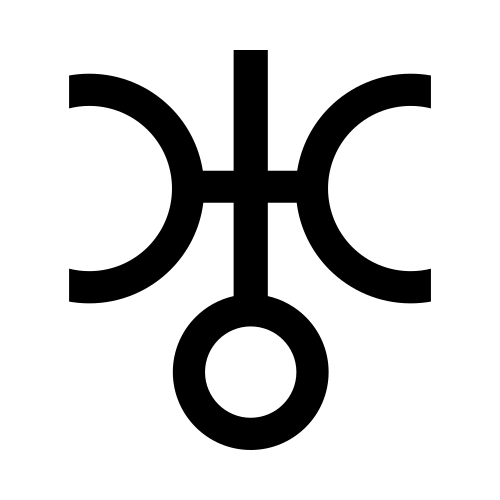
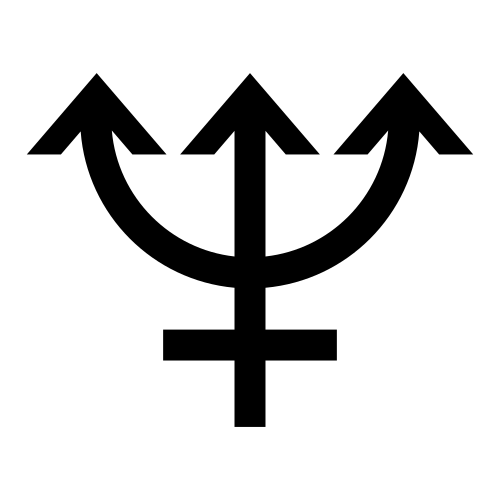
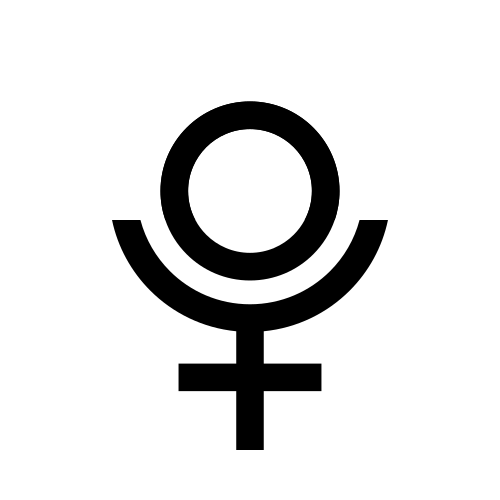
The Sun is at 24°43' Scorpio. The Moon is at 24°48' Pisces (noon position, ±7° margin). Mercury is at 17°02' Scorpio. Venus is at 25°01' Scorpio. Mars is at 10°40' Scorpio. Jupiter is at 25°11' Cancer R. Saturn is at 10°10' Gemini R. Uranus is at 2°53' Gemini R. Neptune is at 1°26' Libra. Pluto is at 7°14' Leo R.
The Sun at 24°43' Scorpio trines the Moon at 24°48' Pisces (0°05') — one of the tightest Sun-Moon trines in the Astrian collection. Venus at 25°01' Scorpio trines Jupiter at 25°11' Cancer retrograde (0°10'). The Sun conjoins Venus (0°18'). The Moon trines Venus (0°13') and trines Jupiter (0°23'). The Sun trines Jupiter (0°27'). Together, these four bodies — Sun and Venus at 24–25° Scorpio, Moon at 24° Pisces, Jupiter at 25° Cancer — form a grand water trine with all angles within half a degree. Mars at 10°40' Scorpio squares Pluto at 7°14' Leo retrograde (3°26'). Uranus at 2°53' Gemini retrograde trines Neptune at 1°26' Libra (1°27'). Saturn at 10°10' Gemini retrograde sextiles Pluto (2°56').
The engine also identifies the following tight minor aspects involving asteroids and calculated points: jupiter semi-square saturn (0.02° sep); moon trine venus (0.21° app).
The tightest major aspects between planets: Sun trine Moon (0°05'), Venus trine Jupiter (0°10'), Moon trine Venus (0°13'), Sun conjunction Venus (0°18'), Moon trine Jupiter (0°23'), Sun trine Jupiter (0°27'), Uranus trine Neptune (1°27'), Saturn sextile Pluto (2°56'), Mars square Pluto (3°26').
The chart was calculated by Astrian's engine using NASA JPL DE441 ephemerides, sub-arcsecond precision. Timezone: Eastern War Time (America/New_York, UTC −4).
| Planet | Sign | Position |
|---|---|---|
| Sun | Scorpio | 24°40' |
| Moon | Pisces | 24°15'±6° |
| Mercury | Scorpio | 16°58' |
| Venus | Scorpio | 24°58' |
| Mars | Scorpio | 10°38' |
| Jupiter | Cancer | 25°11'retrograde |
| Saturn | Gemini | 10°10'retrograde |
| Uranus | Gemini | 02°53'retrograde |
| Neptune | Libra | 01°26' |
| Pluto | Leo | 07°14'retrograde |
| Chiron | Leo | 28°45' |
 Sun
Sun Moon
Moon Mercury
 Venus
Venus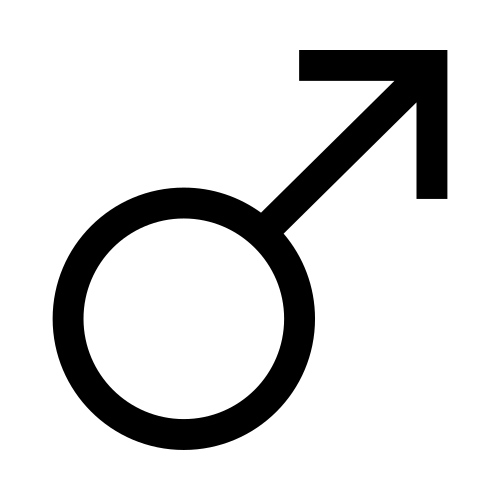 Mars
Mars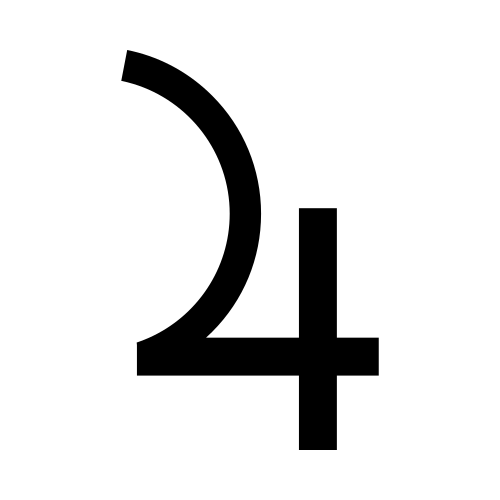 Jupiter
 Saturn
 Uranus
 Neptune
 Pluto
Pluto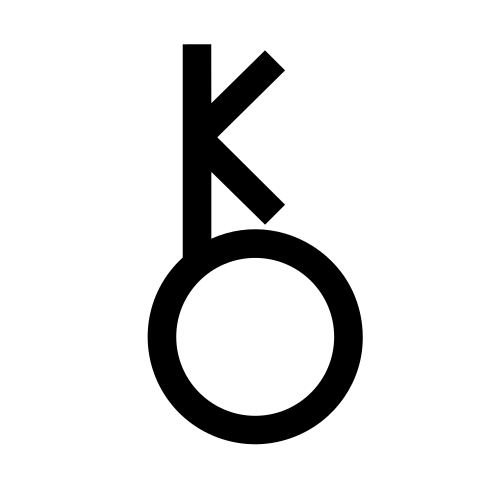 Chiron
Birth time unknown — house positions and Ascendant/MC are not available.
Astronomical context
Those born between approximately 1939 and 1957 carried Pluto in Leo. This generation witnessed the post-war reconstruction of the global order and the rise of mass culture, consumer capitalism, and the first age of television. They came of age during the cultural upheavals of the 1960s and built much of the infrastructure of popular culture, from rock music to the New Hollywood cinema to the social movements that redefined the relationship between the individual and the state.
In astrological tradition, Pluto in Leo is associated with collective transformation of the domains that sign governs: creative self-expression, the ego, the performative, the dramatic, and the structures through which individuals project their identity onto the world. Leo is the sign of the performer, the creator, the king. Pluto's transit through Leo is read, symbolically, as a period when the very concept of individual expression was submitted to deep structural pressure — the old frameworks of who could create, perform, and command attention were broken apart and rebuilt. The generation that carries this placement inherited a world where the amplification of the individual voice through mass media had become the dominant cultural force. The symbolic reading is correlative, not causal.
Other profiles in the Astrian collection born under this configuration include John Lennon (1940), Bob Marley (1945), Freddie Mercury (1946), David Bowie (1947), Meryl Streep (1949), and Tom Hanks (1956). Martin Scorsese, born in 1942, belongs to the early years of this generational wave.
Other profiles from this Pluto in Leo generation
Symbolic reading
The following describes what classical astrological tradition associates with these configurations. Astrian does not apply these descriptions to the person's biography.
The Sun at 24°43' Scorpio is the most prominent structural feature of this chart. Without a documented birth time, there is no Ascendant or Midheaven — the reading is confined to planetary positions by sign and the aspects between planets.
The Moon at 24°48' Pisces represents the noon position; the actual placement falls within approximately 7° on either side. If born early in the day, the Moon could be in the upper teens of Pisces; if born late, in the low degrees of Aries. The Moon's sign placement in Pisces is probable for most of the day but not absolutely secure at its boundaries.
Mercury at 17°02' Scorpio, Venus at 25°01' Scorpio, and Mars at 10°40' Scorpio complete the personal planet picture — and all three join the Sun in Scorpio, creating a four-planet stellium spanning 14° of the sign.
### The grand water trine
The chart's most extraordinary structural feature is a grand trine in water signs involving four bodies, all within half a degree of exact aspect. The Sun at 24°43' Scorpio and Venus at 25°01' Scorpio (conjunct at 0°18') occupy one vertex. The Moon at 24°48' Pisces occupies the second. Jupiter at 25°11' Cancer retrograde occupies the third. Every trine and conjunction in this configuration is within 0°27' of exact: Sun trine Moon 0°05', Venus trine Jupiter 0°10', Moon trine Venus 0°13', Sun conjunction Venus 0°18', Moon trine Jupiter 0°23', Sun trine Jupiter 0°27'.
In astrological tradition, a grand trine forms when three points occupy three signs of the same element, creating a closed triangular circuit of 120° aspects. Water governs emotion, intuition, the interior life, and the capacity to access what is felt rather than what is articulated. A grand trine in water is read as a configuration where emotional energy flows without obstruction — the feeling life, the intuitive faculty, and the capacity to inhabit emotional states operate as a self-sustaining circuit.
The specific planets in this trine amplify its significance. The Sun (identity) and Venus (aesthetics, the sense of beauty and connection) occupy Scorpio — the sign of depth, intensity, and the encounter with what lies beneath the surface. The Moon (emotion, the interior life) occupies Pisces — the sign of the imaginary, the empathic, and the dissolution of the boundary between self and other. Jupiter (expansion, meaning, the impulse toward the larger frame) occupies Cancer retrograde — the sign of home, memory, and the structures of belonging. The grand trine links identity-and-aesthetics in Scorpio to the emotional interior in Pisces to the expanded sense of home and belonging in Cancer. Everything flows.
The Sun-Venus conjunction at 0°18' deserves separate attention. Venus governs the sense of beauty, value, and the capacity to attract and be attracted. Conjoined with the Sun in Scorpio within a fifth of a degree, the identity and the aesthetic sense are fused — the sense of who one is cannot be separated from the sense of what is beautiful, and both are directed through Scorpio's register of depth, intensity, and the refusal to look away.
### The four-planet Scorpio stellium
Four bodies occupy Scorpio: Mars at 10°40', Mercury at 17°02', the Sun at 24°43', and Venus at 25°01'. This 14° arc through a single sign is a structural feature independent of the birth time. Unlike a stellium confined to personal planets, this one spans from Mars (action, force, the capacity for confrontation) through Mercury (perception, articulation) to the Sun-Venus conjunction (identity fused with aesthetics).
Scorpio governs depth, intensity, the encounter with what is hidden, the psychology of power, and transformation through confrontation rather than evasion. Four bodies concentrated in this sign direct the entire personal apparatus — action, perception, identity, and the sense of beauty — through a single register: the demand to go beneath the surface.
Mars at 10°40' Scorpio stands somewhat apart from the Sun-Venus-Mercury cluster, connected to the rest of the stellium through Mercury but operating more independently. Mars in Scorpio acts with intensity, persistence, and the willingness to enter territory that others avoid.
### Mars square Pluto: the confrontation with power
Mars at 10°40' Scorpio squares Pluto at 7°14' Leo retrograde, orb 3°26'. Mars governs action, the application of force, and the capacity for confrontation. Pluto governs transformation, power, and the encounter with what lies beneath the surface. The square places them in structural tension — the will to act collides with the structures of power, and the confrontation generates intensity that must be discharged rather than contained.
Mars in Scorpio acts through depth and persistence; Pluto in Leo retrograde operates through an internalised relationship with creative authority and the dramatic. The square reads as a configuration where the drive to create is inseparable from a confrontation with power — the power of institutions, of tradition, of the forces that determine who is permitted to make what and how.
### Uranus trine Neptune: the generational backdrop
Uranus at 2°53' Gemini retrograde trines Neptune at 1°26' Libra, orb 1°27'. This is a slow-moving aspect shared by an entire cohort born in the early 1940s, forming the generational backdrop against which the personal planets operate. Uranus (originality, disruption) in cooperative aspect with Neptune (the ideal, the imaginary) reads as a generational signature of creative innovation in the service of a vision — the impulse to change the form through which the ideal is expressed.
The planetary pattern here is read as a symbolic portrait, not a causal explanation. No planet caused, predicted, or determined any event or characteristic.
Astrology is a symbolic language with 2,500 years of literature. The reading above is interpretive, not explanatory.
Astrian does not claim that the natal chart of Martin Scorsese caused or determined any of the above. Astrology is a symbolic system with 2,500 years of literature. Its capacity for retrospective description does not imply explanatory capacity.
A parallel life
The following are verified biographical facts. No connection to the natal chart is implied.
Martin Charles Scorsese was born on 17 November 1942 in Queens, New York, the second son of Charles Scorsese, a clothes presser in the garment district, and Catherine Cappa, a seamstress. Both parents were of Sicilian descent. The family moved to Elizabeth Street in Manhattan's Little Italy when he was three, and the neighbourhood — its rituals, its violence, its claustrophobic intimacy — became the raw material of much of his subsequent work.
He suffered from severe asthma as a child, which kept him out of the street games that defined his peers' social world and pushed him toward two indoor obsessions: cinema and the Catholic Church. He attended nearly every film shown at the local theatres and at one point considered entering the priesthood. He enrolled in the seminary preparatory programme at Cathedral College but was expelled after a year. The tension between the sacred and the profane, between guilt and redemption, between the desire for transcendence and the pull of the street, runs through his work from first film to last.
He studied film at New York University's Tisch School of the Arts, where he completed both his bachelor's (1964) and master's (1966) degrees. His student film It's Not Just You, Murray! (1964) already showed the kinetic camera movement, the rock-and-roll soundtrack, and the moral ambiguity that would define his mature style. He taught at NYU while making his first features: Who's That Knocking at My Door (1967) and Boxcar Bertha (1972).
Mean Streets (1973) — shot on a small budget in Little Italy and Los Angeles — was the film that announced him. Harvey Keitel played Charlie, a small-time hood caught between loyalty to the neighbourhood and the dim awareness that the neighbourhood was destroying him. Robert De Niro played Johnny Boy, the reckless friend whose chaos Charlie cannot stop absorbing. The film established the partnership with De Niro that would produce some of the most important work in American cinema.
Taxi Driver (1976), written by Paul Schrader, cast De Niro as Travis Bickle, a Vietnam veteran drifting through a nocturnal New York of violence and alienation. The film won the Palme d'Or at Cannes and became one of the defining works of the New Hollywood era. Raging Bull (1980), based on the autobiography of middleweight boxer Jake LaMotta, was shot in black and white and is widely regarded as one of the greatest films ever made. De Niro gained sixty pounds to play the ageing LaMotta and won the Academy Award for Best Actor.
The King of Comedy (1982) and After Hours (1985) explored darker veins of comedy and paranoia. The Last Temptation of Christ (1988) provoked international protest for its portrayal of Jesus experiencing human doubt and desire. Goodfellas (1990), based on Nicholas Pileggi's book about the Lucchese crime family, reinvented the gangster film through a narrative voice that was seductive rather than moralistic — the audience was made complicit in the pleasure and the violence simultaneously. Casino (1995) extended this method to Las Vegas. Gangs of New York (2002), The Aviator (2004), and The Departed (2006) marked a turn toward historical scale; The Departed earned him the Academy Award for Best Director, thirty-four years after Mean Streets.
His later work showed no diminishment. The Wolf of Wall Street (2013), Silence (2016), The Irishman (2019), and Killers of the Flower Moon (2023) confirmed a capacity for sustained ambition into his ninth decade. He also became the most prominent advocate for film preservation in the United States, founding the Film Foundation in 1990 and the World Cinema Project in 2007.
He married five times: to Laraine Marie Brennan (1965–1971), Julia Cameron (1975–1977), Isabella Rossellini (1979–1982), Barbara De Fina (1985–1991), and Helen Schermerhorn Morris (1999–present). He has three daughters.
Biographical sources
- Scorsese, Martin, and Michael Henry Wilson. A Personal Journey with Martin Scorsese Through American Movies. Hyperion 1997
- Thompson, David, and Ian Christie, eds. Scorsese on Scorsese. Faber and Faber, revised edition 2003
This profile presents the sky at the birth of Martin Scorsese and verified facts of their biography. Astrian does not claim that astrology has predictive capacity or that the natal chart determines the trajectory of a life. Astrology is a symbolic system with 2,500 years of literature. Its capacity for retrospective description does not imply explanatory capacity.
Related profiles
Calculate your own birth chart with the same NASA JPL DE441 precision.
Calculate my birth chartLast updated: June 12, 2026
Newsletter
A short reading once a month, in your inbox.
A note on the symbolism of the season, recent editorial pieces, and what to look for in next month's sky. No predictions.
Support this project
Independent, no venture funding, no ads. A contribution keeps Astrian precise and free.
Support on Ko-fi (opens in new tab)