PROFILE · SPORTS
Peyton Manning
Peyton Williams Manning
American football player
Born 24 March 1976 · New Orleans, Louisiana, United States · 29.98° N, 90.08° WX
Source: Birth time not documented in publicly accessible records
About this chart
No birth time is documented for this person. The chart therefore shows planetary positions in their signs, the slow aspects between them, and the generational context — but not house placements, the Ascendant, or the Midheaven, which require an accurate birth time. The Moon's sign carries a ±6° margin: if it falls near a sign boundary, the sign could vary. Positions for all other planets are reliable.
Do you have a verified source for this birth time? Share it →
The sky at birth
No birth time is documented for Peyton Manning. The Ascendant, the Midheaven, and the house positions cannot be determined; the reading is confined to planetary sign placements and the aspects between planets. The positions below are calculated for noon local time and are accurate to a fraction of a degree for the slow-moving bodies. One caveat: the Moon lies near a sign boundary, so without an exact time it cannot be fixed to a single sign — it sits close to 27°43' Capricorn within a daily margin of about ±7°.
The Moon is near 27°43' Capricorn (noon position, ±7° margin). Sun is at 4°13' Aries. Mercury is at 26°22' Pisces. Venus is at 11°58' Pisces. Mars is at 2°46' Cancer. Jupiter is at 29°36' Aries. Saturn is at 26°02' Cancer, retrograde. Uranus is at 6°21' Scorpio, retrograde. Neptune is at 13°57' Sagittarius, retrograde. Pluto is at 10°31' Libra, retrograde.
The tightest major aspects between planets: Mercury trine Saturn (0°20'); Moon sextile Mercury (1°21'); Sun square Mars (1°27'); Moon opposite Saturn (1°41'); Moon square Jupiter (1°53'); Venus square Neptune (1°59').
Neptune sextile Pluto (3°26') is structural but generational — an alignment of slow-moving outer planets shared across many birth years.
The engine also registers tight minor aspects involving asteroids and calculated points: Mercury semi-sextile Chiron (0°08'); Saturn square Chiron (0°13'); Uranus sextile Juno (0°25'); Moon sesquiquadrate Ceres (0°32'). These are reported for completeness and carry less weight in traditional reading.
The chart was calculated using NASA JPL DE441 ephemerides, sub-arcsecond precision.
| Planet | Sign | Position |
|---|---|---|
| Sun | Aries | 04°13' |
| Moon | Capricorn | 27°43'±6° |
| Mercury | Pisces | 26°22' |
| Venus | Pisces | 11°58' |
| Mars | Cancer | 02°46' |
| Jupiter | Aries | 29°36' |
| Saturn | Cancer | 26°02'retrograde |
| Uranus | Scorpio | 06°21'retrograde |
| Neptune | Sagittarius | 13°57'retrograde |
| Pluto | Libra | 10°31'retrograde |
| Chiron | Aries | 26°14' |
 Sun
Sun Moon
Moon Mercury
 Venus
Venus Mars
Mars Jupiter
 Saturn
 Uranus
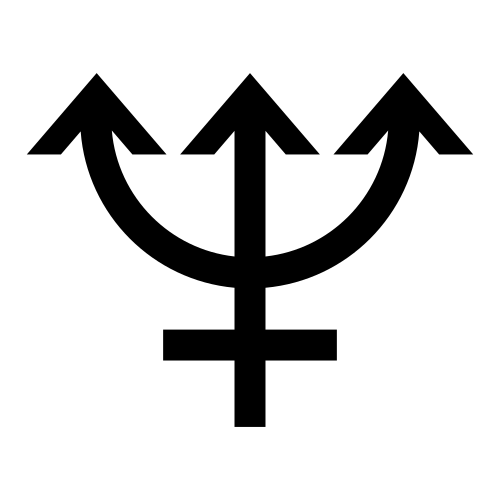 Neptune
 Pluto
Pluto Chiron
Birth time unknown — house positions and Ascendant/MC are not available.
Astronomical context
Pluto travelled through Libra from 1971 to 1984. In astrological tradition this transit is associated with the transformation of relationships, partnership, and the idea of balance — the cohort that redrew norms around marriage, equality, and the terms of personal alliance.
Peyton Manning (born 1976) belongs to this generational configuration. Astrian groups profiles by such shared signatures rather than by any claim of shared destiny. Related profiles in Astrian: Joe Montana · Jerry Rice · Aaron Rodgers. The symbolic reading is correlative, not causal.
Other profiles from this Pluto in Libra generation
Symbolic reading
The following describes what classical astrological tradition associates with these configurations. Astrian does not apply these descriptions to the person's biography.
The Sun in Aries is the most prominent structural feature available without a birth time, centring the chart on initiative, directness, and the will to begin. There is no Ascendant or Midheaven to anchor the angles, so the reading rests on sign placements and the aspects between planets rather than on houses.
Among the personal planets, the Moon in Capricorn is associated in tradition with ambition, structure, and the long view (the Moon's sign is given for the noon chart and may shift with an exact time); Mercury in Pisces with imagination, dissolution, and empathy; Venus in Pisces with imagination, dissolution, and empathy; and Mars in Cancer with attachment, memory, and protection. These placements describe registers of feeling, thought, attraction, and action as the tradition catalogues them, independent of the life that follows.
Mercury trine Saturn (0°20'): tradition reads thought and communication in easy flow with structure, limitation, and discipline.
Moon sextile Mercury (1°21'): tradition reads emotional life and instinct in supportive contact with thought and communication.
Sun square Mars (1°27'): tradition reads identity and central purpose in friction with drive, assertion, and action.
Moon opposite Saturn (1°41'): tradition reads emotional life and instinct set in polarity with structure, limitation, and discipline.
These placements are presented as a symbolic portrait, correlative and never causal — a description within the tradition's vocabulary, not an explanation of the life that follows.
Astrology is a symbolic language with 2,500 years of literature. The reading above is interpretive, not explanatory.
Astrian does not claim that the natal chart of Peyton Manning caused or determined any of the above. Astrology is a symbolic system with 2,500 years of literature. Its capacity for retrospective description does not imply explanatory capacity.
A parallel life
The following are verified biographical facts. No connection to the natal chart is implied.
Peyton Williams Manning was born on March 24, 1976, in New Orleans, Louisiana. He is the son of former NFL quarterback Archie Manning and grew up in a football family. He played college football at the University of Tennessee, where he was a consensus All-American and finished as the school's all-time passing leader.
The Indianapolis Colts selected Manning with the first overall pick in the 1998 NFL Draft. He spent 14 seasons with the Colts, becoming the face of the franchise. He led the team to consistent playoff appearances and won Super Bowl XLI in February 2007, earning MVP honors. During his time in Indianapolis, he was named the NFL's Most Valuable Player four times (2003, 2004, 2008, and 2009).
Manning was known for his extensive preparation and his ability to read defensive schemes at the line of scrimmage. He frequently changed plays at the line using the audible call "Omaha," which became a cultural reference. His partnership with receiver Marvin Harrison was one of the most productive in NFL history, with the two combining for a then-record 143 touchdown passes.
Following a neck injury that caused him to miss the entire 2011 season, Manning was released by the Colts and signed with the Denver Broncos in 2012. He had a remarkable resurgence, setting the single-season NFL records for passing yards (5,477) and touchdown passes (55) in 2013. He won his fifth MVP award that year and won Super Bowl 50 with Denver in February 2016, before retiring.
Manning was inducted into the Pro Football Hall of Fame in 2021. He finished his career with 71,940 passing yards and 539 touchdown passes, both among the highest totals in NFL history at the time of his retirement.
Biographical sources
- Pro Football Hall of Fame. "Peyton Manning." https://www.profootballhof.com/players/peyton-manning/.
- NFL.com. "Peyton Manning Career Stats." https://www.nfl.com/players/peyton-manning/stats/career.
- King, Peter. "Peyton Manning: A Football Life." Sports Illustrated, February 2016..
- Manning, Peyton, and Archie Manning. Manning. HarperCollins, 2000..
This profile presents the sky at the birth of Peyton Manning and verified facts of their biography. Astrian does not claim that astrology has predictive capacity or that the natal chart determines the trajectory of a life. Astrology is a symbolic system with 2,500 years of literature. Its capacity for retrospective description does not imply explanatory capacity.
Related profiles
Calculate your own birth chart with the same NASA JPL DE441 precision.
Calculate my birth chartLast updated: June 14, 2026
Newsletter
A short reading once a month, in your inbox.
A note on the symbolism of the season, recent editorial pieces, and what to look for in next month's sky. No predictions.
Support this project
Independent, no venture funding, no ads. A contribution keeps Astrian precise and free.
Support on Ko-fi (opens in new tab)