PROFILE · SCIENCE & TECHNOLOGY
Vera Rubin
Vera Florence Rubin
astronomer
Born 23 July 1928 · Philadelphia, Pennsylvania, United States · 39.95° N, 75.16° WX
Source: Birth time not documented in publicly accessible records
About this chart
No birth time is documented for this person. The chart therefore shows planetary positions in their signs, the slow aspects between them, and the generational context — but not house placements, the Ascendant, or the Midheaven, which require an accurate birth time. The Moon's sign carries a ±6° margin: if it falls near a sign boundary, the sign could vary. Positions for all other planets are reliable.
Do you have a verified source for this birth time? Share it →
The sky at birth
No birth time is documented for Vera Rubin. The Ascendant, the Midheaven, and the house positions cannot be determined; the reading is confined to planetary sign placements and the aspects between planets. The positions below are calculated for noon local time and are accurate to a fraction of a degree for the slow-moving bodies.
The Moon is near 20°04' Libra (noon position, ±7° margin). Sun is at 0°30' Leo. Mercury is at 10°40' Cancer. Venus is at 6°36' Leo. Mars is at 19°06' Taurus. Jupiter is at 8°10' Taurus. Saturn is at 12°57' Sagittarius, retrograde. Uranus is at 7°20' Aries, retrograde. Neptune is at 27°51' Leo. Pluto is at 17°03' Cancer.
3 bodies occupy Leo (Sun, Venus and Neptune) — a concentration that stands out as a structural feature of the chart.
The tightest major aspects between planets: Venus trine Uranus (0°44'); Venus square Jupiter (1°34'); Mars sextile Pluto (2°04'); Mercury sextile Jupiter (2°29'); Moon square Pluto (3°01'); Mercury square Uranus (3°19').
The engine also registers tight minor aspects involving asteroids and calculated points: Vesta semi-square North Node (0°12'); Venus sextile North Node (0°13'); Venus semi-square Juno (0°25'); Uranus sextile North Node (0°32'). These are reported for completeness and carry less weight in traditional reading.
The chart was calculated using NASA JPL DE441 ephemerides, sub-arcsecond precision.
| Planet | Sign | Position |
|---|---|---|
| Sun | Leo | 00°30' |
| Moon | Libra | 20°04'±6° |
| Mercury | Cancer | 10°40' |
| Venus | Leo | 06°36' |
| Mars | Taurus | 19°06' |
| Jupiter | Taurus | 08°10' |
| Saturn | Sagittarius | 12°57'retrograde |
| Uranus | Aries | 07°20'retrograde |
| Neptune | Leo | 27°51' |
| Pluto | Cancer | 17°03' |
| Chiron | Taurus | 09°57' |
 Sun
Sun Moon
Moon Mercury
 Venus
Venus Mars
Mars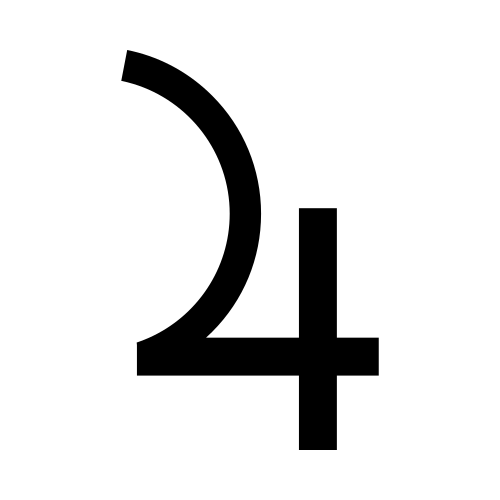 Jupiter
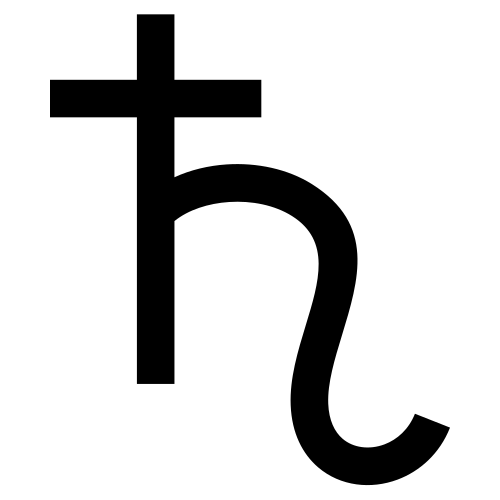 Saturn
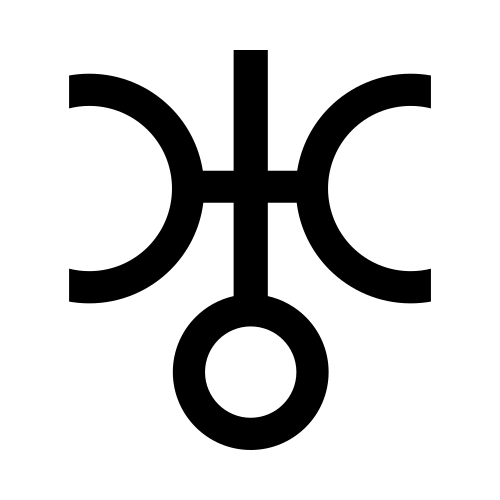 Uranus
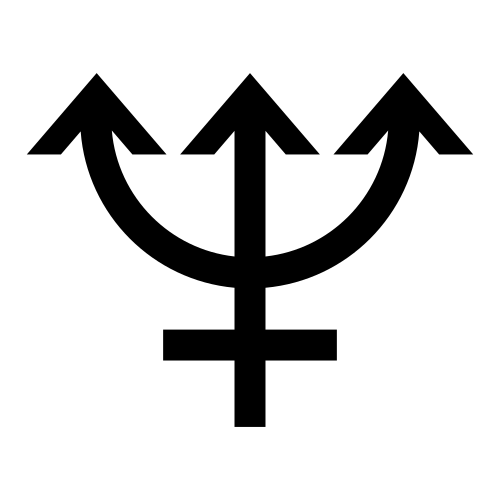 Neptune
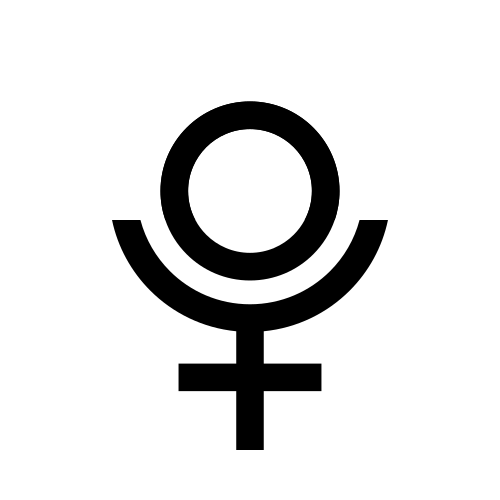 Pluto
Pluto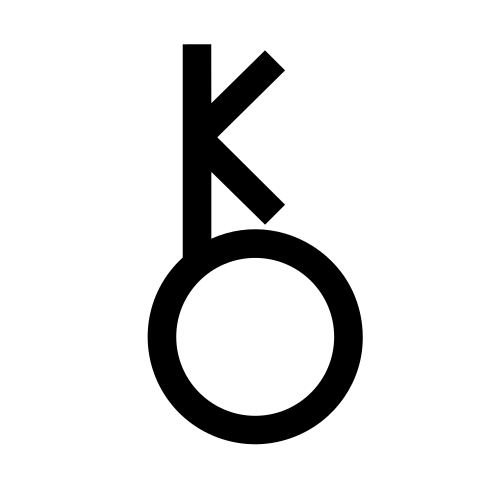 Chiron
Birth time unknown — house positions and Ascendant/MC are not available.
Astronomical context
Pluto crossed Cancer from 1914 to 1939. In astrological tradition this transit is linked to the transformation of home, family, nation, and the sense of belonging — the generation whose lives were marked by the World Wars and a profound redefinition of the nation and the home.
Vera Rubin (born 1928) belongs to this generational configuration. Astrian groups profiles by such shared signatures rather than by any claim of shared destiny. Related profiles in Astrian: Edwin Hubble · Katherine Johnson · Neil deGrasse Tyson. The symbolic reading is correlative, not causal.
Other profiles from this Pluto in Cancer generation
Symbolic reading
The following describes what classical astrological tradition associates with these configurations. Astrian does not apply these descriptions to the person's biography.
The Sun in Leo is the most prominent structural feature available without a birth time, centring the chart on expression, pride, and the creative self. There is no Ascendant or Midheaven to anchor the angles, so the reading rests on sign placements and the aspects between planets rather than on houses.
Among the personal planets, the Moon in Libra is associated in tradition with balance, relationship, and proportion (the Moon's sign is given for the noon chart and may shift with an exact time); Mercury in Cancer with attachment, memory, and protection; Venus in Leo with expression, pride, and the creative self; and Mars in Taurus with stability, persistence, and the tangible. These placements describe registers of feeling, thought, attraction, and action as the tradition catalogues them, independent of the life that follows.
Venus trine Uranus (0°44'): tradition reads values, attraction, and harmony in easy flow with disruption and innovation.
Venus square Jupiter (1°34'): tradition reads values, attraction, and harmony in friction with expansion and meaning.
Mars sextile Pluto (2°04'): tradition reads drive, assertion, and action in supportive contact with depth, power, and transformation.
Mercury sextile Jupiter (2°29'): tradition reads thought and communication in supportive contact with expansion and meaning.
These placements are presented as a symbolic portrait, correlative and never causal — a description within the tradition's vocabulary, not an explanation of the life that follows.
Astrology is a symbolic language with 2,500 years of literature. The reading above is interpretive, not explanatory.
Astrian does not claim that the natal chart of Vera Rubin caused or determined any of the above. Astrology is a symbolic system with 2,500 years of literature. Its capacity for retrospective description does not imply explanatory capacity.
A parallel life
The following are verified biographical facts. No connection to the natal chart is implied.
Vera Florence Rubin was born on July 23, 1928, in Philadelphia, Pennsylvania, and grew up in Washington, D.C. From childhood she was fascinated by the night sky. She earned her undergraduate degree from Vassar College in 1948, one of a very small number of women studying astronomy at the time. She completed her master's degree at Cornell University in 1951, where she studied the motions of galaxies with Martin Schwarzschild and William Shaw. Her master's thesis explored whether galaxies showed a rotation about the center of the universe, work that was received skeptically at the time.
She completed her doctorate at Georgetown University in 1954 under Philip Hauge Abelson, working on the clustering of galaxies. For much of the following decade she combined research with raising four children, all of whom went on to earn doctoral degrees in the natural sciences.
In the 1960s and 1970s, Rubin began a systematic study of the rotation of spiral galaxies in collaboration with instrument physicist Kent Ford, using a new, highly sensitive spectrograph that Ford had developed. Classical gravitational physics, following from Newton's laws, predicted that the orbital velocities of stars in the outer regions of galaxies should decrease with distance from the galactic center, analogously to the way the outer planets of the solar system move more slowly than the inner ones.
Instead, Rubin and Ford found that the rotation curves of spiral galaxies were essentially flat: stars at the outer edges of galaxies moved at roughly the same velocity as those near the center. This result implied that galaxies contained far more mass than could be accounted for by the visible stars and gas alone. The additional, unseen mass became known as dark matter. Their 1978 paper on the Andromeda galaxy and subsequent work on a large sample of spiral galaxies made the case for dark matter compelling and broadly accepted within the astronomical community.
Rubin also contributed important work on the anisotropy of galaxy motions and the large-scale structure of the universe. She was elected to the National Academy of Sciences in 1981 and received the National Medal of Science in 1993.
A prominent advocate for women in science throughout her career, Vera Rubin died on December 25, 2016, in Princeton, New Jersey.
Biographical sources
- Vera C. Rubin and W. Kent Ford Jr., 'Rotation of the Andromeda Nebula from a Spectroscopic Survey of Emission Regions,' The Astrophysical Journal, 1970.
- Vera C. Rubin, W. Kent Ford Jr., and Norbert Thonnard, 'Rotational Properties of 21 Sc Galaxies,' The Astrophysical Journal, 1980.
- Marcia Bartusiak, Einstein's Unfinished Symphony (Smithsonian Institution Press, 2000).
- National Academy of Sciences, Biographical Memoir: Vera Florence Rubin (2018).
This profile presents the sky at the birth of Vera Rubin and verified facts of their biography. Astrian does not claim that astrology has predictive capacity or that the natal chart determines the trajectory of a life. Astrology is a symbolic system with 2,500 years of literature. Its capacity for retrospective description does not imply explanatory capacity.
Calculate your own birth chart with the same NASA JPL DE441 precision.
Calculate my birth chartLast updated: June 14, 2026
Newsletter
A short reading once a month, in your inbox.
A note on the symbolism of the season, recent editorial pieces, and what to look for in next month's sky. No predictions.
Support this project
Independent, no venture funding, no ads. A contribution keeps Astrian precise and free.
Support on Ko-fi (opens in new tab)