PROFILE · SCIENCE & TECHNOLOGY
Edwin Hubble
Edwin Powell Hubble
astronomer
Born 20 November 1889 · 05:45 · 12:37 UTC · Marshfield, Missouri, United States · 37.34° N, 92.91° WB
Source: Astro-Databank (Rodden Rating B)
The sky at birth
With a documented birth time, the full chart can be cast. The Ascendant falls at 13°03' Scorpio and the Midheaven at 20°37' Leo, which fixes the angular framework and allows the planets to be placed in houses.
Sun is at 28°23' Scorpio, house 1. Moon is at 23°46' Libra, house 12. Mercury is at 18°32' Scorpio, house 1. Venus is at 6°51' Scorpio, house 12. Mars is at 5°45' Libra, house 11. Jupiter is at 8°38' Capricorn, house 2. Saturn is at 3°23' Virgo, house 10. Uranus is at 24°32' Libra, house 12. Neptune is at 3°17' Gemini, house 7, retrograde. Pluto is at 6°04' Gemini, house 7, retrograde.
3 bodies occupy Scorpio (Sun, Mercury and Venus) and 3 bodies occupy Libra (Moon, Mars and Uranus) — a concentration that stands out as a structural feature of the chart.
The tightest major aspects between planets: Saturn square Neptune (0°06'); Mars trine Pluto (0°19'); Moon conjunct Uranus (0°46'); Venus sextile Jupiter (1°47'); Mars trine Neptune (2°28'); Saturn square Pluto (2°41').
Neptune conjunct Pluto (2°47') is structural but generational — an alignment of slow-moving outer planets shared across many birth years.
The engine also registers tight minor aspects involving asteroids and calculated points: Sun sesquiquadrate Lilith (0°29'); Mars square North Node (1°01'); Mercury sesquiquadrate North Node (1°12'); Pluto semi-sextile North Node (1°20'). These are reported for completeness and carry less weight in traditional reading.
The chart was calculated using NASA JPL DE441 ephemerides, sub-arcsecond precision.
| Planet | Sign | Position | House |
|---|---|---|---|
| Ascendant | Scorpio | 13°03' | — |
| Midheaven | Leo | 20°37' | — |
| Sun | Scorpio | 28°23' | H1 |
| Moon | Libra | 23°46' | H12 |
| Mercury | Scorpio | 18°32' | H1 |
| Venus | Scorpio | 06°51' | H12 |
| Mars | Libra | 05°45' | H11 |
| Jupiter | Capricorn | 08°38' | H2 |
| Saturn | Virgo | 03°23' | H10 |
| Uranus | Libra | 24°32' | H12 |
| Neptune | Gemini | 03°17'retrograde | H7 |
| Pluto | Gemini | 06°04'retrograde | H7 |
 Sun
Sun Moon
Moon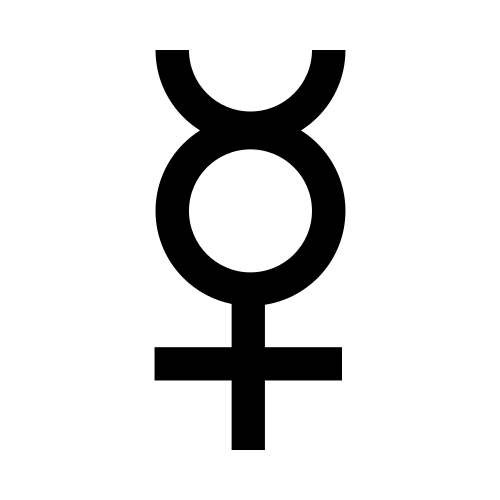 Mercury
 Venus
Venus Mars
Mars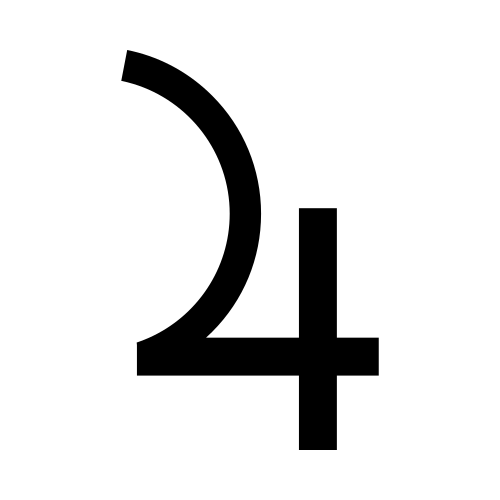 Jupiter
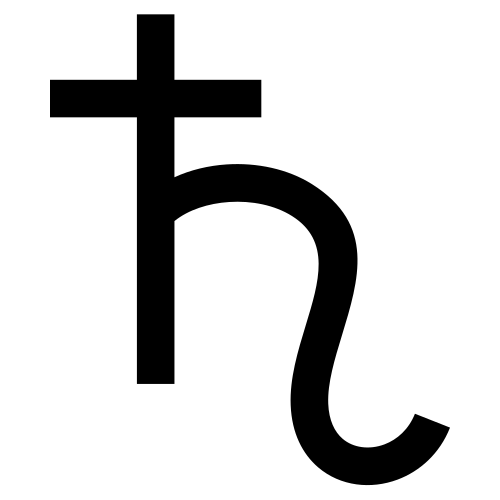 Saturn
 Uranus
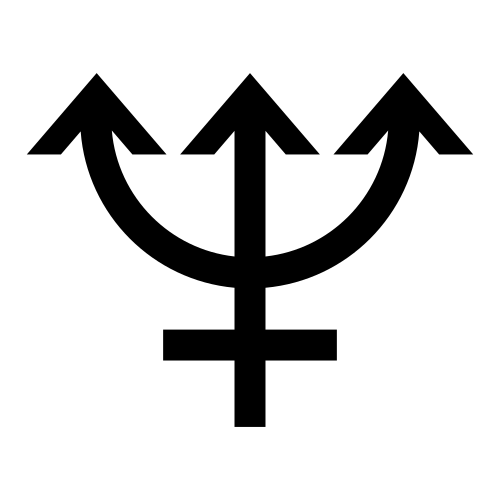 Neptune
 Pluto
PlutoAstronomical context
Pluto travelled through Gemini from the mid-1880s to 1914. In astrological tradition this transit is associated with the transformation of communication, ideas, transport, and the press — the generation that came of age amid the spread of mass media, the telephone, and accelerating mobility.
Edwin Hubble (born 1889) belongs to this generational configuration. Astrian groups profiles by such shared signatures rather than by any claim of shared destiny. Related profiles in Astrian: Vera Rubin · Neil deGrasse Tyson · Enrico Fermi. The symbolic reading is correlative, not causal.
Other profiles from this Pluto in Gemini generation
Symbolic reading
The following describes what classical astrological tradition associates with these configurations. Astrian does not apply these descriptions to the person's biography.
The Sun in Scorpio centres the chart on intensity, depth, and the will to transform. With the Ascendant in Scorpio, tradition adds intensity, depth, and the will to transform as the threshold through which that energy meets the world; the Sun marks the central drive, the Ascendant the manner of approach.
Among the personal planets, the Moon in Libra is associated in tradition with balance, relationship, and proportion; Mercury in Scorpio with intensity, depth, and the will to transform; Venus in Scorpio with intensity, depth, and the will to transform; and Mars in Libra with balance, relationship, and proportion. These placements describe registers of feeling, thought, attraction, and action as the tradition catalogues them, independent of the life that follows.
Saturn square Neptune (0°06'): tradition reads structure, limitation, and discipline in friction with dissolution, imagination, and idealism.
Mars trine Pluto (0°19'): tradition reads drive, assertion, and action in easy flow with depth, power, and transformation.
Moon conjunct Uranus (0°46'): tradition reads emotional life and instinct fused with disruption and innovation.
Venus sextile Jupiter (1°47'): tradition reads values, attraction, and harmony in supportive contact with expansion and meaning.
These placements are presented as a symbolic portrait, correlative and never causal — a description within the tradition's vocabulary, not an explanation of the life that follows.
Astrology is a symbolic language with 2,500 years of literature. The reading above is interpretive, not explanatory.
Astrian does not claim that the natal chart of Edwin Hubble caused or determined any of the above. Astrology is a symbolic system with 2,500 years of literature. Its capacity for retrospective description does not imply explanatory capacity.
A parallel life
The following are verified biographical facts. No connection to the natal chart is implied.
Edwin Powell Hubble was born on November 20, 1889, in Marshfield, Missouri. He grew up in Illinois and showed early promise in both athletics and academics. He studied mathematics and astronomy at the University of Chicago, graduating in 1910, and then went to Oxford as a Rhodes Scholar, where he read law at the request of his father. After his father's death, he returned to science, earning his doctorate in astronomy from the University of Chicago in 1917.
Following service in the United States Army during World War I, Hubble joined the staff of the Mount Wilson Observatory near Pasadena, California, in 1919. There he had access to what was then the world's largest telescope, the 100-inch Hooker reflector, which proved decisive for his subsequent discoveries.
In the early 1920s, a major astronomical debate concerned the nature of certain hazy objects called nebulae. Many astronomers believed these lay within the Milky Way; others suspected they were distant systems comparable to the Milky Way itself. In 1923 and 1924, Hubble resolved individual stars in the Andromeda Nebula, including Cepheid variable stars, whose intrinsic brightness was already well-understood. By calculating the distance to these Cepheids, he demonstrated that Andromeda lay far beyond the boundaries of the Milky Way, making it a separate galaxy. This result, announced in 1925, settled the debate and permanently expanded the known scale of the universe.
Hubble went on to develop a classification system for galaxies, organizing them by their shapes into ellipticals, spirals, and irregulars, a framework that remains in use today.
His most consequential discovery came from measurements of the recession velocities of galaxies combined with their distances. In 1929, he published findings showing that galaxies are moving away from the Milky Way and that more distant galaxies recede faster, a relationship now expressed as Hubble's Law. This provided the key observational evidence that the universe is not static but expanding, a finding consistent with solutions to Einstein's field equations and later foundational to the Big Bang model of cosmology.
Hubble also contributed to the classification of galaxy types and continued refining distance measurements throughout his career at Mount Wilson and later Palomar Observatory.
Edwin Hubble died on September 28, 1953, in San Marino, California. In 1990, NASA launched the Hubble Space Telescope, named in his honor.
Biographical sources
- Gale E. Christianson, Edwin Hubble: Mariner of the Nebulae (Farrar, Straus and Giroux, 1995).
- Edwin Hubble, 'A Relation between Distance and Radial Velocity among Extra-Galactic Nebulae,' Proceedings of the National Academy of Sciences, 1929.
- Marcia Bartusiak, The Day We Found the Universe (Pantheon Books, 2009).
- NASA Hubble Site, Edwin Powell Hubble biography, hubblesite.org.
This profile presents the sky at the birth of Edwin Hubble and verified facts of their biography. Astrian does not claim that astrology has predictive capacity or that the natal chart determines the trajectory of a life. Astrology is a symbolic system with 2,500 years of literature. Its capacity for retrospective description does not imply explanatory capacity.
Related profiles
Calculate your own birth chart with the same NASA JPL DE441 precision.
Calculate my birth chartLast updated: June 14, 2026
Newsletter
A short reading once a month, in your inbox.
A note on the symbolism of the season, recent editorial pieces, and what to look for in next month's sky. No predictions.
Support this project
Independent, no venture funding, no ads. A contribution keeps Astrian precise and free.
Support on Ko-fi (opens in new tab)