PROFILE · SCIENCE & TECHNOLOGY
Abraham Maslow
Abraham Harold Maslow
psychologist
Born 1 April 1908 · Brooklyn, New York, United States · 40.65° N, 73.95° WX
Source: Birth time not documented in publicly accessible records
About this chart
No birth time is documented for this person. The chart therefore shows planetary positions in their signs, the slow aspects between them, and the generational context — but not house placements, the Ascendant, or the Midheaven, which require an accurate birth time. The Moon's sign carries a ±6° margin: if it falls near a sign boundary, the sign could vary. Positions for all other planets are reliable.
Do you have a verified source for this birth time? Share it →
The sky at birth
No birth time is documented for Abraham Maslow. The Ascendant, the Midheaven, and the house positions cannot be determined; the reading is confined to planetary sign placements and the aspects between planets. The positions below are calculated for noon local time and are accurate to a fraction of a degree for the slow-moving bodies.
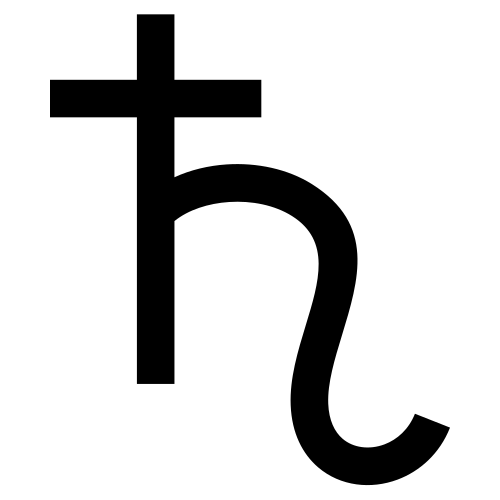
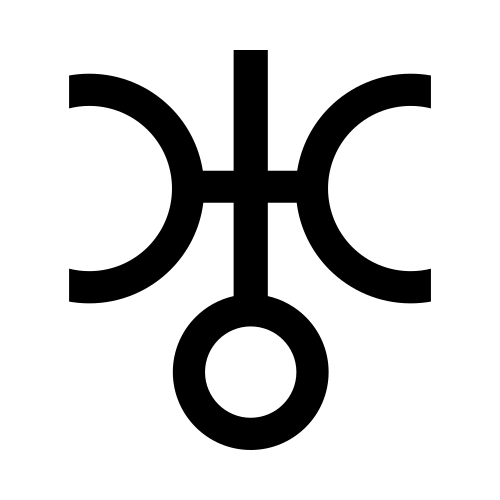
The Moon is near 18°12' Aries (noon position, ±7° margin). Sun is at 11°33' Aries. Mercury is at 14°24' Pisces. Venus is at 25°26' Taurus. Mars is at 26°19' Taurus. Jupiter is at 3°34' Leo. Saturn is at 1°37' Aries. Uranus is at 16°44' Capricorn. Neptune is at 12°05' Cancer. Pluto is at 22°53' Gemini.
3 bodies occupy Aries (Sun, Moon and Saturn) — a concentration that stands out as a structural feature of the chart.
The tightest major aspects between planets: Sun square Neptune (0°32'); Venus conjunct Mars (0°53'); Moon square Uranus (1°28'); Jupiter trine Saturn (1°56'); Mercury trine Neptune (2°19'); Mercury sextile Uranus (2°20').
Uranus opposite Neptune (4°39') is structural but generational — an alignment of slow-moving outer planets shared across many birth years.
The engine also registers tight minor aspects involving asteroids and calculated points: Vesta semi-sextile Lilith (0°08'); Venus semi-square Vesta (0°17'); Venus sesquiquadrate Ceres (0°21'); Lilith semi-sextile North Node (0°23'). These are reported for completeness and carry less weight in traditional reading.
The chart was calculated using NASA JPL DE441 ephemerides, sub-arcsecond precision.
| Planet | Sign | Position |
|---|---|---|
| Sun | Aries | 11°33' |
| Moon | Aries | 18°12'±6° |
| Mercury | Pisces | 14°24' |
| Venus | Taurus | 25°26' |
| Mars | Taurus | 26°19' |
| Jupiter | Leo | 03°34' |
| Saturn | Aries | 01°37' |
| Uranus | Capricorn | 16°44' |
| Neptune | Cancer | 12°05' |
| Pluto | Gemini | 22°53' |
| Chiron | Aquarius | 21°47' |
 Sun
Sun Moon
Moon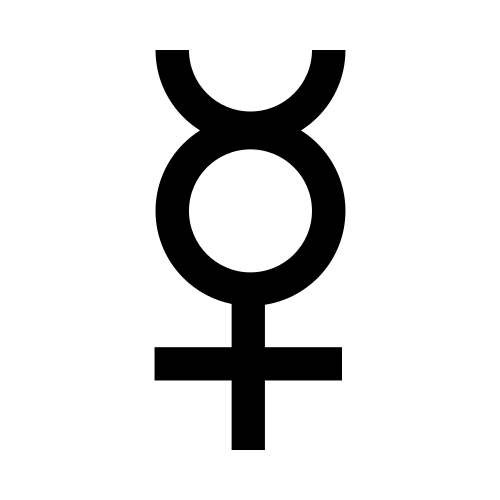 Mercury
 Venus
Venus Mars
Mars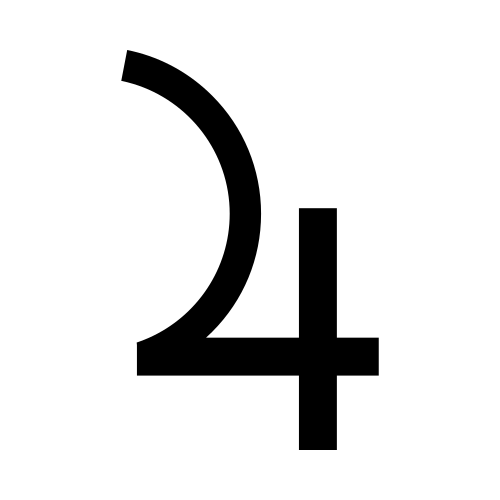 Jupiter
 Saturn
 Uranus
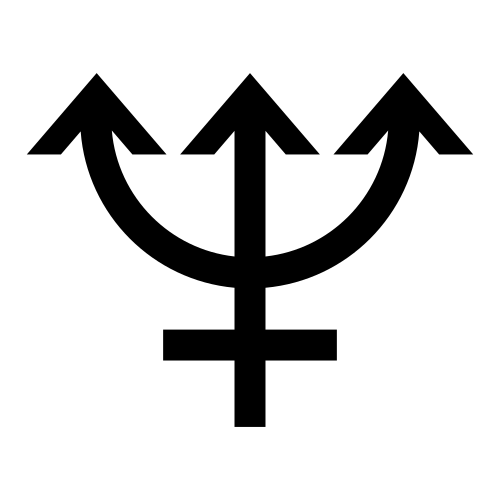 Neptune
 Pluto
Pluto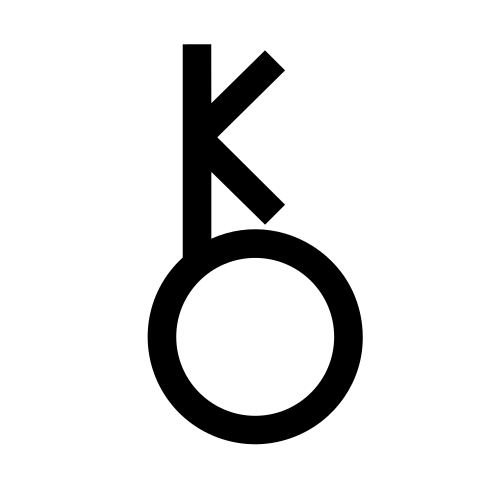 Chiron
Birth time unknown — house positions and Ascendant/MC are not available.
Astronomical context
Pluto travelled through Gemini from the mid-1880s to 1914. In astrological tradition this transit is associated with the transformation of communication, ideas, transport, and the press — the generation that came of age amid the spread of mass media, the telephone, and accelerating mobility.
Abraham Maslow (born 1908) belongs to this generational configuration. Astrian groups profiles by such shared signatures rather than by any claim of shared destiny. Related profiles in Astrian: Viktor Frankl · Simone de Beauvoir · Jean-Paul Sartre. The symbolic reading is correlative, not causal.
Other profiles from this Pluto in Gemini generation
Symbolic reading
The following describes what classical astrological tradition associates with these configurations. Astrian does not apply these descriptions to the person's biography.
The Sun in Aries is the most prominent structural feature available without a birth time, centring the chart on initiative, directness, and the will to begin. There is no Ascendant or Midheaven to anchor the angles, so the reading rests on sign placements and the aspects between planets rather than on houses.
Among the personal planets, the Moon in Aries is associated in tradition with initiative, directness, and the will to begin (the Moon's sign is given for the noon chart and may shift with an exact time); Mercury in Pisces with imagination, dissolution, and empathy; Venus in Taurus with stability, persistence, and the tangible; and Mars in Taurus with stability, persistence, and the tangible. These placements describe registers of feeling, thought, attraction, and action as the tradition catalogues them, independent of the life that follows.
Sun square Neptune (0°32'): tradition reads identity and central purpose in friction with dissolution, imagination, and idealism.
Venus conjunct Mars (0°53'): tradition reads values, attraction, and harmony fused with drive, assertion, and action.
Moon square Uranus (1°28'): tradition reads emotional life and instinct in friction with disruption and innovation.
Jupiter trine Saturn (1°56'): tradition reads expansion and meaning in easy flow with structure, limitation, and discipline.
These placements are presented as a symbolic portrait, correlative and never causal — a description within the tradition's vocabulary, not an explanation of the life that follows.
Astrology is a symbolic language with 2,500 years of literature. The reading above is interpretive, not explanatory.
Astrian does not claim that the natal chart of Abraham Maslow caused or determined any of the above. Astrology is a symbolic system with 2,500 years of literature. Its capacity for retrospective description does not imply explanatory capacity.
A parallel life
The following are verified biographical facts. No connection to the natal chart is implied.
Abraham Harold Maslow was born on 1 April 1908 in Brooklyn, New York, the eldest of seven children of Jewish immigrants from Russia. He described his childhood as unhappy and later recalled feeling isolated in his early years. He initially studied law before shifting to psychology, completing his bachelor's, master's, and doctoral degrees at the University of Wisconsin, where he studied under Edward Thorndike, Harry Harlow, and others, and graduated in 1934.
After teaching at Brooklyn College, Maslow moved to Brandeis University in 1951, where he became chair of the psychology department and spent much of his career. He was also a fellow at the Western Behavioral Sciences Institute and the Laughlin Foundation.
Maslow is most widely associated with the hierarchy of needs, which he introduced in a 1943 paper titled "A Theory of Human Motivation." The theory proposed that human motivations are arranged in a hierarchy from basic physiological needs at the base, through safety, social belonging, and esteem, to self-actualization at the apex. Maslow argued that lower-level needs must generally be met before higher-level needs become motivating. The concept of self-actualization, describing the realization of an individual's full potential, became central to his framework.
In his later work, including Motivation and Personality (1954) and Toward a Psychology of Being (1962), Maslow explored peak experiences, which he described as moments of heightened awareness and fulfilment, and the characteristics of self-actualizing individuals. He drew on the study of people he judged to be psychologically healthy rather than focusing primarily on clinical populations.
Maslow was one of the founders of humanistic psychology, sometimes described as a third force in psychology alongside psychoanalysis and behaviorism, which emphasized human potential, subjective experience, and the pursuit of meaning.
He served as president of the American Psychological Association in 1967. His ideas were applied across fields including education, management, and organizational behavior.
Maslow died of a heart attack on 8 June 1970 in Menlo Park, California.
Biographical sources
- Hoffman, E. (1988). The Right to Be Human: A Biography of Abraham Maslow. Jeremy P. Tarcher..
- Maslow, A.H. (1943). A Theory of Human Motivation. Psychological Review, 50(4), 370-396..
- Maslow, A.H. (1954). Motivation and Personality. Harper & Row..
- American Psychological Association archives: https://www.apa.org/about/governance/president/maslow.
This profile presents the sky at the birth of Abraham Maslow and verified facts of their biography. Astrian does not claim that astrology has predictive capacity or that the natal chart determines the trajectory of a life. Astrology is a symbolic system with 2,500 years of literature. Its capacity for retrospective description does not imply explanatory capacity.
Related profiles
Calculate your own birth chart with the same NASA JPL DE441 precision.
Calculate my birth chartLast updated: June 14, 2026
Newsletter
A short reading once a month, in your inbox.
A note on the symbolism of the season, recent editorial pieces, and what to look for in next month's sky. No predictions.
Support this project
Independent, no venture funding, no ads. A contribution keeps Astrian precise and free.
Support on Ko-fi (opens in new tab)