PROFILE · MUSIC

Drake
Aubrey Drake Graham
musician
Born 24 October 1986 · Toronto, Ontario, Canada · 43.65° N, 79.38° WX
Source: Birth time not documented in publicly accessible records
About this chart
No birth time is documented for this person. The chart therefore shows planetary positions in their signs, the slow aspects between them, and the generational context — but not house placements, the Ascendant, or the Midheaven, which require an accurate birth time. The Moon's sign carries a ±6° margin: if it falls near a sign boundary, the sign could vary. Positions for all other planets are reliable.
Do you have a verified source for this birth time? Share it →
The sky at birth
No birth time is documented for Drake. The Ascendant, Midheaven, and house positions cannot be determined. The planetary positions below are calculated for noon local time and are accurate to within a fraction of a degree for the slow-moving planets. The Moon's position carries a margin of approximately ±7°.
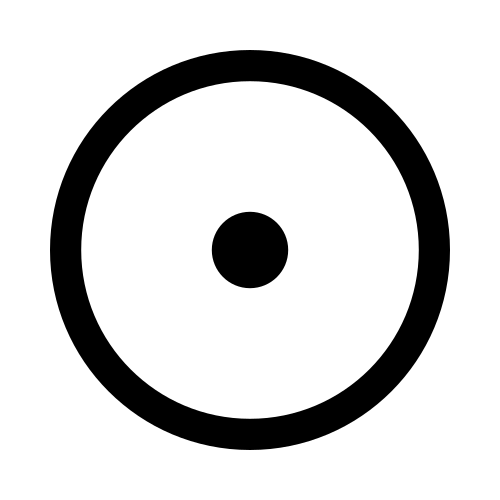
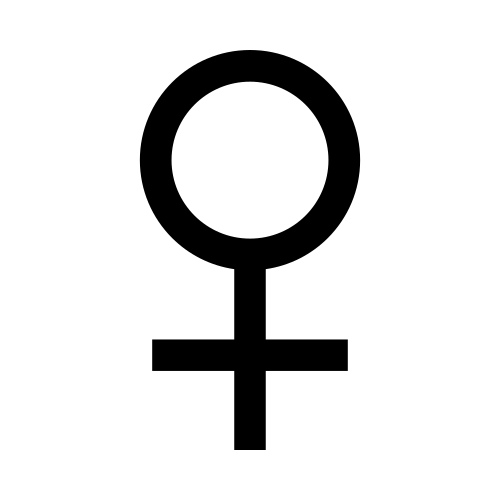
The Sun is at 0°59' Scorpio. The Moon is at 17°30' Cancer (noon position, ±7° margin). Mercury is at 25°04' Scorpio. Venus is at 18°46' Scorpio R. Mars is at 9°03' Aquarius. Jupiter is at 13°20' Pisces R. Saturn is at 7°33' Sagittarius. Uranus is at 19°43' Sagittarius. Neptune is at 3°28' Capricorn. Pluto is at 7°02' Scorpio.
The chart's most striking structural feature is a four-planet concentration in Scorpio: the Sun at 0°59', Pluto at 7°02', Venus at 18°46' retrograde, and Mercury at 25°04'. This stellium spans over 24° and constitutes the dominant signature of the chart. Mars at 9°03' Aquarius forms a sextile with Saturn at 7°33' Sagittarius (1°30') and a square with Pluto at 7°02' Scorpio (2°01'). The Sun at 0°59' Scorpio sextiles Neptune at 3°28' Capricorn (2°29'). Neptune sextiles Pluto (3°34').
The tightest major aspects between planets: Mars sextile Saturn (1°30'), Mars square Pluto (2°01'), Sun sextile Neptune (2°29'), Neptune sextile Pluto (3°34'), Sun conjunction Pluto (6°03').
The engine also identifies the following tight minor aspects involving asteroids and calculated points: moon quincunx juno (0.01° sep); chiron sesquiquadrate ceres (0.13° app); venus semi-square neptune (0.30° app); uranus trine northNode (0.38° app).
The chart was calculated by Astrian's engine using NASA JPL DE441 ephemerides, sub-arcsecond precision. Timezone: Eastern Daylight Time (America/Toronto, UTC −4).
| Planet | Sign | Position |
|---|---|---|
| Sun | Scorpio | 00°56' |
| Moon | Cancer | 17°00'±6° |
| Mercury | Scorpio | 25°02' |
| Venus | Scorpio | 18°47'retrograde |
| Mars | Aquarius | 09°02' |
| Jupiter | Pisces | 13°20'retrograde |
| Saturn | Sagittarius | 07°33' |
| Uranus | Sagittarius | 19°43' |
| Neptune | Capricorn | 03°28' |
| Pluto | Scorpio | 07°02' |
| Chiron | Gemini | 20°58'retrograde |
 Sun
Sun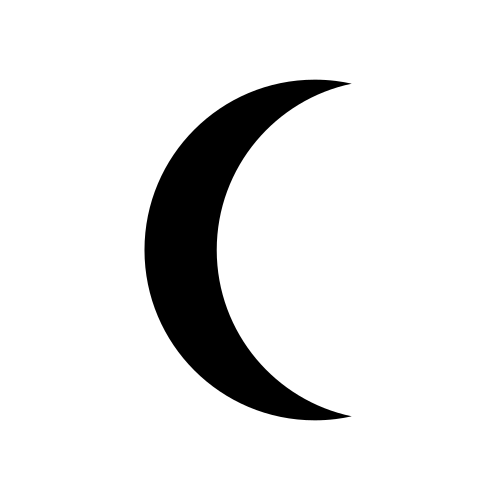 Moon
Moon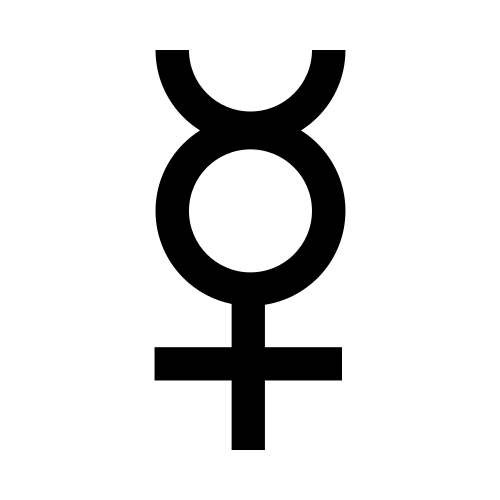 Mercury
 Venus
Venus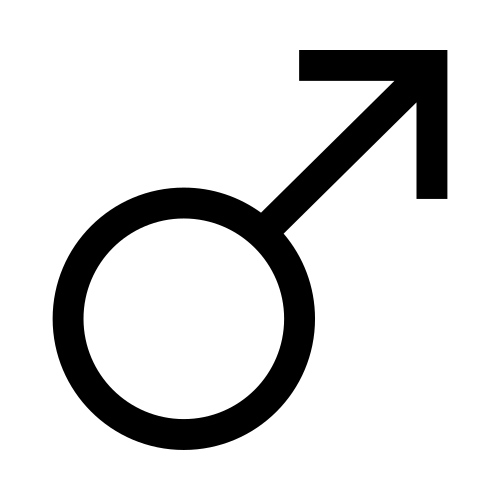 Mars
Mars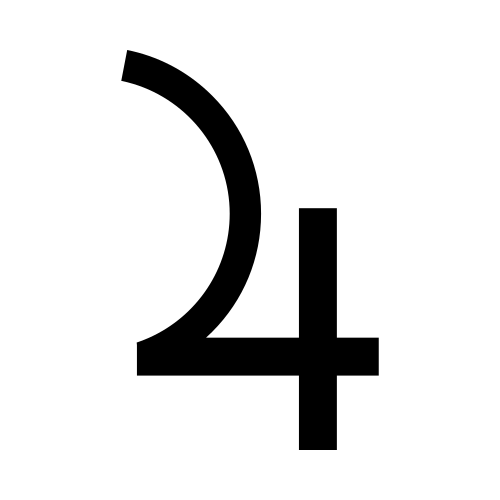 Jupiter
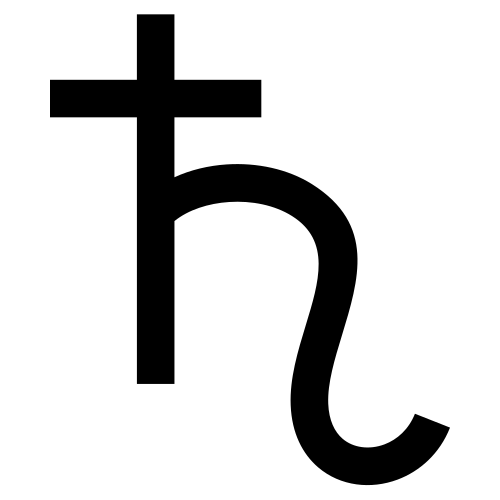 Saturn
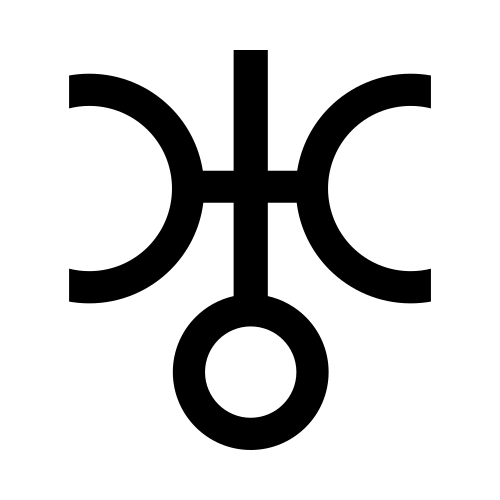 Uranus
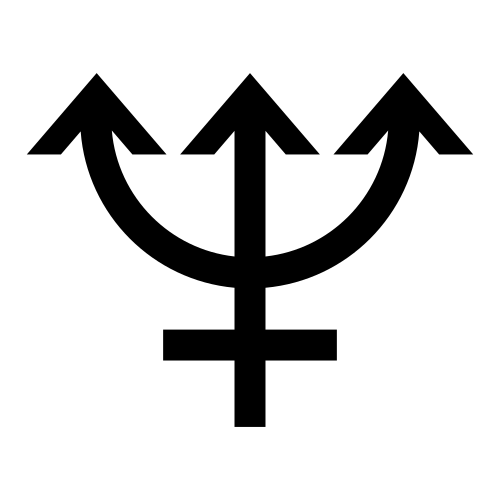 Neptune
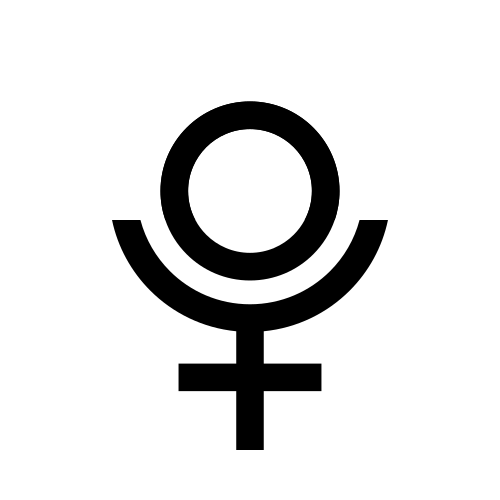 Pluto
Pluto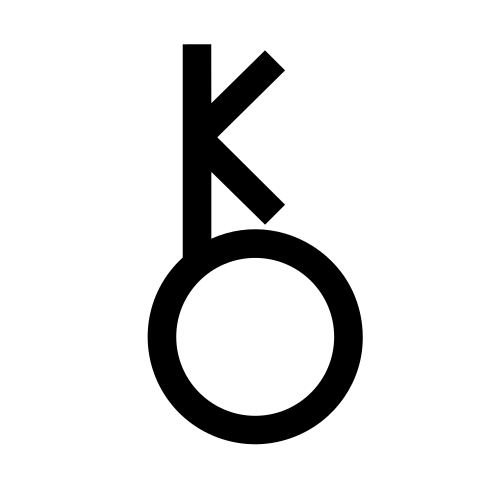 Chiron
Birth time unknown — house positions and Ascendant/MC are not available.
Astronomical context
Those born between approximately 1984 and 1995 carried Pluto in Scorpio. This generation arrived at the end of the Cold War, inheriting an era of accelerated information, digital emergence, the AIDS crisis, and the first wave of economic globalization. They grew up during the transition from analogue to digital and reached adulthood in a world reshaped by the internet, social media, and the 2008 financial crisis.
In astrological tradition, Pluto in Scorpio is associated with collective transformation of the domains that sign governs: sexuality, death and regeneration, shared resources, psychological depth, secrecy, and the exposure of hidden power structures. Scorpio is the sign of what lies beneath surfaces. Pluto's transit through its own modern domicile is read, symbolically, as a period of intensified collective encounter with themes of power, vulnerability, and transformation at the deepest register. The symbolic reading is correlative, not causal.
Others in the Astrian collection born under this configuration include Bruno Mars (1985), The Weeknd (1990), Rosalía (1992), and Bad Bunny (1994). Drake, born in 1986, belongs to the early years of this generational wave.
Other profiles from this Pluto in Scorpio generation
Symbolic reading
The following describes what classical astrological tradition associates with these configurations. Astrian does not apply these descriptions to the person's biography.
The Sun at 0°59' Scorpio is the most prominent structural feature of this chart. Without a documented birth time, there is no Ascendant or Midheaven — the reading is confined to planetary positions by sign and the aspects between planets.
The Moon at 17°30' Cancer represents the noon position; the actual placement falls within approximately 7° on either side. If born early in the day, the Moon could be in the low teens of Cancer; if born late, in the low twenties. The Moon's sign placement in Cancer is secure for the entire day.
Mercury at 25°04' Scorpio, Venus at 18°46' Scorpio retrograde, and Mars at 9°03' Aquarius complete the personal planet picture.
### The Scorpio stellium
The chart's defining structural feature is a four-planet concentration in Scorpio: the Sun at 0°59', Pluto at 7°02', Venus at 18°46' retrograde, and Mercury at 25°04'. Four planets in a single sign — spanning more than 24° — constitute a stellium, the traditional term for a significant concentration of planetary energy in one zone of the zodiac.
In the vocabulary of the tradition, Scorpio governs the psyche's encounter with depth, intensity, vulnerability, power, the hidden, and the transformative. It is the sign of what lies beneath the public surface — the emotional undercurrents, the private negotiations with desire and loss, and the capacity to regenerate from destruction. A concentration of four planets in Scorpio directs a large proportion of the chart's energy toward these registers.
The Sun at 0°59' Scorpio — the very first degree of the sign — is conjunct Pluto at 7°02' Scorpio (6°03'). The Sun represents identity; Pluto represents transformation and the encounter with power. Their conjunction, even at a relatively wide orb, places identity in a sustained relationship with Plutonian themes — the self is not a light structure but carries depth and intensity as a default condition. Venus retrograde at 18°46' Scorpio adds a layer of internalized aesthetic and emotional processing — desire is turned inward, examined, reconsidered. Mercury at 25°04' Scorpio directs communication toward the probing and the psychologically observant.
### Mars sextile Saturn, square Pluto
Mars at 9°03' Aquarius forms a sextile with Saturn at 7°33' Sagittarius (1°30') and a square with Pluto at 7°02' Scorpio (2°01'). These are the two tightest major aspects in the chart. Mars governs action, drive, and the physical application of will. Saturn governs structure, discipline, and the encounter with limitation and authority. Pluto governs transformation and power.
The Mars-Saturn sextile connects action with discipline in a cooperative relationship — drive is structured, ambition is patient, and effort is directed toward sustainable construction rather than impulsive expenditure. The Mars-Pluto square adds friction between action and transformative power — what one does encounters resistance from deeper forces, and the tension between drive and intensity generates a quality of relentless, pressure-tested effort. Together, the two aspects create a configuration where action is simultaneously disciplined (through Saturn) and intensified (through Pluto).
### Sun sextile Neptune
The Sun at 0°59' Scorpio sextiles Neptune at 3°28' Capricorn, orb 2°29'. The Sun represents identity; Neptune represents the ideal, the imaginative, and the dissolution of boundaries. The sextile connects identity to the Neptunian register in a flowing, cooperative relationship — the self draws naturally on imaginative resources and the capacity to project emotion beyond literal boundaries. Neptune in Capricorn grounds this idealism in structure — the imagination works within form rather than dissolving it.
The planetary pattern here is read as a symbolic portrait, not a causal explanation. No planet caused, predicted, or determined any event or characteristic.
Astrology is a symbolic language with 2,500 years of literature. The reading above is interpretive, not explanatory.
Astrian does not claim that the natal chart of Drake caused or determined any of the above. Astrology is a symbolic system with 2,500 years of literature. Its capacity for retrospective description does not imply explanatory capacity.
A parallel life
The following are verified biographical facts. No connection to the natal chart is implied.
Aubrey Drake Graham was born on 24 October 1986 in Toronto, Ontario, Canada, the only child of Dennis Graham, an African-American musician and drummer from Memphis, Tennessee, who had played with Jerry Lee Lewis and other artists, and Sandra "Sandi" Graham (née Sher), a Canadian Ashkenazi Jewish woman who worked as a florist and English teacher. His parents divorced when he was five. His father returned to Memphis and was intermittently present; Drake grew up with his mother in the Forest Hill neighbourhood of Toronto, attending Forest Hill Collegiate Institute.
At fifteen, a high school friend's father, who was an acting agent, arranged an audition for the Canadian teen drama Degrassi: The Next Generation. Drake was cast as Jimmy Brooks, a basketball star who is shot by a classmate and left in a wheelchair — a role he played from 2001 to 2007 across seven seasons. The role provided financial stability during his adolescent years; he was not, however, pursuing acting as a long-term vocation.
He released his first mixtape, Room for Improvement, in 2006, followed by Comeback Season in 2007. The third, So Far Gone (2009), was released for free online and proved to be a transformative event: "Best I Ever Had" reached number two on the Billboard Hot 100, and the mixtape attracted the attention of Lil Wayne, who invited Drake to join his Young Money Entertainment label. He signed with Young Money and Cash Money Records in June 2009.
His debut studio album, Thank Me Later (2010), debuted at number one on the Billboard 200. Take Care (2011) solidified his position, winning the Grammy for Best Rap Album and establishing the emotionally vulnerable, singing-and-rapping style that would define the sound of mainstream hip-hop for the decade. The album's title track, featuring Rihanna, and "Marvins Room" became touchstones of a new mode — hip-hop unafraid of tenderness, interiority, and confession.
Nothing Was the Same (2013), If You're Reading This It's Too Late (2015), Views (2016), More Life (2017), Scorpion (2018), Certified Lover Boy (2021), and For All the Dogs (2023) each debuted at or near the top of global charts. "One Dance" (2016) spent fifteen weeks at number one on the Billboard Hot 100 and became one of the most-streamed songs of the decade. "God's Plan" (2018) debuted at number one with the largest first-week streaming numbers in history at the time.
He holds the record for the most entries on the Billboard Hot 100 — over 300 charted songs as of 2025. He has won four Grammy Awards from forty-nine nominations, though his relationship with the Recording Academy has been publicly contentious. His feud with Kendrick Lamar in 2024, conducted through a series of escalating diss tracks ("Push Ups," "Taylor Made Freestyle," and Lamar's "Not Like Us"), became the most widely discussed hip-hop rivalry since the late 1990s.
He has a son, Adonis Mahbed Graham (born 2017), with the French visual artist Sophie Brussaux. He owns the OVO Sound record label and the OVO clothing line. His business interests include a stake in the Toronto Raptors and a reported gambling portfolio. In 2019, the Raptors won their first NBA championship; Drake's visible courtside presence throughout the playoff run made him a fixture of the cultural moment.
As of 2025, he has sold an estimated 170 million records worldwide. He is the best-selling digital music artist in history.
Biographical sources
- Charnas, Dan. The Big Payback: The History of the Business of Hip-Hop. New American Library 2010
- The New York Times. 2011
This profile presents the sky at the birth of Drake and verified facts of their biography. Astrian does not claim that astrology has predictive capacity or that the natal chart determines the trajectory of a life. Astrology is a symbolic system with 2,500 years of literature. Its capacity for retrospective description does not imply explanatory capacity.
Related profiles
Calculate your own birth chart with the same NASA JPL DE441 precision.
Calculate my birth chartLast updated: June 12, 2026
Newsletter
A short reading once a month, in your inbox.
A note on the symbolism of the season, recent editorial pieces, and what to look for in next month's sky. No predictions.
Support this project
Independent, no venture funding, no ads. A contribution keeps Astrian precise and free.
Support on Ko-fi (opens in new tab)