PROFILE · MUSIC

Rosalía
Rosalía Vila Tobella
musician
Born 25 September 1992 · Sant Esteve Sesrovires, Catalonia, Spain · 41.47° N, 1.87° EX
Source: Birth time not documented in publicly accessible records
About this chart
No birth time is documented for this person. The chart therefore shows planetary positions in their signs, the slow aspects between them, and the generational context — but not house placements, the Ascendant, or the Midheaven, which require an accurate birth time. The Moon's sign carries a ±6° margin: if it falls near a sign boundary, the sign could vary. Positions for all other planets are reliable.
Do you have a verified source for this birth time? Share it →
The sky at birth
No birth time is documented for Rosalía. The Ascendant, Midheaven, and house positions cannot be determined. The planetary positions below are calculated for noon local time and are accurate to within a fraction of a degree for the slow-moving planets. The Moon's position carries a margin of approximately ±7°.
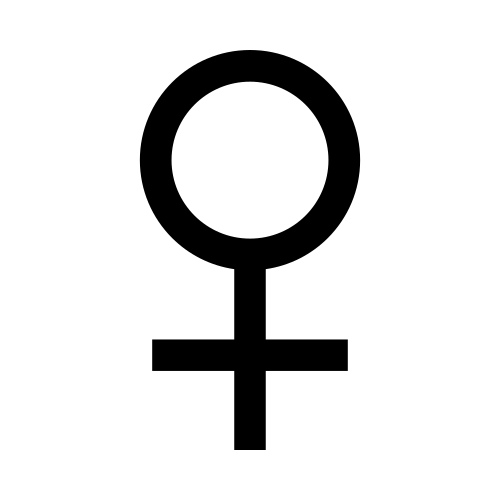
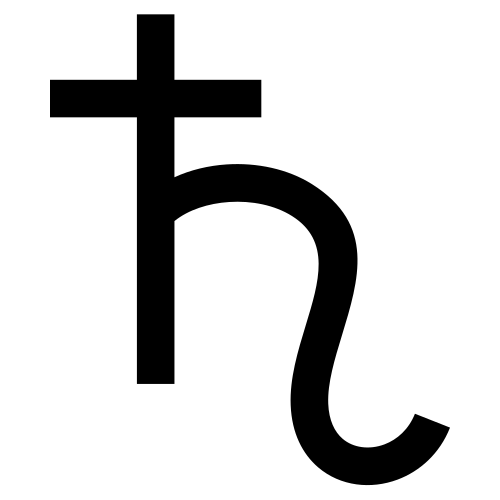
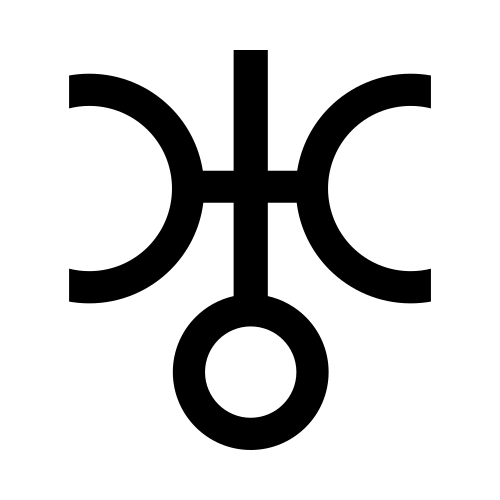
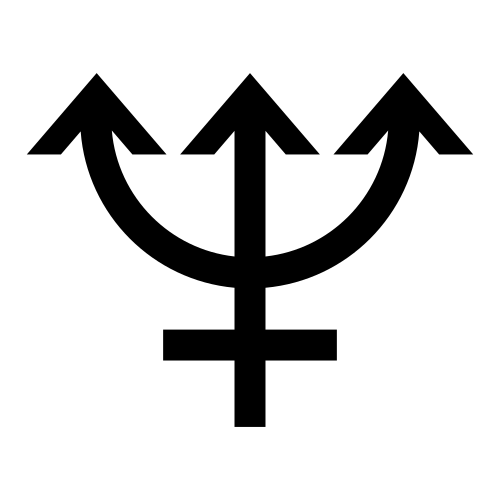
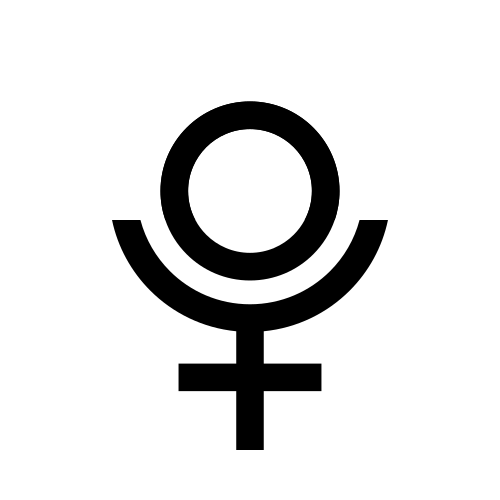
The Sun is at 2°37' Libra. The Moon is at 18°45' Virgo (noon position, ±7° margin). Mercury is at 10°49' Libra. Venus is at 0°22' Scorpio. Mars is at 7°14' Cancer. Jupiter is at 26°46' Virgo. Saturn is at 12°10' Aquarius R. Uranus is at 14°02' Capricorn. Neptune is at 16°10' Capricorn R. Pluto is at 21°01' Scorpio.
Mercury at 10°49' Libra is the most aspected personal planet, forming a trine with Saturn at 12°10' Aquarius retrograde (1°21') — the tightest major aspect in the chart — while simultaneously squaring Uranus at 14°02' Capricorn (3°13') and Mars at 7°14' Cancer (3°35'). Mars and Uranus oppose each other across the Cancer-Capricorn axis (6°48'), creating a loose cardinal T-pattern with Mercury at the apex. Uranus conjoins Neptune at 16°10' Capricorn retrograde (2°08'). The Sun at 2°37' Libra conjoins Jupiter at 26°46' Virgo (5°51').
The tightest major aspects between planets: Mercury trine Saturn (1°21'), Uranus conjunction Neptune (2°08'), Mercury square Uranus (3°13'), Mercury square Mars (3°35'), Sun conjunction Jupiter (5°51'), Mars opposition Uranus (6°48').
The engine also identifies the following tight minor aspects involving asteroids and calculated points: jupiter trine ceres (0.27° sep); jupiter sesquiquadrate saturn (0.40° app); moon semi-sextile chiron (0.62° app); venus trine juno (0.66° app).
The chart was calculated by Astrian's engine using NASA JPL DE441 ephemerides, sub-arcsecond precision. Timezone: Central European Summer Time (Europe/Madrid, UTC +2).
| Planet | Sign | Position |
|---|---|---|
| Sun | Libra | 02°35' |
| Moon | Virgo | 18°07'±6° |
| Mercury | Libra | 10°45' |
| Venus | Scorpio | 00°19' |
| Mars | Cancer | 07°13' |
| Jupiter | Virgo | 26°45' |
| Saturn | Aquarius | 12°10'retrograde |
| Uranus | Capricorn | 14°02' |
| Neptune | Capricorn | 16°10'retrograde |
| Pluto | Scorpio | 21°01' |
| Chiron | Leo | 19°22' |
 Sun
Sun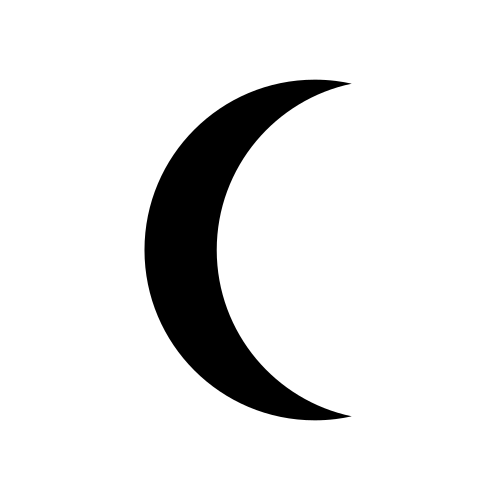 Moon
Moon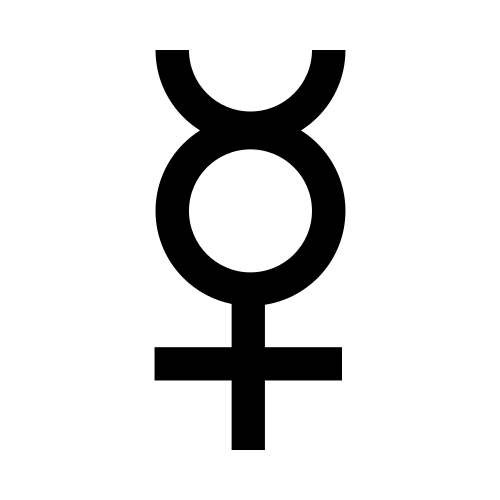 Mercury
 Venus
Venus Mars
Mars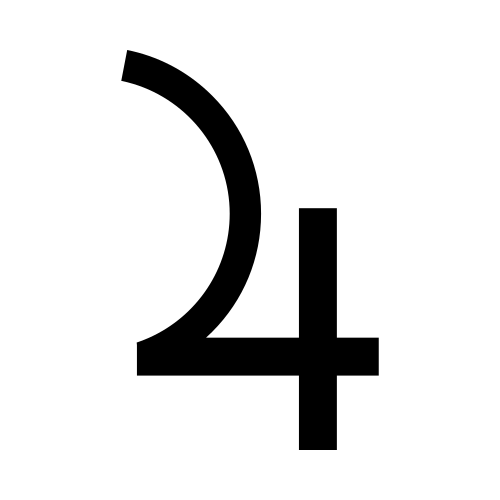 Jupiter
 Saturn
 Uranus
 Neptune
 Pluto
Pluto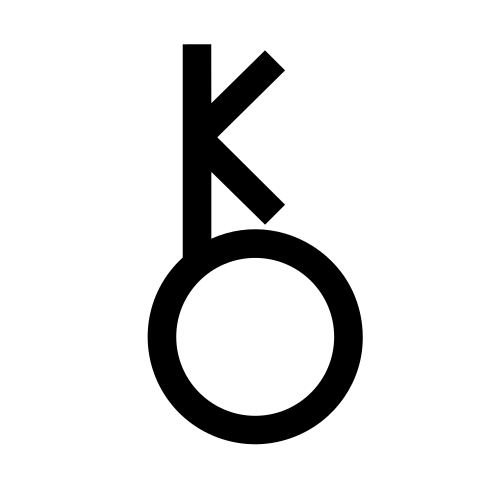 Chiron
Birth time unknown — house positions and Ascendant/MC are not available.
Astronomical context
Those born between approximately 1984 and 1995 carried Pluto in Scorpio. This generation arrived at the end of the Cold War, inheriting an era of accelerated information, digital emergence, the AIDS crisis, and the first wave of economic globalization. They grew up during the transition from analogue to digital and reached adulthood in a world reshaped by the internet, social media, and the 2008 financial crisis.
In astrological tradition, Pluto in Scorpio is associated with collective transformation of the domains that sign governs: sexuality, death and regeneration, shared resources, psychological depth, secrecy, and the exposure of hidden power structures. Scorpio is the sign of what lies beneath surfaces. Pluto's transit through its own modern domicile is read, symbolically, as a period of intensified collective encounter with themes of power, vulnerability, and transformation at the deepest register. The symbolic reading is correlative, not causal.
Others in the Astrian collection born under this configuration include Bruno Mars (1985), Drake (1986), The Weeknd (1990), and Bad Bunny (1994). Rosalía, born in 1992, belongs to the later years of this generational wave.
Other profiles from this Pluto in Scorpio generation
Symbolic reading
The following describes what classical astrological tradition associates with these configurations. Astrian does not apply these descriptions to the person's biography.
The Sun at 2°37' Libra is the most prominent structural feature of this chart. Without a documented birth time, there is no Ascendant or Midheaven — the reading is confined to planetary positions by sign and the aspects between planets.
The Moon at 18°45' Virgo represents the noon position; the actual placement falls within approximately 7° on either side. If born early in the day, the Moon could be in the low teens of Virgo; if born late, in the mid-twenties. The Moon's sign placement in Virgo is secure for the entire day.
Mercury at 10°49' Libra, Venus at 0°22' Scorpio, and Mars at 7°14' Cancer complete the personal planet picture.
### The Mercury T-pattern: trine Saturn, square Mars, square Uranus
The chart's most distinctive structural feature is a configuration centred on Mercury. Mercury at 10°49' Libra forms three simultaneous aspects: a trine to Saturn at 12°10' Aquarius retrograde (1°21'), a square to Uranus at 14°02' Capricorn (3°13'), and a square to Mars at 7°14' Cancer (3°35'). Mars and Uranus oppose each other across the Cancer-Capricorn axis (6°48'), creating a loose T-pattern with Mercury at the apex.
Mercury governs communication, articulation, and the faculty of making connections between disparate elements. Saturn governs structure, discipline, and the mastery of form. Uranus governs originality, disruption, and the refusal of convention. Mars governs action, drive, and the physical application of will.
The Mercury-Saturn trine — the tightest major aspect in the chart — provides a cooperative foundation: communication is naturally disciplined, articulate, and oriented toward structural mastery. The simultaneous squares from Mercury to Mars and Uranus introduce acute tension: the communicative faculty is pulled between the demand for direct physical action (Mars in Cancer) and the demand for radical innovation (Uranus in Capricorn). The opposition between Mars and Uranus runs beneath Mercury, creating a polarity between instinctive drive and disruptive originality that Mercury must negotiate from the apex.
In a cardinal T-pattern, the energy is active and initiating. The tradition reads this configuration as one where the communicative and artistic faculty is under simultaneous pressure from discipline, action, and disruption — producing expression that is neither complacent nor merely rebellious but structurally ambitious and inventively forceful.
### Uranus conjunction Neptune
Uranus at 14°02' Capricorn conjoins Neptune at 16°10' Capricorn retrograde, orb 2°08'. This conjunction is generational — it defined the early 1990s cohort — but its tight orb gives it particular intensity in this pattern. Uranus governs disruption and originality; Neptune governs the ideal, the dissolving of boundaries, and the visionary. Their conjunction in Capricorn — the sign of institutional structure — creates a generational energy directed toward the reimagination of established forms. When the conjunction participates in the Mercury T-pattern (through Mercury's square to Uranus), the generational impulse toward institutional disruption becomes channelled through the personal communicative faculty.
### Sun conjunction Jupiter
The Sun at 2°37' Libra conjoins Jupiter at 26°46' Virgo, orb 5°51'. The orb is relatively wide, but the conjunction crosses the Virgo-Libra cusp and connects the chart's central identity with Jupiter's capacity for expansion and amplification. The Sun in Libra carries the Libran register of aesthetics, partnership, and relational awareness; Jupiter amplifies this toward broader reach and larger audiences.
The planetary pattern here is read as a symbolic portrait, not a causal explanation. No planet caused, predicted, or determined any event or characteristic.
Astrology is a symbolic language with 2,500 years of literature. The reading above is interpretive, not explanatory.
Astrian does not claim that the natal chart of Rosalía caused or determined any of the above. Astrology is a symbolic system with 2,500 years of literature. Its capacity for retrospective description does not imply explanatory capacity.
A parallel life
The following are verified biographical facts. No connection to the natal chart is implied.
Rosalía Vila Tobella was born on 25 September 1992 in Sant Esteve Sesrovires, a small town approximately thirty kilometres west of Barcelona, in the Catalonia region of Spain. Her father, José Manuel Vila, was a businessman; her mother, Pilar Tobella, worked in fashion. She has an older sister, Pilar. The family was not from a flamenco background.
She began singing as a child, enrolled in the Taller de Músics in Barcelona at thirteen, and later studied at the Escola Superior de Música de Catalunya (ESMUC), where she trained in classical flamenco under the instruction of José Miguel "Chiqui" Vizcaya. She graduated in 2017. The formal training — years of disciplined study of cante jondo, compás, and flamenco history — provided the technical foundation that would distinguish her work from that of pop artists who borrowed from flamenco superficially.
Her debut album, Los Ángeles (2017), was a spare, acoustic meditation on death built around traditional flamenco forms. It won the Spanish National Music Prize for Best Newcomer and was nominated for the Latin Grammy for Best Alternative Album.
El Mal Querer (2018), her second album, was structured around the anonymous thirteenth-century Occitan romance Flamenca, with each track corresponding to a chapter. The album fused traditional cante with electronic production, reggaetón rhythms, and avant-garde sound design. It won the Latin Grammy for Best Fusion/Urban Interpretation and was named the best Spanish-language album of the decade by multiple publications. The single "Malamente" became a cultural event in Spain and introduced her to international audiences.
In the period between albums, she collaborated with J Balvin ("Con Altura," 2019), Travis Scott ("TKN," 2020), and Billie Eilish ("Lo Vas a Olvidar," 2021), moving between Latin urban, hip-hop, and alt-pop with apparent ease.
MOTOMAMI (2022) — the title a neologism she coined to describe feminine energy that is simultaneously soft and powerful — won the Grammy for Best Latin Rock or Alternative Album, the Latin Grammy for Album of the Year, and was named the best album of 2022 by the New York Times. It was the first album by a Spanish artist to win a Grammy in a non-Latin-specific category.
Her relationship with the Puerto Rican singer Rauw Alejandro, from 2022 to 2023, and their public breakup became one of the most widely followed celebrity stories in the Spanish-speaking world.
As of 2025, she has won two Grammy Awards, eight Latin Grammy Awards, and multiple MTV Video Music Awards. She is widely regarded as the most internationally recognized Spanish musical artist of her generation.
Biographical sources
- Fou.
This profile presents the sky at the birth of Rosalía and verified facts of their biography. Astrian does not claim that astrology has predictive capacity or that the natal chart determines the trajectory of a life. Astrology is a symbolic system with 2,500 years of literature. Its capacity for retrospective description does not imply explanatory capacity.
Related profiles
Calculate your own birth chart with the same NASA JPL DE441 precision.
Calculate my birth chartLast updated: June 12, 2026
Newsletter
A short reading once a month, in your inbox.
A note on the symbolism of the season, recent editorial pieces, and what to look for in next month's sky. No predictions.
Support this project
Independent, no venture funding, no ads. A contribution keeps Astrian precise and free.
Support on Ko-fi (opens in new tab)