PROFILE · SCIENCE & TECHNOLOGY
Max Planck
Max Karl Ernst Ludwig Planck
theoretical physicist
Born 23 April 1858 · Kiel, Duchy of Holstein · 54.32° N, 10.14° EX
Source: Birth time not documented in publicly accessible records
About this chart
No birth time is documented for this person. The chart therefore shows planetary positions in their signs, the slow aspects between them, and the generational context — but not house placements, the Ascendant, or the Midheaven, which require an accurate birth time. The Moon's sign carries a ±6° margin: if it falls near a sign boundary, the sign could vary. Positions for all other planets are reliable.
Do you have a verified source for this birth time? Share it →
The sky at birth
No birth time is documented for Max Planck. The Ascendant, the Midheaven, and the house positions cannot be determined; the reading is confined to planetary sign placements and the aspects between planets. The positions below are calculated for noon local time and are accurate to a fraction of a degree for the slow-moving bodies.
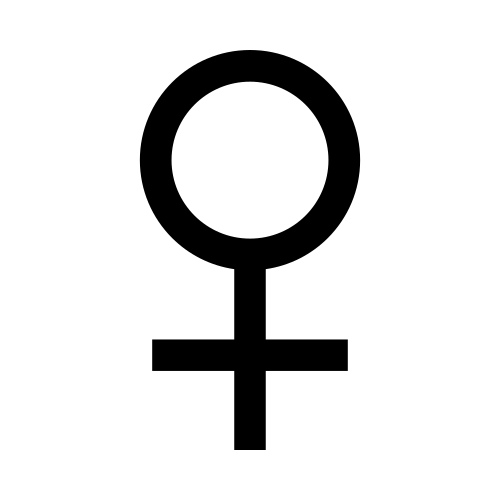
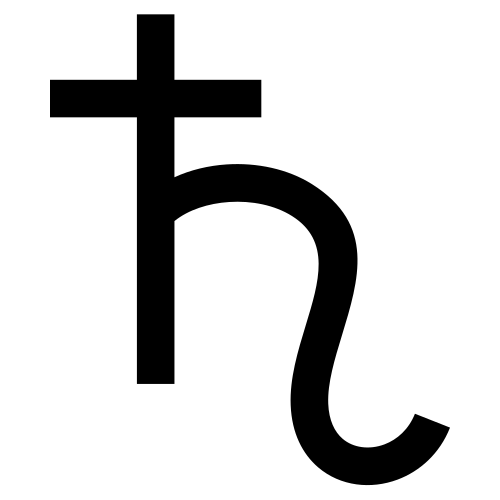
The Moon is near 8°43' Virgo (noon position, ±7° margin). Sun is at 2°58' Taurus. Mercury is at 22°34' Taurus. Venus is at 16°35' Taurus. Mars is at 1°10' Sagittarius, retrograde. Jupiter is at 22°27' Taurus. Saturn is at 22°16' Cancer. Uranus is at 27°43' Taurus. Neptune is at 23°49' Pisces. Pluto is at 6°01' Taurus.
6 bodies occupy Taurus (Sun, Mercury, Venus, Jupiter, Uranus and Pluto) — a concentration that stands out as a structural feature of the chart.
The tightest major aspects between planets: Mercury conjunct Jupiter (0°07'); Jupiter sextile Saturn (0°11'); Mercury sextile Saturn (0°19'); Mercury sextile Neptune (1°14'); Jupiter sextile Neptune (1°22'); Saturn trine Neptune (1°33').
Uranus sextile Neptune (3°54') is structural but generational — an alignment of slow-moving outer planets shared across many birth years.
The engine also registers tight minor aspects involving asteroids and calculated points: Sun sesquiquadrate Lilith (0°01'); Venus sextile North Node (1°05'); Venus quincunx Lilith (1°22'); Lilith square North Node (2°28'). These are reported for completeness and carry less weight in traditional reading.
The chart was calculated using NASA JPL DE441 ephemerides, sub-arcsecond precision.
| Planet | Sign | Position |
|---|---|---|
| Sun | Taurus | 02°58' |
| Moon | Virgo | 08°43'±6° |
| Mercury | Taurus | 22°34' |
| Venus | Taurus | 16°35' |
| Mars | Sagittarius | 01°10'retrograde |
| Jupiter | Taurus | 22°27' |
| Saturn | Cancer | 22°16' |
| Uranus | Taurus | 27°43' |
| Neptune | Pisces | 23°49' |
| Pluto | Taurus | 06°01' |
 Sun
Sun Moon
Moon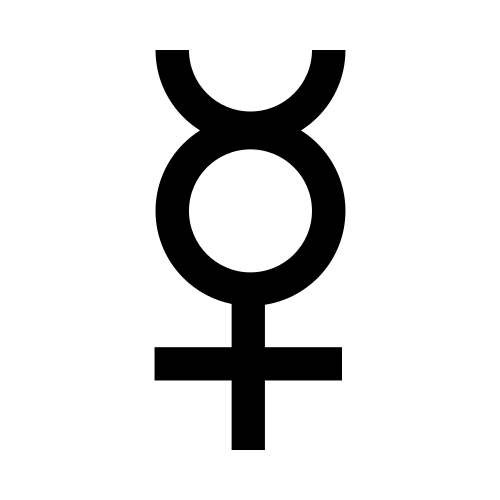 Mercury
 Venus
Venus Mars
Mars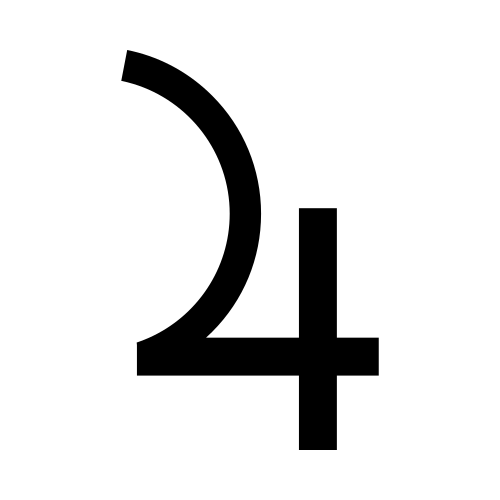 Jupiter
 Saturn
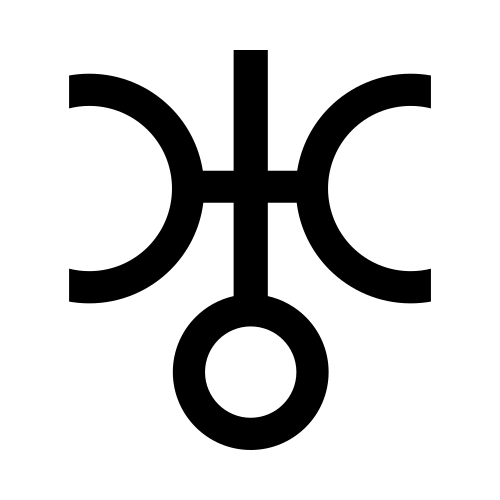 Uranus
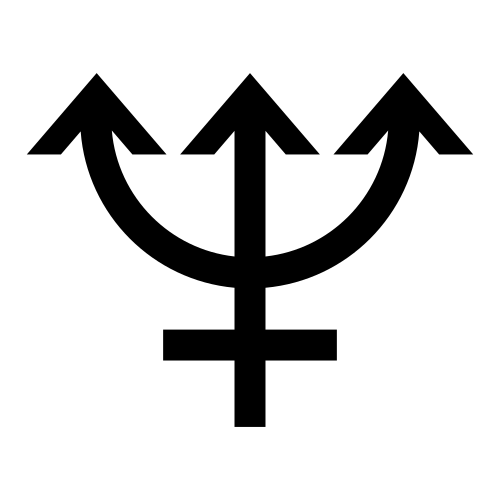 Neptune
 Pluto
PlutoBirth time unknown — house positions and Ascendant/MC are not available.
Astronomical context
Pluto crossed Taurus roughly from 1853 to 1884. In astrological tradition this transit is linked to the transformation of value, resources, and the material world — the generation whose lifetimes coincided with the consolidation of industrial capital and new forms of wealth.
Max Planck (born 1858) belongs to this generational configuration. Astrian groups profiles by such shared signatures rather than by any claim of shared destiny. Related profiles in Astrian: Niels Bohr · Werner Heisenberg · Erwin Schrödinger. The symbolic reading is correlative, not causal.
Other profiles from this Pluto in Taurus generation
Symbolic reading
The following describes what classical astrological tradition associates with these configurations. Astrian does not apply these descriptions to the person's biography.
The Sun in Taurus is the most prominent structural feature available without a birth time, centring the chart on stability, persistence, and the tangible. There is no Ascendant or Midheaven to anchor the angles, so the reading rests on sign placements and the aspects between planets rather than on houses.
Among the personal planets, the Moon in Virgo is associated in tradition with analysis, craft, and the refinement of method (the Moon's sign is given for the noon chart and may shift with an exact time); Mercury in Taurus with stability, persistence, and the tangible; Venus in Taurus with stability, persistence, and the tangible; and Mars in Sagittarius with expansion, conviction, and the horizon. These placements describe registers of feeling, thought, attraction, and action as the tradition catalogues them, independent of the life that follows.
Mercury conjunct Jupiter (0°07'): tradition reads thought and communication fused with expansion and meaning.
Jupiter sextile Saturn (0°11'): tradition reads expansion and meaning in supportive contact with structure, limitation, and discipline.
Mercury sextile Saturn (0°19'): tradition reads thought and communication in supportive contact with structure, limitation, and discipline.
Mercury sextile Neptune (1°14'): tradition reads thought and communication in supportive contact with dissolution, imagination, and idealism.
These placements are presented as a symbolic portrait, correlative and never causal — a description within the tradition's vocabulary, not an explanation of the life that follows.
Astrology is a symbolic language with 2,500 years of literature. The reading above is interpretive, not explanatory.
Astrian does not claim that the natal chart of Max Planck caused or determined any of the above. Astrology is a symbolic system with 2,500 years of literature. Its capacity for retrospective description does not imply explanatory capacity.
A parallel life
The following are verified biographical facts. No connection to the natal chart is implied.
Max Karl Ernst Ludwig Planck was born on April 23, 1858, in Kiel, then part of the Duchy of Holstein. He came from an academic family with a tradition of scholarship in law and theology. He studied physics at the University of Munich and the University of Berlin, where he was influenced by Hermann von Helmholtz and Gustav Kirchhoff. He received his doctorate from Munich in 1879 with a thesis on the second law of thermodynamics.
Planck was appointed professor of theoretical physics at the University of Berlin in 1889, where he remained for most of his career. During the 1890s, he devoted intensive work to the problem of blackbody radiation: classical physics predicted that a blackbody should emit infinite energy at high frequencies, a result so clearly wrong it became known as the ultraviolet catastrophe.
In October 1900, Planck presented an empirical formula that correctly described the blackbody radiation spectrum. To derive a theoretical justification for this formula, he was compelled in December 1900 to introduce a radical assumption: that energy is not continuous but is emitted and absorbed in discrete packets, which he called quanta. The mathematical relationship involved a new fundamental constant, now universally known as Planck's constant (h), with the value approximately 6.626 x 10^-34 joule-seconds.
Planck himself viewed this hypothesis with ambivalence, hoping it might eventually be reconciled with classical physics. It was Albert Einstein's 1905 explanation of the photoelectric effect using quanta that demonstrated the physical reality of Planck's insight and extended it beyond thermal radiation. The quantum hypothesis subsequently became the foundation of an entirely new physics.
In 1918, Planck received the Nobel Prize in Physics for the discovery of energy quanta. He served as president of the Kaiser Wilhelm Society from 1930 to 1937 and worked to protect scientific institutions during the rise of National Socialism, with limited success.
Planck's later years were marked by profound personal tragedy: his first wife died in 1909, one son was killed in World War I, and twin daughters died in childbirth. His son Erwin was executed in 1945 for alleged involvement in the July 1944 plot against Hitler.
Max Planck died on October 4, 1947, in Göttingen. The Max Planck Society, Germany's foremost research organization, was named in his honor in 1948.
Biographical sources
- John L. Heilbron, The Dilemmas of an Upright Man: Max Planck and the Fortunes of German Science (Harvard University Press, 1996).
- Max Planck, 'Zur Theorie des Geset.
This profile presents the sky at the birth of Max Planck and verified facts of their biography. Astrian does not claim that astrology has predictive capacity or that the natal chart determines the trajectory of a life. Astrology is a symbolic system with 2,500 years of literature. Its capacity for retrospective description does not imply explanatory capacity.
Related profiles
Calculate your own birth chart with the same NASA JPL DE441 precision.
Calculate my birth chartLast updated: June 14, 2026
Newsletter
A short reading once a month, in your inbox.
A note on the symbolism of the season, recent editorial pieces, and what to look for in next month's sky. No predictions.
Support this project
Independent, no venture funding, no ads. A contribution keeps Astrian precise and free.
Support on Ko-fi (opens in new tab)