PROFILE · SCIENCE & TECHNOLOGY
J. Robert Oppenheimer
Julius Robert Oppenheimer
theoretical physicist
Born 22 April 1904 · New York City, United States · 40.71° N, 74.01° WX
Source: Birth time not documented in publicly accessible records
About this chart
No birth time is documented for this person. The chart therefore shows planetary positions in their signs, the slow aspects between them, and the generational context — but not house placements, the Ascendant, or the Midheaven, which require an accurate birth time. The Moon's sign carries a ±6° margin: if it falls near a sign boundary, the sign could vary. Positions for all other planets are reliable.
Do you have a verified source for this birth time? Share it →
The sky at birth
No birth time is documented for J. Robert Oppenheimer. The Ascendant, the Midheaven, and the house positions cannot be determined; the reading is confined to planetary sign placements and the aspects between planets. The positions below are calculated for noon local time and are accurate to a fraction of a degree for the slow-moving bodies. One caveat: the Moon lies near a sign boundary, so without an exact time it cannot be fixed to a single sign — it sits close to 25°39' Cancer within a daily margin of about ±7°.
The Moon is near 25°39' Cancer (noon position, ±7° margin). Sun is at 2°07' Taurus. Mercury is at 22°05' Taurus. Venus is at 11°43' Aries. Mars is at 11°44' Taurus. Jupiter is at 12°36' Aries. Saturn is at 19°46' Aquarius. Uranus is at 29°48' Sagittarius, retrograde. Neptune is at 3°33' Cancer. Pluto is at 19°07' Gemini.
3 bodies occupy Taurus (Sun, Mercury and Mars) — a concentration that stands out as a structural feature of the chart.
The tightest major aspects between planets: Saturn trine Pluto (0°39'); Venus conjunct Jupiter (0°53'); Sun sextile Neptune (1°26'); Sun trine Uranus (2°19'); Mercury square Saturn (2°19'); Moon sextile Mercury (3°34').
Uranus opposite Neptune (3°44') is structural but generational — an alignment of slow-moving outer planets shared across many birth years.
The engine also registers tight minor aspects involving asteroids and calculated points: Mercury quincunx Ceres (0°01'); Saturn trine Vesta (0°03'); Uranus semi-sextile Chiron (0°11'); Moon sextile North Node (0°13'). These are reported for completeness and carry less weight in traditional reading.
The chart was calculated using NASA JPL DE441 ephemerides, sub-arcsecond precision.
| Planet | Sign | Position |
|---|---|---|
| Sun | Taurus | 02°07' |
| Moon | Cancer | 25°39'±6° |
| Mercury | Taurus | 22°05' |
| Venus | Aries | 11°43' |
| Mars | Taurus | 11°44' |
| Jupiter | Aries | 12°36' |
| Saturn | Aquarius | 19°46' |
| Uranus | Sagittarius | 29°48'retrograde |
| Neptune | Cancer | 03°33' |
| Pluto | Gemini | 19°07' |
| Chiron | Aquarius | 00°00' |
 Sun
Sun Moon
Moon Mercury
 Venus
Venus Mars
Mars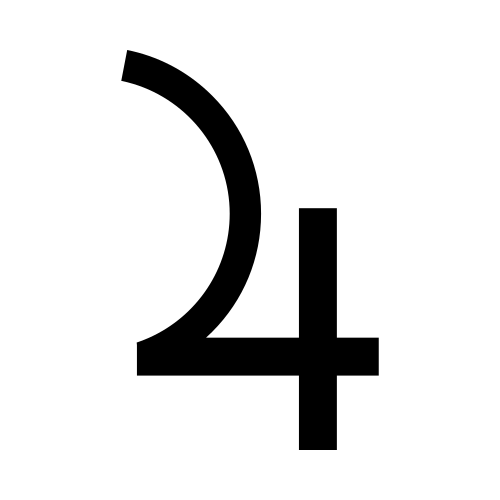 Jupiter
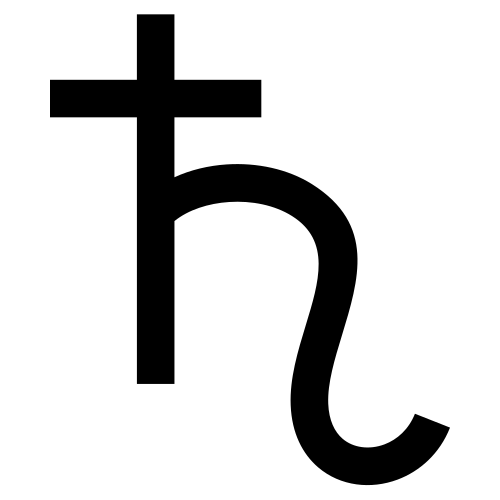 Saturn
 Uranus
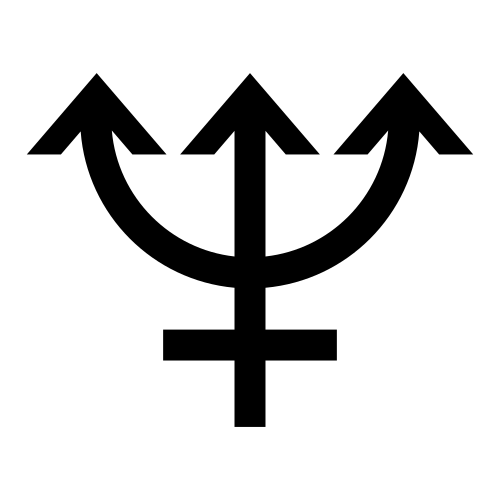 Neptune
 Pluto
Pluto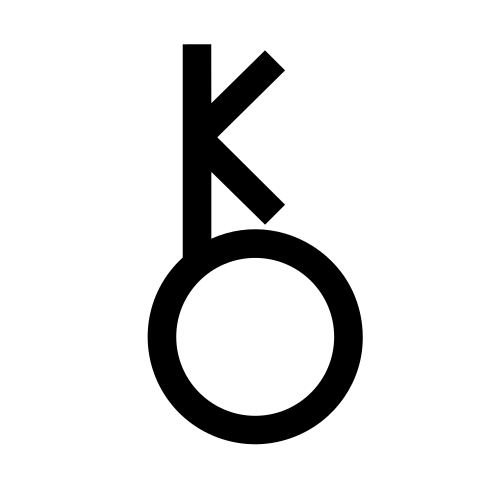 Chiron
Birth time unknown — house positions and Ascendant/MC are not available.
Astronomical context
Pluto travelled through Gemini from the mid-1880s to 1914. In astrological tradition this transit is associated with the transformation of communication, ideas, transport, and the press — the generation that came of age amid the spread of mass media, the telephone, and accelerating mobility.
J. Robert Oppenheimer (born 1904) belongs to this generational configuration. Astrian groups profiles by such shared signatures rather than by any claim of shared destiny. Related profiles in Astrian: John von Neumann · Enrico Fermi · Werner Heisenberg. The symbolic reading is correlative, not causal.
Other profiles from this Pluto in Gemini generation
Symbolic reading
The following describes what classical astrological tradition associates with these configurations. Astrian does not apply these descriptions to the person's biography.
The Sun in Taurus is the most prominent structural feature available without a birth time, centring the chart on stability, persistence, and the tangible. There is no Ascendant or Midheaven to anchor the angles, so the reading rests on sign placements and the aspects between planets rather than on houses.
Among the personal planets, the Moon in Cancer is associated in tradition with attachment, memory, and protection (the Moon's sign is given for the noon chart and may shift with an exact time); Mercury in Taurus with stability, persistence, and the tangible; Venus in Aries with initiative, directness, and the will to begin; and Mars in Taurus with stability, persistence, and the tangible. These placements describe registers of feeling, thought, attraction, and action as the tradition catalogues them, independent of the life that follows.
Saturn trine Pluto (0°39'): tradition reads structure, limitation, and discipline in easy flow with depth, power, and transformation.
Venus conjunct Jupiter (0°53'): tradition reads values, attraction, and harmony fused with expansion and meaning.
Sun sextile Neptune (1°26'): tradition reads identity and central purpose in supportive contact with dissolution, imagination, and idealism.
Sun trine Uranus (2°19'): tradition reads identity and central purpose in easy flow with disruption and innovation.
These placements are presented as a symbolic portrait, correlative and never causal — a description within the tradition's vocabulary, not an explanation of the life that follows.
Astrology is a symbolic language with 2,500 years of literature. The reading above is interpretive, not explanatory.
Astrian does not claim that the natal chart of J. Robert Oppenheimer caused or determined any of the above. Astrology is a symbolic system with 2,500 years of literature. Its capacity for retrospective description does not imply explanatory capacity.
A parallel life
The following are verified biographical facts. No connection to the natal chart is implied.
Julius Robert Oppenheimer was born on 22 April 1904 in New York City into a wealthy family of German-Jewish background. He showed wide intellectual interests from an early age and studied chemistry at Harvard University, completing his undergraduate degree in three years. He then traveled to Europe, studying first at the Cavendish Laboratory in Cambridge and then at the University of Göttingen under Max Born, where he received his doctorate in theoretical physics in 1927.
Returning to the United States, Oppenheimer held joint appointments at the University of California, Berkeley, and the California Institute of Technology. During the late 1920s and 1930s, he made contributions to quantum mechanics, including work on the Born-Oppenheimer approximation, which separates the motion of electrons and nuclei in molecular calculations. He and his students also worked on theoretical aspects of cosmic rays, nuclear physics, and the behaviour of extremely dense stellar objects, including what are now understood as black holes and neutron stars.
In 1942, Oppenheimer was appointed scientific director of the Manhattan Project, the United States government programme to develop nuclear weapons during the Second World War. He directed the Los Alamos Laboratory in New Mexico, where a concentrated group of scientists from several countries worked on the design and construction of fission weapons. The first test of a nuclear device took place in New Mexico in July 1945.
After the war, Oppenheimer became chairman of the General Advisory Committee of the Atomic Energy Commission and director of the Institute for Advanced Study in Princeton. He engaged in public debates about the control and development of nuclear weapons and expressed reservations about the development of thermonuclear weapons.
In 1954, during the McCarthy era, Oppenheimer's security clearance was revoked following hearings in which his past political associations and opposition to the hydrogen bomb programme were examined. He was not charged with any crime but was effectively removed from government advisory roles. He continued as director of the Institute for Advanced Study until 1966. He died on 18 February 1967 in Princeton, New Jersey. His security clearance was posthumously restored in 2022 by the United States Department of Energy.
Biographical sources
- Bird, Kai, and Martin J. Sherwin. American Prometheus: The Triumph and Tragedy of J. Robert Oppenheimer. New York: Alfred A. Knopf, 2005..
- Goodchild, Peter. J. Robert Oppenheimer: Shatterer of Worlds. London: BBC, 1980..
- Hawkins, David, Edith C. Truslow, and Ralph Carlisle Smith. Project Y: The Los Alamos Story. Los Angeles: Tomash Publishers, 1983..
- Pais, Abraham, and Robert P. Crease. J. Robert Oppenheimer: A Life. Oxford: Oxford University Press, 2006..
This profile presents the sky at the birth of J. Robert Oppenheimer and verified facts of their biography. Astrian does not claim that astrology has predictive capacity or that the natal chart determines the trajectory of a life. Astrology is a symbolic system with 2,500 years of literature. Its capacity for retrospective description does not imply explanatory capacity.
Related profiles
Calculate your own birth chart with the same NASA JPL DE441 precision.
Calculate my birth chartLast updated: June 14, 2026
Newsletter
A short reading once a month, in your inbox.
A note on the symbolism of the season, recent editorial pieces, and what to look for in next month's sky. No predictions.
Support this project
Independent, no venture funding, no ads. A contribution keeps Astrian precise and free.
Support on Ko-fi (opens in new tab)