PROFILE · SCIENCE & TECHNOLOGY
Erwin Schrödinger
Erwin Rudolf Josef Alexander Schrödinger
physicist
Born 12 August 1887 · Vienna, Austria-Hungary · 48.21° N, 16.37° EX
Source: Birth time not documented in publicly accessible records
About this chart
No birth time is documented for this person. The chart therefore shows planetary positions in their signs, the slow aspects between them, and the generational context — but not house placements, the Ascendant, or the Midheaven, which require an accurate birth time. The Moon's sign carries a ±6° margin: if it falls near a sign boundary, the sign could vary. Positions for all other planets are reliable.
Do you have a verified source for this birth time? Share it →
The sky at birth
No birth time is documented for Erwin Schrödinger. The Ascendant, the Midheaven, and the house positions cannot be determined; the reading is confined to planetary sign placements and the aspects between planets. The positions below are calculated for noon local time and are accurate to a fraction of a degree for the slow-moving bodies. One caveat: the Moon lies near a sign boundary, so without an exact time it cannot be fixed to a single sign — it sits close to 24°39' Taurus within a daily margin of about ±7°.
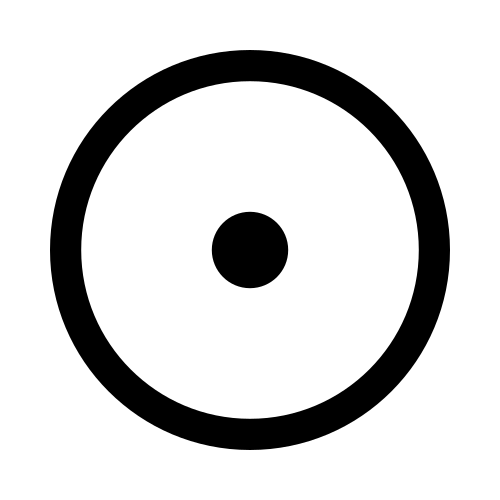
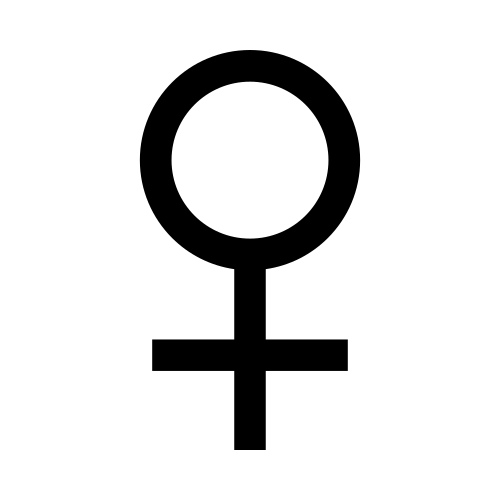
The Moon is near 24°39' Taurus (noon position, ±7° margin). Sun is at 19°22' Leo. Mercury is at 1°51' Leo. Venus is at 0°12' Libra. Mars is at 20°31' Cancer. Jupiter is at 29°29' Libra. Saturn is at 29°13' Cancer. Uranus is at 9°44' Libra. Neptune is at 29°57' Taurus. Pluto is at 4°55' Gemini.
3 bodies occupy Libra (Venus, Jupiter and Uranus) — a concentration that stands out as a structural feature of the chart.
The tightest major aspects between planets: Venus trine Neptune (0°15'); Jupiter square Saturn (0°16'); Saturn sextile Neptune (0°44'); Venus sextile Saturn (0°59'); Mercury sextile Venus (1°39'); Mercury sextile Neptune (1°54').
Uranus trine Pluto (4°49') is structural but generational — an alignment of slow-moving outer planets shared across many birth years.
The engine also registers tight minor aspects involving asteroids and calculated points: Uranus opposite Lilith (0°35'); Sun conjunct North Node (0°37'); Moon semi-square Lilith (0°40'); Mars semi-sextile North Node (1°46'). These are reported for completeness and carry less weight in traditional reading.
The chart was calculated using NASA JPL DE441 ephemerides, sub-arcsecond precision.
| Planet | Sign | Position |
|---|---|---|
| Sun | Leo | 19°22' |
| Moon | Taurus | 24°39'±6° |
| Mercury | Leo | 01°51' |
| Venus | Libra | 00°12' |
| Mars | Cancer | 20°31' |
| Jupiter | Libra | 29°29' |
| Saturn | Cancer | 29°13' |
| Uranus | Libra | 09°44' |
| Neptune | Taurus | 29°57' |
| Pluto | Gemini | 04°55' |
 Sun
Sun Moon
Moon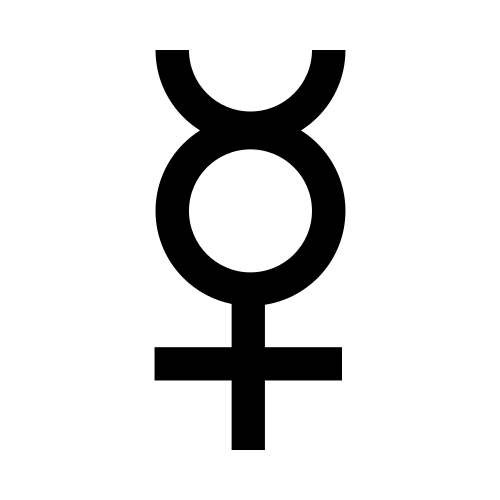 Mercury
 Venus
Venus Mars
Mars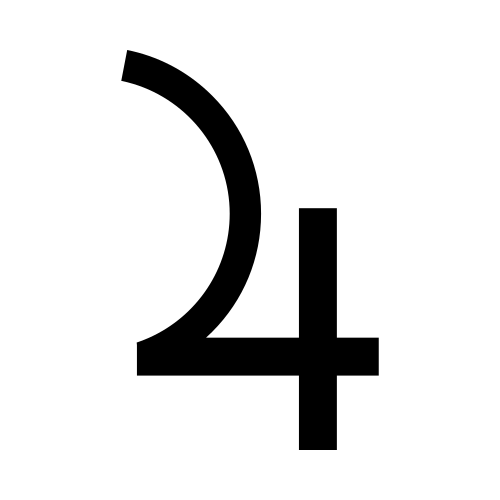 Jupiter
 Saturn
 Uranus
 Neptune
 Pluto
PlutoBirth time unknown — house positions and Ascendant/MC are not available.
Astronomical context
Pluto travelled through Gemini from the mid-1880s to 1914. In astrological tradition this transit is associated with the transformation of communication, ideas, transport, and the press — the generation that came of age amid the spread of mass media, the telephone, and accelerating mobility.
Erwin Schrödinger (born 1887) belongs to this generational configuration. Astrian groups profiles by such shared signatures rather than by any claim of shared destiny. Related profiles in Astrian: Niels Bohr · Werner Heisenberg · Max Planck. The symbolic reading is correlative, not causal.
Other profiles from this Pluto in Gemini generation
Symbolic reading
The following describes what classical astrological tradition associates with these configurations. Astrian does not apply these descriptions to the person's biography.
The Sun in Leo is the most prominent structural feature available without a birth time, centring the chart on expression, pride, and the creative self. There is no Ascendant or Midheaven to anchor the angles, so the reading rests on sign placements and the aspects between planets rather than on houses.
Among the personal planets, the Moon in Taurus is associated in tradition with stability, persistence, and the tangible (the Moon's sign is given for the noon chart and may shift with an exact time); Mercury in Leo with expression, pride, and the creative self; Venus in Libra with balance, relationship, and proportion; and Mars in Cancer with attachment, memory, and protection. These placements describe registers of feeling, thought, attraction, and action as the tradition catalogues them, independent of the life that follows.
Venus trine Neptune (0°15'): tradition reads values, attraction, and harmony in easy flow with dissolution, imagination, and idealism.
Jupiter square Saturn (0°16'): tradition reads expansion and meaning in friction with structure, limitation, and discipline.
Saturn sextile Neptune (0°44'): tradition reads structure, limitation, and discipline in supportive contact with dissolution, imagination, and idealism.
Venus sextile Saturn (0°59'): tradition reads values, attraction, and harmony in supportive contact with structure, limitation, and discipline.
These placements are presented as a symbolic portrait, correlative and never causal — a description within the tradition's vocabulary, not an explanation of the life that follows.
Astrology is a symbolic language with 2,500 years of literature. The reading above is interpretive, not explanatory.
Astrian does not claim that the natal chart of Erwin Schrödinger caused or determined any of the above. Astrology is a symbolic system with 2,500 years of literature. Its capacity for retrospective description does not imply explanatory capacity.
A parallel life
The following are verified biographical facts. No connection to the natal chart is implied.
Erwin Rudolf Josef Alexander Schrödinger was born on 12 August 1887 in Vienna, Austria-Hungary. He studied physics at the University of Vienna, where he received his doctorate in 1910. After serving in the First World War, he held positions at several European universities before accepting a professorship at the University of Zurich.
In 1926, working in Zurich, Schrödinger published the equation that now bears his name: a partial differential equation that describes how the quantum state of a physical system changes over time. This was a significant development in the formulation of quantum mechanics, providing a mathematical framework grounded in wave mechanics. In the same year, he demonstrated the mathematical equivalence of his wave mechanics and the matrix mechanics formulation developed by Werner Heisenberg and colleagues.
In 1927, Schrödinger succeeded Max Planck in the chair of theoretical physics at the University of Berlin. After the National Socialist government came to power in Germany in 1933, Schrödinger, who had ethical objections to the new regime, left Germany and eventually settled at the University of Oxford. In the same year, 1933, he was awarded the Nobel Prize in Physics jointly with Paul Dirac.
In 1940, Schrödinger accepted an invitation to join the newly established Dublin Institute for Advanced Studies, where he remained until 1956. During this period he delivered a series of lectures that were published in 1944 as the book What Is Life?, in which he applied concepts from physics to the question of how genetic information might be encoded in biological molecules. This work has been cited by several molecular biologists as an influence on their research.
Schrödinger returned to Vienna in 1956 and was appointed to a special professorship at the University of Vienna. He died on 4 January 1961 in Vienna.
Biographical sources
- Moore, Walter. Schrodinger: Life and Thought. Cambridge: Cambridge University Press, 1989..
- Schrödinger, Erwin. What Is Life? Cambridge: Cambridge University Press, 1944..
- Jammer, Max. The Conceptual Development of Quantum Mechanics. New York: McGraw-Hill, 1966..
- Mehra, Jagdish, and Helmut Rechenberg. The Historical Development of Quantum Theory. Vol. 5. New York: Springer, 1987..
This profile presents the sky at the birth of Erwin Schrödinger and verified facts of their biography. Astrian does not claim that astrology has predictive capacity or that the natal chart determines the trajectory of a life. Astrology is a symbolic system with 2,500 years of literature. Its capacity for retrospective description does not imply explanatory capacity.
Related profiles
Calculate your own birth chart with the same NASA JPL DE441 precision.
Calculate my birth chartLast updated: June 14, 2026
Newsletter
A short reading once a month, in your inbox.
A note on the symbolism of the season, recent editorial pieces, and what to look for in next month's sky. No predictions.
Support this project
Independent, no venture funding, no ads. A contribution keeps Astrian precise and free.
Support on Ko-fi (opens in new tab)