PROFILE · SCIENCE & TECHNOLOGY
Werner Heisenberg
Werner Karl Heisenberg
theoretical physicist
Born 5 December 1901 · 16:45 · 12:36 UTC · Würzburg, German Empire · 49.79° N, 9.93° EAA
Source: Astro-Databank (Rodden Rating AA)
The sky at birth
With a documented birth time, the full chart can be cast. The Ascendant falls at 21°06' Gemini and the Midheaven at 17°28' Aquarius, which fixes the angular framework and allows the planets to be placed in houses.
Sun is at 12°50' Sagittarius, house 6. Moon is at 13°44' Libra, house 5. Mercury is at 28°00' Scorpio, house 6. Venus is at 0°05' Aquarius, house 9. Mars is at 8°44' Capricorn, house 7. Jupiter is at 15°28' Capricorn, house 8. Saturn is at 14°43' Capricorn, house 8. Uranus is at 16°51' Sagittarius, house 6. Neptune is at 0°33' Cancer, house 1, retrograde. Pluto is at 17°46' Gemini, house 12, retrograde.
3 bodies occupy Capricorn (Mars, Jupiter and Saturn) — a concentration that stands out as a structural feature of the chart.
The tightest major aspects between planets: Jupiter conjunct Saturn (0°45'); Sun sextile Moon (0°55'); Uranus opposite Pluto (0°55'); Moon square Saturn (0°59'); Moon square Jupiter (1°44'); Mercury sextile Venus (2°05').
Uranus opposite Pluto (0°55') is structural but generational — an alignment of slow-moving outer planets shared across many birth years.
The engine also registers tight minor aspects involving asteroids and calculated points: Mercury quincunx Ceres (0°04'); Sun sesquiquadrate Ceres (0°14'); Chiron semi-square Vesta (0°34'); Mars sextile Pallas (0°46'). These are reported for completeness and carry less weight in traditional reading.
The chart was calculated using NASA JPL DE441 ephemerides, sub-arcsecond precision.
| Planet | Sign | Position | House |
|---|---|---|---|
| Ascendant | Gemini | 21°06' | — |
| Midheaven | Aquarius | 17°28' | — |
| Sun | Sagittarius | 12°50' | H6 |
| Moon | Libra | 13°44' | H5 |
| Mercury | Scorpio | 28°00' | H6 |
| Venus | Aquarius | 00°05' | H9 |
| Mars | Capricorn | 08°44' | H7 |
| Jupiter | Capricorn | 15°28' | H8 |
| Saturn | Capricorn | 14°43' | H8 |
| Uranus | Sagittarius | 16°51' | H6 |
| Neptune | Cancer | 00°33'retrograde | H1 |
| Pluto | Gemini | 17°46'retrograde | H12 |
| Chiron | Capricorn | 04°49' | H7 |
 Sun
Sun Moon
Moon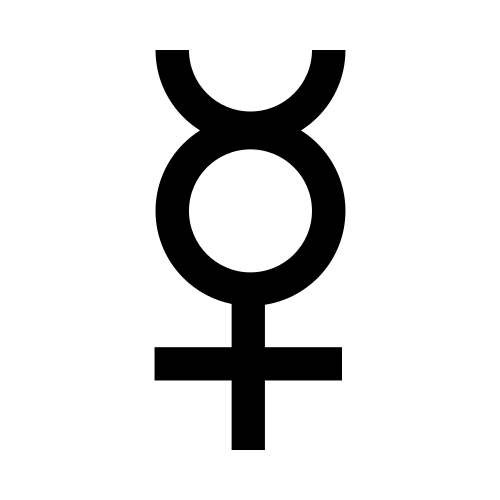 Mercury
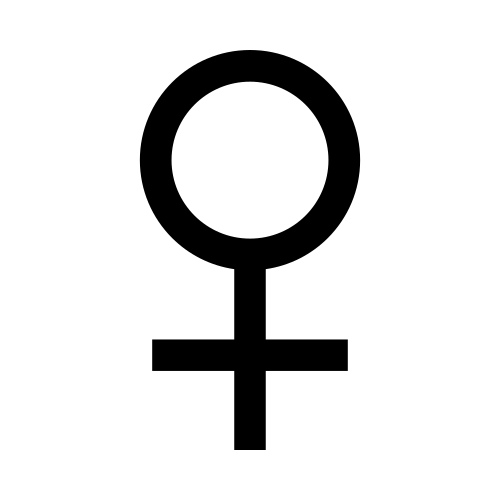 Venus
Venus Mars
Mars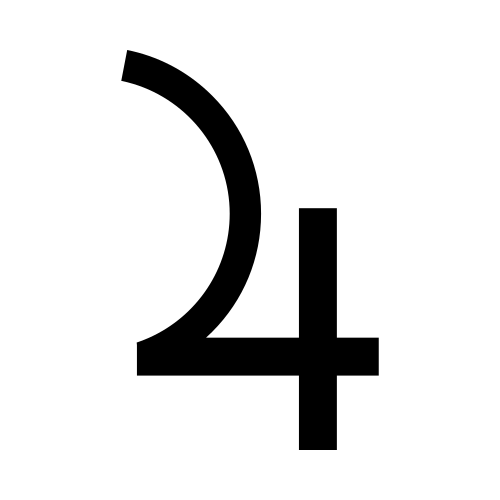 Jupiter
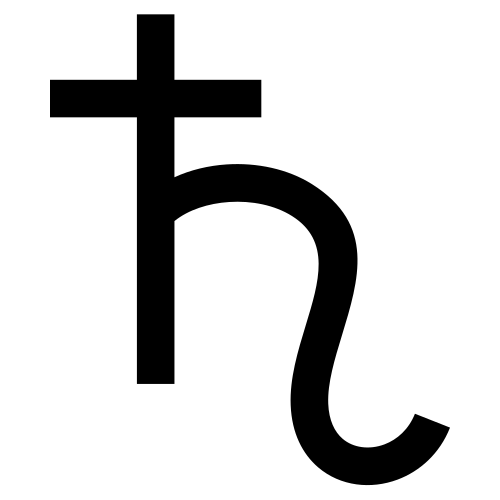 Saturn
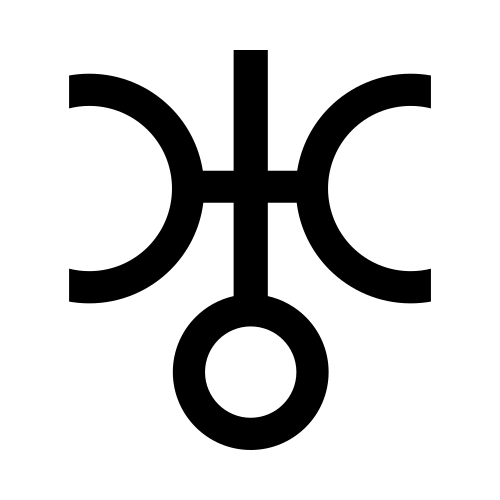 Uranus
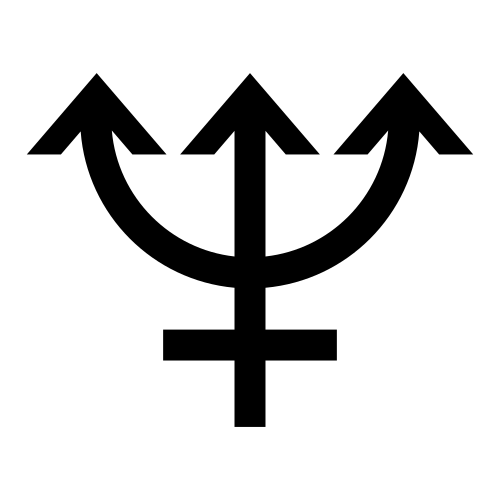 Neptune
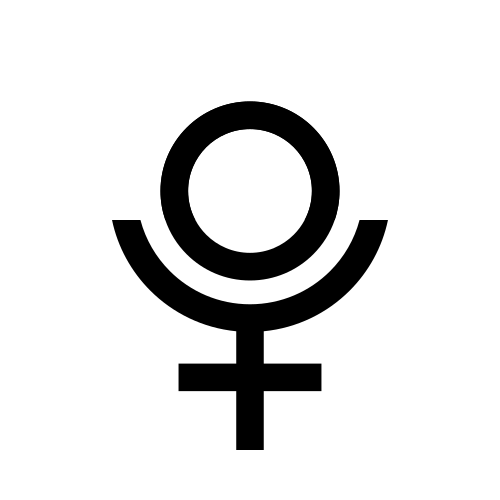 Pluto
Pluto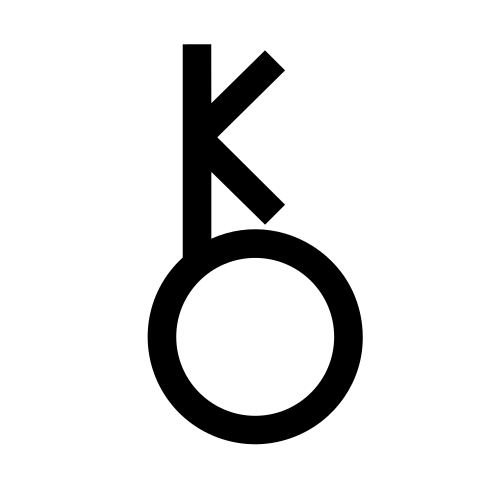 Chiron
Astronomical context
Pluto travelled through Gemini from the mid-1880s to 1914. In astrological tradition this transit is associated with the transformation of communication, ideas, transport, and the press — the generation that came of age amid the spread of mass media, the telephone, and accelerating mobility.
Werner Heisenberg (born 1901) belongs to this generational configuration. Astrian groups profiles by such shared signatures rather than by any claim of shared destiny. Related profiles in Astrian: Niels Bohr · Erwin Schrödinger · Max Planck. The symbolic reading is correlative, not causal.
Other profiles from this Pluto in Gemini generation
Symbolic reading
The following describes what classical astrological tradition associates with these configurations. Astrian does not apply these descriptions to the person's biography.
The Sun in Sagittarius centres the chart on expansion, conviction, and the horizon. With the Ascendant in Gemini, tradition adds curiosity, exchange, and versatility as the threshold through which that energy meets the world; the Sun marks the central drive, the Ascendant the manner of approach.
Among the personal planets, the Moon in Libra is associated in tradition with balance, relationship, and proportion; Mercury in Scorpio with intensity, depth, and the will to transform; Venus in Aquarius with independence, abstraction, and the collective; and Mars in Capricorn with ambition, structure, and the long view. These placements describe registers of feeling, thought, attraction, and action as the tradition catalogues them, independent of the life that follows.
Jupiter conjunct Saturn (0°45'): tradition reads expansion and meaning fused with structure, limitation, and discipline.
Sun sextile Moon (0°55'): tradition reads identity and central purpose in supportive contact with emotional life and instinct.
Uranus opposite Pluto (0°55'): tradition reads disruption and innovation set in polarity with depth, power, and transformation.
Moon square Saturn (0°59'): tradition reads emotional life and instinct in friction with structure, limitation, and discipline.
These placements are presented as a symbolic portrait, correlative and never causal — a description within the tradition's vocabulary, not an explanation of the life that follows.
Astrology is a symbolic language with 2,500 years of literature. The reading above is interpretive, not explanatory.
Astrian does not claim that the natal chart of Werner Heisenberg caused or determined any of the above. Astrology is a symbolic system with 2,500 years of literature. Its capacity for retrospective description does not imply explanatory capacity.
A parallel life
The following are verified biographical facts. No connection to the natal chart is implied.
Werner Karl Heisenberg was born on December 5, 1901, in Würzburg, Bavaria, Germany. He grew up in Munich, where his father was a professor of Byzantine studies at the university. Heisenberg studied physics at the University of Munich under Arnold Sommerfeld and at the University of Göttingen under Max Born, completing his doctorate at Munich in 1923.
In 1924 and 1925 Heisenberg worked in Copenhagen with Niels Bohr, a collaboration that deeply influenced his thinking. In 1925, at the age of 23, Heisenberg developed matrix mechanics, the first complete and mathematically consistent formulation of quantum mechanics. In this framework, physical quantities are represented as matrices rather than classical variables. Working with Max Born and Pascual Jordan, he developed the mathematical structure of the theory more fully.
In 1927 Heisenberg formulated the uncertainty principle, which states that certain pairs of physical properties of a particle, such as position and momentum, cannot both be precisely determined simultaneously. The more precisely one is known, the less precisely the other can be known. This is not a limitation of measurement technology but a fundamental feature of quantum systems. The principle had profound implications for the philosophical interpretation of quantum mechanics and the nature of physical knowledge.
In 1932 Heisenberg was awarded the Nobel Prize in Physics for the creation of quantum mechanics, with the prize formally noting the applications that had already followed from this work, including the discovery of the allotropic forms of hydrogen.
Heisenberg held a professorship in Leipzig and later in Berlin. During World War II he led Germany's nuclear energy project, the Uranverein (uranium club). The extent and nature of his contribution to the German atomic bomb program, and whether he deliberately slowed it down, have been subjects of historical debate. After the war he was interned at Farm Hall in England with other German nuclear scientists. He subsequently played a significant role in rebuilding German science and was the founding director of what is now the Max Planck Institute for Physics in Munich.
Werner Heisenberg died on February 1, 1976, in Munich, Germany.
Biographical sources
- David Cassidy, Uncertainty: The Life and Science of Werner Heisenberg (W.H. Freeman, 1992).
- Nobel Pri.
This profile presents the sky at the birth of Werner Heisenberg and verified facts of their biography. Astrian does not claim that astrology has predictive capacity or that the natal chart determines the trajectory of a life. Astrology is a symbolic system with 2,500 years of literature. Its capacity for retrospective description does not imply explanatory capacity.
Related profiles
Calculate your own birth chart with the same NASA JPL DE441 precision.
Calculate my birth chartLast updated: June 14, 2026
Newsletter
A short reading once a month, in your inbox.
A note on the symbolism of the season, recent editorial pieces, and what to look for in next month's sky. No predictions.
Support this project
Independent, no venture funding, no ads. A contribution keeps Astrian precise and free.
Support on Ko-fi (opens in new tab)