PROFILE · SPORTS
Ken Griffey Jr.
George Kenneth Griffey Jr.
baseball player
Born 21 November 1969 · Donora, Pennsylvania, United States · 40.18° N, 79.86° WX
Source: Birth time not documented in publicly accessible records
About this chart
No birth time is documented for this person. The chart therefore shows planetary positions in their signs, the slow aspects between them, and the generational context — but not house placements, the Ascendant, or the Midheaven, which require an accurate birth time. The Moon's sign carries a ±6° margin: if it falls near a sign boundary, the sign could vary. Positions for all other planets are reliable.
Do you have a verified source for this birth time? Share it →
The sky at birth
No birth time is documented for Ken Griffey Jr.. The Ascendant, the Midheaven, and the house positions cannot be determined; the reading is confined to planetary sign placements and the aspects between planets. The positions below are calculated for noon local time and are accurate to a fraction of a degree for the slow-moving bodies. One caveat: the Moon lies near a sign boundary, so without an exact time it cannot be fixed to a single sign — it sits close to 2°14' Taurus within a daily margin of about ±7°.
The Moon is near 2°14' Taurus (noon position, ±7° margin). Sun is at 29°13' Scorpio. Mercury is at 2°17' Sagittarius. Venus is at 13°47' Scorpio. Mars is at 12°17' Aquarius. Jupiter is at 25°26' Libra. Saturn is at 3°39' Taurus, retrograde. Uranus is at 7°32' Libra. Neptune is at 28°28' Scorpio. Pluto is at 26°58' Virgo.
3 bodies occupy Scorpio (Sun, Venus and Neptune) — a concentration that stands out as a structural feature of the chart.
The tightest major aspects between planets: Sun conjunct Neptune (0°45'); Moon conjunct Saturn (1°25'); Neptune sextile Pluto (1°29'); Venus square Mars (1°30'); Sun sextile Pluto (2°14'); Sun conjunct Mercury (3°04').
Neptune sextile Pluto (1°29') is structural but generational — an alignment of slow-moving outer planets shared across many birth years.
The engine also registers tight minor aspects involving asteroids and calculated points: Sun semi-square Pallas (0°01'); Moon semi-square North Node (0°11'); Uranus semi-square Vesta (0°14'); Mercury trine Chiron (0°18'). These are reported for completeness and carry less weight in traditional reading.
The chart was calculated using NASA JPL DE441 ephemerides, sub-arcsecond precision.
| Planet | Sign | Position |
|---|---|---|
| Sun | Scorpio | 29°13' |
| Moon | Taurus | 02°14'±6° |
| Mercury | Sagittarius | 02°17' |
| Venus | Scorpio | 13°47' |
| Mars | Aquarius | 12°17' |
| Jupiter | Libra | 25°26' |
| Saturn | Taurus | 03°39'retrograde |
| Uranus | Libra | 07°32' |
| Neptune | Scorpio | 28°28' |
| Pluto | Virgo | 26°58' |
| Chiron | Aries | 02°35'retrograde |
 Sun
Sun Moon
Moon Mercury
 Venus
Venus Mars
Mars Jupiter
 Saturn
 Uranus
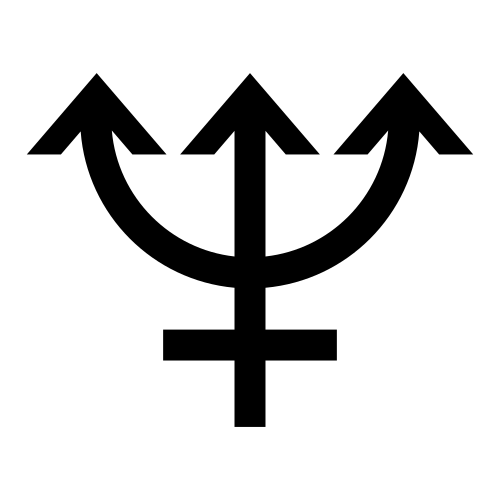 Neptune
 Pluto
Pluto Chiron
Birth time unknown — house positions and Ascendant/MC are not available.
Astronomical context
Pluto crossed Virgo from the late 1950s to 1971. In astrological tradition the passage is linked to the transformation of work, health, technique, and systems of organization — the generation that came of age amid automation and the reorganization of labour.
Ken Griffey Jr. (born 1969) belongs to this generational configuration. Astrian groups profiles by such shared signatures rather than by any claim of shared destiny. Related profiles in Astrian: Barry Bonds · Mickey Mantle · Derek Jeter. The symbolic reading is correlative, not causal.
Other profiles from this Pluto in Virgo generation
Symbolic reading
The following describes what classical astrological tradition associates with these configurations. Astrian does not apply these descriptions to the person's biography.
The Sun in Scorpio is the most prominent structural feature available without a birth time, centring the chart on intensity, depth, and the will to transform. There is no Ascendant or Midheaven to anchor the angles, so the reading rests on sign placements and the aspects between planets rather than on houses.
Among the personal planets, the Moon in Taurus is associated in tradition with stability, persistence, and the tangible (the Moon's sign is given for the noon chart and may shift with an exact time); Mercury in Sagittarius with expansion, conviction, and the horizon; Venus in Scorpio with intensity, depth, and the will to transform; and Mars in Aquarius with independence, abstraction, and the collective. These placements describe registers of feeling, thought, attraction, and action as the tradition catalogues them, independent of the life that follows.
Sun conjunct Neptune (0°45'): tradition reads identity and central purpose fused with dissolution, imagination, and idealism.
Moon conjunct Saturn (1°25'): tradition reads emotional life and instinct fused with structure, limitation, and discipline.
Neptune sextile Pluto (1°29'): tradition reads dissolution, imagination, and idealism in supportive contact with depth, power, and transformation.
Venus square Mars (1°30'): tradition reads values, attraction, and harmony in friction with drive, assertion, and action.
These placements are presented as a symbolic portrait, correlative and never causal — a description within the tradition's vocabulary, not an explanation of the life that follows.
Astrology is a symbolic language with 2,500 years of literature. The reading above is interpretive, not explanatory.
Astrian does not claim that the natal chart of Ken Griffey Jr. caused or determined any of the above. Astrology is a symbolic system with 2,500 years of literature. Its capacity for retrospective description does not imply explanatory capacity.
A parallel life
The following are verified biographical facts. No connection to the natal chart is implied.
George Kenneth Griffey Jr. was born on November 21, 1969, in Donora, Pennsylvania. His father, Ken Griffey Sr., was himself a professional baseball player who had a lengthy career with the Cincinnati Reds and other teams, providing an environment in which the younger Griffey was immersed in the game from an early age. The family moved to Cincinnati as Griffey Jr. grew up, and he attended Moeller High School, where his abilities attracted significant scouting attention.
The Seattle Mariners selected Griffey with the first overall pick in the 1987 Major League Baseball Draft. He made his major league debut in April 1989 at the age of 19 and immediately demonstrated the combination of hitting ability and outfield defense that would define his career. His fluid swing and exceptional speed in center field made him one of the most complete players in the game during the early 1990s.
Griffey's peak seasons with the Mariners in the 1990s established him as one of the best players in baseball. He won the American League Most Valuable Player Award in 1997, when he hit 56 home runs and drove in 147 runs. He was selected for the All-Star Game 13 times and won the Gold Glove Award for his outfield defense 10 consecutive times from 1990 to 1999. His home run numbers placed him among the top hitters of his era.
In 2000, Griffey was traded to the Cincinnati Reds at his request, returning to the city where he had grown up and where his father had played. Injuries significantly limited his effectiveness during his years in Cincinnati, and he never fully recaptured the form he had shown in Seattle. He returned to the Mariners in 2009 for a final season and retired in 2010 after 22 professional seasons.
Griffey finished his career with 630 home runs, ranking among the all-time leaders. He was inducted into the National Baseball Hall of Fame in 2016, receiving votes on 99.3 percent of ballots, the highest percentage recorded at that time. His number 24 was retired by the Seattle Mariners.
Biographical sources
- National Baseball Hall of Fame. "Ken Griffey Jr.: Inductee 2016." Cooperstown, NY. https://baseballhall.org.
- Baseball Reference. "Ken Griffey Jr. Statistics." https://www.baseball-reference.com.
- Blethen, Frank. "Ken Griffey Jr.: From Donora to the Hall." Seattle Times, July 24, 2016..
- Major League Baseball. "Seattle Mariners: Retired Numbers." https://www.mlb.com.
This profile presents the sky at the birth of Ken Griffey Jr. and verified facts of their biography. Astrian does not claim that astrology has predictive capacity or that the natal chart determines the trajectory of a life. Astrology is a symbolic system with 2,500 years of literature. Its capacity for retrospective description does not imply explanatory capacity.
Related profiles
Calculate your own birth chart with the same NASA JPL DE441 precision.
Calculate my birth chartLast updated: June 14, 2026
Newsletter
A short reading once a month, in your inbox.
A note on the symbolism of the season, recent editorial pieces, and what to look for in next month's sky. No predictions.
Support this project
Independent, no venture funding, no ads. A contribution keeps Astrian precise and free.
Support on Ko-fi (opens in new tab)