PROFILE · SCIENCE & TECHNOLOGY
Ludwig Wittgenstein
Ludwig Josef Johann Wittgenstein
philosopher
Born 26 April 1889 · Vienna, Austria-Hungary · 48.24° N, 16.29° EX
Source: Birth time not documented in publicly accessible records
About this chart
No birth time is documented for this person. The chart therefore shows planetary positions in their signs, the slow aspects between them, and the generational context — but not house placements, the Ascendant, or the Midheaven, which require an accurate birth time. The Moon's sign carries a ±6° margin: if it falls near a sign boundary, the sign could vary. Positions for all other planets are reliable.
Do you have a verified source for this birth time? Share it →
The sky at birth
No birth time is documented for Ludwig Wittgenstein. The Ascendant, the Midheaven, and the house positions cannot be determined; the reading is confined to planetary sign placements and the aspects between planets. The positions below are calculated for noon local time and are accurate to a fraction of a degree for the slow-moving bodies. One caveat: the Moon lies near a sign boundary, so without an exact time it cannot be fixed to a single sign — it sits close to 24°16' Pisces within a daily margin of about ±7°.
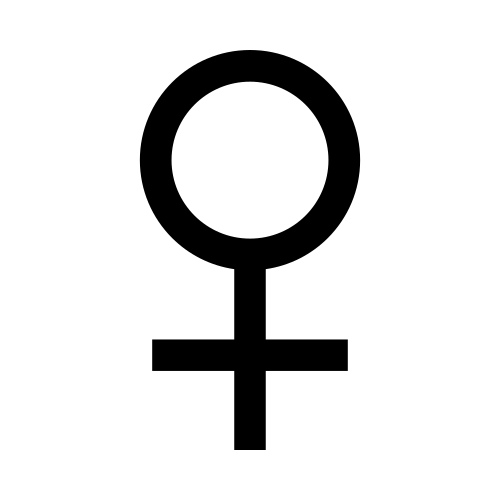
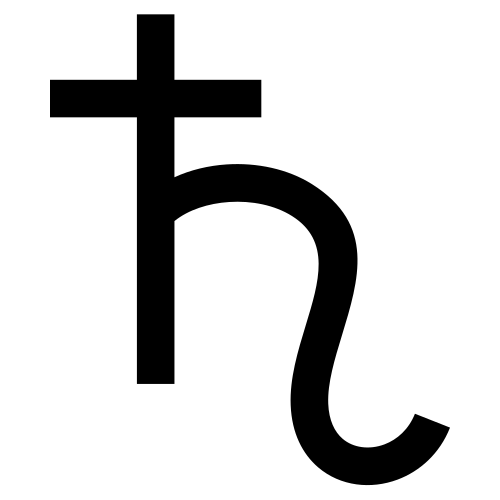
The Moon is near 24°16' Pisces (noon position, ±7° margin). Sun is at 6°22' Taurus. Mercury is at 7°44' Taurus. Venus is at 13°43' Taurus, retrograde. Mars is at 20°28' Taurus. Jupiter is at 8°16' Capricorn, retrograde. Saturn is at 13°33' Leo. Uranus is at 19°15' Libra, retrograde. Neptune is at 1°02' Gemini. Pluto is at 4°46' Gemini.
4 bodies occupy Taurus (Sun, Mercury, Venus and Mars) — a concentration that stands out as a structural feature of the chart.
The tightest major aspects between planets: Venus square Saturn (0°10'); Mercury trine Jupiter (0°32'); Sun conjunct Mercury (1°22'); Sun trine Jupiter (1°53'); Neptune conjunct Pluto (3°44'); Moon sextile Mars (3°48').
Neptune conjunct Pluto (3°44') is structural but generational — an alignment of slow-moving outer planets shared across many birth years.
The engine also registers tight minor aspects involving asteroids and calculated points: Neptune semi-square North Node (0°17'); Uranus trine Lilith (0°29'); Mars semi-sextile Lilith (0°44'); Sun semi-square Lilith (1°38'). These are reported for completeness and carry less weight in traditional reading.
The chart was calculated using NASA JPL DE441 ephemerides, sub-arcsecond precision.
| Planet | Sign | Position |
|---|---|---|
| Sun | Taurus | 06°22' |
| Moon | Pisces | 24°16'±6° |
| Mercury | Taurus | 07°44' |
| Venus | Taurus | 13°43'retrograde |
| Mars | Taurus | 20°28' |
| Jupiter | Capricorn | 08°16'retrograde |
| Saturn | Leo | 13°33' |
| Uranus | Libra | 19°15'retrograde |
| Neptune | Gemini | 01°02' |
| Pluto | Gemini | 04°46' |
 Sun
Sun Moon
Moon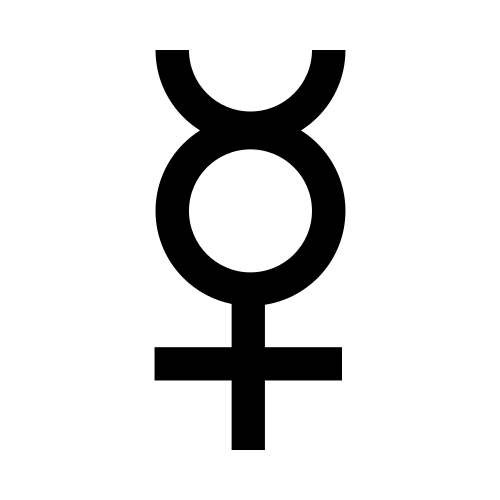 Mercury
 Venus
Venus Mars
Mars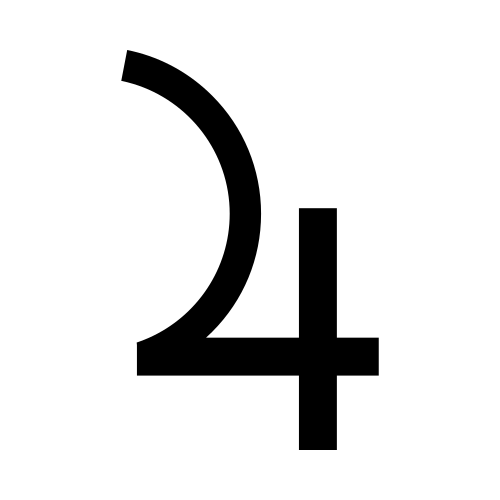 Jupiter
 Saturn
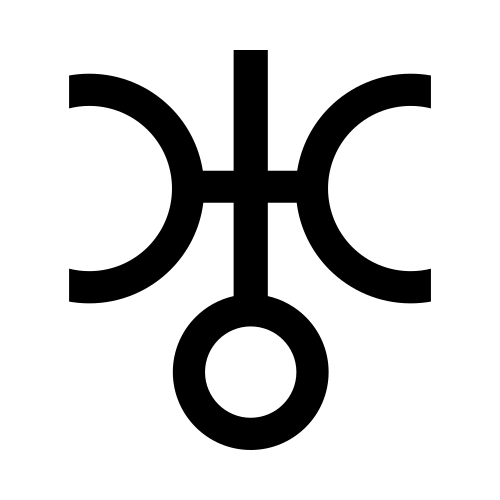 Uranus
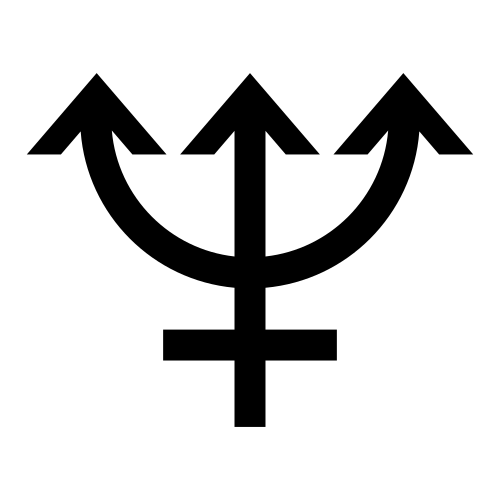 Neptune
 Pluto
PlutoBirth time unknown — house positions and Ascendant/MC are not available.
Astronomical context
Pluto travelled through Gemini from the mid-1880s to 1914. In astrological tradition this transit is associated with the transformation of communication, ideas, transport, and the press — the generation that came of age amid the spread of mass media, the telephone, and accelerating mobility.
Ludwig Wittgenstein (born 1889) belongs to this generational configuration. Astrian groups profiles by such shared signatures rather than by any claim of shared destiny. Related profiles in Astrian: Friedrich Nietzsche · Bertrand Russell · Kurt Gödel. The symbolic reading is correlative, not causal.
Other profiles from this Pluto in Gemini generation
Symbolic reading
The following describes what classical astrological tradition associates with these configurations. Astrian does not apply these descriptions to the person's biography.
The Sun in Taurus is the most prominent structural feature available without a birth time, centring the chart on stability, persistence, and the tangible. There is no Ascendant or Midheaven to anchor the angles, so the reading rests on sign placements and the aspects between planets rather than on houses.
Among the personal planets, the Moon in Pisces is associated in tradition with imagination, dissolution, and empathy (the Moon's sign is given for the noon chart and may shift with an exact time); Mercury in Taurus with stability, persistence, and the tangible; Venus in Taurus with stability, persistence, and the tangible; and Mars in Taurus with stability, persistence, and the tangible. These placements describe registers of feeling, thought, attraction, and action as the tradition catalogues them, independent of the life that follows.
Venus square Saturn (0°10'): tradition reads values, attraction, and harmony in friction with structure, limitation, and discipline.
Mercury trine Jupiter (0°32'): tradition reads thought and communication in easy flow with expansion and meaning.
Sun conjunct Mercury (1°22'): tradition reads identity and central purpose fused with thought and communication.
Sun trine Jupiter (1°53'): tradition reads identity and central purpose in easy flow with expansion and meaning.
These placements are presented as a symbolic portrait, correlative and never causal — a description within the tradition's vocabulary, not an explanation of the life that follows.
Astrology is a symbolic language with 2,500 years of literature. The reading above is interpretive, not explanatory.
Astrian does not claim that the natal chart of Ludwig Wittgenstein caused or determined any of the above. Astrology is a symbolic system with 2,500 years of literature. Its capacity for retrospective description does not imply explanatory capacity.
A parallel life
The following are verified biographical facts. No connection to the natal chart is implied.
Ludwig Josef Johann Wittgenstein was born on 26 April 1889 in Vienna into one of the wealthiest families in the Austro-Hungarian Empire. His father, Karl Wittgenstein, was a prominent industrialist in the steel sector. Ludwig was the youngest of eight children. He was educated at home until the age of fourteen, then attended the Realschule in Linz before studying mechanical engineering in Berlin and later in Manchester, where he developed an interest in the mathematical foundations of aeronautics.
His reading of Bertrand Russell and Gottlob Frege redirected his attention to mathematical logic, and in 1911 he went to Cambridge to study under Russell at Trinity College. Russell recognized his ability quickly. During the First World War, Wittgenstein served in the Austro-Hungarian army on several fronts and was taken prisoner by Italian forces in 1918. While in captivity he completed the manuscript that became his first major work.
The Tractatus Logico-Philosophicus was published in German in 1921 and in English translation in 1922. The work addressed the relationship between language and the world and the limits of what can be meaningfully said. After its publication, Wittgenstein believed philosophy to be essentially complete and withdrew from academic life. He worked as a primary school teacher in rural Austria from 1920 to 1926, then as a gardener and architect before returning to Cambridge in 1929.
He was elected to a fellowship at Trinity College and in 1939 succeeded G. E. Moore as professor of philosophy. During the Second World War he worked as a medical orderly in London and later as a laboratory assistant in Newcastle. He resigned his professorship in 1947 to concentrate on writing.
His second major work, Philosophical Investigations, was published posthumously in 1953. It substantially revised the positions of the Tractatus, developing an account of meaning grounded in use and social practice rather than in logical form. Wittgenstein died of prostate cancer on 29 April 1951 in Cambridge. He became a British citizen in 1939.
Biographical sources
- Monk, Ray. Ludwig Wittgenstein: The Duty of Genius. Free Press, 1990..
- Kenny, Anthony. Wittgenstein. Revised edition. Blackwell, 2006..
- McGuinness, Brian. Wittgenstein: A Life. Young Ludwig 1889-1921. University of California Press, 1988..
- Wittgenstein, Ludwig. Philosophical Investigations. Translated by G. E. M. Anscombe. Blackwell, 1953..
This profile presents the sky at the birth of Ludwig Wittgenstein and verified facts of their biography. Astrian does not claim that astrology has predictive capacity or that the natal chart determines the trajectory of a life. Astrology is a symbolic system with 2,500 years of literature. Its capacity for retrospective description does not imply explanatory capacity.
Related profiles
Calculate your own birth chart with the same NASA JPL DE441 precision.
Calculate my birth chartLast updated: June 14, 2026
Newsletter
A short reading once a month, in your inbox.
A note on the symbolism of the season, recent editorial pieces, and what to look for in next month's sky. No predictions.
Support this project
Independent, no venture funding, no ads. A contribution keeps Astrian precise and free.
Support on Ko-fi (opens in new tab)