PROFILE · SCIENCE & TECHNOLOGY
Kurt Gödel
Kurt Friedrich Gödel
logician and mathematician
Born 28 April 1906 · Brünn (Brno), Austria-Hungary · 49.20° N, 16.61° EX
Source: Birth time not documented in publicly accessible records
About this chart
No birth time is documented for this person. The chart therefore shows planetary positions in their signs, the slow aspects between them, and the generational context — but not house placements, the Ascendant, or the Midheaven, which require an accurate birth time. The Moon's sign carries a ±6° margin: if it falls near a sign boundary, the sign could vary. Positions for all other planets are reliable.
Do you have a verified source for this birth time? Share it →
The sky at birth
No birth time is documented for Kurt Gödel. The Ascendant, the Midheaven, and the house positions cannot be determined; the reading is confined to planetary sign placements and the aspects between planets. The positions below are calculated for noon local time and are accurate to a fraction of a degree for the slow-moving bodies. One caveat: the Moon lies near a sign boundary, so without an exact time it cannot be fixed to a single sign — it sits close to 29°28' Gemini within a daily margin of about ±7°.
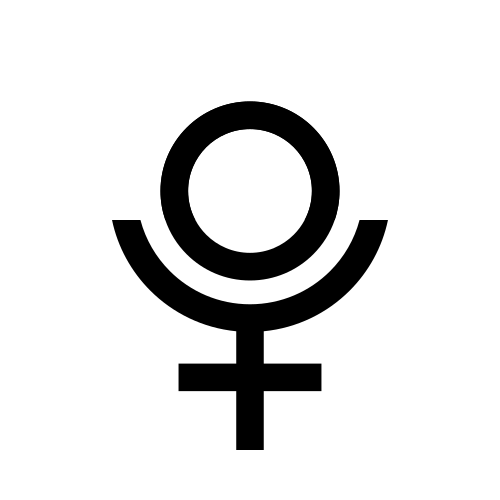
The Moon is near 29°28' Gemini (noon position, ±7° margin). Sun is at 7°14' Taurus. Mercury is at 11°11' Aries. Venus is at 25°29' Taurus. Mars is at 29°49' Taurus. Jupiter is at 9°03' Gemini. Saturn is at 12°18' Pisces. Uranus is at 8°23' Capricorn, retrograde. Neptune is at 8°02' Cancer. Pluto is at 21°12' Gemini.
3 bodies occupy Taurus (Sun, Venus and Mars) and 3 bodies occupy Gemini (Moon, Jupiter and Pluto) — a concentration that stands out as a structural feature of the chart.
The tightest major aspects between planets: Uranus opposite Neptune (0°22'); Sun sextile Neptune (0°48'); Sun trine Uranus (1°10'); Mercury sextile Jupiter (2°08'); Mercury square Uranus (2°48'); Mercury square Neptune (3°09').
Uranus opposite Neptune (0°22') is structural but generational — an alignment of slow-moving outer planets shared across many birth years.
The engine also registers tight minor aspects involving asteroids and calculated points: Mars semi-sextile Ceres (0°07'); Chiron semi-square Pallas (0°08'); Saturn semi-sextile Chiron (0°11'); Moon sextile Ceres (0°13'). These are reported for completeness and carry less weight in traditional reading.
The chart was calculated using NASA JPL DE441 ephemerides, sub-arcsecond precision.
| Planet | Sign | Position |
|---|---|---|
| Sun | Taurus | 07°14' |
| Moon | Gemini | 29°28'±6° |
| Mercury | Aries | 11°11' |
| Venus | Taurus | 25°29' |
| Mars | Taurus | 29°49' |
| Jupiter | Gemini | 09°03' |
| Saturn | Pisces | 12°18' |
| Uranus | Capricorn | 08°23'retrograde |
| Neptune | Cancer | 08°02' |
| Pluto | Gemini | 21°12' |
| Chiron | Aquarius | 12°29' |
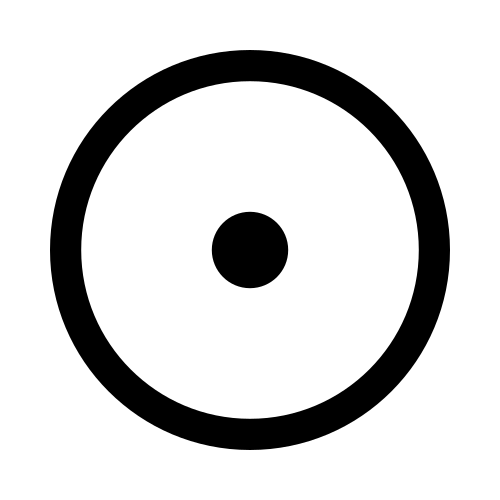 Sun
Sun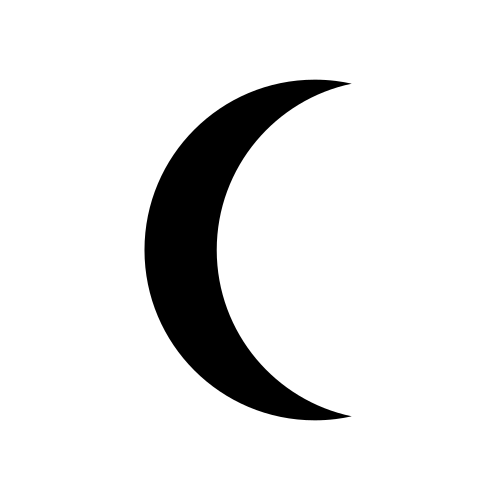 Moon
Moon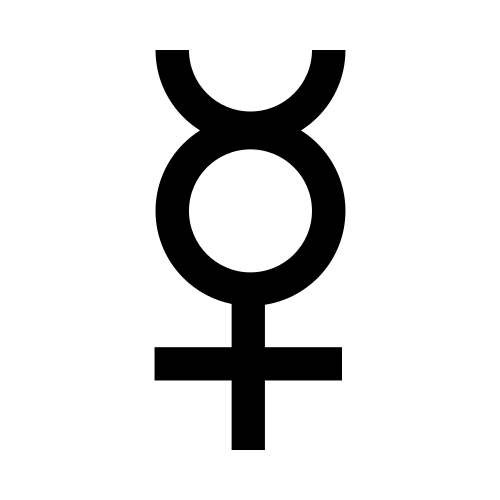 Mercury
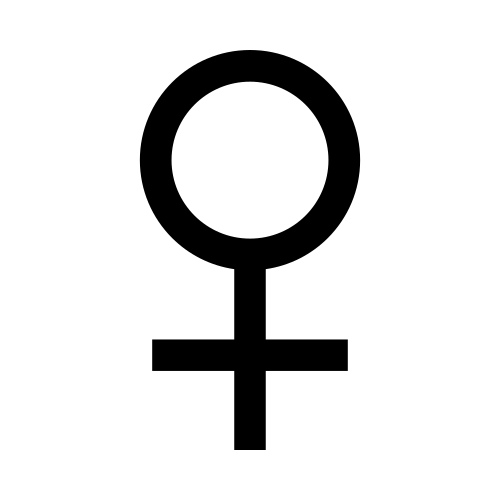 Venus
Venus Mars
Mars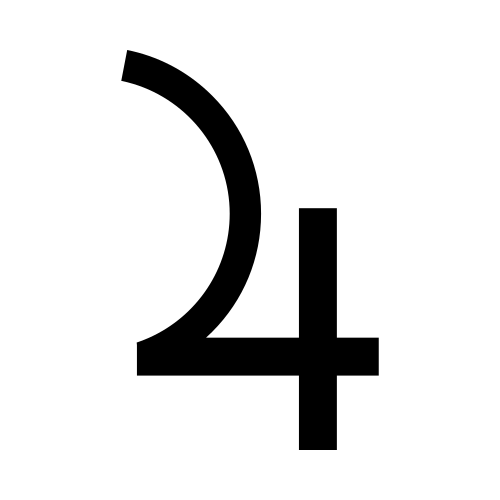 Jupiter
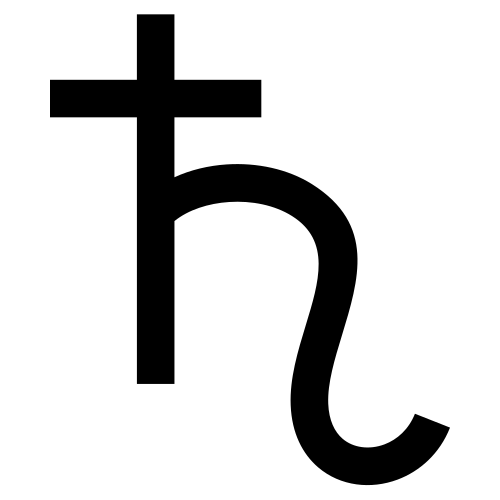 Saturn
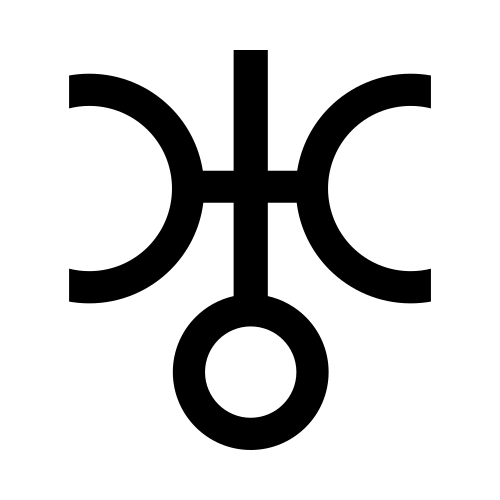 Uranus
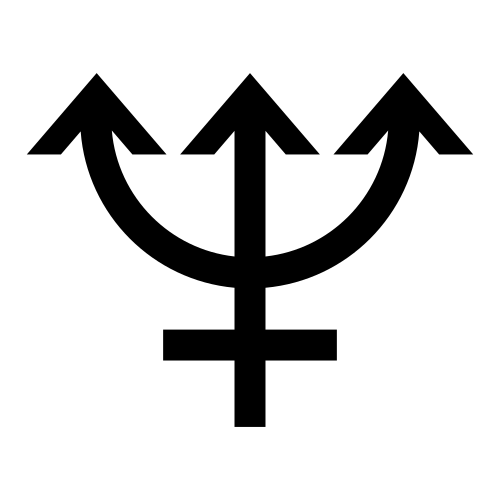 Neptune
 Pluto
Pluto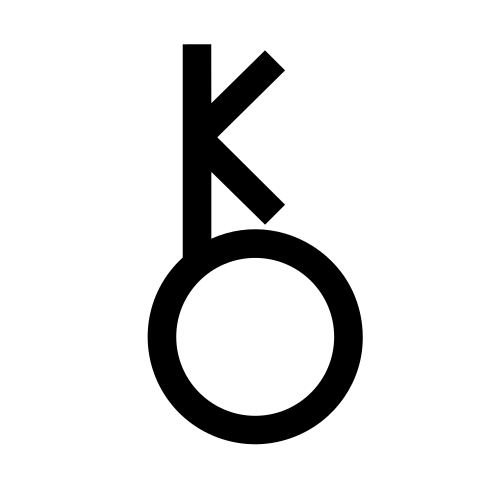 Chiron
Birth time unknown — house positions and Ascendant/MC are not available.
Astronomical context
Pluto travelled through Gemini from the mid-1880s to 1914. In astrological tradition this transit is associated with the transformation of communication, ideas, transport, and the press — the generation that came of age amid the spread of mass media, the telephone, and accelerating mobility.
Kurt Gödel (born 1906) belongs to this generational configuration. Astrian groups profiles by such shared signatures rather than by any claim of shared destiny. Related profiles in Astrian: John von Neumann · Ludwig Wittgenstein · Leonhard Euler. The symbolic reading is correlative, not causal.
Other profiles from this Pluto in Gemini generation
Symbolic reading
The following describes what classical astrological tradition associates with these configurations. Astrian does not apply these descriptions to the person's biography.
The Sun in Taurus is the most prominent structural feature available without a birth time, centring the chart on stability, persistence, and the tangible. There is no Ascendant or Midheaven to anchor the angles, so the reading rests on sign placements and the aspects between planets rather than on houses.
Among the personal planets, the Moon in Gemini is associated in tradition with curiosity, exchange, and versatility (the Moon's sign is given for the noon chart and may shift with an exact time); Mercury in Aries with initiative, directness, and the will to begin; Venus in Taurus with stability, persistence, and the tangible; and Mars in Taurus with stability, persistence, and the tangible. These placements describe registers of feeling, thought, attraction, and action as the tradition catalogues them, independent of the life that follows.
Uranus opposite Neptune (0°22'): tradition reads disruption and innovation set in polarity with dissolution, imagination, and idealism.
Sun sextile Neptune (0°48'): tradition reads identity and central purpose in supportive contact with dissolution, imagination, and idealism.
Sun trine Uranus (1°10'): tradition reads identity and central purpose in easy flow with disruption and innovation.
Mercury sextile Jupiter (2°08'): tradition reads thought and communication in supportive contact with expansion and meaning.
These placements are presented as a symbolic portrait, correlative and never causal — a description within the tradition's vocabulary, not an explanation of the life that follows.
Astrology is a symbolic language with 2,500 years of literature. The reading above is interpretive, not explanatory.
Astrian does not claim that the natal chart of Kurt Gödel caused or determined any of the above. Astrology is a symbolic system with 2,500 years of literature. Its capacity for retrospective description does not imply explanatory capacity.
A parallel life
The following are verified biographical facts. No connection to the natal chart is implied.
Kurt Friedrich Gödel was born on April 28, 1906, in Brno, then part of the Austro-Hungarian Empire and now in the Czech Republic. He grew up in a prosperous family and showed a keen interest in mathematics and philosophy from childhood. He studied at the University of Vienna, where he came into contact with the Vienna Circle, a group of philosophers and scientists who advocated logical positivism, though Gödel's own views ultimately diverged from theirs.
In 1931, at the age of 25, Gödel published his incompleteness theorems, results that would permanently alter the field of mathematical logic. The first incompleteness theorem states that in any consistent formal system powerful enough to describe basic arithmetic, there exist statements that can neither be proved nor disproved within that system. The second theorem states that such a system cannot prove its own consistency. These results refuted the program advanced by David Hilbert to establish a complete and consistent foundation for all of mathematics.
Gödel completed his doctorate at Vienna in 1930 and his habilitation in 1932. He made several visits to the Institute for Advanced Study in Princeton in the 1930s, where he met Albert Einstein, with whom he developed a close and lasting friendship. In 1940, fleeing the political situation in Europe following the annexation of Austria by Germany, Gödel and his wife Adele emigrated to the United States, travelling eastward via the Trans-Siberian Railway and across the Pacific.
Gödel joined the Institute for Advanced Study in Princeton permanently in 1940, becoming a full professor there in 1953. In 1949 he published a solution to the field equations of general relativity that describes a rotating universe in which closed time-like curves are possible, a contribution to theoretical physics known as the Gödel metric.
In 1948 Gödel became a United States citizen; Einstein and the economist Oskar Morgenstern accompanied him to his citizenship examination, reportedly to prevent him from inadvertently arguing with the examining judge over a logical inconsistency he believed he had found in the US Constitution.
In his later years Gödel suffered from increasing paranoia and anxiety. He became convinced he might be poisoned and refused to eat food that had not been prepared by his wife. After Adele was hospitalised in 1977, he ate virtually nothing. Kurt Gödel died on January 14, 1978, in Princeton, New Jersey, of malnutrition caused by self-starvation.
Biographical sources
- John W. Dawson Jr., Logical Dilemmas: The Life and Work of Kurt Gödel (A.K. Peters, 1997).
- Rebecca Goldstein, Incompleteness: The Proof and Paradox of Kurt Gödel (W.W. Norton, 2005).
- K. Gödel, "Über formal unentscheidbare Sät.
This profile presents the sky at the birth of Kurt Gödel and verified facts of their biography. Astrian does not claim that astrology has predictive capacity or that the natal chart determines the trajectory of a life. Astrology is a symbolic system with 2,500 years of literature. Its capacity for retrospective description does not imply explanatory capacity.
Related profiles
Calculate your own birth chart with the same NASA JPL DE441 precision.
Calculate my birth chartLast updated: June 14, 2026
Newsletter
A short reading once a month, in your inbox.
A note on the symbolism of the season, recent editorial pieces, and what to look for in next month's sky. No predictions.
Support this project
Independent, no venture funding, no ads. A contribution keeps Astrian precise and free.
Support on Ko-fi (opens in new tab)