PROFILE · FILM & STAGE
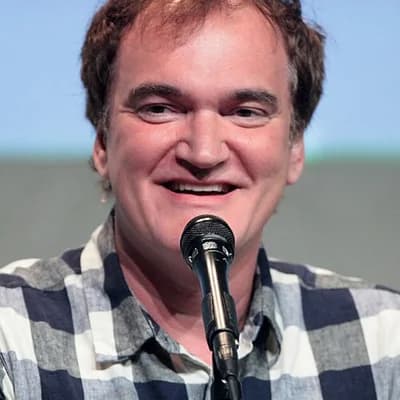
Quentin Tarantino
Quentin Jerome Tarantino
filmmaker
Born 27 March 1963 · Knoxville, Tennessee, United States · 35.96° N, 83.92° WX
Source: Birth time not documented in publicly accessible records
About this chart
No birth time is documented for this person. The chart therefore shows planetary positions in their signs, the slow aspects between them, and the generational context — but not house placements, the Ascendant, or the Midheaven, which require an accurate birth time. The Moon's sign carries a ±6° margin: if it falls near a sign boundary, the sign could vary. Positions for all other planets are reliable.
Do you have a verified source for this birth time? Share it →
The sky at birth
No birth time is documented for Quentin Tarantino. The Ascendant, Midheaven, and house positions cannot be determined. The planetary positions below are calculated for noon local time and are accurate to within a fraction of a degree for the slow-moving planets. The Moon's position carries a margin of approximately ±7°.
The Sun is at 6°18' Aries. The Moon is at 7°36' Taurus (noon position, ±7° margin). Mercury is at 3°02' Aries. Venus is at 27°13' Aquarius. Mars is at 6°02' Leo. Jupiter is at 28°13' Pisces. Saturn is at 19°38' Aquarius. Uranus is at 1°54' Virgo R. Neptune is at 15°15' Scorpio R. Pluto is at 10°14' Virgo R.
The Sun at 6°18' Aries trines Mars at 6°02' Leo (0°16') — the tightest major aspect in the chart and one of the tightest Sun-Mars trines in the Astrian collection. The Moon at 7°36' Taurus squares Mars (1°34'), though this aspect carries the Moon's ±7° uncertainty. The Sun conjoins Mercury at 3°02' Aries (3°16'). Mercury trines Mars (3°00'). The Moon trines Pluto at 10°14' Virgo retrograde (2°38'), again with lunar uncertainty. The Moon trines Uranus at 1°54' Virgo retrograde (5°42'). Venus at 27°13' Aquarius opposes Uranus (4°41'). Saturn at 19°38' Aquarius squares Neptune at 15°15' Scorpio retrograde (4°23'). Mercury conjoins Jupiter at 28°13' Pisces (4°49').
The engine also identifies the following tight minor aspects involving asteroids and calculated points: mars semi-sextile ceres (0.02° app); venus trine lilith (0.10° app); chiron sesquiquadrate lilith (0.24° app).
The tightest major aspects between planets: Sun trine Mars (0°16'), Moon square Mars (1°34'), Moon trine Pluto (2°38'), Mercury trine Mars (3°00'), Sun conjunction Mercury (3°16'), Saturn square Neptune (4°23'), Venus opposition Uranus (4°41'), Mercury conjunction Jupiter (4°49'), Moon trine Uranus (5°42').
The chart was calculated by Astrian's engine using NASA JPL DE441 ephemerides, sub-arcsecond precision. Timezone: Eastern Standard Time (America/New_York, UTC −5).
| Planet | Sign | Position |
|---|---|---|
| Sun | Aries | 06°18' |
| Moon | Taurus | 07°36'±6° |
| Mercury | Aries | 03°02' |
| Venus | Aquarius | 27°13' |
| Mars | Leo | 06°02' |
| Jupiter | Pisces | 28°13' |
| Saturn | Aquarius | 19°38' |
| Uranus | Virgo | 01°54'retrograde |
| Neptune | Scorpio | 15°15'retrograde |
| Pluto | Virgo | 10°14'retrograde |
| Chiron | Pisces | 12°06' |
 Sun
Sun Moon
Moon Mercury
 Venus
Venus Mars
Mars Jupiter
 Saturn
 Uranus
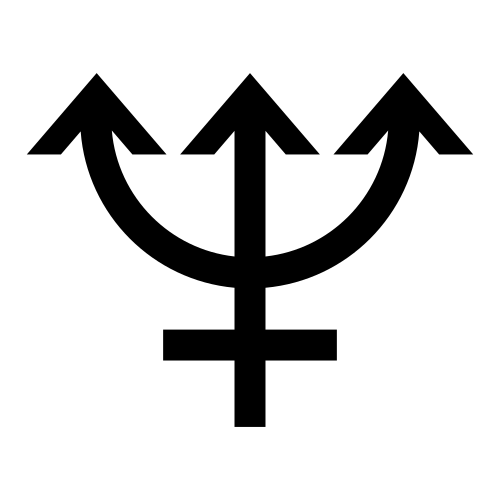 Neptune
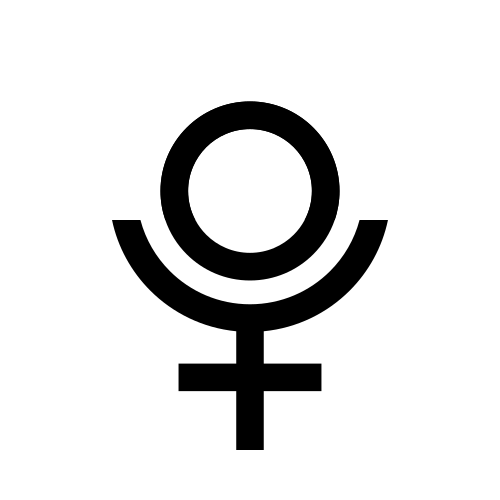 Pluto
Pluto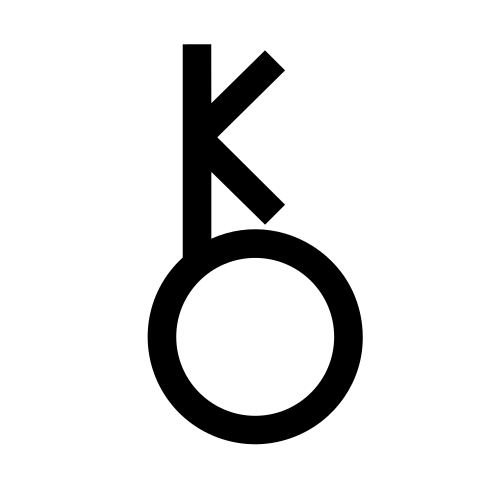 Chiron
Birth time unknown — house positions and Ascendant/MC are not available.
Astronomical context
Those born between approximately 1957 and 1972 carried Pluto in Virgo. This generation grew up amid the social transformations of the 1960s and 1970s — the civil rights movement, the Vietnam War, the sexual revolution, the environmental movement — and inherited both the idealism and the disillusionment of the postwar order. They came of age during the economic recessions of the late 1970s and early 1980s and built much of the infrastructure of the information economy.
In astrological tradition, Pluto in Virgo is associated with collective transformation of the domains that sign governs: work, craft, method, health, service, and the structures through which the practical and the analytical are applied to the material world. Virgo is the sign of the craftsman, the analyst, the servant of the work itself. Pluto's transit through Virgo is read, symbolically, as a period when the institutions of labour, technique, and practical knowledge were subjected to deep structural pressure — the old frameworks of how work was organised, how craft was practised, and how the useful was distinguished from the useless were torn apart and rebuilt. The generation that carries this placement inherited a world where the nature of work itself was being radically transformed. The symbolic reading is correlative, not causal.
Other profiles in the Astrian collection born under this configuration include Madonna (1958), Whitney Houston (1963), and Brad Pitt (1963). Quentin Tarantino, born in 1963, belongs to the middle years of this generational wave.
Other profiles from this Pluto in Virgo generation
Symbolic reading
The following describes what classical astrological tradition associates with these configurations. Astrian does not apply these descriptions to the person's biography.
The Sun at 6°18' Aries is the most prominent structural feature of this chart. Without a documented birth time, there is no Ascendant or Midheaven — the reading is confined to planetary positions by sign and the aspects between planets.
The Moon at 7°36' Taurus represents the noon position; the actual placement falls within approximately 7° on either side. If born early in the day, the Moon could be in the low degrees of Taurus; if born late, in the mid-teens. The Moon's sign placement in Taurus is secure for the entire day.
Mercury at 3°02' Aries, Venus at 27°13' Aquarius, and Mars at 6°02' Leo complete the personal planet picture.
### Sun trine Mars: fire that moves
The chart's defining feature is the Sun at 6°18' Aries trining Mars at 6°02' Leo, orb 0°16' — functionally exact, and one of the tightest Sun-Mars aspects in the Astrian collection. The Sun governs identity, the central organising principle of the self. Mars governs action, the application of force, and the drive to impose the will upon the world. The trine connects them cooperatively in fire signs — the identity and the capacity for action are aligned rather than in conflict, and both operate through the register of fire: initiative, boldness, the impulse to begin rather than wait.
The Sun in Aries is in its exaltation — the sign where solar energy is expressed with maximum directness and force. Mars in Leo acts through the register of the dramatic, the performative, and the creative. The trine between them reads as a constitution where the self is experienced as an instrument of action, and action is experienced as an expression of the self. There is no gap between wanting and doing; the impulse to create and the capacity to execute are fused.
Mercury at 3°02' Aries conjoins the Sun (3°16') and trines Mars (3°00'), extending the fire trine into the communicative faculty. The Sun-Mercury conjunction in Aries fuses identity with articulation — the mind operates at the speed of impulse, and speech is an extension of action rather than a reflection upon it. Mercury trining Mars links the communicative faculty directly to the drive to act: what is thought is spoken, and what is spoken has the force of a blow.
### Moon square Mars: the emotional engine
The Moon at 7°36' Taurus squares Mars at 6°02' Leo, orb 1°34' — though this aspect carries the Moon's ±7° uncertainty. If the actual birth time places the Moon near its noon position, this is a tight square: the emotional faculty (Moon) in tension with the drive to act (Mars). Squares generate friction, and friction generates energy. The Moon in Taurus seeks stability, comfort, and the accumulation of sensory pleasure; Mars in Leo demands dramatic action and the assertion of creative will. The square forces them into negotiation — the emotional need for security is disrupted by the demand to create, and the creative impulse is fuelled by the emotional intensity that the disruption generates.
Moon-Mars squares in the tradition are read as configurations that produce emotional volatility directed into purposeful action — the feeling life is not calm but neither is it wasted; it is converted into fuel.
### Venus opposition Uranus: the unconventional aesthetic
Venus at 27°13' Aquarius opposes Uranus at 1°54' Virgo retrograde, orb 4°41'. Venus governs aesthetics, the sense of beauty and value, and the capacity to attract. Uranus governs originality, the unexpected, and the drive to break established patterns. The opposition places them face to face — the aesthetic sense must negotiate with the impulse to disrupt, and the disruption is itself experienced through the lens of what is beautiful.
Venus in Aquarius perceives beauty in the unconventional, the collective, and the intellectually stimulating. Uranus in Virgo retrograde operates through an internalised drive to restructure method and craft. The opposition reads as an aesthetic faculty that is drawn to what breaks the mould — beauty is found not in the expected but in the violation of expectation, and the violation is executed with the precision of craft.
### Saturn square Neptune: structure against the ideal
Saturn at 19°38' Aquarius squares Neptune at 15°15' Scorpio retrograde, orb 4°23'. This is a slower-moving aspect shared by a cohort born in the early 1960s, but it operates within the individual chart as a tension between structure and the ideal. Saturn demands form, limitation, and the acceptance of what is possible. Neptune dissolves form and points toward what lies beyond the possible. The square forces a confrontation: the ideal must find a form, and the form must accommodate the ideal without destroying it.
Saturn in Aquarius structures through systems and collective frameworks. Neptune in Scorpio retrograde idealises through the register of depth, intensity, and the hidden. The square reads as a tension between the demand to work within recognisable structures and the pull toward something darker, deeper, and less easily contained.
The planetary pattern here is read as a symbolic portrait, not a causal explanation. No planet caused, predicted, or determined any event or characteristic.
Astrology is a symbolic language with 2,500 years of literature. The reading above is interpretive, not explanatory.
Astrian does not claim that the natal chart of Quentin Tarantino caused or determined any of the above. Astrology is a symbolic system with 2,500 years of literature. Its capacity for retrospective description does not imply explanatory capacity.
A parallel life
The following are verified biographical facts. No connection to the natal chart is implied.
Quentin Jerome Tarantino was born on 27 March 1963 in Knoxville, Tennessee, the only child of Connie McHugh, a nurse, and Tony Tarantino, a musician and actor of Italian descent. His parents separated before his birth; he never developed a relationship with his father. His mother moved to Los Angeles when he was four, and he grew up in the South Bay neighbourhoods of Torrance and Harbor City — working-class areas far from the film industry but close to the cheap theatres and drive-ins that showed the exploitation films, martial arts movies, and European genre pictures that would form his education.
He dropped out of Narbonne High School at fifteen. He held various jobs — usher at an adult cinema, telemarketer, recruiter for an aerospace firm — but the decisive period was the five years he spent working at Video Archives in Manhattan Beach (1984–1989), an independent rental shop where the staff operated as an informal film school. He watched between three and five films a day, absorbing not just Hollywood but Hong Kong action cinema, Italian gialli, French New Wave, Japanese samurai films, blaxploitation, and spaghetti westerns. The store became a laboratory for the encyclopaedic cinematic literacy that would define his work.
He wrote screenplays throughout his twenties. True Romance (1987, later produced by Tony Scott in 1993) and Natural Born Killers (1989, later produced by Oliver Stone in 1994) circulated in Hollywood and established his reputation as a writer before he had directed anything. He raised the budget for his first film — approximately $1.2 million — through a combination of pre-sales and the support of producer Lawrence Bender.
Reservoir Dogs (1992), a heist film structured almost entirely around its aftermath, premiered at the Sundance Film Festival and announced him with the force of a detonation. The film was notable for its non-linear structure, its dense and apparently inconsequential dialogue (which was in fact deeply consequential), and its unflinching depiction of violence — not as spectacle but as a moral condition. He was twenty-nine.
Pulp Fiction (1994) won the Palme d'Or at Cannes and changed the landscape of American independent cinema. The film's interlocking narrative, its use of pop-cultural dialogue as a carrier of character and theme, its rehabilitation of actors considered past their prime (John Travolta), and its casual, even joyful engagement with violence as a structural element of storytelling produced imitators for a decade. It earned seven Academy Award nominations and won for Best Original Screenplay.
Jackie Brown (1997), adapted from Elmore Leonard's novel Rum Punch, was his most restrained and emotionally mature film — a departure from the kinetic energy of the first two features, and the one that confirmed he could modulate his voice without losing it. The Kill Bill duology (2003–2004) was a maximalist homage to the martial arts and revenge genres, executed with a formal precision that elevated the pastiche into something with its own emotional weight.
Death Proof (2007), released as part of the Grindhouse double feature with Robert Rodriguez, was a commercial failure but a deliberate experiment in form. Inglourious Basterds (2009) applied his methods to the Second World War, producing an alternate-history revenge fantasy that was simultaneously a meditation on the power of cinema itself. Django Unchained (2012) did the same for the American South and slavery, earning him a second Academy Award for Best Original Screenplay. The Hateful Eight (2015), shot in 70mm Ultra Panavision, confined eight characters to a single room during a blizzard and produced a chamber piece of escalating violence and paranoia. Once Upon a Time in Hollywood (2019), set in 1969 Los Angeles on the eve of the Manson murders, was his most personal and elegiac film — a love letter to the industry that formed him and a meditation on the relationship between fiction and history.
He has stated repeatedly that he will retire after his tenth film. As of 2026, he has directed nine.
He married Israeli singer and model Daniella Pick in 2018. They have two children and divide their time between Los Angeles and Tel Aviv.
Biographical sources
- Peary, Gerald. Quentin Tarantino: Interviews. University Press of Mississippi 1998
- Charyn, Jerome. Raised by Wolves: The Turbulent Art and Times of Quentin Tarantino. Thunder's Mouth Press 2006
This profile presents the sky at the birth of Quentin Tarantino and verified facts of their biography. Astrian does not claim that astrology has predictive capacity or that the natal chart determines the trajectory of a life. Astrology is a symbolic system with 2,500 years of literature. Its capacity for retrospective description does not imply explanatory capacity.
Related profiles
Calculate your own birth chart with the same NASA JPL DE441 precision.
Calculate my birth chartLast updated: June 12, 2026
Newsletter
A short reading once a month, in your inbox.
A note on the symbolism of the season, recent editorial pieces, and what to look for in next month's sky. No predictions.
Support this project
Independent, no venture funding, no ads. A contribution keeps Astrian precise and free.
Support on Ko-fi (opens in new tab)