PROFILE · MUSIC
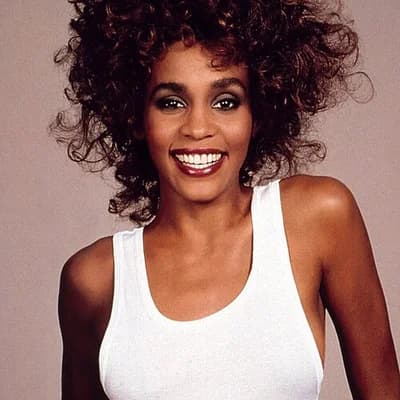
Whitney Houston
Whitney Elizabeth Houston
musician
Born 9 August 1963 · Newark, New Jersey, United States · 40.74° N, 74.17° WX
Source: Birth time not documented in publicly accessible records
About this chart
No birth time is documented for this person. The chart therefore shows planetary positions in their signs, the slow aspects between them, and the generational context — but not house placements, the Ascendant, or the Midheaven, which require an accurate birth time. The Moon's sign carries a ±6° margin: if it falls near a sign boundary, the sign could vary. Positions for all other planets are reliable.
Do you have a verified source for this birth time? Share it →
The sky at birth
No birth time is documented for Whitney Houston. The Ascendant, Midheaven, and house positions cannot be determined. The planetary positions below are calculated for noon local time and are accurate to within a fraction of a degree for the slow-moving planets. The Moon's position carries a margin of approximately ±7°.
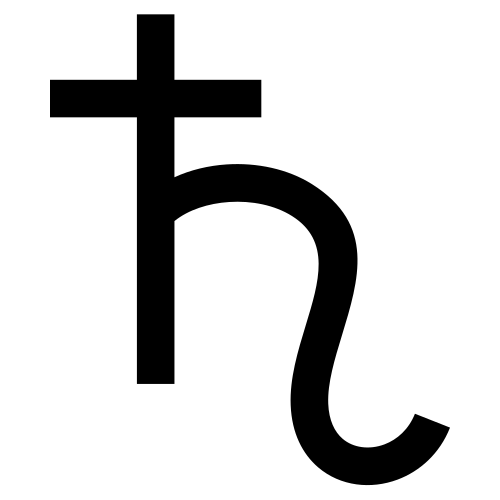
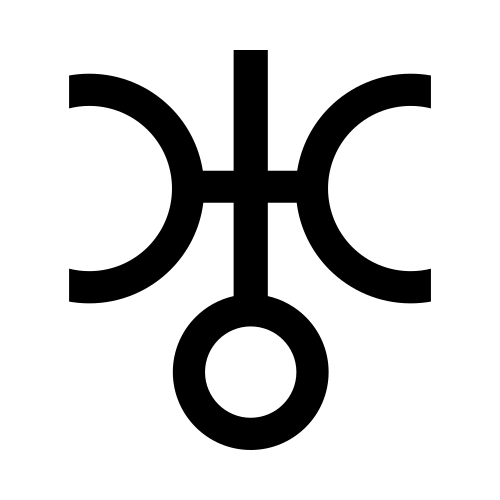
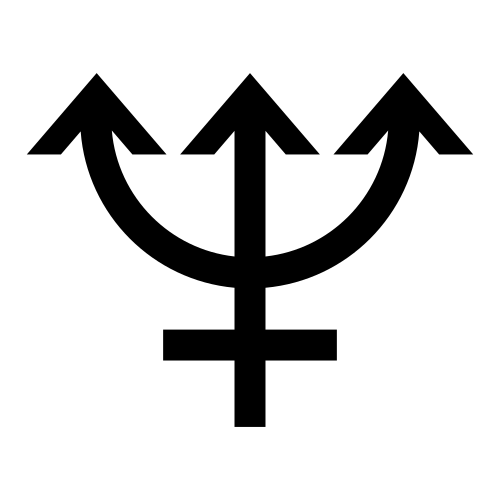
The Sun is at 16°22' Leo. The Moon is at 12°23' Aries (noon position, ±7° margin). Mercury is at 9°46' Virgo. Venus is at 10°47' Leo. Mars is at 8°17' Libra. Jupiter is at 19°28' Aries R. Saturn is at 20°01' Aquarius R. Uranus is at 4°25' Virgo. Neptune is at 12°56' Scorpio. Pluto is at 11°00' Virgo.
The chart features an exceptionally tight Mercury-Pluto conjunction in Virgo: Mercury at 9°46' and Pluto at 11°00', separated by 1°14'. Jupiter at 19°28' Aries retrograde and Saturn at 20°01' Aquarius retrograde form a sextile at 0°33'. The Sun at 16°22' Leo opposes Saturn across the Leo-Aquarius axis (3°39') and trines Jupiter (3°06'). Three planets occupy Virgo: Mercury at 9°46', Uranus at 4°25', and Pluto at 11°00'.
The tightest major aspects between planets: Jupiter sextile Saturn (0°33'), Mercury conjunct Pluto (1°14'), Neptune sextile Pluto (1°56'), Venus square Neptune (2°09'), Venus sextile Mars (2°30'), Sun trine Jupiter (3°06'), Mercury sextile Neptune (3°10'), Sun square Neptune (3°26'), Sun opposition Saturn (3°39'), Sun trine Moon (3°59' — time-dependent).
The engine also identifies the following tight minor aspects involving asteroids and calculated points: moon quincunx lilith (0.01° sep); jupiter sesquiquadrate uranus (0.06° app); neptune sextile pallas (0.10° app); uranus semi-sextile ceres (0.17° app).
The chart was calculated by Astrian's engine using NASA JPL DE441 ephemerides, sub-arcsecond precision. Timezone: Eastern Daylight Time (America/New_York, UTC −4).
| Planet | Sign | Position |
|---|---|---|
| Sun | Leo | 16°20' |
| Moon | Aries | 11°47'±6° |
| Mercury | Virgo | 09°42' |
| Venus | Leo | 10°44' |
| Mars | Libra | 08°16' |
| Jupiter | Aries | 19°28'retrograde |
| Saturn | Aquarius | 20°01'retrograde |
| Uranus | Virgo | 04°25' |
| Neptune | Scorpio | 12°56' |
| Pluto | Virgo | 11°00' |
| Chiron | Pisces | 13°45'retrograde |
 Sun
Sun Moon
Moon Mercury
 Venus
Venus Mars
Mars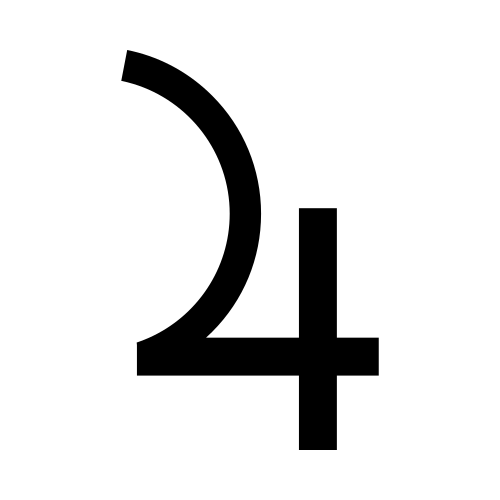 Jupiter
 Saturn
 Uranus
 Neptune
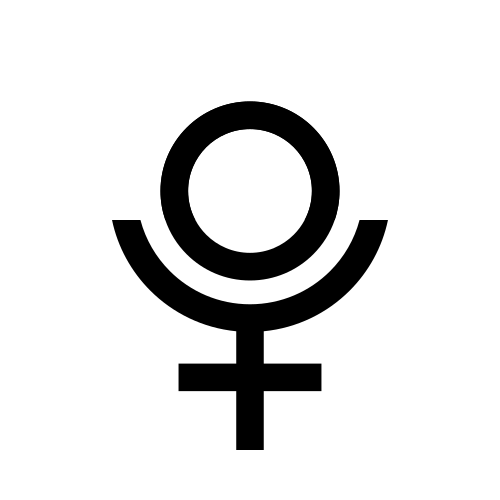 Pluto
Pluto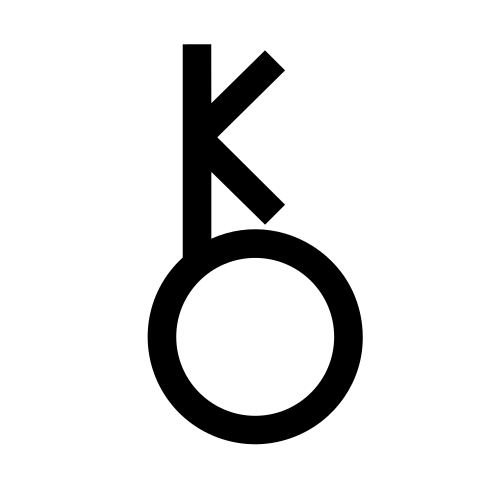 Chiron
Birth time unknown — house positions and Ascendant/MC are not available.
Astronomical context
Those born between approximately 1957 and 1972 carried Pluto in Virgo. This generation grew up amid the civil rights movement, the Vietnam War, and Watergate. They came of age during the economic restructuring of the 1980s, the end of the Cold War, and the rise of the information economy.
In astrological tradition, Pluto in Virgo is associated with collective transformation of the domains that sign governs: work, health, systems of service, practical method, and the relationship between labor and daily life. Virgo is the sign of analysis, precision, and the refinement of process. Pluto's transit through Virgo is read, symbolically, as a generational mandate to overhaul the working order — its techniques, its standards of craft, its relationship to the body. The symbolic reading is correlative, not causal.
Others in the Astrian collection born under this configuration include Michael Jackson (1958), Madonna (1958), Barack Obama (1961), and Quentin Tarantino (1963). Houston, born in 1963, belongs to the later years of this generational wave.
Other profiles from this Pluto in Virgo generation
Symbolic reading
The following describes what classical astrological tradition associates with these configurations. Astrian does not apply these descriptions to the person's biography.
The Sun at 16°22' Leo is the most prominent structural feature of this chart. Without a documented birth time, there is no Ascendant or Midheaven — the reading is confined to planetary positions by sign and the aspects between planets.
The Moon at 12°23' Aries represents the noon position; the actual placement falls within approximately 7° on either side. If born early in the day, the Moon would be in the mid-single digits of Aries; if born late, in the late teens. The Moon's sign placement in Aries is probable for the entire day.
Mercury at 9°46' Virgo, Venus at 10°47' Leo, and Mars at 8°17' Libra complete the personal planet picture.
### Mercury conjunct Pluto in Virgo
The chart's most distinctive personal aspect is the conjunction of Mercury at 9°46' Virgo and Pluto at 11°00' Virgo — an orb of 1°14'. Mercury governs communication, the voice (literally and symbolically), and the articulation of inner experience. Pluto governs transformation, intensity, depth, and the encounter with what lies beneath surfaces. Their conjunction in Virgo — a sign of precision, analysis, and the refinement of technique — merges the communicative faculty with the transformative drive in a register that is technically exacting.
In the tradition, Mercury-Pluto conjunctions are read as configurations where communication carries unusual depth and intensity. The voice — whether literal or symbolic — becomes an instrument of power, capable of reaching registers that are not accessible to ordinary expression. The conjunction in Virgo, a sign that governs craft and the body's service, places this intensity within a framework of technical mastery.
Uranus at 4°25' Virgo adds a third body to the Virgo concentration, though it is wider from Mercury and Pluto (5-7° from each). The three bodies together constitute a generational concentration in Virgo that is structurally notable.
### Jupiter sextile Saturn
Jupiter at 19°28' Aries retrograde and Saturn at 20°01' Aquarius retrograde form a sextile at 0°33' — the tightest major aspect in the chart between classical planets. Jupiter governs expansion, abundance, and the impulse toward more. Saturn governs structure, limitation, and the discipline of form. The sextile is a productive alignment; it connects the expansive and the structural in a relationship of cooperation. Both planets are retrograde, which the tradition reads as an inward or reflective quality to their operation.
Jupiter in Aries operates in the register of bold initiative and independent action. Saturn in Aquarius operates in the register of social structure, collective responsibility, and the discipline of community. Their sextile connects individual ambition with collective accountability.
### Sun opposition Saturn
The Sun at 16°22' Leo opposes Saturn at 20°01' Aquarius retrograde, orb 3°39'. The Sun represents central identity; Saturn represents limitation, discipline, and the weight of external expectation. Oppositions create polarity — a tension between two forces that is experienced as an encounter with something outside the self. The Leo-Aquarius axis, in the tradition, governs the relationship between individual expression and collective belonging.
Sun-Saturn oppositions are read in the tradition as configurations where the sense of self is tested by demands for discipline, where identity must be earned rather than assumed, and where achievement carries a quality of effort that is never entirely effortless.
### Venus square Neptune
Venus at 10°47' Leo squares Neptune at 12°56' Scorpio, orb 2°09'. Venus governs aesthetics, desire, and the sense of what is beautiful. Neptune governs the ideal, the dissolving of boundaries, and the capacity for transcendence or illusion. The square creates tension between these registers — the aesthetic sense is drawn toward the ideal but meets resistance, distortion, or confusion in the encounter.
In the tradition, Venus-Neptune squares are associated with artistic sensibility of unusual refinement that coexists with vulnerability in matters of love, self-image, and the boundary between reality and fantasy.
### Sun trine Jupiter
The Sun at 16°22' Leo trines Jupiter at 19°28' Aries, orb 3°06'. The Sun represents identity and vitality; Jupiter represents expansion and amplification. The trine — a harmonious aspect — connects identity with the impulse to amplify in a fire-sign register (Leo and Aries) that is warm, expansive, and performance-oriented. In the tradition, Sun-Jupiter trines are read as configurations of natural confidence and the capacity to project on a large scale.
The planetary pattern here is read as a symbolic portrait, not a causal explanation. No planet caused, predicted, or determined any event or characteristic.
Astrology is a symbolic language with 2,500 years of literature. The reading above is interpretive, not explanatory.
Astrian does not claim that the natal chart of Whitney Houston caused or determined any of the above. Astrology is a symbolic system with 2,500 years of literature. Its capacity for retrospective description does not imply explanatory capacity.
A parallel life
The following are verified biographical facts. No connection to the natal chart is implied.
Whitney Elizabeth Houston was born on 9 August 1963 in Newark, New Jersey, the youngest of three children of John Russell Houston Jr., an entertainment executive and former Army serviceman, and Emily "Cissy" Houston, a gospel and soul singer who had performed with Elvis Presley, Aretha Franklin, and Dionne Warwick. Cissy Houston was a member of the Sweet Inspirations; Dionne Warwick was Whitney's cousin; Aretha Franklin was her godmother. She grew up in a middle-class household in East Orange, New Jersey, and began singing in the junior gospel choir at New Hope Baptist Church in Newark before she was twelve.
As a teenager, she sang background vocals on records by Chaka Khan and Lou Rawls, modeled for Seventeen and Glamour, and was recruited by several record labels. Clive Davis, the head of Arista Records, signed her in 1983 after seeing her perform at a New York nightclub. He delayed her debut for two years while she developed her repertoire and stage presence.
Her self-titled debut album, Whitney Houston (1985), produced three consecutive number-one singles on the Billboard Hot 100: "Saving All My Love for You," "How Will I Know," and "Greatest Love of All." The album sold 25 million copies worldwide and won the Grammy for Best Female Pop Vocal Performance. Her second album, Whitney (1987), debuted at number one on the Billboard 200 — the first album by a female artist to do so. It produced four consecutive number-one singles: "I Wanna Dance with Somebody (Who Loves Me)," "Didn't We Almost Have It All," "So Emotional," and "Where Do Broken Hearts Go." The seven consecutive number-one singles across both albums set a record that stood until 2019.
Her rendition of "The Star-Spangled Banner" at Super Bowl XXV in January 1991, performed during the Gulf War, was subsequently released as a commercial single and reached the top twenty — the only time the national anthem has charted as a pop hit.
The soundtrack to The Bodyguard (1992), her first film, sold 45 million copies worldwide. Her recording of Dolly Parton's "I Will Always Love You" topped the Hot 100 for fourteen weeks and remains one of the best-selling singles in history. The film grossed $411 million worldwide. She starred in three more films: Waiting to Exhale (1995), The Preacher's Wife (1996), and the television film Cinderella (1997).
She married Bobby Brown, the R&B singer, on 18 July 1992. They had a daughter, Bobbi Kristina Brown, born in 1993. The marriage was publicly turbulent. They divorced in 2007.
By the early 2000s, her voice had been damaged by years of drug use — she later acknowledged addiction to cocaine and marijuana in a 2002 interview with Diane Sawyer. Her albums My Love Is Your Love (1998) and Just Whitney (2002) sold well but showed a declining vocal range. A comeback album, I Look to You (2009), debuted at number one, but her live performances were inconsistent.
On 11 February 2012, she was found submerged in a bathtub at the Beverly Hilton Hotel in Beverly Hills, California. She was forty-eight years old. The Los Angeles County Coroner ruled the death accidental drowning, with atherosclerotic heart disease and cocaine use as contributing factors. Her daughter, Bobbi Kristina Brown, died in similar circumstances in July 2015 at age twenty-two.
Houston won seven Grammy Awards, two Emmy Awards, sixteen Billboard Music Awards, and an unprecedented six consecutive American Music Awards for Favorite Female Artist. She has sold an estimated 200 million records worldwide. She was inducted into the Rock and Roll Hall of Fame in 2020.
Biographical sources
- Houston, Cissy. Remembering Whitney: My Story of Love, Loss, and the Night the Music Stopped. HarperCollins 2013
- Winfrey, Oprah. Interview with Whitney Houston. The Oprah Winfrey Show, September 2009..
- Taraborrelli, J. Randy. A Woman Named Whitney. Grand Central Publishing, 2017..
This profile presents the sky at the birth of Whitney Houston and verified facts of their biography. Astrian does not claim that astrology has predictive capacity or that the natal chart determines the trajectory of a life. Astrology is a symbolic system with 2,500 years of literature. Its capacity for retrospective description does not imply explanatory capacity.
Related profiles
Calculate your own birth chart with the same NASA JPL DE441 precision.
Calculate my birth chartLast updated: June 12, 2026
Newsletter
A short reading once a month, in your inbox.
A note on the symbolism of the season, recent editorial pieces, and what to look for in next month's sky. No predictions.
Support this project
Independent, no venture funding, no ads. A contribution keeps Astrian precise and free.
Support on Ko-fi (opens in new tab)