PROFILE · FILM & STAGE
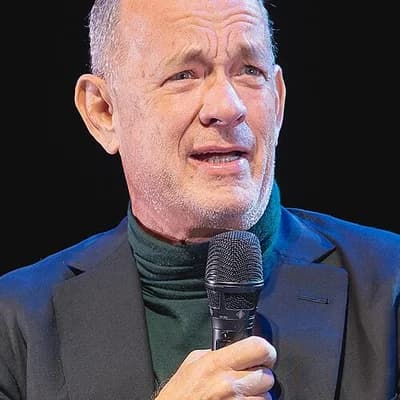
Tom Hanks
Thomas Jeffrey Hanks
actor
Born 9 July 1956 · Concord, California, United States · 37.98° N, 122.03° WX
Source: Birth time not documented in publicly accessible records
About this chart
No birth time is documented for this person. The chart therefore shows planetary positions in their signs, the slow aspects between them, and the generational context — but not house placements, the Ascendant, or the Midheaven, which require an accurate birth time. The Moon's sign carries a ±6° margin: if it falls near a sign boundary, the sign could vary. Positions for all other planets are reliable.
Do you have a verified source for this birth time? Share it →
The sky at birth
No birth time is documented for Tom Hanks. The Ascendant, Midheaven, and house positions cannot be determined. The planetary positions below are calculated for noon local time and are accurate to within a fraction of a degree for the slow-moving planets. The Moon's position carries a margin of approximately ±7°.
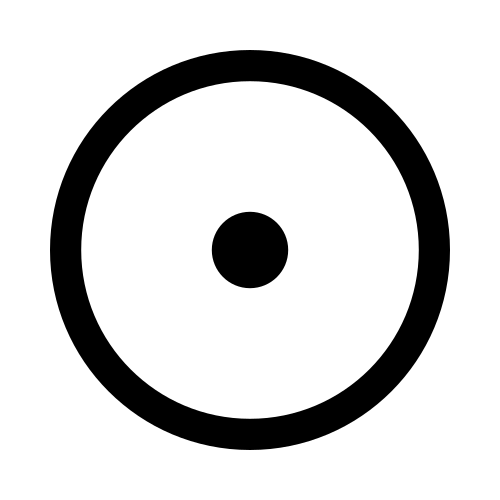
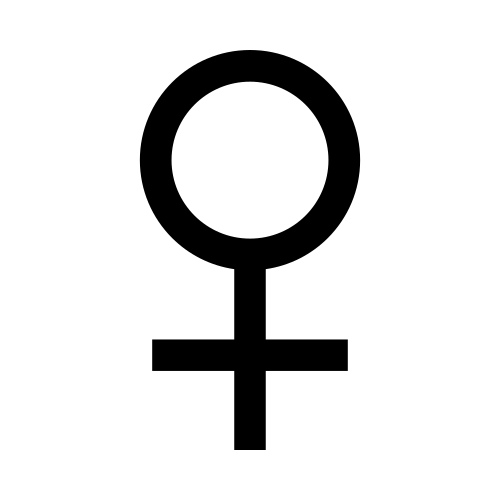
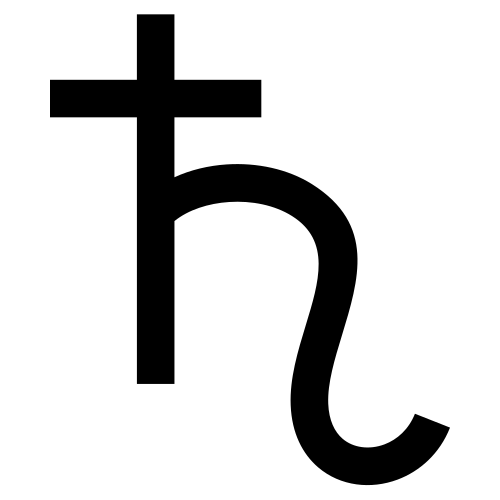
The Sun is at 17°32' Cancer. The Moon is at 10°56' Leo (noon position, ±7° margin). Mercury is at 5°55' Cancer. Venus is at 22°49' Gemini R. Mars is at 17°21' Pisces. Jupiter is at 0°22' Virgo. Saturn is at 26°30' Scorpio R. Uranus is at 1°39' Leo. Neptune is at 27°38' Libra. Pluto is at 26°59' Leo.
The Sun at 17°32' Cancer trines Mars at 17°21' Pisces (0°11') — the tightest major aspect in the chart and one of the tightest Sun-Mars trines in the Astrian collection. Saturn at 26°30' Scorpio retrograde squares Pluto at 26°59' Leo (0°29'). Neptune at 27°38' Libra sextiles Pluto (0°39'). Jupiter at 0°22' Virgo sextiles Neptune (2°44'). Pluto at 26°59' Leo conjoins Jupiter at 0°22' Virgo (3°23'), a cross-sign conjunction linking the end of Leo to the beginning of Virgo. Uranus at 1°39' Leo squares Neptune (4°01').
The engine also identifies the following tight minor aspects involving asteroids and calculated points: mercury quincunx northNode (0.05° app); mars semi-sextile ceres (0.16° sep); uranus square vesta (0.28° sep).
The tightest major aspects between planets: Sun trine Mars (0°11'), Saturn square Pluto (0°29'), Neptune sextile Pluto (0°39'), Jupiter sextile Neptune (2°44'), Pluto conjunction Jupiter (3°23'), Uranus square Neptune (4°01').
The chart was calculated by Astrian's engine using NASA JPL DE441 ephemerides, sub-arcsecond precision. Timezone: Pacific Daylight Time (America/Los_Angeles, UTC −7).
| Planet | Sign | Position |
|---|---|---|
| Sun | Cancer | 17°30' |
| Moon | Leo | 10°19'±6° |
| Mercury | Cancer | 05°50' |
| Venus | Gemini | 22°49'retrograde |
| Mars | Pisces | 17°20' |
| Jupiter | Virgo | 00°22' |
| Saturn | Scorpio | 26°30'retrograde |
| Uranus | Leo | 01°39' |
| Neptune | Libra | 27°38' |
| Pluto | Leo | 26°59' |
| Chiron | Aquarius | 10°14'retrograde |
 Sun
Sun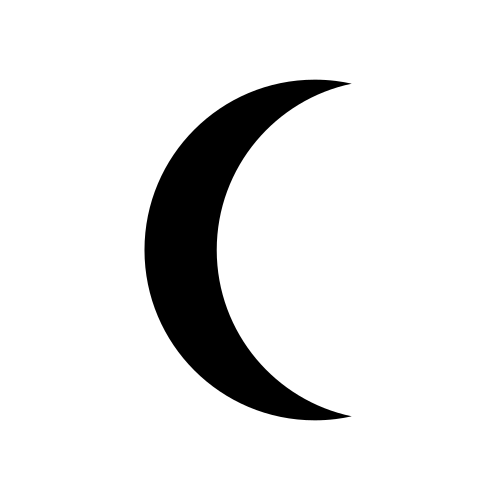 Moon
Moon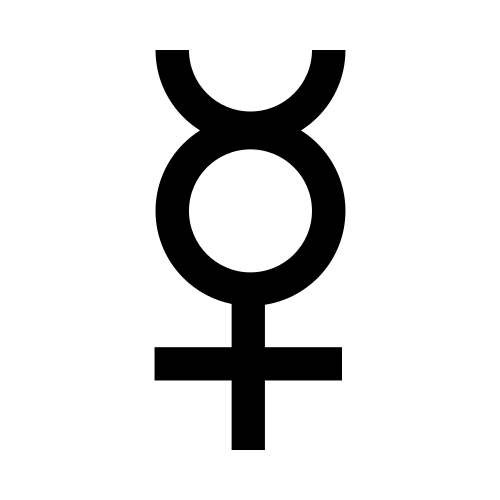 Mercury
 Venus
Venus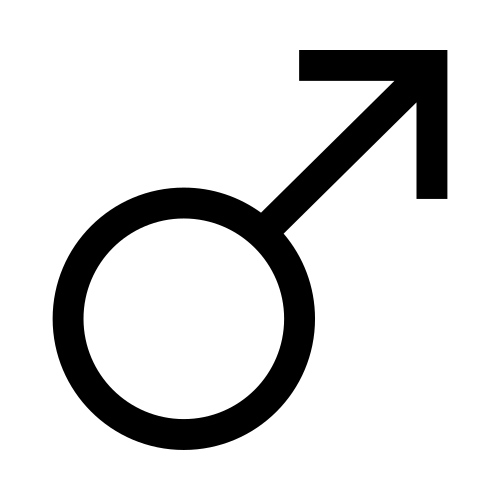 Mars
Mars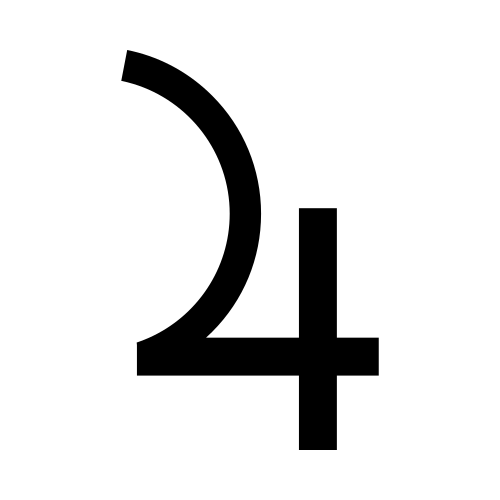 Jupiter
 Saturn
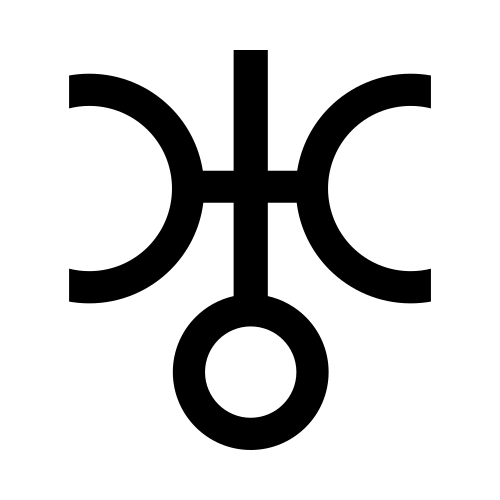 Uranus
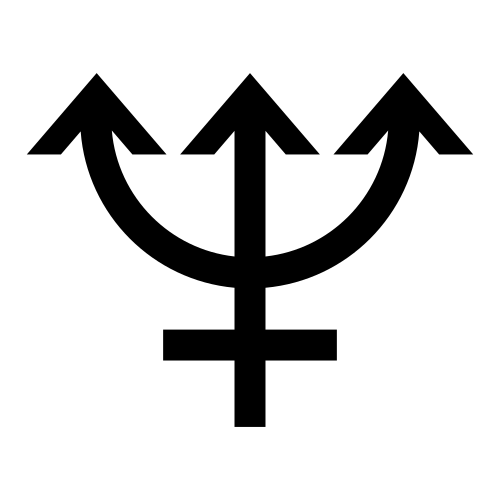 Neptune
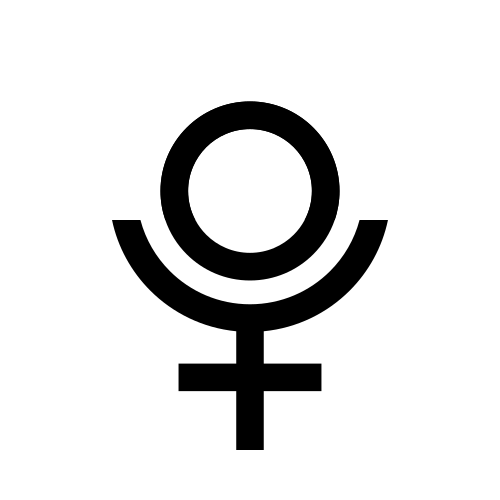 Pluto
Pluto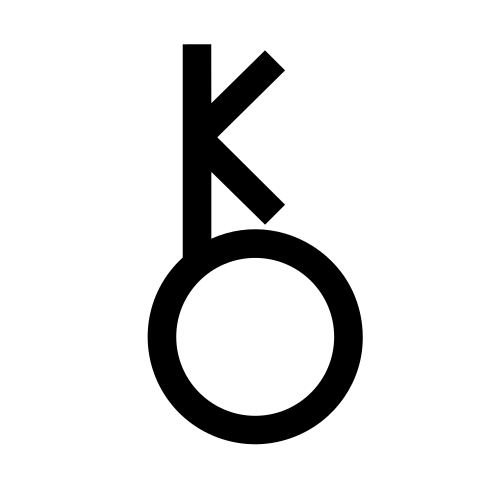 Chiron
Birth time unknown — house positions and Ascendant/MC are not available.
Astronomical context
Those born between approximately 1939 and 1957 carried Pluto in Leo. This generation arrived during or shortly after the Second World War, grew up during the Cold War's formative decades, and came of age alongside the rise of television, the civil rights movement, rock and roll, and the first wave of postwar consumer culture. They inherited a world that had been broken by total war and was rebuilding itself through mass media, suburbanization, and the long economic expansion of the 1950s and 1960s.
In astrological tradition, Pluto in Leo is associated with collective transformation of the domains that sign governs: creative self-expression, performance, authority, the relationship between individual charisma and collective power, and the nature of fame itself. Leo is the sign of the stage, the sovereign, the heart's declaration. Pluto's transit through Leo — roughly coinciding with the postwar era — is read, symbolically, as a period when the structures of individual expression and creative authority were subjected to deep, irreversible transformation. The generation that carries this placement grew up in a culture that was simultaneously inventing modern celebrity and beginning to dismantle the institutions that produced it. The symbolic reading is correlative, not causal.
Others in the Astrian collection born under this configuration include John Lennon (1940), Bob Marley (1945), Freddie Mercury (1946), and Meryl Streep (1949). Tom Hanks, born in 1956, belongs to the final years of this generational wave.
Other profiles from this Pluto in Leo generation
Symbolic reading
The following describes what classical astrological tradition associates with these configurations. Astrian does not apply these descriptions to the person's biography.
The Sun at 17°32' Cancer is the most prominent structural feature of this chart. Without a documented birth time, there is no Ascendant or Midheaven — the reading is confined to planetary positions by sign and the aspects between planets.
The Moon at 10°56' Leo represents the noon position; the actual placement falls within approximately 7° on either side. If born early in the day, the Moon could be in the low single digits of Leo; if born late, in the mid-teens. The Moon's sign placement in Leo is secure for the entire day.
Mercury at 5°55' Cancer, Venus at 22°49' Gemini retrograde, and Mars at 17°21' Pisces complete the personal planet picture.
### The Sun-Mars trine: identity and action in water
The chart's most striking feature is the Sun at 17°32' Cancer trine Mars at 17°21' Pisces, orb 0°11' — functionally exact. The Sun represents the core identity; Mars represents action, will, and the application of physical energy. A trine is the most cooperative of the major aspects — it connects two points in a relationship of natural flow, ease, and mutual reinforcement. At 0°11', this is not merely cooperative but fused: the identity and the will to act are virtually indistinguishable.
Both planets occupy water signs. Cancer's register involves instinct, emotional intelligence, the protective impulse, and adaptation to environment. Pisces' register involves empathy, imagination, permeability to the emotional states of others, and the capacity to dissolve the boundary between self and other. A Sun-Mars trine across the Cancer-Pisces axis operates entirely within water: the identity acts through feeling, and feeling is the medium of action. The tradition reads this configuration as one where drive is not aggressive or assertive in the fire-sign manner but responsive, adaptive, and channelled through emotional attunement.
### Saturn square Pluto
Saturn at 26°30' Scorpio retrograde squares Pluto at 26°59' Leo, orb 0°29' — the second-tightest aspect in the chart. Saturn governs structure, limitation, endurance, and the weight of accumulated responsibility. Pluto governs transformation, depth, the encounter with power at its most irreducible. The square is a dynamic aspect that forces engagement between two principles that do not naturally accommodate each other.
Saturn in Scorpio carries its own double intensity: the planet of limitation in the sign of depth and extremity. Pluto in Leo carries the generational signature of this cohort — creative authority subjected to transformation — but at the personal level, Pluto's proximity to the late degrees of Leo gives it concentrated force. The square between them introduces a structural tension between endurance and transformation, between the demand to sustain form and the demand to let it be remade.
### The Jupiter-Neptune-Pluto triangle
Three outer planets form a connected pattern. Neptune at 27°38' Libra sextiles Pluto at 26°59' Leo (0°39') — a generational aspect, but unusually tight here. Jupiter at 0°22' Virgo sextiles Neptune (2°44') and conjoins Pluto across the Leo-Virgo cusp (3°23'). The three bodies create a triangular configuration linking expansion (Jupiter), imagination and ideal (Neptune), and transformative depth (Pluto) in a pattern of mutual cooperation.
Jupiter's conjunction with Pluto — even at 3°23' and crossing signs — connects the expansive, amplifying principle with Plutonian depth. The tradition reads Jupiter-Pluto contacts as configurations where growth is not superficial but penetrating, and where reach and depth reinforce rather than oppose each other. Neptune's sextile to both adds the dimension of the imaginative and the ideal — expansion and depth operating through a veil of aesthetic sensitivity.
### Venus retrograde in Gemini
Venus at 22°49' Gemini retrograde does not form close major aspects with the other planets, but its retrograde status deserves mention. Venus governs aesthetics, social connection, and the sense of value. In Gemini, Venus operates through language, curiosity, and the pleasure of verbal exchange. A retrograde Venus in the tradition is read as an internalized aesthetic processing — the sense of beauty and connection works inward before it expresses outward, and there is a quality of reconsidering, of returning to earlier valuations.
The planetary pattern here is read as a symbolic portrait, not a causal explanation. No planet caused, predicted, or determined any event or characteristic.
Astrology is a symbolic language with 2,500 years of literature. The reading above is interpretive, not explanatory.
Astrian does not claim that the natal chart of Tom Hanks caused or determined any of the above. Astrology is a symbolic system with 2,500 years of literature. Its capacity for retrospective description does not imply explanatory capacity.
A parallel life
The following are verified biographical facts. No connection to the natal chart is implied.
Thomas Jeffrey Hanks was born on 9 July 1956 in Concord, California, the third of four children. His father, Amos Mefford Hanks, was an itinerant cook who moved between restaurants across Northern California and Nevada; his mother, Janet Marylyn Frager, was a hospital worker. His parents divorced when he was four. He moved repeatedly with his father through Sacramento, Oakland, and Reno as his father remarried twice. His younger brother Jim would also become an actor.
He attended Skyline High School in Oakland and began acting in school productions. After two years at Chabot College in Hayward, California, he transferred to California State University, Sacramento, but left before graduating to intern at the Great Lakes Shakespeare Festival in Cleveland, Ohio, where he spent three seasons (1977–1979) performing in repertory — Shakespeare, Chekhov, and modern American drama — and learning the physical and vocal discipline of classical theater.
He moved to New York and then to Los Angeles. His first professional break was the television sitcom Bosom Buddies (1980–1982), which was cancelled after two seasons. A string of lightweight comedies followed — The Man with One Red Shoe (1985), The Money Pit (1986), Turner & Hooch (1989) — before Big (1988) revealed the dramatic capacity underneath the comic surface. He earned his first Academy Award nomination for the film, playing a thirteen-year-old boy in a man's body with a precision that was less caricature than sustained emotional inhabitation.
The transition to dramatic leading man was completed by Philadelphia (1993), in which he played Andrew Beckett, a lawyer with AIDS facing workplace discrimination. He won the Academy Award for Best Actor. The following year, Forrest Gump (1994) brought a second consecutive Best Actor Oscar — making him the first actor to achieve back-to-back wins since Spencer Tracy in 1937 and 1938. The two films represented opposite poles of his range: Philadelphia demanded physical deterioration and controlled rage; Forrest Gump demanded innocence sustained across decades without tipping into sentimentality.
His collaboration with Steven Spielberg became the defining professional partnership of his career. Saving Private Ryan (1998) cast him as Captain John Miller, a schoolteacher-turned-infantry-officer in Normandy; the role required him to carry the film's moral center through sequences of extreme violence without losing the audience's trust. Catch Me If You Can (2002), The Terminal (2004), Bridge of Spies (2015), and The Post (2017) continued the partnership across genres.
In parallel, he voiced Woody the cowboy in the four Toy Story films (1995–2019), the most commercially successful animated franchise in history. He produced and starred in Cast Away (2000), losing fifty-five pounds during production. He played Walt Disney in Saving Mr. Banks (2013), Captain Richard Phillips in Captain Phillips (2013), and Fred Rogers in A Beautiful Day in the Neighborhood (2019).
He married the actress Samantha Lewes in 1978; they divorced in 1987. They had two children: Colin Hanks (born 1977, also an actor) and Elizabeth Ann Hanks (born 1982). In 1988 he married the actress and producer Rita Wilson. They have two sons: Chet Hanks (born 1990) and Truman Hanks (born 1995). He became a Greek citizen in 2020 through Wilson's Greek heritage.
He published a collection of short stories, Uncommon Type (2017), and a novel, The Making of Another Major Motion Picture Masterpiece (2023). He received the Presidential Medal of Freedom in 2016 and the Kennedy Center Honors in 2014.
By 2025, he had been nominated for six Academy Awards and won two. His films have grossed more than $10 billion worldwide. He remains one of the highest-grossing actors in cinema history and one of the most publicly trusted figures in American cultural life.
Biographical sources
- Gardner, David. Tom Hanks: The Unauthori*.
This profile presents the sky at the birth of Tom Hanks and verified facts of their biography. Astrian does not claim that astrology has predictive capacity or that the natal chart determines the trajectory of a life. Astrology is a symbolic system with 2,500 years of literature. Its capacity for retrospective description does not imply explanatory capacity.
Related profiles
Calculate your own birth chart with the same NASA JPL DE441 precision.
Calculate my birth chartLast updated: June 12, 2026
Newsletter
A short reading once a month, in your inbox.
A note on the symbolism of the season, recent editorial pieces, and what to look for in next month's sky. No predictions.
Support this project
Independent, no venture funding, no ads. A contribution keeps Astrian precise and free.
Support on Ko-fi (opens in new tab)