PROFILE · MUSIC
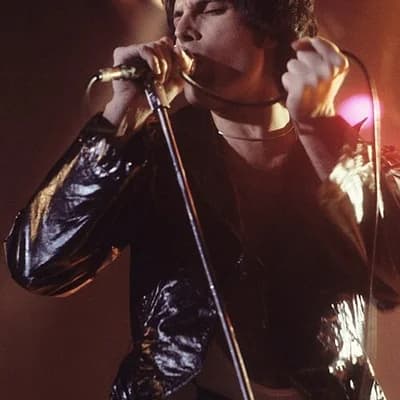
Freddie Mercury
Farrokh Bulsara
musician
Born 5 September 1946 · Stone Town, Zanzibar, Tanzania · 6.17° S, 39.20° EX
Source: Birth time not documented in publicly accessible records
About this chart
No birth time is documented for this person. The chart therefore shows planetary positions in their signs, the slow aspects between them, and the generational context — but not house placements, the Ascendant, or the Midheaven, which require an accurate birth time. The Moon's sign carries a ±6° margin: if it falls near a sign boundary, the sign could vary. Positions for all other planets are reliable.
Do you have a verified source for this birth time? Share it →
The sky at birth
No birth time is documented for Freddie Mercury. The Ascendant, Midheaven, and house positions cannot be determined. The planetary positions below are calculated for noon local time and are accurate to within a fraction of a degree for the slow-moving planets. The Moon's position carries a margin of approximately ±7°.
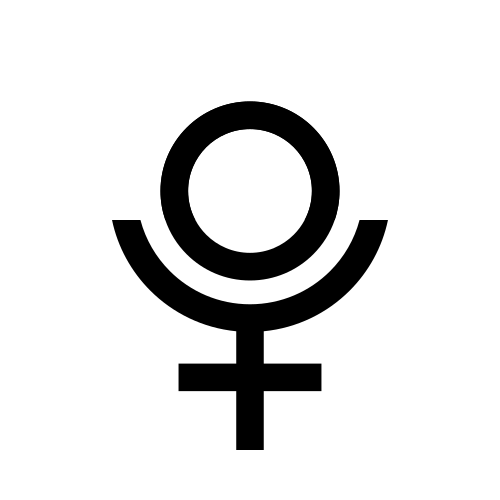
The Sun is at 12°11' Virgo. The Moon is at 1°17' Capricorn (noon position, ±7° margin). Mercury is at 3°13' Virgo. Venus is at 28°23' Libra. Mars is at 17°10' Libra. Jupiter is at 26°06' Libra. Saturn is at 4°05' Leo. Uranus is at 21°34' Gemini. Neptune is at 7°23' Libra. Pluto is at 12°19' Leo.
Four planets occupy Libra: Neptune at 7°23', Mars at 17°10', Jupiter at 26°06', and Venus at 28°23'. This concentration in a single sign is a structural feature independent of birth time. Venus and Jupiter form a conjunction at 2°17' separation. The Sun at 12°11' Virgo forms a semi-sextile to Pluto at 12°19' Leo (0°08'). Saturn at 4°05' Leo sextiles Neptune at 7°23' Libra (3°18'). Mars at 17°10' Libra trines Uranus at 21°34' Gemini (4°24').
The tightest major aspects between planets: Venus conjunction Jupiter (2°17'), Saturn sextile Neptune (3°18'), Mars trine Uranus (4°24').
The engine also identifies the following tight minor aspects involving asteroids and calculated points: sun semi-sextile pluto (0.13° app); venus sextile pallas (0.18° app); venus semi-square lilith (0.25° app); mercury quincunx vesta (0.34° app).
The chart was calculated by Astrian's engine using NASA JPL DE441 ephemerides, sub-arcsecond precision. Timezone: East Africa Time (Africa/Dar_es_Salaam, UTC +3).
| Planet | Sign | Position |
|---|---|---|
| Sun | Virgo | 12°11' |
| Moon | Capricorn | 01°17'±6° |
| Mercury | Virgo | 03°13' |
| Venus | Libra | 28°23' |
| Mars | Libra | 17°10' |
| Jupiter | Libra | 26°06' |
| Saturn | Leo | 04°05' |
| Uranus | Gemini | 21°34' |
| Neptune | Libra | 07°23' |
| Pluto | Leo | 12°19' |
| Chiron | Libra | 20°50' |
 Sun
Sun Moon
Moon Mercury
 Venus
Venus Mars
Mars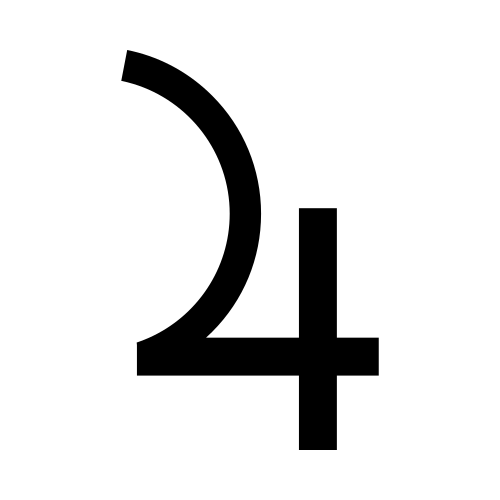 Jupiter
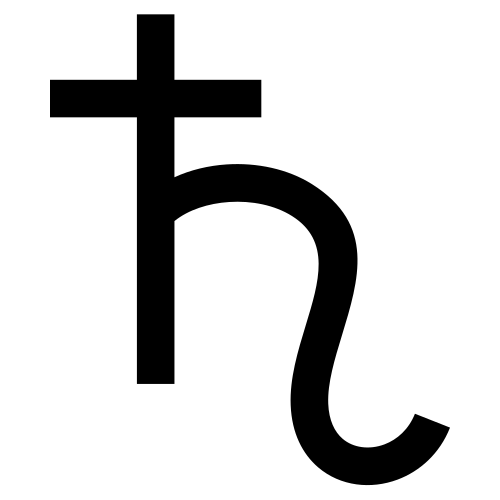 Saturn
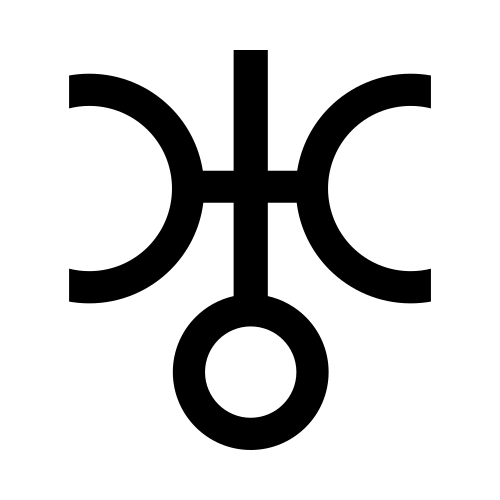 Uranus
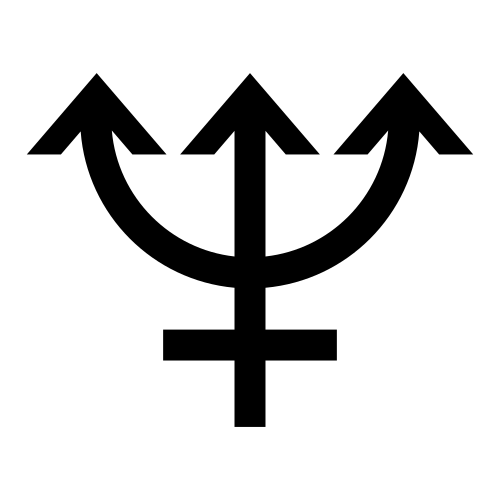 Neptune
 Pluto
Pluto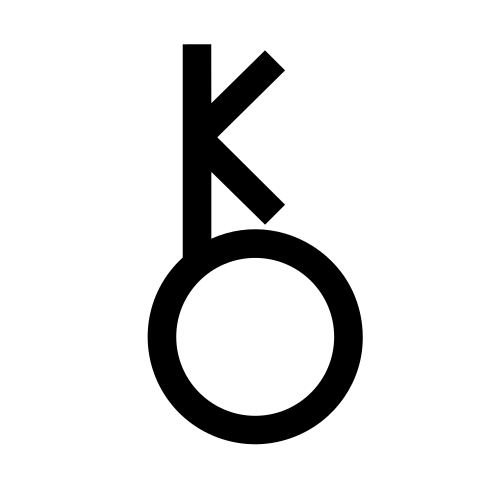 Chiron
Birth time unknown — house positions and Ascendant/MC are not available.
Astronomical context
Those born between approximately 1939 and 1957 carried Pluto in Leo. This generation witnessed the post-war reconstruction of the global order and the rise of mass culture, consumer capitalism, the nuclear age, and the first era of television.
In astrological tradition, Pluto in Leo is associated with collective transformation of the domains that sign governs: creative self-expression, performance, the cult of personality, the relationship between the individual and the audience, and the structures of fame. Leo is the sign of the stage, the heart, and the creative act. Pluto's transit through Leo is read, symbolically, as a generational mandate to transform the nature of personal expression and its relationship to power. The symbolic reading is correlative, not causal.
Others in the Astrian collection born under this configuration include John Lennon (1940), Bob Marley (1945), David Bowie (1947), Steve Jobs (1955), and Stephen Hawking (1942). Mercury, born in 1946, belongs to the middle years of this generational wave.
Other profiles from this Pluto in Leo generation
Symbolic reading
The following describes what classical astrological tradition associates with these configurations. Astrian does not apply these descriptions to the person's biography.
The Sun at 12°11' Virgo is the most prominent structural feature of this chart. Without a documented birth time, there is no Ascendant or Midheaven — the reading is confined to planetary positions by sign and the aspects between planets.
The Moon at 1°17' Capricorn represents the noon position; the actual placement falls within approximately 7° on either side. If born early in the day, the Moon could be in the mid-twenties of Sagittarius; if born late, in the mid-single digits of Capricorn. The Moon's sign placement is uncertain — it may be in late Sagittarius or early Capricorn depending on birth time.
Mercury at 3°13' Virgo, Venus at 28°23' Libra, and Mars at 17°10' Libra complete the personal planet picture.
### The Libra concentration
The chart's most prominent structural feature by volume is the four-planet concentration in Libra: Neptune at 7°23', Mars at 17°10', Jupiter at 26°06', and Venus at 28°23'. Four planets in a single sign — spanning over 21° — constitutes a stellium, the traditional term for a significant concentration of planetary energy in one area of the zodiac.
In the vocabulary of the tradition, Libra governs aesthetics, partnership, the negotiation of opposites, the presentation of beauty, and the relational dimension of experience. It is the sign of the artist as collaborator — the creative act understood not in isolation but in dialogue with others. A four-planet concentration in Libra directs a large proportion of the chart's energy toward these domains.
Neptune's presence at the earliest degree of the Libra concentration adds a layer of idealism, fantasy, and the dissolving of boundaries to the entire configuration. Neptune in Libra — a position it occupied from approximately 1942 to 1957 — is generational, but its inclusion in a personal stellium of this density integrates the generational idealism into the individual pattern.
### Venus conjunction Jupiter
Venus at 28°23' Libra conjoins Jupiter at 26°06' Libra, orb 2°17'. This is the tightest major aspect in the chart between classical planets. Venus governs aesthetics, desire, the sense of beauty, and the presentation of the desirable. Jupiter governs expansion, abundance, and the amplification of what it touches. Their conjunction amplifies the aesthetic sensibility — beauty is experienced and projected on an expanded scale.
In Libra — Venus's own sign, where it operates at full strength in the tradition — this conjunction intensifies the Libran emphasis. Venus in domicile already possesses natural aesthetic authority; Jupiter's conjunction amplifies this toward the theatrical, the grand, and the generous.
### Sun semi-sextile Pluto
The Sun at 12°11' Virgo forms a semi-sextile to Pluto at 12°19' Leo, orb 0°08'. The semi-sextile is a minor aspect connecting adjacent signs — it creates a relationship that is close but structurally awkward, a constant low-level awareness between registers that do not naturally communicate. The Sun represents identity; Pluto represents transformation, power, and the encounter with psychological depth. Their near-exact semi-sextile places identity in a persistent, subtle tension with transformative intensity — not the dramatic confrontation of a square or opposition, but a quieter, more continuous pressure.
### Saturn sextile Neptune
Saturn at 4°05' Leo sextiles Neptune at 7°23' Libra, orb 3°18'. Saturn governs structure, discipline, and endurance of form. Neptune governs the ideal, the imaginary, and the dissolution of boundaries. The sextile is a cooperative aspect — it connects the structural and the visionary in a productive relationship, where discipline serves the ideal and imagination is given form.
### Mars trine Uranus
Mars at 17°10' Libra trines Uranus at 21°34' Gemini, orb 4°24'. Mars governs action and assertion; Uranus governs originality and the breaking of established form. The trine connects these registers in an air-sign axis (Libra and Gemini) that is communicative, intellectually agile, and socially engaged. In the tradition, Mars-Uranus trines are read as configurations where action carries an element of the unexpected — where what is done is done with an originality that feels effortless.
The planetary pattern here is read as a symbolic portrait, not a causal explanation. No planet caused, predicted, or determined any event or characteristic.
Astrology is a symbolic language with 2,500 years of literature. The reading above is interpretive, not explanatory.
Astrian does not claim that the natal chart of Freddie Mercury caused or determined any of the above. Astrology is a symbolic system with 2,500 years of literature. Its capacity for retrospective description does not imply explanatory capacity.
A parallel life
The following are verified biographical facts. No connection to the natal chart is implied.
Farrokh Bulsara was born on 5 September 1946 in the Government Hospital in Stone Town, Zanzibar (then a British protectorate, now part of Tanzania), the elder of two children of Bomi Bulsara, a cashier at the British Colonial Office, and Jer Bulsara (née Bhada). The family was Parsi — Zoroastrian Iranians who had settled in Gujarat, India, generations earlier. They spoke Gujarati at home.
At eight, he was sent to St. Peter's Church of England School, a boarding school in Panchgani, in the Western Ghats of Maharashtra, India. It was there that he began to be called "Freddie" — the name stuck. He studied at St. Peter's for eight years, formed his first band, the Hectics, and developed his piano technique. He passed his school-leaving examinations at St. Mary's School in Mumbai and returned to Zanzibar in 1963.
On 12 January 1964, the Zanzibar Revolution overthrew the Sultan's government; the Bulsara family, along with most of the island's Indian and Arab population, fled. They settled in Feltham, Middlesex, west of London. Freddie enrolled at Isleworth Polytechnic and then at Ealing Art College, where he earned a diploma in graphic art and design in 1969.
He was a fan of Jimi Hendrix and attended his concerts in London. He sold secondhand clothes at the Kensington Market stall he ran with Roger Taylor, a drummer he had met through mutual friends. In April 1970, he joined Taylor and guitarist Brian May in the band Smile, renaming it Queen. Bassist John Deacon joined in 1971. The name Freddie Mercury was adopted at this time.
Queen's self-titled debut album was released in 1973. Their fourth album, A Night at the Opera (1975), contained "Bohemian Rhapsody," a six-minute single that defied every convention of rock radio — operatic passages, no chorus, multiple time signatures — and reached number one in the United Kingdom for nine weeks. The accompanying promotional film, directed by Bruce Gowers, is widely considered one of the first modern music videos.
The band's subsequent albums — A Day at the Races (1976), News of the World (1977), Jazz (1978), The Game (1980) — produced a sequence of songs that entered the permanent repertoire of popular music: "Somebody to Love," "We Will Rock You," "We Are the Champions," "Don't Stop Me Now," "Crazy Little Thing Called Love," "Another One Bites the Dust." Mercury wrote or co-wrote many of these. His vocal range, documented by researchers as spanning from bass-low F to soprano-high F (nearly four octaves in studio recordings), was one of the most studied voices in the history of recorded music.
Queen's performance at Live Aid on 13 July 1985 — a twenty-minute set at Wembley Stadium before 72,000 people and a global television audience estimated at 1.9 billion — is consistently ranked as one of the greatest live performances in the history of rock music.
Mercury released two solo albums: Mr. Bad Guy (1985) and Barcelona (1988), the latter a collaboration with the soprano Montserrat Caballé. The title track, "Barcelona," became the official anthem of the 1992 Summer Olympics — though Mercury did not live to see the Games.
In the final years of his life, he continued to record with Queen despite deteriorating health. The Miracle (1989) and Innuendo (1991) contained some of the band's most complex and emotionally charged work. He recorded vocal tracks for a posthumous album, Made in Heaven (1995), during periods when he was able to stand and sing.
On 23 November 1991, he issued a public statement confirming that he had AIDS. He died the following evening, 24 November 1991, at his home, Garden Lodge, in Kensington, London. He was forty-five years old. The cause of death was bronchopneumonia secondary to AIDS.
His death and the subsequent Freddie Mercury Tribute Concert for AIDS Awareness at Wembley Stadium on 20 April 1992 — attended by 72,000 and watched by an estimated 1 billion television viewers — significantly increased public awareness of the AIDS epidemic at a time when stigma was still pervasive.
Queen's global record sales exceed 300 million units. Mercury was posthumously inducted into the Rock and Roll Hall of Fame as a member of Queen in 2001. A statue of him, erected in 1996, overlooks Lake Geneva in Montreux, Switzerland, where he spent his final years recording.
Biographical sources
- Jones, Lesley-Ann. Freddie Mercury: The Definitive Biography. Hodder & Stoughton, 2011 (revised edition)
- Jackson, Laura. Freddie Mercury: The Biography. Piatkus 1996
This profile presents the sky at the birth of Freddie Mercury and verified facts of their biography. Astrian does not claim that astrology has predictive capacity or that the natal chart determines the trajectory of a life. Astrology is a symbolic system with 2,500 years of literature. Its capacity for retrospective description does not imply explanatory capacity.
Related profiles
Calculate your own birth chart with the same NASA JPL DE441 precision.
Calculate my birth chartLast updated: June 12, 2026
Newsletter
A short reading once a month, in your inbox.
A note on the symbolism of the season, recent editorial pieces, and what to look for in next month's sky. No predictions.
Support this project
Independent, no venture funding, no ads. A contribution keeps Astrian precise and free.
Support on Ko-fi (opens in new tab)