PROFILE · MUSIC
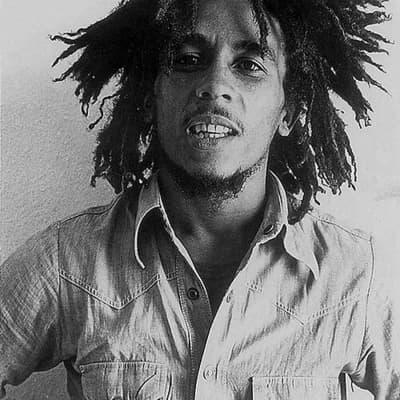
Bob Marley
Robert Nesta Marley
musician
Born 6 February 1945 · Nine Mile, Saint Ann, Jamaica · 18.28° N, 77.37° WX
Source: Birth time not documented in publicly accessible records
About this chart
No birth time is documented for this person. The chart therefore shows planetary positions in their signs, the slow aspects between them, and the generational context — but not house placements, the Ascendant, or the Midheaven, which require an accurate birth time. The Moon's sign carries a ±6° margin: if it falls near a sign boundary, the sign could vary. Positions for all other planets are reliable.
Do you have a verified source for this birth time? Share it →
The sky at birth
No birth time is documented for Bob Marley. The Ascendant, Midheaven, and house positions cannot be determined. The planetary positions below are calculated for noon local time and are accurate to within a fraction of a degree for the slow-moving planets. The Moon's position carries a margin of approximately ±7°.
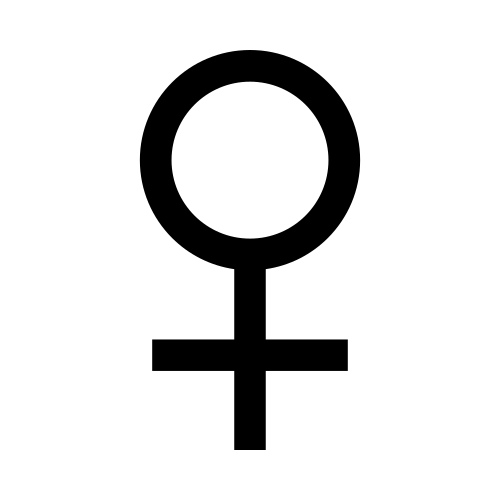
The Sun is at 17°33' Aquarius. The Moon is at 2°05' Sagittarius (noon position, ±7° margin). Mercury is at 2°02' Aquarius. Venus is at 4°22' Aries. Mars is at 24°05' Capricorn. Jupiter is at 26°28' Virgo R. Saturn is at 4°30' Cancer R. Uranus is at 9°08' Gemini R. Neptune is at 6°11' Libra R. Pluto is at 8°54' Leo R.
The chart's most prominent personal configuration is a cardinal T-square involving Venus, Saturn, and Neptune. Venus at 4°22' Aries squares Saturn at 4°30' Cancer retrograde (0°08') and opposes Neptune at 6°11' Libra retrograde (1°49'). Saturn at the apex squares both Venus and Neptune (Saturn-Neptune at 1°41'). Mercury at 2°02' Aquarius sextiles Venus (2°20') and forms a quincunx to Saturn (2°28'). Mars at 24°05' Capricorn trines Jupiter at 26°28' Virgo retrograde (2°23').
The tightest major aspects between planets: Venus square Saturn (0°08'), Uranus sextile Pluto (0°14'), Saturn square Neptune (1°41'), Venus opposition Neptune (1°49'), Mercury sextile Venus (2°20'), Mars trine Jupiter (2°23'), Mercury quincunx Saturn (2°28'), Uranus trine Neptune (2°57').
The engine also identifies the following tight minor aspects involving asteroids and calculated points: moon sextile mercury (0.05° sep); mars sesquiquadrate uranus (0.05° app); venus square saturn (0.13° app); jupiter square juno (0.13° app).
The chart was calculated by Astrian's engine using NASA JPL DE441 ephemerides, sub-arcsecond precision. Timezone: Eastern Standard Time (America/Jamaica, UTC −5).
| Planet | Sign | Position |
|---|---|---|
| Sun | Aquarius | 17°33' |
| Moon | Sagittarius | 02°05'±6° |
| Mercury | Aquarius | 02°02' |
| Venus | Aries | 04°22' |
| Mars | Capricorn | 24°05' |
| Jupiter | Virgo | 26°28'retrograde |
| Saturn | Cancer | 04°30'retrograde |
| Uranus | Gemini | 09°08'retrograde |
| Neptune | Libra | 06°11'retrograde |
| Pluto | Leo | 08°54'retrograde |
| Chiron | Libra | 02°59'retrograde |
 Sun
Sun Moon
Moon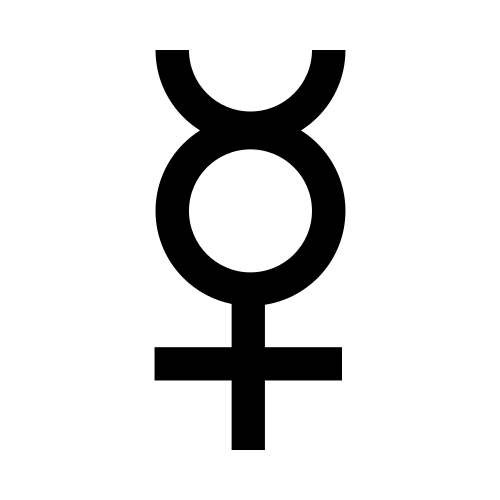 Mercury
 Venus
Venus Mars
Mars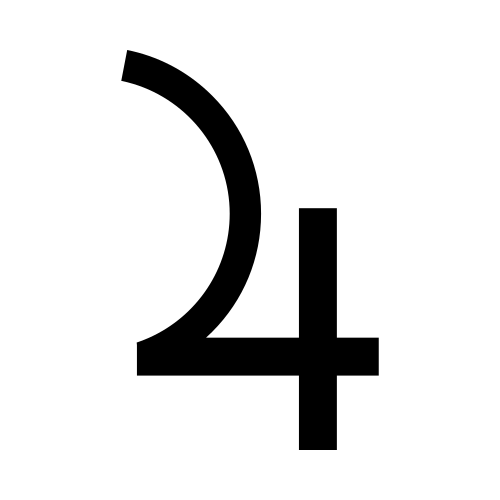 Jupiter
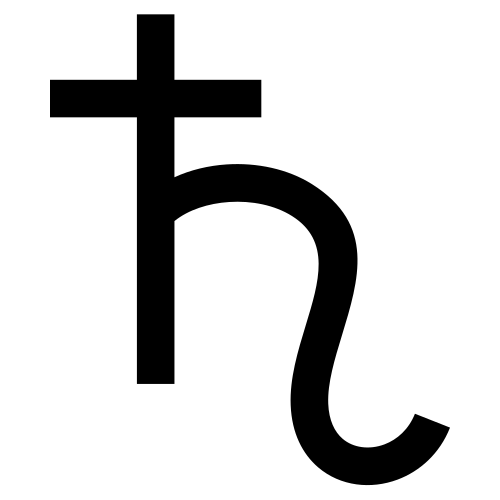 Saturn
 Uranus
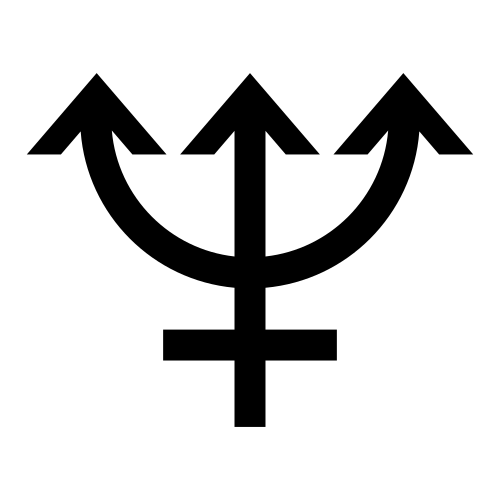 Neptune
 Pluto
Pluto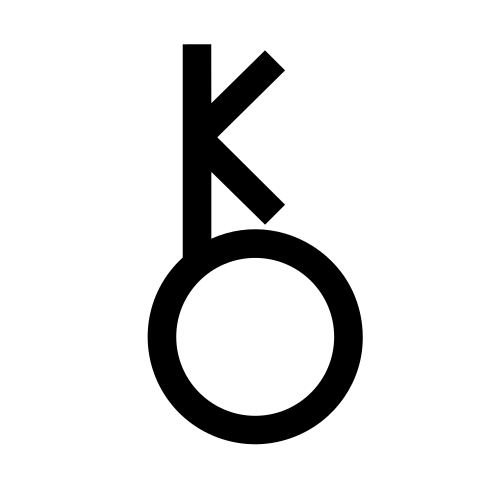 Chiron
Birth time unknown — house positions and Ascendant/MC are not available.
Astronomical context
Those born between approximately 1939 and 1957 carried Pluto in Leo. This generation witnessed the post-war reconstruction of the global order and the rise of mass culture, consumer capitalism, the nuclear age, and the first era of television.
In astrological tradition, Pluto in Leo is associated with collective transformation of the domains that sign governs: creative self-expression, performance, the cult of personality, the relationship between the individual and the audience, and the structures of fame. Leo is the sign of the stage, the heart, and the creative act. Pluto's transit through Leo is read, symbolically, as a generational mandate to transform the nature of personal expression and its relationship to power. The symbolic reading is correlative, not causal.
Others in the Astrian collection born under this configuration include John Lennon (1940), Freddie Mercury (1946), David Bowie (1947), Steve Jobs (1955), and Stephen Hawking (1942). Marley, born in 1945, belongs to the middle years of this generational wave.
Other profiles from this Pluto in Leo generation
Symbolic reading
The following describes what classical astrological tradition associates with these configurations. Astrian does not apply these descriptions to the person's biography.
The Sun at 17°33' Aquarius is the most prominent structural feature of this chart. Without a documented birth time, there is no Ascendant or Midheaven — the reading is confined to planetary positions by sign and the aspects between planets.
The Moon at 2°05' Sagittarius represents the noon position; the actual placement falls within approximately 7° on either side. If born early in the day, the Moon could be in the mid-twenties of Scorpio; if born late, in the mid-single digits of Sagittarius. The Moon's sign placement is uncertain — it may be in late Scorpio or early Sagittarius depending on birth time.
Mercury at 2°02' Aquarius, Venus at 4°22' Aries, and Mars at 24°05' Capricorn complete the personal planet picture.
### The Venus-Saturn-Neptune T-square
The chart's most distinctive personal configuration is a cardinal T-square involving Venus, Saturn, and Neptune. Venus at 4°22' Aries squares Saturn at 4°30' Cancer retrograde, orb 0°08' — the tightest major aspect in the chart. Venus simultaneously opposes Neptune at 6°11' Libra retrograde, orb 1°49'. Saturn, at the apex of the T-square, squares both Venus (0°08') and Neptune (1°41').
Venus governs aesthetics, desire, the sense of beauty, and the presentation of the desirable. Saturn governs structure, limitation, discipline, and the endurance of form. Neptune governs the ideal, the dissolving of boundaries, and the capacity for both transcendence and illusion. The T-square places all three in a relationship of acute structural tension.
The Venus-Saturn square at the base of the configuration creates friction between the aesthetic impulse and the demand for discipline — beauty must be earned, not assumed. The Venus-Neptune opposition stretches the aesthetic sensibility between the personal and the ideal — what is desired and what is imagined exist in polarized tension across the Aries-Libra axis. Saturn at the apex of the T-square receives the full pressure of this opposition and channels it through the Cancerian register of home, belonging, roots, and emotional security.
In a cardinal T-square, the energy is active, initiating, and externally directed. The tradition reads this configuration as one of high creative tension — the aesthetic faculty operates under simultaneous pressure from structure and vision, producing a quality of expression that is neither complacent nor abstract.
### Mercury sextile Venus, quincunx Saturn
Mercury at 2°02' Aquarius connects to the T-square through a sextile to Venus (2°20') and a quincunx to Saturn (2°28'). Mercury governs communication and articulation. Its sextile to Venus links the communicative faculty to the aesthetic sensibility in a cooperative aspect. Its quincunx to Saturn creates ongoing adjustment between expression and structure. Mercury participates in the T-square's dynamic without being fully embedded in it — the voice reaches toward beauty but negotiates continuously with limitation.
### Mars trine Jupiter
Mars at 24°05' Capricorn trines Jupiter at 26°28' Virgo retrograde, orb 2°23'. Mars governs action, drive, and the physical application of will. Jupiter governs expansion, vision, and the amplification of what it touches. The trine connects these registers in an earth-sign axis (Capricorn and Virgo) that is practical, grounded, and oriented toward material accomplishment. In the tradition, Mars-Jupiter trines are read as configurations of productive energy — action that is not merely forceful but expansive, directed not at survival alone but at the building of something larger.
### The generational Uranus-Pluto sextile
Uranus at 9°08' Gemini retrograde sextiles Pluto at 8°54' Leo retrograde, orb 0°14' — one of the tightest aspects in the chart by orb. This is generational — the Uranus-Pluto sextile was active throughout the mid-1940s — but its near-exact precision gives it particular intensity in this individual pattern. Uranus governs revolution and originality; Pluto governs transformation and power. Their sextile connects these registers in a productive relationship, creating a generational energy directed toward the creative transformation of established structures.
The planetary pattern here is read as a symbolic portrait, not a causal explanation. No planet caused, predicted, or determined any event or characteristic.
Astrology is a symbolic language with 2,500 years of literature. The reading above is interpretive, not explanatory.
Astrian does not claim that the natal chart of Bob Marley caused or determined any of the above. Astrology is a symbolic system with 2,500 years of literature. Its capacity for retrospective description does not imply explanatory capacity.
A parallel life
The following are verified biographical facts. No connection to the natal chart is implied.
Robert Nesta Marley was born on 6 February 1945 in Nine Mile, a small settlement in the hills of Saint Ann Parish, Jamaica. His father, Norval Sinclair Marley, was a white Jamaican of English descent who worked as a plantation overseer for the British colonial government; his mother, Cedella Booker (née Malcolm), was a Black Jamaican teenager of eighteen. Norval, who was about fifty at the time of his son's birth, provided occasional financial support but was largely absent. He died in 1955, when Bob was ten. The racial ambiguity of his parentage — neither fully accepted by the white nor the Black community — marked his childhood.
He grew up in Nine Mile with his mother and maternal grandfather, Omeriah Malcolm, a Myalist and respected figure in the community. At twelve, in 1957, he moved with his mother to Trench Town, a government housing project in west Kingston that had become a crucible of Jamaican popular music. He left school at fourteen to pursue music.
In 1963, he formed the Wailers with Bunny Wailer (Neville Livingston) and Peter Tosh (Winston Hubert McIntosh). Their early recordings for the producer Coxsone Dodd at Studio One — "Simmer Down" (1964), which reached number one in Jamaica — established them within the ska and rocksteady scene. By the late 1960s the group had absorbed the influence of Rastafari, the spiritual movement that would define Marley's worldview and public identity.
The Wailers signed with Island Records in 1972, and their album Catch a Fire (1973) was the first reggae record marketed and distributed internationally as a major-label rock album. Burnin' (1973) included "Get Up, Stand Up" and "I Shot the Sheriff," the latter covered by Eric Clapton, whose version reached number one in the United States. Peter Tosh and Bunny Wailer left the group in 1974; Marley continued as Bob Marley and the Wailers.
Natty Dread (1974), Rastaman Vibration (1976), and Exodus (1977) established him as an international figure of singular stature — a musician whose work carried political and spiritual weight beyond the conventions of popular entertainment. Exodus was named Album of the Century by Time magazine in 1999.
On 3 December 1976, two days before the Smile Jamaica Concert organized to ease political tensions on the island, gunmen entered his home at 56 Hope Road in Kingston and shot him, his wife Rita, and his manager Don Taylor. All three survived. Marley performed at the concert two days later with his arm in a sling. The assassination attempt was widely attributed to political factions, though no one was ever charged. He left Jamaica for London and later Miami.
The Kaya (1978) and Survival (1979) albums continued his global ascent. He performed at the Zimbabwe independence celebration in Salisbury (now Harare) on 17 April 1980 — the only private citizen invited to play at the ceremony marking the end of white minority rule.
In July 1977, he was diagnosed with acral lentiginous melanoma under the nail of his right big toe. He refused amputation, partly on religious grounds. The cancer spread. His final concert was at the Stanley Theater in Pittsburgh, Pennsylvania, on 23 September 1980.
He died on 11 May 1981 at Cedars of Lebanon Hospital in Miami, Florida. He was thirty-six years old. His final words to his son Ziggy were reported as: "Money can't buy life."
He was posthumously inducted into the Rock and Roll Hall of Fame in 1994. Legend (1984), a posthumous compilation, has sold an estimated 33 million copies worldwide, making it the best-selling reggae album of all time. He received the Grammy Lifetime Achievement Award in 2001. His image, music, and message have made him one of the most recognized cultural figures of the twentieth century.
Biographical sources
- White, Timothy. Catch a Fire: The Life of Bob Marley. Henry Holt, 1983 (revised 2006)
- Steffens, Roger, and Leroy Jodie Pierson. Bob Marley and the Wailers: The Definitive Discography. Rounder Books 2005
This profile presents the sky at the birth of Bob Marley and verified facts of their biography. Astrian does not claim that astrology has predictive capacity or that the natal chart determines the trajectory of a life. Astrology is a symbolic system with 2,500 years of literature. Its capacity for retrospective description does not imply explanatory capacity.
Related profiles
Calculate your own birth chart with the same NASA JPL DE441 precision.
Calculate my birth chartLast updated: June 12, 2026
Newsletter
A short reading once a month, in your inbox.
A note on the symbolism of the season, recent editorial pieces, and what to look for in next month's sky. No predictions.
Support this project
Independent, no venture funding, no ads. A contribution keeps Astrian precise and free.
Support on Ko-fi (opens in new tab)