PROFILE · SCIENCE & TECHNOLOGY
Joseph Campbell
Joseph John Campbell
mythologist and writer
Born 26 March 1904 · White Plains, New York, United States · 41.03° N, 73.77° WX
Source: Birth time not documented in publicly accessible records
About this chart
No birth time is documented for this person. The chart therefore shows planetary positions in their signs, the slow aspects between them, and the generational context — but not house placements, the Ascendant, or the Midheaven, which require an accurate birth time. The Moon's sign carries a ±6° margin: if it falls near a sign boundary, the sign could vary. Positions for all other planets are reliable.
Do you have a verified source for this birth time? Share it →
The sky at birth
No birth time is documented for Joseph Campbell. The Ascendant, the Midheaven, and the house positions cannot be determined; the reading is confined to planetary sign placements and the aspects between planets. The positions below are calculated for noon local time and are accurate to a fraction of a degree for the slow-moving bodies. One caveat: the Moon lies near a sign boundary, so without an exact time it cannot be fixed to a single sign — it sits close to 29°14' Cancer within a daily margin of about ±7°.
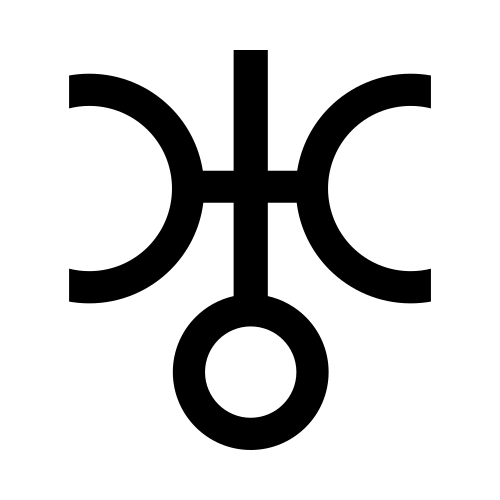
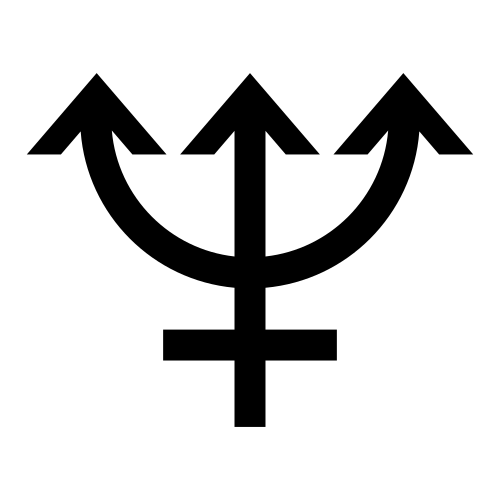
The Moon is near 29°14' Cancer (noon position, ±7° margin). Sun is at 5°37' Aries. Mercury is at 5°25' Aries. Venus is at 8°37' Pisces. Mars is at 21°45' Aries. Jupiter is at 6°08' Aries. Saturn is at 17°40' Aquarius. Uranus is at 29°55' Sagittarius. Neptune is at 3°10' Cancer. Pluto is at 18°46' Gemini.
4 bodies occupy Aries (Sun, Mercury, Mars and Jupiter) — a concentration that stands out as a structural feature of the chart.
The tightest major aspects between planets: Sun conjunct Mercury (0°11'); Sun conjunct Jupiter (0°31'); Mercury conjunct Jupiter (0°43'); Saturn trine Pluto (1°07'); Mercury square Neptune (2°15'); Sun square Neptune (2°26').
Uranus opposite Neptune (3°16') is structural but generational — an alignment of slow-moving outer planets shared across many birth years.
The engine also registers tight minor aspects involving asteroids and calculated points: Mercury sextile Juno (0°08'); Moon opposite Chiron (0°08'); Sun sextile Juno (0°19'); Pallas sextile Juno (0°29'). These are reported for completeness and carry less weight in traditional reading.
The chart was calculated using NASA JPL DE441 ephemerides, sub-arcsecond precision.
| Planet | Sign | Position |
|---|---|---|
| Sun | Aries | 05°37' |
| Moon | Cancer | 29°14'±6° |
| Mercury | Aries | 05°25' |
| Venus | Pisces | 08°37' |
| Mars | Aries | 21°45' |
| Jupiter | Aries | 06°08' |
| Saturn | Aquarius | 17°40' |
| Uranus | Sagittarius | 29°55' |
| Neptune | Cancer | 03°10' |
| Pluto | Gemini | 18°46' |
| Chiron | Capricorn | 29°06' |
 Sun
Sun Moon
Moon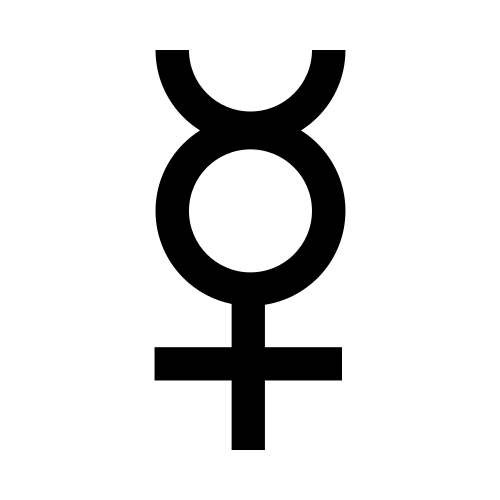 Mercury
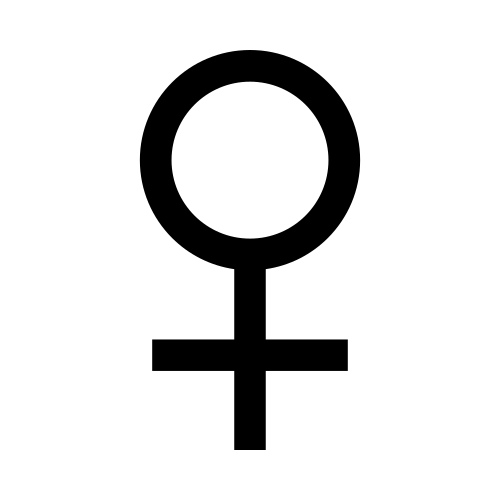 Venus
Venus Mars
Mars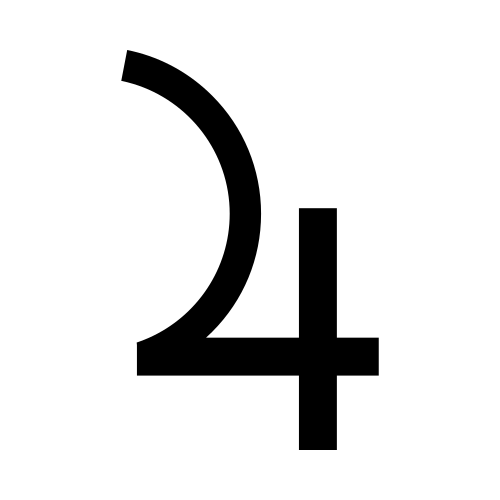 Jupiter
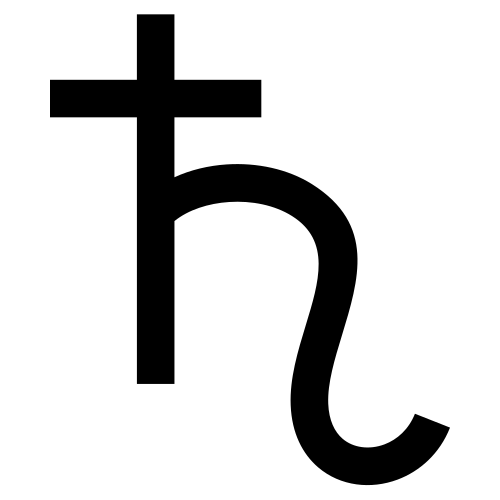 Saturn
 Uranus
 Neptune
 Pluto
Pluto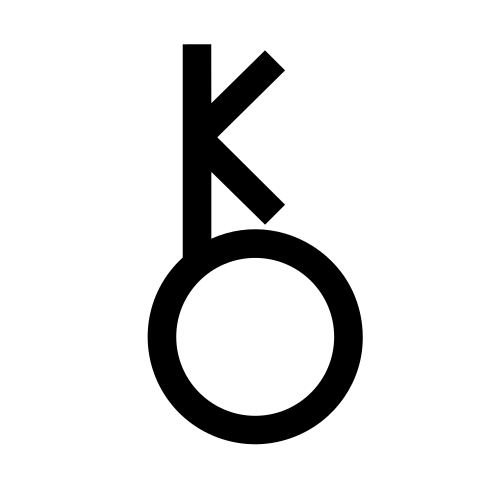 Chiron
Birth time unknown — house positions and Ascendant/MC are not available.
Astronomical context
Pluto travelled through Gemini from the mid-1880s to 1914. In astrological tradition this transit is associated with the transformation of communication, ideas, transport, and the press — the generation that came of age amid the spread of mass media, the telephone, and accelerating mobility.
Joseph Campbell (born 1904) belongs to this generational configuration. Astrian groups profiles by such shared signatures rather than by any claim of shared destiny. Related profiles in Astrian: Carl Jung · Friedrich Nietzsche · Yuval Noah Harari. The symbolic reading is correlative, not causal.
Other profiles from this Pluto in Gemini generation
Symbolic reading
The following describes what classical astrological tradition associates with these configurations. Astrian does not apply these descriptions to the person's biography.
The Sun in Aries is the most prominent structural feature available without a birth time, centring the chart on initiative, directness, and the will to begin. There is no Ascendant or Midheaven to anchor the angles, so the reading rests on sign placements and the aspects between planets rather than on houses.
Among the personal planets, the Moon in Cancer is associated in tradition with attachment, memory, and protection (the Moon's sign is given for the noon chart and may shift with an exact time); Mercury in Aries with initiative, directness, and the will to begin; Venus in Pisces with imagination, dissolution, and empathy; and Mars in Aries with initiative, directness, and the will to begin. These placements describe registers of feeling, thought, attraction, and action as the tradition catalogues them, independent of the life that follows.
Sun conjunct Mercury (0°11'): tradition reads identity and central purpose fused with thought and communication.
Sun conjunct Jupiter (0°31'): tradition reads identity and central purpose fused with expansion and meaning.
Mercury conjunct Jupiter (0°43'): tradition reads thought and communication fused with expansion and meaning.
Saturn trine Pluto (1°07'): tradition reads structure, limitation, and discipline in easy flow with depth, power, and transformation.
These placements are presented as a symbolic portrait, correlative and never causal — a description within the tradition's vocabulary, not an explanation of the life that follows.
Astrology is a symbolic language with 2,500 years of literature. The reading above is interpretive, not explanatory.
Astrian does not claim that the natal chart of Joseph Campbell caused or determined any of the above. Astrology is a symbolic system with 2,500 years of literature. Its capacity for retrospective description does not imply explanatory capacity.
A parallel life
The following are verified biographical facts. No connection to the natal chart is implied.
Joseph John Campbell was born on March 26, 1904, in White Plains, New York, into an Irish-Catholic family. His early encounter with Native American exhibitions at the American Museum of Natural History sparked a lifelong fascination with mythology that ran alongside his formal education. He studied at Dartmouth College and then transferred to Columbia University, graduating with a degree in English literature in 1925 and completing a master's degree in medieval literature in 1927.
Campbell traveled to Europe on a fellowship, studying Old French, Provençal, and Sanskrit at the University of Paris and the University of Munich. During this period he encountered the work of Sigmund Freud, Carl Jung, and James Joyce, all of which shaped his comparative approach to myth. He returned to the United States in 1929 without completing a doctorate, a decision that reflected his growing sense that the institutional boundaries of academic disciplines did not fit the broad comparative project he envisioned.
During the Depression years Campbell lived austerely in Woodstock, New York, reading widely across world literature, philosophy, and mythology. In 1934 he joined the faculty of Sarah Lawrence College in Bronxville, New York, where he taught for thirty-eight years in the literature program.
Campbell's most influential work, The Hero with a Thousand Faces, was published in 1949. In it he argued that the mythologies of the world, despite their surface differences, share a fundamental narrative structure: a hero departs from the ordinary world, undergoes trials and ordeals in an extraordinary realm, and returns transformed, bringing a boon to his community. He called this pattern the monomyth, a term borrowed from James Joyce's Finnegans Wake. The book drew on myths, folktales, and religious narratives from cultures spanning every inhabited continent, alongside interpretive frameworks from comparative religion and Jungian psychology.
His subsequent works included The Masks of God, a four-volume comparative study of world mythology published between 1959 and 1968, and The Mythic Image. Late in his life he collaborated with journalist Bill Moyers on a television series, The Power of Myth, recorded at George Lucas's Skywalker Ranch, which aired on PBS in 1988 and introduced his ideas to a wide popular audience.
Joseph Campbell's concept of the hero's journey has been widely cited as an influence on storytelling in film and literature, including by filmmaker George Lucas in relation to Star Wars.
Joseph Campbell died on October 30, 1987, in Honolulu, Hawaii.
Biographical sources
- Joseph Campbell, The Hero with a Thousand Faces (Bollingen Series XVII, Pantheon Books, 1949).
- Stephen Larsen and Robin Larsen, A Fire in the Mind: The Life of Joseph Campbell (Doubleday, 1991).
- Joseph Campbell with Bill Moyers, The Power of Myth (Doubleday, 1988).
- Joseph Campbell, The Masks of God, 4 vols. (Viking Press, 1959-1968).
This profile presents the sky at the birth of Joseph Campbell and verified facts of their biography. Astrian does not claim that astrology has predictive capacity or that the natal chart determines the trajectory of a life. Astrology is a symbolic system with 2,500 years of literature. Its capacity for retrospective description does not imply explanatory capacity.
Related profiles
Calculate your own birth chart with the same NASA JPL DE441 precision.
Calculate my birth chartLast updated: June 14, 2026
Newsletter
A short reading once a month, in your inbox.
A note on the symbolism of the season, recent editorial pieces, and what to look for in next month's sky. No predictions.
Support this project
Independent, no venture funding, no ads. A contribution keeps Astrian precise and free.
Support on Ko-fi (opens in new tab)